Week 1 HW: Principles and Practices
🧠 Question 1
First, describe a biological engineering application or tool you want to develop and why.
This could be inspired by an idea for your HTGAA class project and/or something you are already doing in your research, or something you are just curious about.
✍️ Answer
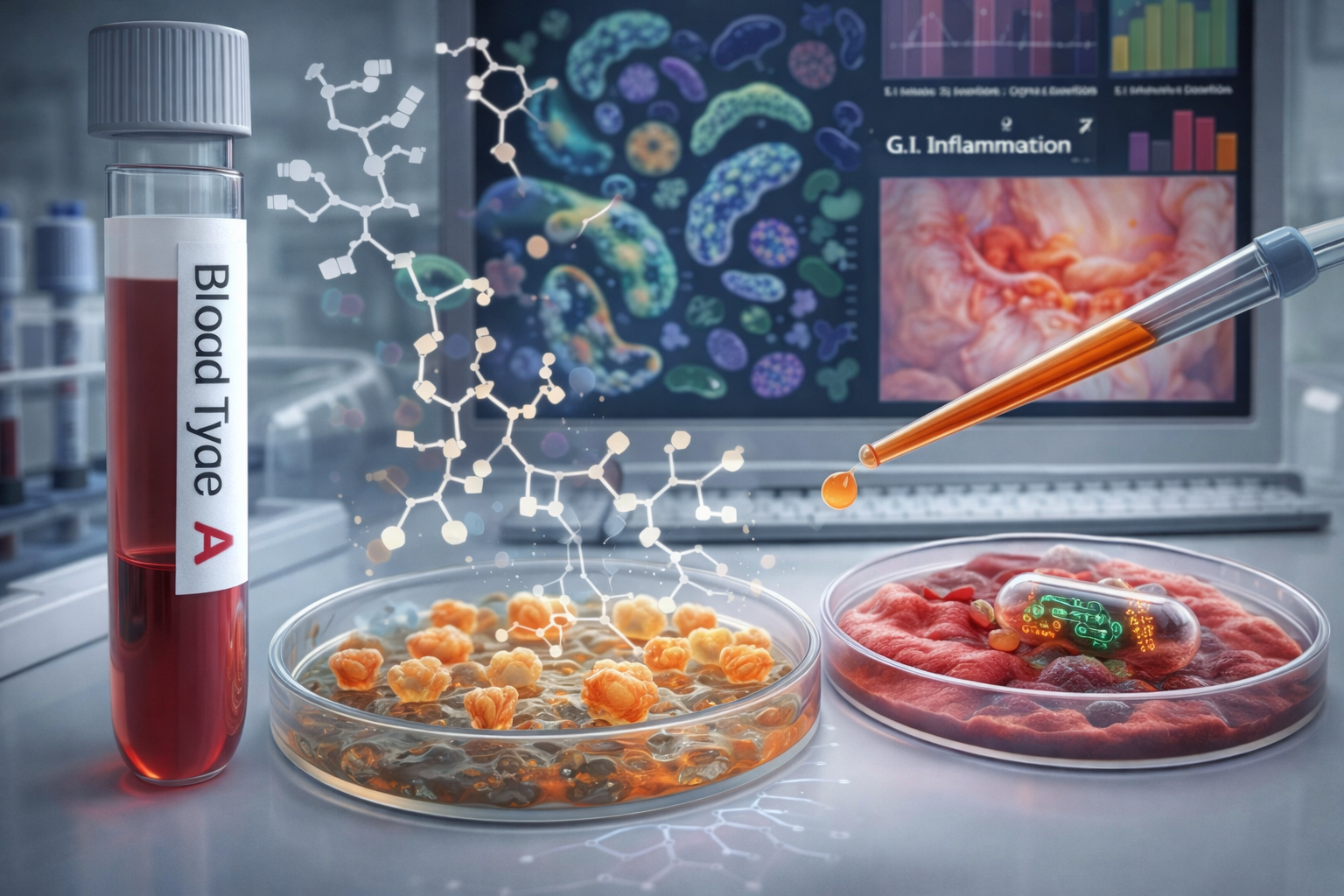
One biological engineering tool I’m curious about developing is a synthetic biology–based system to explore whether blood group types, especially blood type A, are actually linked to higher gastrointestinal disease risk at a biological level. I’ve read in multiple papers that people with blood type A may have a higher risk for certain gastrointestinal problems (1). However, when I looked into it more, most of the evidence seems to come from population statistics rather than experimental or mechanistic studies. There doesn’t seem to be a clear biological explanation, and there also aren’t many tools that can directly test this relationship in a controlled way. That gap is what makes me interested in this idea. From a synthetic biology perspective, I find it interesting that ABO blood groups are defined by differences in glycan structures, which are known to play roles in cell–cell interactions, immune responses, and host–microbiome relationships (2). This makes me wonder whether these glycan differences could influence how the gut environment responds to inflammation or pathogens and whether that could partially explain the observed disease risk. A possible approach could be to use engineered cells or microbial biosensors with simple genetic circuits that respond to blood-group-related glycan patterns and gastrointestinal inflammation markers. The goal wouldn’t be to create a finished diagnostic tool right away, but rather a research platform that helps test whether these associations are biologically meaningful instead of just statistical.
🧠 Question 2
Next, describe one or more governance/policy goals related to ensuring that this application or tool contributes to an “ethical” future, like ensuring non-malfeasance (preventing harm). Break big goals down into two or more specific sub-goals. Below is one example framework (developed in the context of synthetic genomics) you can choose to use or adapt, or you can develop your own. The example was developed to consider policy goals of ensuring safety and security, alongside other goals, like promoting constructive uses, but you could propose other goals for example, those relating to equity or autonomy.
✍️ Answer
Because this tool links blood group type with disease risk, it raises important ethical and governance concerns. A key goal is preventing harm, especially avoiding discrimination or overinterpretation of results, since blood type alone does not determine gastrointestinal disease risk. Governance should also ensure biological safety and scientific responsibility, particularly if engineered cells or genetic circuits are used, by requiring proper containment and validation before findings are shared beyond research settings. In addition, protecting individual autonomy and privacy is essential, as combining blood group information with biosensor data creates sensitive health information that should only be used with informed consent. Finally, equity should be considered to ensure that the tool does not disproportionately benefit or disadvantage specific populations.
🧠 Question 3
Next, describe at least three different potential governance “actions” by considering the four aspects below (Purpose, Design, Assumptions, Risks of Failure & “Success”). Try to outline a mix of actions (e.g., a new requirement/rule, incentive, or technical strategy) pursued by different “actors” (e.g., academic researchers, companies, federal regulators, law enforcement, etc.). Draw upon your existing knowledge and a little additional digging, and feel free to use analogies to other domains (e.g., 3D printing, drones, financial systems, etc.).
✍️ Answer
Action 1: Regulatory Oversight and Ethical Review
Purpose: Currently, early-stage synthetic biology research often proceeds with minimal oversight, especially in academic labs. I propose requiring that any research using engineered cells or biosensors targeting blood group data undergo formal ethical review and regulatory approval before publication or broader use.
Design: National regulators (e.g., EMA) and university ethics boards would evaluate safety, privacy protections, and non-discrimination measures. Researchers would submit risk assessments and validation plans.
Assumptions: This assumes regulators and review boards have enough expertise in synthetic biology to assess risk accurately and that labs comply with these requirements.
Risks of Failure & “Success”: Failure could occur if the review is too slow or inconsistent, slowing research unnecessarily. Success could unintentionally create overconfidence in safety, leading others to assume the tool is risk-free.
Action 2: Privacy and Data Governance Framework Purpose: Right now, blood group and biosensor data could be collected without strong protections. I propose treating this information as sensitive health data, requiring secure storage, anonymisation, and informed consent for research or secondary use.
Design: Universities, hospitals, and biotech companies would implement encrypted databases and adopt privacy-by-design models, such as federated learning, where data stays local but insights can still be shared.
Assumptions: Assumes technical infrastructure is available and participants understand consent procedures.
Risks of Failure & “Success”: Data leaks could lead to discrimination or misuse. Overly restrictive rules could hinder collaboration and slow scientific progress.
Action 3: Incentives for Equitable and Responsible Innovation Purpose: Often, SynBio innovations are developed for wealthy populations or commercial markets. I propose funding programs and grants that encourage open-source development of biosensor tools and ensure accessibility to diverse populations.
Design: Government research agencies (e.g., DFG, Horizon Europe) could tie grants to equity and open-science requirements. NGOs and academic labs could partner to distribute tools widely and safely.
Assumptions: Assumes companies and researchers are motivated by incentives and will participate voluntarily.
Risks of Failure & “Success”: Companies may avoid participation, limiting innovation. Open designs could also be misused if security oversight is insufficient.
🧠 Question 4
Next, score (from 1 to 3, with 1 as the best, or n/a) each of your governance actions against your rubric of policy goals. The following is one framework, but feel free to make your own:
✍️ Answer
| Does the option: | Option 1 | Option 2 | Option 3 |
|---|---|---|---|
| Enhance Biosecurity | |||
| • By preventing incidents | 1 | 2 | 3 |
| • By helping respond | 1 | 2 | 3 |
| Foster Lab Safety | |||
| • By preventing incident | 1 | 2 | 3 |
| • By helping respond | 1 | 2 | 3 |
| Protect the environment | |||
| • By preventing incidents | 1 | 2 | 3 |
| • By helping respond | 1 | 2 | 3 |
| Other considerations | |||
| • Minimizing costs and burdens to stakeholders | 3 | 2 | 1 |
| • Feasibility? | 2 | 1 | 3 |
| • Not impede research | 3 | 2 | 1 |
| • Promote constructive applications | 1 | 2 | 3 |
🧠 Question 5
Last, drawing upon this scoring, describe which governance option, or combination of options, you would prioritise, and why. Outline any trade-offs you considered as well as assumptions and uncertainties. For this, you can choose one or more relevant audiences for your recommendation, which could range from the very local (e.g., to MIT leadership or the Cambridge Mayoral Office) to the national (e.g., to President Biden or the head of a federal agency) to the international (e.g., to the United Nations Office of the Secretary-General or the leadership of a multinational firm or industry consortia). These could also be one of the “actor” groups in your matrix.
✍️ Answer
Based on the scoring of the three governance options, I would prioritise a combination of Option 1 (Regulatory Oversight & Ethical Review) and Option 2 (Privacy & Data Governance Framework), while also incorporating elements of Option 3 (Equity & Incentives) where possible. Regulatory oversight is the most important because it directly enhances biosecurity, lab safety, and environmental protection, which are essential when working with engineered cells or biosensors that interact with human biological data. Privacy and data governance complement this by protecting sensitive blood group and biosensor information, ensuring that individuals’ autonomy is respected and minimising the risk of misuse or discrimination.
Option 3, focusing on equitable access and open-science incentives, is valuable for promoting constructive applications and broad societal benefit, but it has less impact on immediate safety and biosecurity concerns. The main trade-off is that prioritising regulatory oversight and privacy measures may increase costs and slow research progress, while emphasising equity and open access could increase the risk of misuse if technical safeguards are insufficient.
I would recommend this combined approach to national-level regulators and research oversight bodies, such as the EMA or national bioethics committees, because they are in a position to implement formal policies and standards that balance safety, privacy, and societal benefit. The key assumptions are that regulators have sufficient expertise in synthetic biology and that institutions will comply with these rules. Uncertainties include the potential for unforeseen technical risks in engineered biosensors and how effectively privacy protections can prevent indirect discrimination.
This week’s class made me realise that even curiosity-driven synthetic biology work can raise ethical concerns, especially when human biological data is involved. One issue that was new to me was how combining traits like blood group type with disease risk can lead to harm if results are overinterpreted or misused, even without malicious intent. To address this, early ethical review, clear data privacy rules, and careful communication of uncertainty seem important governance actions.
Assignment (Week 2 Lecture Prep)- Professor Jacobson
🧠 Question 1
Nature’s machinery for copying DNA is called polymerase. What is the error rate of polymerase? How does this compare to the length of the human genome? How does biology deal with that discrepancy?
✍️ Answer
Error rate ≈ 1 in 10⁶ bases (10⁻⁶)
Human genome size ≈ 3.2 Gb (3 × 10⁹ bp)
- With an error rate of 10⁻⁶, naïvely you’d expect: ~3,000 errors per replication
Biology deals with the discrepancy between the finite error rate of DNA polymerase and the very large size of the human genome by using closed-loop, error-correcting replication rather than relying on single-pass accuracy. Replicative DNA polymerases contain a 3′→5′ proofreading exonuclease that removes misincorporated nucleotides during synthesis, improving fidelity by several orders of magnitude. Errors that escape proofreading are further corrected by post-replication mismatch repair systems such as the MutS pathway, which detect and repair base-pair mismatches. Together, these layered correction mechanisms reduce the effective error rate sufficiently to allow replication of gigabase-scale genomes, enabling biological DNA synthesis to scale far beyond what would be possible with open-loop chemical synthesis.
🧠 Question 2
How many different ways are there to code (DNA nucleotide code) for an average human protein? In practice what are some of the reasons that all of these different codes don’t work to code for the protein of interest?
✍️ Answer
Average human protein ≈ 1036 bp (~350 aa)
- Combined with: Degenerate genetic code (multiple codons per amino acid)
- This implies: ~3³⁵⁰ possible DNA sequences for one average human protein (combinatorial explosion, not the exact number)
a. GC content & secondary structure
- GC = 10%, 50%, 90% → radically different folding energies
- Strong secondary structures block transcription/translation
b. Repeats & homopolymers
- Shown as problematic for synthesis and stability
- Cause deletions and recombination
c. Physical DNA behavior matters
- DNA is not just information — it is matter with thermodynamics
So many valid codons fail because they: Fold incorrectly, Are unstable, Are hard to synthesize and, Break regulatory behavior
Assignment (Week 2 Lecture Prep)- Dr. LeProust
🧠 Question 1
What’s the most commonly used method for oligosynthesis currently?
✍️ Answer
The most commonly used method for oligonucleotide synthesis is solid-phase phosphoramidite chemistry, originally developed by Caruthers. In this method, DNA is synthesised on a solid support (such as controlled pore glass or silicon) through repetitive cycles of nucleotide coupling, capping of unreacted sites, oxidation, and deprotection. The lecture highlight that this chemistry is highly automatable and forms the basis of modern high-throughput oligo synthesis platforms, including array-based and silicon-based synthesis systems.
🧠 Question 2
Why is it difficult to make oligos longer than 200 nt via direct synthesis?
✍️ Answer
Direct chemical synthesis of oligos becomes inefficient beyond ~200 nucleotides because each synthesis cycle has a coupling efficiency slightly below 100%. These small inefficiencies accumulate over many cycles, leading to a rapid decrease in the fraction of full-length products and a buildup of truncated sequences. As oligo length increases, synthesis errors and truncation products dominate the pool, making purification of the correct full-length oligo increasingly difficult. Additionally, longer sequences are more prone to secondary structure formation, further reducing synthesis efficiency as mentioned.
🧠 Question 3
Why can’t you make a 2000 bp gene via direct oligo synthesis?
✍️ Answer
Synthesising a 2000 bp gene directly using phosphoramidite chemistry is not feasible because the cumulative effect of coupling inefficiencies and error rates makes the yield of full-length, error-free molecules vanishingly small. Over thousands of synthesis cycles, the probability of obtaining a correct full-length product approaches zero, while the majority of molecules are truncated or contain multiple errors. For this reason, the lecture emphasize that modern gene synthesis relies on assembling shorter, chemically synthesized oligos into longer gene fragments using enzymatic assembly methods, followed by sequence verification, rather than attempting direct synthesis of long genes.
Assignment (Week 2 Lecture Prep)- George Church
🧠 Question 1
What are the 10 essential amino acids in all animals and how does this affect your view of the “Lysine Contingency”?
✍️ Answer
Animals require ten essential amino acids: histidine, isoleucine, leucine, lysine, methionine, phenylalanine, threonine, tryptophan, valine, and arginine (during growth) because they cannot synthesise them on their own. This limitation is metabolic rather than genetic, meaning the ribosome can translate these amino acids, but the organism must obtain them from the environment, as emphasised in Church’s slides of amino acid constraints.
The lysine contingency is especially important because animals completely lack a lysine biosynthesis pathway. This makes lysine a reliable metabolic bottleneck that can be exploited for biocontainment. An engineered organism that depends on lysine, or a lysine analogue, cannot survive without external supplementation, reducing the risk of escape or uncontrolled spread. Lysine is also central to protein function due to its positive charge and role in protein–protein interactions and post-translational modifications. Because lysine is essential at metabolic, structural, and regulatory levels, the lysine contingency provides a robust and evolution-resistant control strategy in synthetic biology.
Assignment (Your HTGAA Website) — DUE BY START OF FEB 10 LECTURE
Begin personalising your HTGAA website in in https://edit.htgaa.org/, starting with your homepage—fill in the template with information about yourself, or remove what’s there and make it your own. Be creative! - Donr As with all assignments in HTGAA, be sure to write up every part of this homework on your HTGAA website in order to receive credit. - Done
References
(1) J. Y. Huang, R. Wang, Y.-T. Gao, and J.-M. Yuan, “ABO blood type and the risk of cancer – Findings from the Shanghai Cohort Study,” PLoS ONE, vol. 12, no. 9, p. e0184295, Sep. 2017, doi: 10.1371/journal.pone.0184295.
(2) G. Misevic, “ABO blood group system,” Blood and Genomics, vol. 2, no. 2, pp. 71–84, Jan. 2018, doi: 10.46701/apjbg.2018022018113.
**The cover page and the text rephrasing of some lines done by AI.