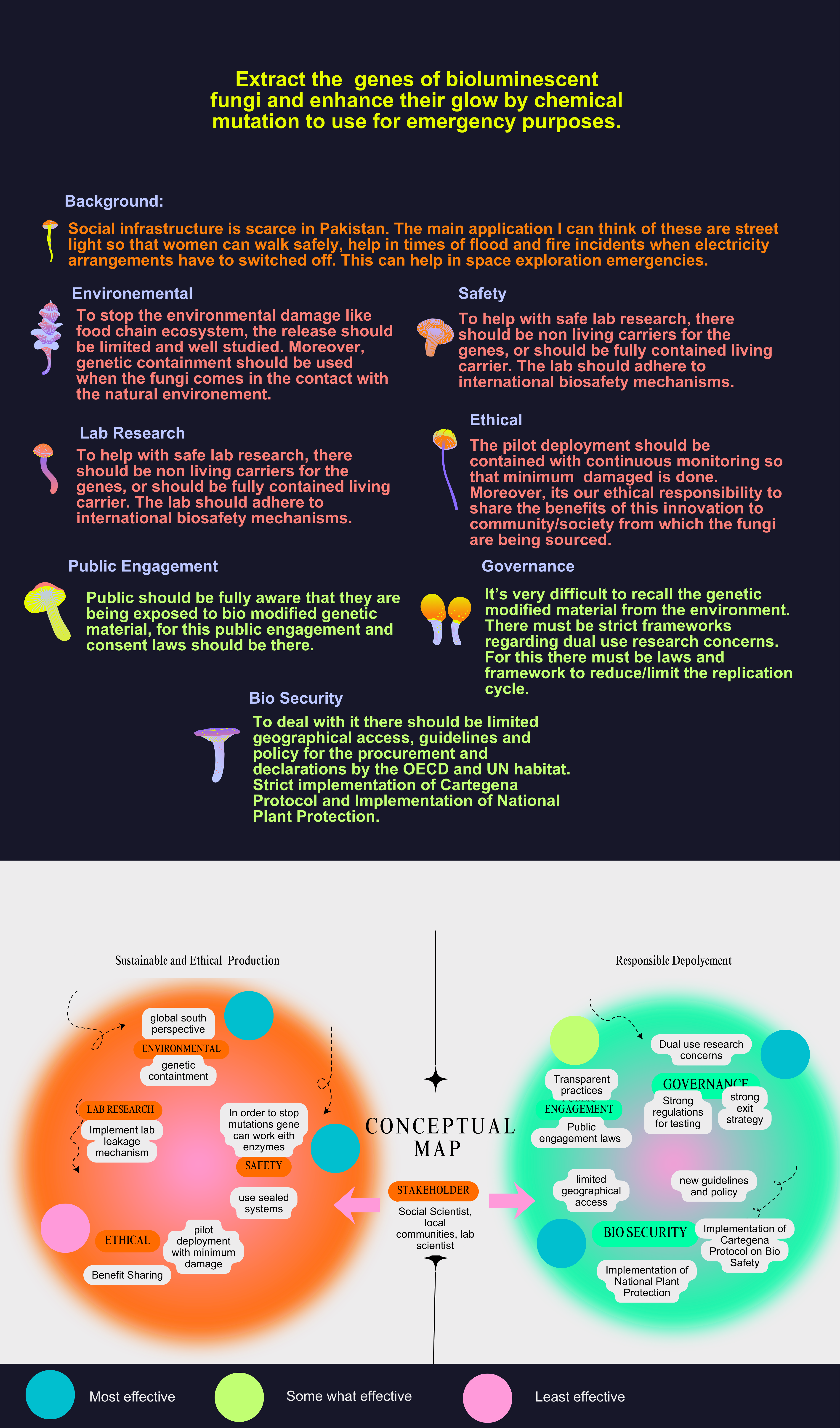
Explaination: Biological Application: I want to extract the genes of the bioluminiscent fungi and enhace their glow by chemical mutations which can be used as a part of social infrastructure, space exploration and in times of energy.
The governance policy goals and the framework: I have developed my owm framework shared above. The policy goals are as following: 1.Ensure the environment integrity, the horizontal mutation may add to environmental problems. 2.Bio Security the end product can be used as a threat to bio security. 3.public engagement is also very important where public must know that they have been exposed to bio engineered materials.
My Classwork Reflecting on what you learned and did in class this week, outline any ethical concerns that arose, especially any that were new to you. Then propose any governance actions you think might be appropriate to address those issues. This should be included on your class page for this week.
Reflecting on the class, I was very fascinated by the idea of bio security and this was something very new to me. This has motivated me to do more research on it and after connecting the dots, I have relaized that its directly related to my topic and an essentia governance issue. Moreover, the following governance actions can be proposed: 1.Strict biosecurity laws 2.Better border protocols 3.Use of reseachers and sensors
##Pre Reading and Question Answer Exercise-Part of Week 2 Lecture Prep
Q.1:Nature’s machinery for copying DNA is called polymerase. What is the error rate of polymerase? How does this compare to the length of the human genome. How does biology deal with that discrepancy?
Ans:The error rate of polymerase is 10-4 as stated in bio numbers polymerase.The human genome has 3 billion base pairs. biology resolves this high error rate through multilayeres proof reading systems suvh as exonuclyotoc proofreading , post replcation and proofreading in the trans. Reference: website.https://bionumbers.hms.harvard.edu/bionumber.aspx?s=n&v=2&id=105476
Subsections of Homework
Week 1 HW: Principles and Practices
Explaination:
Biological Application: I want to extract the genes of the bioluminiscent fungi and enhace their glow by chemical mutations which can be used as a part of social infrastructure, space exploration and in times of energy.
The governance policy goals and the framework: I have developed my owm framework shared above. The policy goals are as following:
1.Ensure the environment integrity, the horizontal mutation may add to environmental problems.
2.Bio Security the end product can be used as a threat to bio security.
3.public engagement is also very important where public must know that they have been exposed to bio engineered materials.
The potential governance actions: I have explained the potential governance actions above in the diagram and categorized it into most effective, somewhat effective and least effective but I want to share the most important below:
1.Genetic Containtment: This refers to the idea of the breaking the replication cycle of the organism and self detruction capabililty after it has been exposed to natural environment when the seal breaks.
purpose: The Cartegena protocol doesn’t explicitly mention the kill switch but it supports them via neutral language.
Design: The caretegena protocal should have the seperate provision for this kill switch mechanism, the stakeholders include governments and international bodies.
Assumptions: There are chances, this whole kill switch mechanism won’t work for this tool.
Risk of failures and success: This may failed because of biological engineering limitations. we dont know how this organism would react moreover may there are less provision of changes in cartegena protocol.
2.Public Engagement laws:The public should be aware that thay are being exposed to genetically modified organisms.
Purpose: The purpose is to be more transparent with the public.
Design: There must be declaration, consent and public engagaement laws.
Assumptions: May be general public won’t buy that.This is because of lack of awareness.
Risk of failures: the laws won’t pass in the parliment.
3.Dual use research concerns: due to interdiscplinary aspect of the research, the research can contribute to the non ethical domains.
Purpose: to limit the use of organism.
Design: The research application and use of organism must be kept limited.
Assumptions: Currently there are no such laws in Pakistan.
Risk of failures: lack of laws, use of grey channels for procurement.
Governance Actions I would choose:
As per my diagram I would like to work with the combination of of most effective and someehat effective to yeild maximum benefits. The reason behind is this that it inlcudes multiple stakeholders and works with the intesection of devlopment, deplyoment and policy laws. This inlucde general public, social and lab scientist, international organizations and law making bodies.
Week 1 CW: Principles and Practices
My Classwork
Reflecting on what you learned and did in class this week, outline any ethical concerns that arose, especially any that were new to you. Then propose any governance actions you think might be appropriate to address those issues. This should be included on your class page for this week.
Reflecting on the class, I was very fascinated by the idea of bio security and this was something very new to me. This has motivated me to do more research on it and after connecting the dots, I have relaized that its directly related to my topic and an essentia governance issue. Moreover, the following governance actions can be proposed:
1.Strict biosecurity laws
2.Better border protocols
3.Use of reseachers and sensors
Week 2 HW: DNA r/w/e
Week 2 Lecture Prep: r/w/e dna
##Pre Reading and Question Answer Exercise-Part of Week 2 Lecture Prep
Q.1:Nature’s machinery for copying DNA is called polymerase. What is the error rate of polymerase? How does this compare to the length of the human genome. How does biology deal with that discrepancy?
Ans:The error rate of polymerase is 10-4 as stated in bio numbers polymerase.The human genome has 3 billion base pairs. biology resolves this high error rate through multilayeres proof reading systems suvh as exonuclyotoc proofreading , post replcation and proofreading in the trans. Reference: website.https://bionumbers.hms.harvard.edu/bionumber.aspx?s=n&v=2&id=105476
Q.2: How many different ways are there to code (DNA nucleotide code) for an average human protein? In practice what are some of the reasons that all of these different codes don’t work to code for the protein of interest?
Ans: there are 100 power 100 possibilities but few works because of the efficiency, stability and folding kinetics.
Q.3:What’s the most commonly used method for oligo synthesis currently?
Ans:Solid phase phosphoramidite it remains gold standard because of high coupling efficiency.
Q.4: Why is it difficult to make oligos longer than 200nt via direct synthesis?
Ans: This is because of the accumulation of impurites and difficulty to sepeatey of full length sequences of vast majority of truncated failed products.
Q.5:Why can’t you make a 2000bp gene via direct oligo synthesis?
Ans:This is beacuse of impurties and lack of efficiency and chemical reactions have more error rates.
Q.6:[Using Google & Prof. Church’s slide #4] What are the 10 essential amino acids in all animals and how does this affect your view of the “Lysine Contingency”?
Ans:Histidine, Isoleucine,Leucine,Lysine,Methionine,Phenylalanine,Threonine,Tryptophan,Valine,Arginine (conditionally essential for many, but essential for growth/specialized needs). As far as theory its doesn’t make them any different because any vertabre cant synthesie the lysine.