Week 1 HW: Principles and Practices
BIO QR CODES
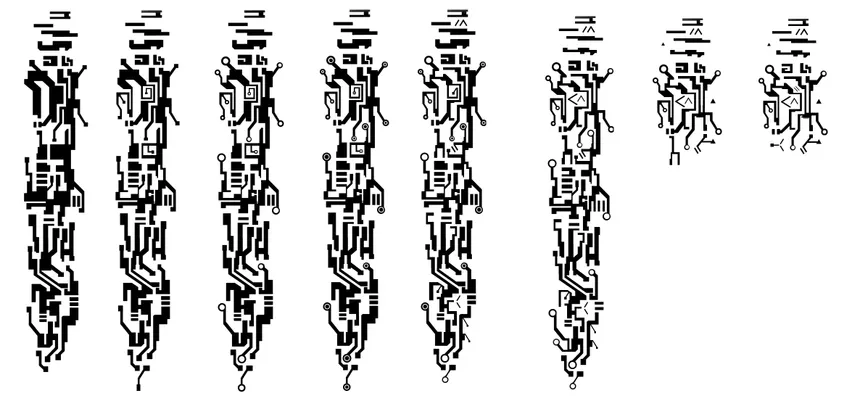
(This image is from Fluxey, Deviant art: link)
Guidelines
There are many goals to keep in mind to avoid or atleast minimize these risks. Some of them are listed below.
1. Biocontainment:
Goal: To ensure this organism does not cause physical harm to its users and the ecosystem.
Method : One such method is to enclose the organism in a hydrogel matrix and also make the organism a synthetic Auxotroph. This matrix maintains the shape of the QR, prevents spread, overlap and supplies the nutrients for growth and maintenance. If the organism escapes the matrix, it cannot survive. (Think Lysine Contingency from Jurassic Park.).
Governance Action: One way to enforce the method is to ensure large regulatory bodies (even labs and policy makers) follow strict guidelines, a ‘Death-on-escape’ standard where the survival rate of the organism is lesser than a set probability.
2. A right to log-out
Goal: Providing users an easy option to opt out of this system, in case of distrust or other disadvantages. This gives the users a choice to stay away from potential constant monitoring and/or fears of data leaks.
Method : Users must have a way to remove the tattoo or deactivate it. The storage system should ensure complete data removal after the deactivation of the tattoo. This removal should not lead to restricted access to healthcare and other services.
Governance Action : Reliable methods to remove the tattoos should be provided when this is being supplied. Common OTCs or software methods of deactivation for temporary cases. Laws should prevent institutions from punishing induviduals who opt out of this system and ndependent audits can ensure that opting out truly removes users from data collection and tracking.
3. Data access and Privacy concerns
Goal: To prevent access to personal information from unauthorised personnel.
Method: Rather than making the QR code provide information directly, the QR code acts a pointer in a database. This allows a tiered access to information. For example, healthcare workers can access information about the patient’s medical history, blood type or medical insurance but an average civilian can only get limited information, this is left up to the user. Additional safeguards include access logging, authentication, and automatic alerts for unusual activity to prevent silent abuse.
Governance Action: Federal Health Agencies must mandate that any Bio-ID system intergrates with existing National Provider Identifier databases to verify the identity of healthcare workers
Potential Governance Actions
1. A National Bio-digital standard
Purpose : Currently, Medical reports are protected by laws like HIPAA but this falls into a gray area. This proposal mandates that the QR codes follow a standardised API portocol.
Design: Regulators must define a “Manifest File” for the ID. Developers must implement a Zero-Knowledge Proof handshake. For example, when scanned, the system should only tell you “This person has insurance” rather than handing out the insurance provider’s details unless the scanner has high-level credentials.
Assumptions: This assumes that federal agenecies have the expertise and trust the technology to keep up with it.
Risk of Failure: A “Bio-Data Breach” where a single hack links a person’s digital ID to their permanent biological tattoo, making the leak “un eraseable.”
Success: if successful, medical bracelets become obsolete. There is no risk of loss of ID. An uninteded consqeuence would be a class-divide, people without the tattoo would have slower access to healthcare and other services.
2. The “Right to Deletion/ Opting out” (Policy/Requirement)
Purpose A Physical Deleteion Requirement where every Bio-ID must be paired with a “Deactivator”
Design: The bacteria should be engineered to a specific chemical that for example, could tigger a lysis circuit and kill the bacteria. This could range from really specific to really broad.
Assumption: This chemical would not be accidentally applied, usually from an unrealted agent (like soap or lotion) and that it is 100% effective at killing all cells.
Risk of Failure : If too broad, a malicious agent could spray the deactivator and erase the ID’s of many people. If too specific, it would be hard to erase the ID.
Success: Complete user autonomy. It ensures that no one is “permanently tracked” and gives people a way to “log out” of the biological world.
3. Equitable Optical Scannability Certification
Purpose: Many optical sensors (like pulse oximeters) have historically failed for induviduals with different skin tones. For this, a mandatory Inclusion Standard for biological pigments should be introduced.
Design: Before the ID can be supplied, a test on the Fitzpactrick Skin Type scale must be performed and must be certified. Also the ID should be exposed to various environmental conditions for testing.
Assumptions: Assumes that a single set of pigments can be engineered to be high-contrast for everyone and can withstand various conditions.
Risk of Failure: The certification is expensive and makes it accessible to only large corporations which might lead to a centralised system.
Success The code becomes readable by everyone and wouldn’t discriminate.
4. Purpose Limitation Law
Purpose: Prevent Bio-IDs from being repurposed for surveillance, policing, advertising, or social control.
Design: Legally restrict Bio-ID usage to clearly defined domains (e.g., emergency healthcare, patient identification, Transactions). Any expansion requires public review and legislative approval.
Assumptions:Assumes lawmakers can adapt quickly to technological change.
Risk of Failure:Governments or corporations may attempt to bypass limits in emergencies.
Success:Stops dystopian “function creep” where helpful tools become control systems.
| Does the option: | National Bio-digital standard | The right to deletion | Optical Scannability Certification | Purpose Limitation Law |
|---|---|---|---|---|
| Enhance Biosecurity | ||||
| • By preventing incidents | 1 | 1 | n/a | 1 |
| • By helping respond | 1 | 1 | n/a | 3 |
| Foster Lab Safety | ||||
| • By preventing incident | 3 | 1 | 3 | n/a |
| • By helping respond | 3 | 1 | n/a | n/a |
| Protect the environment | ||||
| • By preventing incidents | 2 | 1 | 3 | n/a |
| • By helping respond | 2 | 1 | n/a | n/a |
| Other considerations | ||||
| • Minimizing costs and burdens to stakeholders | 2 | 1 | 3 | 1 |
| • Feasibility? | 2 | 2 | 1 | 1 |
| • Not impede research | 3 | 1 | 3 | 1 |
| • Promote constructive applications | 1 | 2 | 1 | 1 |
Based on Everything, I would choose a combination of option 1, 2 and 4 as priority with 3 as an addon later for fairness and accessibility. National Bio-digital Standard provides a technical and legal backbone by enforcing least-privilege access, identity verification and privacy preservation. Wihtout this, the system becomes liable to misuse and leaks.
The Right to Deletion is the best framework for lab and environmental safety, by creating a way to opt out of this system, it supports ethical governance and protects users from long term tracking and limits harm if the system fails. This is essntial for human trust and prevents a dystopian outcome.
Purpose Limitation Law This block the function creep where a healthcare tool becomes a surveillance, policing or commerical control system. This limits the area which the system can creep into, crucial for long-term ethical stability.
Trade Offs
1. Security vs Innovation:
Option 1 and Option 3 reduce innovation by prioritising secrurity.
2. Autonomy vs Stability:
Option 2 greatly enchnaces freedom and autonomy by providing a way to opt out based on the induvidual’s choice. This is an acceptable tradeoff to stability.
3. Cost vs Inclusivesness
Obtaining certifications and audits are expensive, however not being inclusive cause public backlash and becomes far more disadvantageous in the long term. If cost is prioritised, there is an non-economic divide, if inclusiveness is a priority, costs might increase, causing an economic divide.
Assumptions
Technical and Biologcial competence by the public and Federal agencies.
Ethical legitmacy is as important as technical performance.
The public is well informed and receptive to invasive procedures for long term ease and benefit.
Uncertainties
Whether Synthetic Biology advances enough to reliably prevent mutations and reverse any global effects or any other effects.
Whether all nations would agree to use this technology in the same way and adhere to the same laws.
How quickly attackers adapt to security systems.