Week 7 HW: Genetic Circuits Part II: Neuromorphic Circuits
Assignment Part 1: Intracellular Artificial Neural Networks (IANNs)
What advantages do IANNs have over traditional genetic circuits, whose input/output behaviors are Boolean functions?
It enable non-linear threshold computation over the concentration of the molecules.
Describe a useful application for an IANN; include a detailed description of input/output behavior, as well as any limitations an IANN might face to achieve your goal.
An useful application could be the development of responses upon specific thresholds of morphogens, for long-space tissue patterning (and cell-fate determination).
Where A, B and C are threshold (A being the most with high concentration requeriment). A should repress B and C, and B should repress C.
A limitation could be the specifity of the range of operation of the cassettes (crosstalk between the thresholds response modules).
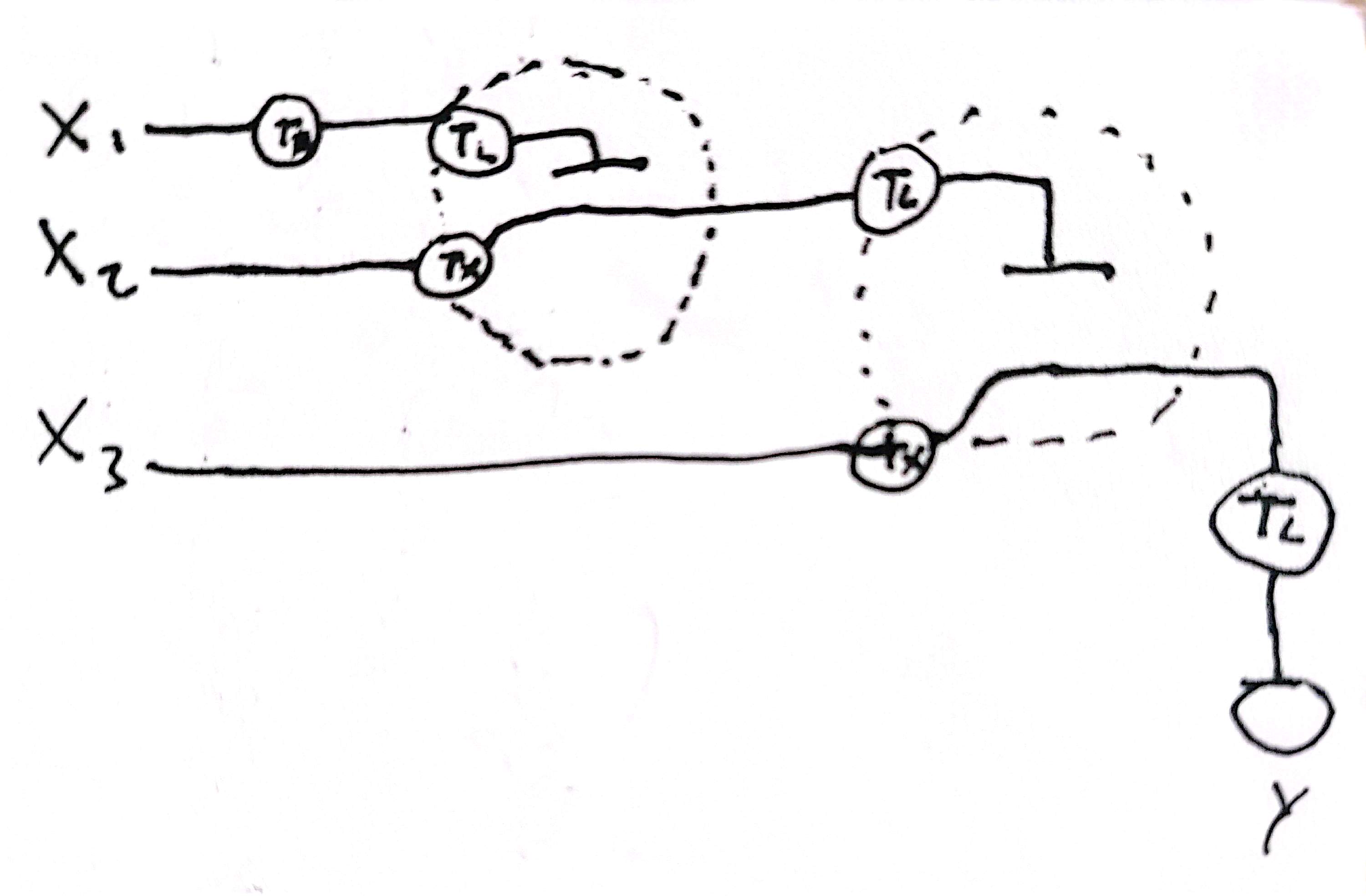
Draw a diagram for an intracellular multilayer perceptron where layer 1 outputs an endoribonuclease that regulates a fluorescent protein output in layer 2.
Assignment Part 2: Fungal Materials
What are some examples of existing fungal materials and what are they used for? What are their advantages and disadvantages over traditional counterparts?
Pleurotus ostreatus for construction (concret crack healing) by Konwarh et al, 2020. Pleurotus ostreatus for concrete crack healing offers self-repair capability, lower maintenance costs, and greater sustainability compared to traditional sealants and repair materials. However, it still has limitations in long-term durability, mechanical reliability, and large-scale implementation; fungi skin wound healing by Ruggeri et al, 2023. Are biocompatible, biodegradable, and may promote tissue regeneration better than some synthetic dressings. Their disadvantages include sterilization challenges, regulatory barriers, and inconsistent material properties; and Ganoderma sessile as a block for architectural design by Attias et al, 2020. Ganoderma sessile as an architectural block is lightweight, sustainable, biodegradable, and provides good insulation compared to conventional building materials. However, it has lower structural strength, moisture sensitivity, and limited durability for demanding construction applications.
What might you want to genetically engineer fungi to do and why? What are the advantages of doing synthetic biology in fungi as opposed to bacteria?
One idea that i have in the past was to engineer fungi to produce melanin and other UV/radiation absorbent materials to serve as building blocks for the astronauts. Fungi offers the advantages of euakariots (PT modifications, multicelullarity, specialized organelles, etc) + the advantages of bacteria (rapid growth, industrial protein production, fast prototyping, etc).