Week 11 homework
Bioproduction and cloud labs 🥼
Part A: The 1,536 Pixel Artwork Canvas | Collective artwork
Contribute at least one pixel to the global artwork experiment before the editing ends on Sunday 19/04 at 11.59pm EST. A personalized URL was sent to the email address associated with your Discourse account, and you can discuss the artwork on the Discourse. Make a note on your HTGAA webpages including:
- what you contributed to the community bioart project (e.g., “I made part of the DNA on the bottom right plate”)
- what you liked about the project, and
- what about this collaborative art experiment could be made better for next year.
What survived of my main contributions to the bioart project are initiating and adding several pixels in the DNA double helix positioned in the left part of the bottom right plate. I also painted some of the Electra2 blue pixels in the background of the same plate (Figure 11.1).
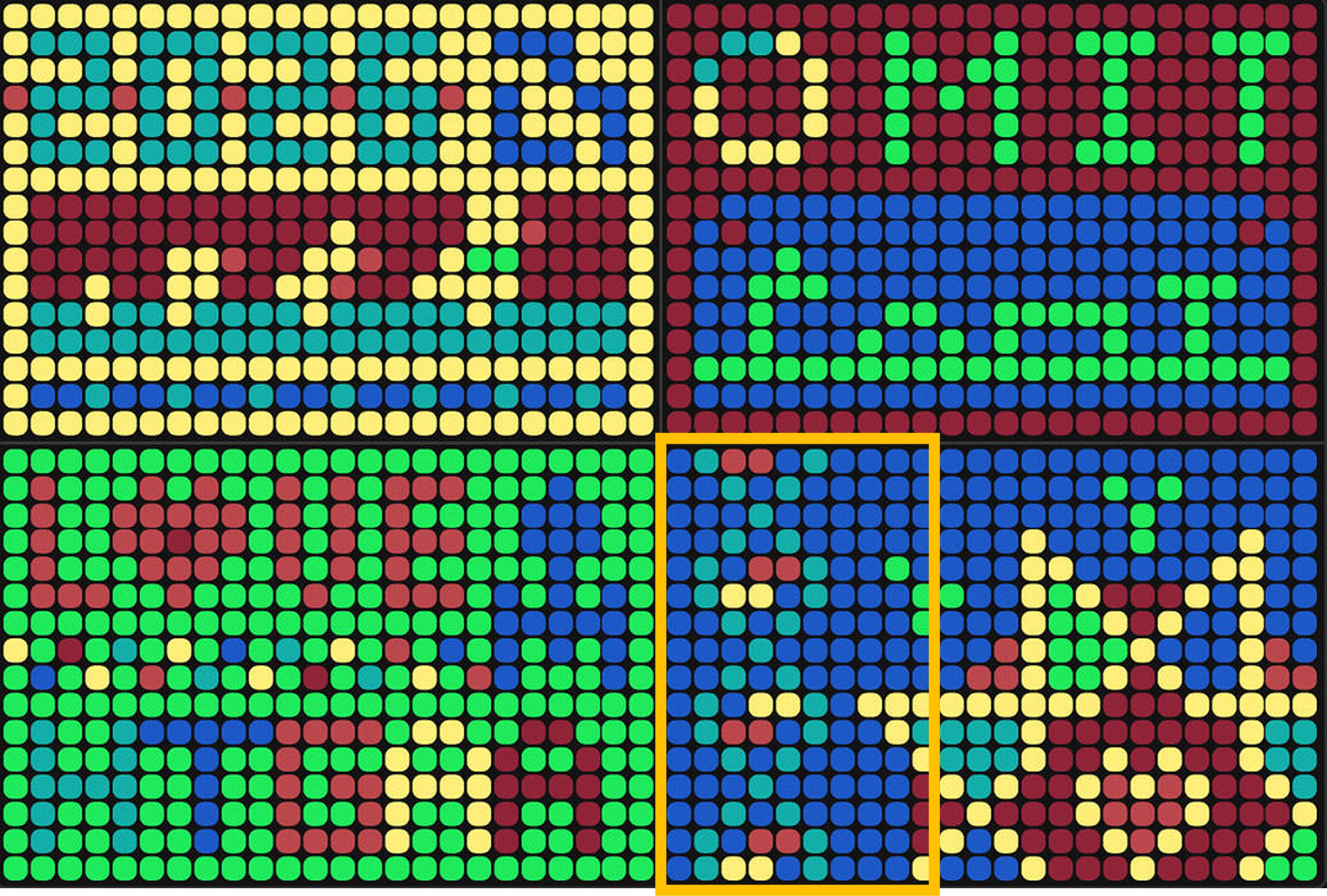 Figure 11.1 The final selected picture generated through the collaborative biopixel artwork project, where I have framed the area roughly containing my contributions in a yellow rectangle. #evolving_ducks
What I liked about the project: It was one of the few times during this course that I felt connected to other HTGAA students from all around the world. I also liked that we were free to choose what we wanted to draw on the canvas and I really enjoyed interacting with the interface/tool, as it was very intuitive and user-friendly. Thank you, Ronan!
What about this collaborative art experiment could be made better for next year: Adding more colors for the next bioart experiment would be great, while I would also like to see a more pixel-dense version of the plate surface area, so that the resolution of the final created picture is sharper. Given that each represents a well in one out of four 384-well plates, I suppose my suggestion means making the canvas bigger by adding more plates in its periphery. Finally, although I did like that there was no specific subject to depict in the artwork, it would be nice if next time there were two instead of one projects: one without a topic (like this year), so that students are given full creative freedom to unfold their bio-drawing talent, and one with a particular theme, so that they are encouraged to truly collaborate and exchange artistic ideas with other HTGAA participants in the context a shared goal.
Part B: Cell-free protein synthesis | Cell-free reagents
1. Referencing the cell-free protein synthesis reaction composition (the middle box outlined in yellow on the image above, also listed below), provide a 1-2 sentence description of what each component’s role is in the cell-free reaction.
E. coli lysate
- BL21(DE3) Star lysate (includes T7 RNA polymerase): This lysate provides the core molecular machinery required for cell-free transcription and translation, including ribosomes, tRNAs, enzymes, and translation factors extracted from E. coli. The BL21(DE3) strain also contains T7 RNA polymerase, which enables strong transcription from T7 promoters commonly used in cell-free expression systems.
Salts/Buffer
- Potassium Glutamate: Potassium glutamate helps maintain ionic strength and mimics the intracellular environment of bacterial cells, supporting proper ribosome function and protein synthesis. It also stabilizes enzymes and improves translation efficiency.
- HEPES-KOH pH 7.5: HEPES-KOH acts as a buffering agent that maintains a stable pH during the reaction. Stable pH is essential because transcription and translation enzymes are highly sensitive to pH changes.
- Magnesium Glutamate: Magnesium ions are critical cofactors for ribosomes, RNA polymerases, and many enzymes involved in transcription and translation. Magnesium glutamate provides the optimal magnesium concentration needed for efficient protein synthesis.
- Potassium Phosphate Monobasic: This compound contributes to phosphate buffering and helps maintain ionic balance within the reaction. It also supports nucleotide metabolism and energy transfer processes.
- Potassium Phosphate Dibasic: Potassium phosphate dibasic works together with the monobasic form to stabilize pH and maintain phosphate equilibrium. Proper buffering improves reaction stability and protein production efficiency.
Energy/Nucleotide system
- Ribose: Ribose serves as a precursor for nucleotide synthesis and energy metabolism within the cell-free system. It can help sustain transcriptional activity by supporting RNA-related metabolic pathways.
- Glucose: Glucose functions as an energy source that helps regenerate ATP during the reaction. Continuous ATP regeneration is necessary because transcription and translation consume large amounts of energy.
- AMP: AMP is one of the nucleotide building blocks involved in RNA synthesis and cellular energy cycling. It also participates in ATP regeneration pathways within the reaction mixture.
- CMP: CMP provides cytidine nucleotides required for RNA transcription. Adequate nucleotide availability is essential for sustained mRNA production.
- GMP: GMP supplies guanosine nucleotides necessary for RNA synthesis and energy metabolism. It contributes directly to the formation of mRNA transcripts.
- UMP: UMP provides uridine nucleotides used during RNA transcription. Balanced nucleotide concentrations improve transcription efficiency and reduce premature termination.
- Guanine: Guanine can be salvaged and converted into guanine nucleotides for RNA synthesis. Supplementing guanine helps support continuous nucleotide recycling during the reaction.
Translation mix (amino acids)
- 17 Amino Acid Mix: This mixture supplies most of the amino acids required for protein synthesis by ribosomes. These amino acids are incorporated into the growing polypeptide chain during translation.
- Tyrosine: Tyrosine is added separately because it may be less stable or required at different concentrations than other amino acids. It is an essential building block for many proteins.
- Cysteine: Cysteine is supplied separately because it is chemically reactive and prone to oxidation in solution. It is important for forming disulfide bonds and stabilizing protein structure.
Additives
- Nicotinamide: Nicotinamide acts as a precursor for NAD+ and related cofactors involved in metabolic and energy-regeneration reactions. It helps support enzymatic activity and prolong reaction efficiency.
Backfill
- Nuclease-Free Water: Nuclease-free water is used to bring the reaction mixture to the correct final volume while preventing degradation of DNA and RNA templates. The absence of nucleases is critical for maintaining stable transcription and translation.
2. Describe the main differences between the 1-hour optimized PEP-NTP master mix and the 20-hour NMP-Ribose-Glucose master mix (2 - 3 sentences).
The easiest to spot difference between the two master mixes is the presence of potassium phosphate monobasic and dibasic solely in the 20-hour one, as they are needed in a longer-lasting reaction to stabilize the pH and regulate phosphate equilibrium both for nucleic acid synthesis but also for energy regeneration. Since I mentioned energy regeneration, another discrepancy between the two reactions can be seen under the “Energy/Nucleotide system” section. The one-hour reaction utilizes NTPs for fast transcription, as well as PEP-Mono and maltodextrin for immediate energy provision due to its very short duration. On the contrary, the 20-hour reaction used NMPs, which can be converted to NTPs and can be employed for energy recovery along with ribose and glucose (that are not included in the one-hour master mix) given enough time. As a last observation of components that differ between the two reactions, the shorter one includes more additives, such as spermidine and DMSO, than the 20-hour protein synthesis, as they can boost translation efficiency and stabilize mRNA structure for faster result acquisition.
Part C: Planning the global experiment | Cell-free master mix design
1. Given the 6 fluorescent proteins we used for our collaborative painting, identify and explain at least one biophysical or functional property of each protein that affects expression or readout in cell-free systems. (Hint: options include maturation time, acid sensitivity, folding, oxygen dependence, etc.) (1 - 2 sentences each).
To obtain more information about each fluorescence protein, I navigated to their respective pages on the Fluorescent Protein Database (FPBase), as well as scientific papers describing their biochemical properties:
- sfGFP: It is a basic (constitutively fluorescent) green fluorescent protein of natural (cnidarian) origin. It is reported to form very rapidly-maturing monomers or weak dimers with moderate acid sensitivity 1. The protein molecules are oxygen-dependent for correct fluorophore formation 2.
- mRFP1: It is a monomeric constitutively fluorescent red fluorescent protein of natural (cnidarian) origin. It is characterized by a longer maturation time (slow maturation) and very low acid sensitivity 1, while it requires molecular oxygen for chromophore formation as a derivative of DsRed 3.
- mKO2: It is a constitutively fluorescent orange fluorescent protein of natural (cnidarian) origin. It has moderate acid sensitivity and is O2-dependent for the maturation of its chromophore. It is monomeric 4 and displays rapidly-maturing fluorescent protein kinetics 5.
- mTurquoise2: It is a monomeric constitutively fluorescent cyan fluorescent protein of natural (cnidarian) origin. It demonstrates rapid maturation and low acid sensitivity 1, whereas it needs molecular oxygen for fluorophore formation being a GFP derivative 3.
- mScarlet_I: It is a synthetic constitutively fluorescent red fluorescent protein. It is reported to be a rapidly-maturing monomer with moderate acid sensitivity 6 that depends on aerobic conditions for chromophore formation 7.
- Electra2: It is a constitutively fluorescent blue fluorescent protein of natural (cnidarian) origin. It forms efficiently-maturing stable monomers, while it shows high resistance to acidic environments and requires oxygen to fluoresce 8.
2. Create a hypothesis for how adjusting one or more reagents in the cell-free mastermix could improve a specific biophysical or functional property you identified above, in order to maximize fluorescence over a 36-hour incubation. Clearly state the protein, the reagent(s), and the expected effect.
Based on information I gathered about the fluorescent proteins we used for the bioart project (presented in the previous question) and on the specific purpose of each reagent in the cell-free protein synthesis master mix (as elaborated on in Part B), I modified the concentration of the following reagents for synthesis of specific fluorescent proteins:
A comprehensive list of all reagents and their respective concentrations in the cell-free reactions that have been customized to the unique properties of each fluorescent protein can be seen in Table 11.1.
Table 11.1 Master mix reagent concentrations for six different wells from the bio-artwork after they have been individually tailored to maximize fluorescence of one out of the six fluorescent proteins used in the project, each represented in a different well.
| Reagent | mTurquoise2 (Q4-B5) | sfGFP (Q2-D11) | mRFP1 (Q1-J6) | Electra2 (Q3-F19) | mKO2 (Q4-M11) | mScarlet_I (Q1-D9) |
|---|---|---|---|---|---|---|
| Cell Lysate | 6.000 μL | 6.000 μL | 6.000 μL | 6.000 μL | 6.000 μL | 6.000 μL |
| DNA Template | 2.000 μL | 2.000 μL | 2.000 μL | 2.000 μL | 2.000 μL | 2.000 μL |
| Nuclease-Free Water | 1.100 μL | 0.950 μL | 1.250 μL | 1.100 μL | 1.000 μL | 1.000 μL |
| Potassium Glutamate | 312.563 mM | 312.563 mM | 314.750 mM | 312.563 mM | 312.563 mM | 312.563 mM |
| Magnesium Glutamate | 10.100 mM | 11.350 mM | 11.350 mM | 10.100 mM | 10.100 mM | 10.100 mM |
| HEPES-KOH pH 7.5 | 45.000 mM | 50.000 mM | 45.000 mM | 45.000 mM | 50.000 mM | 50.000 mM |
| 17 Amino Acid Mix | 4.500 mM | 4.500 mM | 4.063 mM | 4.500 mM | 4.500 mM | 4.500 mM |
| Tyrosine pH 12 | 4.125 mM | 4.125 mM | 4.063 mM | 4.125 mM | 4.125 mM | 4.125 mM |
| Cysteine | 4.000 mM | 4.000 mM | 4.000 mM | 4.000 mM | 4.000 mM | 4.000 mM |
| Ribose | 11.625 g/L | 11.625 g/L | 11.625 g/L | 11.625 g/L | 11.625 g/L | 11.625 g/L |
| AMP | 1.000 mM | 1.000 mM | 0.750 mM | 1.000 mM | 1.000 mM | 1.000 mM |
| CMP | 0.375 mM | 0.375 mM | 0.375 mM | 0.375 mM | 0.375 mM | 0.375 mM |
| GMP | - | - | - | - | - | - |
| UMP | 0.375 mM | 0.375 mM | 0.375 mM | 0.375 mM | 0.375 mM | 0.375 mM |
| Guanine | 0.156 mM | 0.156 mM | 0.156 mM | 0.156 mM | 0.156 mM | 0.156 mM |
| Glucose | 2.000 g/L | 2.000 g/L | 2.000 g/L | 2.000 g/L | 2.000 g/L | 2.000 g/L |
| Potassium phosphate dibasic | 10.000 mM | 10.000 mM | 10.000 mM | 10.000 mM | 10.000 mM | 10.000 mM |
| Potassium phosphate monobasic | 10.000 mM | 10.000 mM | 10.000 mM | 10.000 mM | 10.000 mM | 10.000 mM |
| Nicotinamide | 3.500 mM | 3.500 mM | 3.500 mM | 3.500 mM | 3.500 mM | 3.500 mM |
Shinoda H, Shannon M, Nagai T. Fluorescent proteins for investigating biological events in acidic environments. International Journal of Molecular Sciences. 2018;19(6):1548. doi:10.3390/ijms19061548 ↩︎ ↩︎ ↩︎
Stepanenko OV, Stepanenko OV, Kuznetsova IM, Shcherbakova DM, Verkhusha VV, Turoverov KK. Distinct effects of guanidine thiocyanate on the structure of superfolder GFP. PLoS ONE. 2012;7(11):e48809. doi:10.1371/journal.pone.0048809 ↩︎
Remington SJ. Fluorescent proteins: maturation, photochemistry and photophysics. Curr Opin Struct Biol. 2006;16(6):714-721. doi:10.1016/j.sbi.2006.10.001 ↩︎ ↩︎
Kaida A, Miura M. Differential dependence on oxygen tension during the maturation process between monomeric Kusabira Orange 2 and monomeric Azami Green expressed in HeLa cells. Biochem Biophys Res Commun. 2012;421(4):855-859. doi:10.1016/j.bbrc.2012.04.102 ↩︎
Sakaue-Sawano A, Kurokawa H, Morimura T, et al. Visualizing spatiotemporal dynamics of multicellular cell-cycle progression. Cell. 2008;132(3):487-498. doi:10.1016/j.cell.2007.12.033 ↩︎
Bindels DS, Haarbosch L, van Weeren L, et al. mScarlet: a bright monomeric red fluorescent protein for cellular imaging. Nat Methods. 2017;14(1):53-56. doi:10.1038/nmeth.4074 ↩︎
Pavlou A, Cinquemani E, Geiselmann J, de Jong H. Maturation models of fluorescent proteins are necessary for unbiased estimates of promoter activity. Biophys J. September 21, 2022. doi:10.1016/j.bpj.2022.09.021 ↩︎
Hashimura H, Nakagawa H, Sawai S. Use of blue fluorescent protein Electra2 for live-cell imaging in Dictyostelium discoideum. microPublication Biology. 2025. doi:10.17912/micropub.biology.001774 ↩︎