This week introduces synthesis of proteins using cellular machinery outside of a cell.
Lecture (Tues, Mar 17)
Cell-Free Systems (▶️Recording) Kate Adamala, Peter Nguyen, Ally Huang
Recitation (Wed, Mar 18)
Cell-free protein synthesis (▶️Recording |
💻Slides) Ben Arias-Almeida, Ice Kiattisewee
Homework Part A: General and Lecturer-Specific Questions
Assignees for the following sections
MIT/Harvard students
Required
Committed Listeners
Required
A.1. General homework questions
Explain the main advantages of cell-free protein synthesis over traditional in vivo methods, specifically in terms of flexibility and control over experimental variables. Name at least two cases where cell-free expression is more beneficial than cell production.
Describe the main components of a cell-free expression system and explain the role of each component.
Why is energy provision regeneration critical in cell-free systems? Describe a method you could use to ensure continuous ATP supply in your cell-free experiment.
Compare prokaryotic versus eukaryotic cell-free expression systems. Choose a protein to produce in each system and explain why.
How would you design a cell-free experiment to optimize the expression of a membrane protein? Discuss the challenges and how you would address them in your setup.
Imagine you observe a low yield of your target protein in a cell-free system. Describe three possible reasons for this and suggest a troubleshooting strategy for each.
For the answers to Homework Part A - General homework questions and Homework question from Kate Adamala - see document below 😀👇🏻
A.2. Homework question from Kate Adamala
Design an example of a useful synthetic minimal cell as follows:
Example solution
Based on: Lentini, R. et al., 2014. Nat comm, 5, p.4012.
Pick a function and describe it.
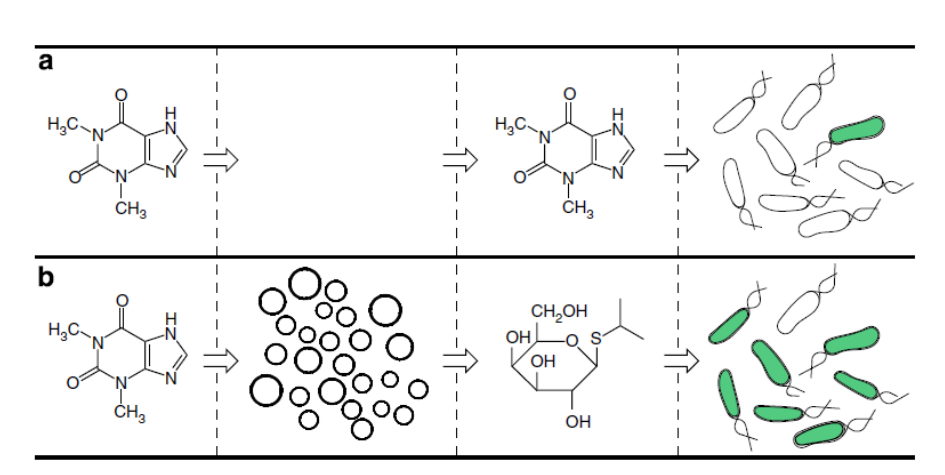
What would your synthetic cell do? What is the input and what is the output? Expand the sensing capacity of bacteria. Input: theophylline (inert to bacteria). Output of the SMC: IPTG. Output of the whole system: GFP produced in bacteria.
(Theophyline aptamer reference: *Martini, L. & Mansy, S.S., 2011. Cell-like systems with riboswitch controlled gene expression. Chemical Communications, 47(38), p.10734.*)
Could this function be realized by cell-free Tx/Tl alone, without encapsulation? No. If the IPTG were not encapsulated, it would go into the bacteria without the need of theophylline-induced membrane channel synthesis, thus the synthetic cell actuator would not exist.
Could this function be realized by genetically modified natural cell? Yes, in this particular case: the theophylline aptamer could be incorporated into a transformed gene. This lacks generality though – it is easier to make SMC than modify bacteria, so in this system a single bacteria reporter can be used to detect various small molecules.
Describe the desired outcome of your synthetic cell operation. In the presence of SMC, bacteria sense theophylline.
Design all components that would need to be part of your synthetic cell.
What would be the membrane made of? Phospholipids + cholesterol.
What would you encapsulate inside? Enzymes, small molecules. cell-free Tx/Tl system, IPTG, gene for membrane transporter under the control of theophylline aptamer.
Which organism your Tx/Tl system will come from? Is bacterial OK, or do you need a mammalian system for some reason? (hint: for example, if you want to use small molecule modulated promotors, like Tet-ON, you need mammalian) Bacterial, because of the theophylline riboswitch used as SMC input.
How will your synthetic cell communicate with the environment? (hint: are substrates permeable? or do you need to express the membrane channel?) The membrane is permeable to the input molecule (theophylline), the output is IPTG that will cross the membrane via the membrane pore created after theophyline-initiated gene expression.
Experimental details
List all lipids and genes. (bonus: find the specific genes; for example, instead of just saying “small molecule membrane channel” pick the actual gene.)
Lipids: POPC, cholesterol
Enzymes: bacterial cell-free Tx/Tl
Genes: a-hemolysin (aHL) to encapsulate in SMC
Biological cells: *E.coli* transformed with GFP under T7 promoter and a lac operator
How will you measure the function of your system? Measure GFP output of the cells via flow cytometry. Alternatively, use enzymatic reporter, like luciferase, and measure bulk output of the enzyme.
Artificial cells translate chemical signals for E. coli. (a) In the absence of artificial cells (circles), E. coli (oblong) cannot sense theophylline. (b) Artificial cells can be engineered to detect theophylline and in response release IPTG, a chemical signal that induces a response in E. coli.
Freeze-dried cell-free systems can be incorporated into all kinds of materials as biological sensors or as inducible enzymes to modify the material itself or the surrounding environment. Choose one application field — Architecture, Textiles/Fashion, or Robotics — and propose an application using cell-free systems that are functionally integrated into the material. Answer each of these key questions for your proposal pitch:
Write a one-sentence summary pitch sentence describing your concept.
How will the idea work, in more detail? Write 3-4 sentences or more.
What societal challenge or market need will this address?
How do you envision addressing the limitation of cell-free reactions (e.g., activation with water, stability, one-time use)?
Application field: Architecture
1. One-sentence summary pitch
“Bioactive architectural lattices that detect airborne pathogens and release antimicrobial peptides on-demand, creating self-sanitizing indoor environments activated by humidity or water spray.”
2. How will the idea work?
This concept builds upon wearable freeze-dried cell-free (wFDCF) technology developed by Nguyen and colleagues at the Wyss Institute , but scales it up for architectural applications. The system consists of 3D-printed biopolymer lattices (composed of cellulose fibers, chitosan gels, and silk fibroin) embedded with freeze-dried “biosites”—porous pellets containing cell-free TXTL (transcription-translation) machinery, DNA circuits encoding antimicrobial peptides (such as nisin or LL-37), and riboswitch-based pathogen sensors.
When airborne pathogens (S. aureus, E. coli, or influenza virus) contact the lattice surface, they are captured by the porous biopolymer matrix and detected via toehold switch sensors or CRISPR-Cas12a-based genetic circuits that specifically recognize pathogen-derived nucleic acids . Upon detection, the riboswitch-triggered circuit activates expression of antimicrobial peptides, which are immediately released from the cell-free system into the surrounding environment to neutralize the threat. The entire system is activated by ambient humidity or controlled water misting, eliminating the need for living cells while providing programmable, on-demand biocidal functionality within building materials.
The lattices are designed with functionally graded porosity—denser regions provide structural integrity while sparser, high-porosity zones maximize air contact with biosites and facilitate capillary-driven fluid distribution during rehydration . The modular, foldable geometry allows installation as ceiling-hung ribbons, wall partitions, or facade elements that maximize surface area exposure to air circulation.
3. Societal challenge and market need
This technology addresses the global challenge of healthcare-associated infections (HAIs) and indoor air quality, which costs the US healthcare system alone approximately $28–45 billion annually and causes 99,000 deaths per year . The COVID-19 pandemic starkly revealed the lack of rapid, accurate environmental diagnostics and the vulnerability of indoor spaces to airborne pathogen transmission.
Current solutions rely on passive HEPA filtration or chemical disinfectants that require manual application and provide no real-time detection capability. This bioactive architectural system offers:
Real-time pathogen detection without laboratory infrastructure
Autonomous, targeted antimicrobial response rather than blanket chemical treatment
Biodegradable, non-toxic materials (silk fibroin, cellulose, chitosan) that replace carcinogenic and carbon-positive conventional building materials
Scalability through additive manufacturing and modular assembly
The market need extends beyond healthcare to include schools, public transportation hubs, food processing facilities, and residential buildings—any indoor environment where air quality and pathogen control are critical.
4. Addressing limitations of Cell-Free reactions
a) Activation with water
Rather than viewing water-activation as a limitation, this system leverages it as a controlled activation mechanism. The biosites are designed to respond to:
Ambient humidity (40–60% RH typical of indoor environments) for passive, continuous low-level monitoring
Controlled water misting systems (similar to existing building humidification or fire suppression systems) for active, on-demand activation when elevated pathogen risk is detected
The biopolymer matrix (silk fibroin and sodium alginate) naturally regulates water uptake through capillary action, ensuring consistent rehydration of embedded cell-free pellets without manual intervention . The system uses ×1.5-concentrated cell-free reactions to accelerate signal output, ensuring antimicrobial peptide production completes before evaporation terminates the reaction.
b) Stability and Shelf-Life
Freeze-dried cell-free systems have demonstrated shelf stability for months to years when properly sealed and stored at room temperature . To enhance longevity in architectural applications:
Biosites are encapsulated in lyophilized biopolymer sponges that protect against oxidation and moisture ingress during storage
Silk fibroin stabilization (which showed 74% expression retention compared to buffer-diluted controls) provides a protective, crowding environment that enhances protein synthesis kinetics
Modular replacement design: Individual biosite pellets can be swapped out when depleted, similar to changing air filters, without replacing entire structural elements
c) One-time use
While individual biosites are single-use (one activation cycle per freeze-dried pellet), the system architecture is designed for modularity and serviceability:
Biosites are press-fitted into lattice cells, allowing easy removal and replacement
Distributed sensing arrays ensure that only activated zones require replacement, while the structural lattice remains intact for years
Future iterations could incorporate regenerative capsules containing fresh freeze-dried TXTL reservoirs that auto-dispense to replenish spent biosites, though this remains an area for future development
Additional mitigation strategies
Evaporation control: Impermeable silicone elastomer barriers (as demonstrated in wFDCF wearables) constrain rehydration volume to ~50 μL per sensor, preventing excessive dilution
Signal amplification: CRISPR-Cas12a’s collateral cleavage activity provides signal amplification, enabling detection at femtomolar sensitivity even with limited reaction time
Colorimetric readout: For maintenance purposes, visible color change (via LacZ or other enzymatic reporters) indicates which biosites have been activated and require replacement
Homework question from Ally Huang
Freeze-dried cell-free reactions have great potential in space, where resources are constrained. As described in my talk, the Genes in Space competition challenges students to consider how biotechnology, including cell-free reactions, can be used to solve biological problems encountered in space. While the competition is limited to only high school students, your assignment will be to develop your own mock Genes in Space proposal to practice thinking about biotech applications in space!
For this particular assignment, your proposal is required to incorporate the BioBits® cell-free protein expression system, but you may also use the other tools in the Genes in Space toolkit (the miniPCR® thermal cycler and the P51 Molecular Fluorescence Viewer). For more inspiration, check out https://www.genesinspace.org/ .
Provide background information that describes the space biology question or challenge you propose to address. Explain why this topic is significant for humanity, relevant for space exploration, and scientifically interesting. (Maximum 100 words)
Name the molecular or genetic target that you propose to study. Examples of molecular targets include individual genes and proteins, DNA and RNA sequences, or broader -omics approaches. (Maximum 30 words)
Describe how your molecular or genetic target relates to the space biology question or challenge your proposal addresses. (Maximum 100 words)
Clearly state your hypothesis or research goal and explain the reasoning behind it. (Maximum 150 words)
Outline your experimental plan - identify the sample(s) you will test in your experiment, including any necessary controls, the type of data or measurements that will be collected, etc. (Maximum 100 words)
Proposal:Real-Time Monitoring of Radiation-Induced DNA Damage Response in Space Using BioBits® Cell-Free Synthesis of γ-H2AX and 53BP1 Repair Proteins
1. Background information
Space radiation poses severe health risks to astronauts, causing DNA double-strand breaks (DSBs) that can lead to cancer, immune dysfunction, and cardiovascular disease. Current biodosimetry requires blood sample return to Earth, creating critical delays in assessing astronaut health during long-duration missions. Cell-free protein synthesis (CFPS) has been validated aboard the ISS, demonstrating that BioBits® can produce functional proteins and biosensors in microgravity using minimal resources. This proposal addresses the urgent need for real-time, in-situ DNA damage assessment capability to enable immediate medical countermeasures and personalized radiation protection during deep space exploration to the Moon and Mars.
2. Molecular/Genetic target
Primary targets: γ-H2AX (phosphorylated H2A.X histone) and 53BP1 (tumor suppressor p53-binding protein 1) DNA damage response proteins; secondary target: fluorescent reporter (mCherry or sfGFP) for visualization.
3. Relationship between target and Space Biology challenge
γ-H2AX and 53BP1 are critical biomarkers of DNA DSBs—the most dangerous form of radiation-induced damage . These proteins form nuclear foci at damage sites, with γ-H2AX appearing within minutes and 53BP1 recruiting repair machinery. Astronauts experience elevated cell-free mitochondrial DNA and persistent DNA damage during spaceflight, correlating with immune dysfunction and long-term health risks. By synthesizing these repair proteins in real-time using BioBits®, we can develop a quantitative biosensor that measures radiation exposure through functional DNA repair capacity rather than just damage accumulation, providing actionable data for crew health management during missions beyond low-Earth orbit where radiation exposure increases dramatically.
4. Hypothesis and research goal
Hypothesis: BioBits® cell-free systems can synthesize functional γ-H2AX and 53BP1 proteins in microgravity that retain DNA damage-binding activity, enabling development of a rapid, fluorescence-based assay for monitoring astronaut cellular radiation response without requiring living cells or sample return to Earth.
Reasoning: Previous Genes in Space experiments validated that BioBits® performs comparably in space and on Earth for protein expression and biosensor applications. The 2024 winning proposal demonstrated cell-free bacteriophage synthesis in space, establishing precedent for complex macromolecular assembly. γ-H2AX and 53BP1 are well-characterized, robustly folding proteins that do not require eukaryotic post-translational modifications for their damage-recognition functions. By expressing these proteins with fluorescent tags (mCherry-γ-H2AX and sfGFP-53BP1 fusion proteins), we can visualize protein synthesis using the P51™ Fluorescence Viewer and validate functionality through DNA-binding assays. This approach leverages the freeze-dried, room-temperature stable nature of BioBits® to create a “just-add-water” diagnostic platform suitable for resource-constrained spacecraft environment.
5. Experimental plan
Samples: BioBits® freeze-dried pellets with plasmids encoding mCherry-γ-H2AX and sfGFP-53BP1; positive control (RFP expression plasmid); negative control (no DNA template).
Procedure: Rehydrate pellets with nuclease-free water, incubate at 37°C using miniPCR® thermal cycler for 90 minutes, visualize fluorescence with P51™ Viewer. Functional validation: add synthesized proteins to DNA-coated microbeads irradiated with bleomycin (DNA damage inducer) and assess binding via fluorescence microscopy or P51™ Viewer.
Measurements: Fluorescence intensity (protein yield), DNA-binding efficiency (functional assay), comparison between spaceflight and ground controls. Data recorded via iPad imaging for quantitative analysis.
Homework Part B: Individual Final Project
Assignees for the following sections
MIT/Harvard students
Required
Committed Listeners
Required
We’d like students to start exploring their final project in depth this week! Of your three Aims, for this week you should have at least Aim 1 decided and written down.
Put your chosen final project slide in the appropriate slide deck following the instructions on slide 1:
First Twist order deadline for MIT/Harvard/Wellesley students is Friday, April 3 at 11PM ET
First Twist order deadline for Committed Listeners is Friday, April 10 at 11PM ET. (Your Node Lead will place the Twist order, so please work with them to finalize your constructs and ordering decisions.)
Lang, X., Zhang, C., Lin, J., et al. (2025). A simplified and highly efficient cell-free protein synthesis system for prokaryotese. Life 14:RP109495.
https://doi.org/10.7554/eLife.109495.1l
Hunt, A. C., Rasor, B. J., Seki, K., et al. (2024). Cell-Free Gene Expression: Methods and Applications. ACS Synthetic Biology, 125, 1, 91–149.
https://doi.org/10.1021/acs.chemrev.4c00116
Zemella, A., Thoring, L., Hoffmeister, C., et al. (2015). Cell-Free Protein Synthesis: Pros and Cons of Prokaryotic and Eukaryotic Systems. ChemBioChem, 16(17):2420-2431. https://doi.org/10.1002/cbic.201500340
Steinkühler, J., Peruzzi, J. A., Krüger, A., et al. (2023). Improving Cell-Free Expression of Model Membrane Proteins by Tuning Ribosome Cotranslational Membrane Association and Nascent Chain Aggregation. ACS Synthetic Biology, 13, 1, 129–140. https://doi.org/10.1021/acssynbio.3c00357
Yadav, S., Perkins, A. J. P., Liyanagedera, S. B. W., et al. (2025). ATP Regeneration from Pyruvate in the PURE System. ACS Synthetic Biology, 14, 1, 247–256. https://doi.org/10.1021/acssynbio.4c00697
Batista, A.C., Soudier, P., Kushwaha, M. and Faulon, J. L. (2021), Optimising protein synthesis in cell-free systems, a review. Eng. Biol, 5: 10-19.
https://doi.org/10.1049/enb2.12004
Wang, Y., Zhang, YH. P. (2009). Cell-free protein synthesis energized by slowly-metabolized maltodextrin. BMC Biotechnol, 9:58. https://doi.org/10.1186/1472-6750-9-58
Anderson, M. J., Stark, J. C., Hodgman, C. et al. (2015). Energizing eukaryotic cell-free protein synthesis with glucose metabolism, FEBS Letters, 589.
https://pmc.ncbi.nlm.nih.gov/articles/PMC4651010/
Webber, M. J., Anderson, D. G. & Langer, R. (2015). Engineering Synthetically Modified Insulin for Glucose-Responsive Diabetes Therapy. Expert Rev Endocrinol Metab., 10(5):483-489. https://pmc.ncbi.nlm.nih.gov/articles/PMC4999256/
Liu, J., Xue, J., Fu, L. et al. (2022). Genetically Encoded Synthetic Beta Cells for Insulin Biosynthesis and Release under Hyperglycemic Conditions. Adv. Funct. Mater., 32, 2111271. https://doi.org/10.1002/adfm.202111271
Hilburger, C. E., Jacobs, M. L., Lewis, K. R. et al. (2019). Controlling Secretion in Artificial Cells with a Membrane AND Gate. ACS Synth Biol., 8(6):1224-1230. https://pmc.ncbi.nlm.nih.gov/articles/PMC6885402/
Green, T. P., Talley, J. P., & Bundy, B. C. (2025). Recent Advances in Developing Cell-Free Protein Synthesis Biosensors for Medical Diagnostics and Environmental Monitoring. Biosensors, 15(8), 499. https://doi.org/10.3390/bios15080499
Ho, G., Kubušová, V., Irabien, C. et al. (2023). Multiscale design of cell-free biologically active architectural structures. Front. Bioeng. Biotechnol. 11:1125156. https://doi.org/10.3389/fbioe.2023.1125156
Nguyen, P.Q., Soenksen, L.R., Donghia, N.M. et al. (2021). Wearable materials with embedded synthetic biology sensors for biomolecule detection. Nat Biotechnol 39, 1366–1374. https://doi.org/10.1038/s41587-021-00950-3
Kim, S., Min, K., Park, YG. et al. Stem cells in space: microgravity effects on stem cell fate and implications for regenerative medicine. npj Microgravity 12, 6 (2026).
https://doi.org/10.1038/s41526-025-00547-z
Beheshti, A., McDonald, J. T., Hada, M. et al. (2021). Genomic Changes Driven by Radiation-Induced DNA Damage and Microgravity in Human Cells. International Journal of Molecular Sciences, 22(19), 10507.
https://doi.org/10.3390/ijms221910507
Bisserier, M., Shanmughapriya, S., Rai, A. K. et al. (2021). Cell-Free Mitochondrial DNA as a Potential Biomarker for Astronauts’ Health. Journal of the American Heart Association, AHA Journals, 10(21). https://doi.org/10.1161/JAHA.121.022055
Bezdan, D., Grigorev, K., Meydan, C. et al. (2020). Cell-free DNA (cfDNA) and Exosome Profiling from a Year-Long Human Spaceflight Reveals Circulating Biomarkers. iScience, 23. Cell Press. https://doi.org/10.1016/j.isci.2020.101844
Kocalar, S., Miller, B. M., Huang, A., et al. (2024). Validation of Cell-Free Protein Synthesis Aboard the International Space Station. ACS Synth Biol. 15;13(3):942-950.
https://doi.org/10.1021/acssynbio.3c00733
Moreno-Villanueva, M., Wong, M., Lu, T. et al. (2017). Interplay of space radiation and microgravity in DNA damage and DNA damage response. npj Microgravity 3, 14.
https://doi.org/10.1038/s41526-017-0019-7
Pariset, E., Bertucci, A., Petay, M. et al. (2020). DNA Damage Baseline Predicts Resilience to Space Radiation and Radiotherapy. Cell Rep. 8;33(10):108434. https://doi.org/10.1016/j.celrep.2020.108434