Week 3 HW: Principles and Practices
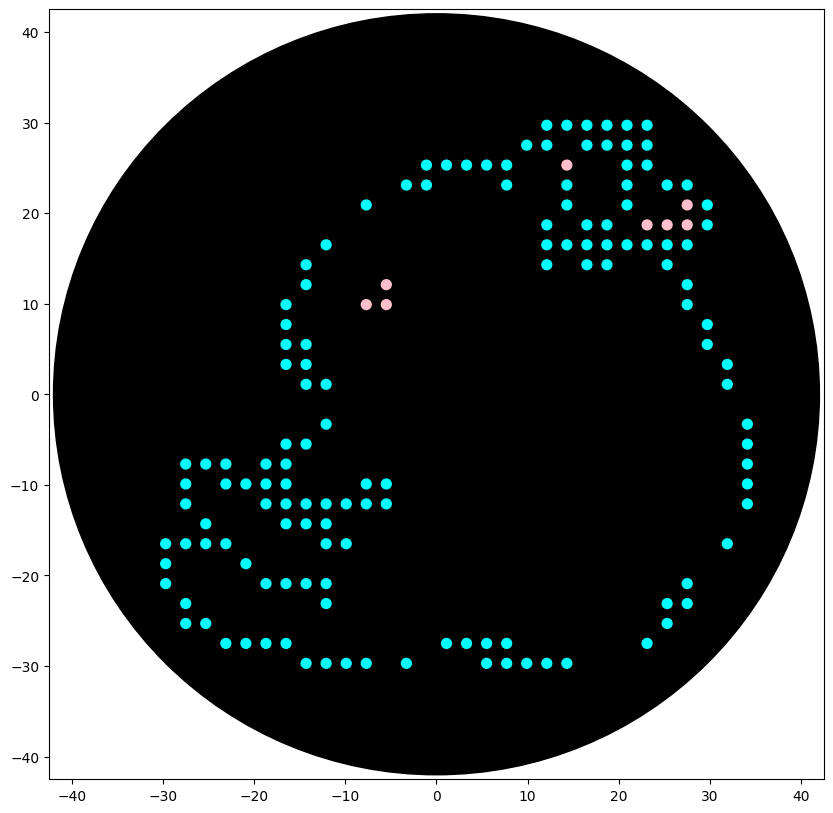
For this lab, I made a little bunny drawing! I used Ronan’s tool as a base and then fixed it to work with colab environment and colours that we have in our node.
Post-Lab Questions
Find and describe a published paper that utilizes the Opentrons or an automation tool to achieve novel biological applications.
https://www.nature.com/articles/s41598-024-64938-0
This study by Norton-Baker et al. (2024) used an Opentrons OT-2 liquid-handling tool to efficiently characterise a large number of proteins. They also described a generalizable pipeline for high-throughput protein purification using small-scale expression in E. coli and an affordable liquid-handling robot. As a result, the automation significantly increased throughput, reduced manual labour, and improved consistency across samples, demonstrating how accessible robotics can accelerate biological research workflows. It also allowed to confirm the validity of previous findings.
On a separate note, I really enjoyed their explanation for using the tool : “Therefore, we aimed to develop a protocol using the OT-2 to provide a low-cost option for the purification and analysis of enzymes, or other proteins, making high-throughput studies more accessible to a broader range of research laboratories. Beyond increasing efficiency, this automation-assisted approach reduces the labor burden on researchers and lowers the risk of repetitive use injuries.”"
Write a description about what you intend to do with automation tools for your final project. You may include example pseudocode, Python scripts, 3D printed holders, a plan for how to use Ginkgo Nebula, and more. You may reference this week’s recitation slide deck for lab automation details.
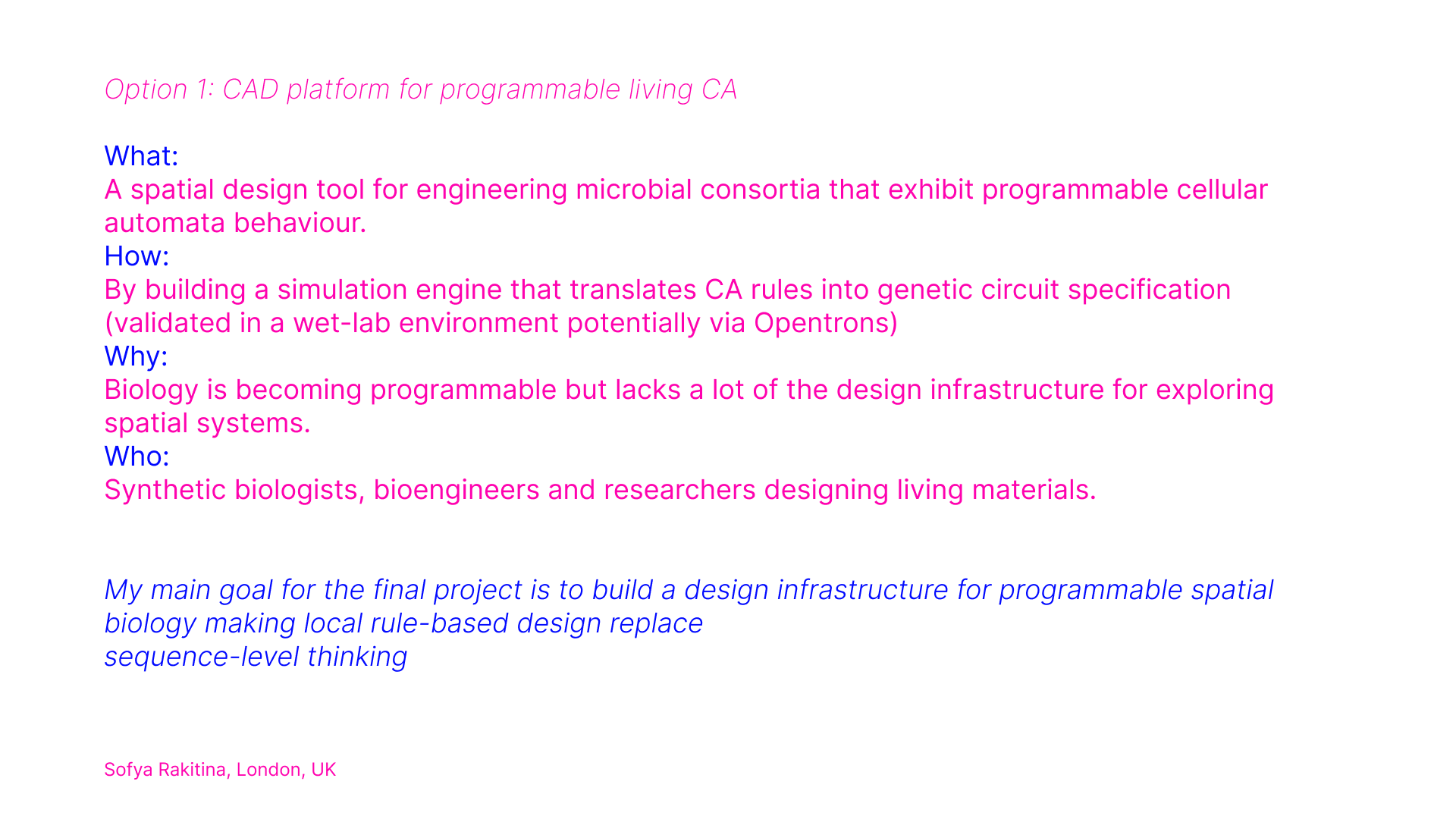
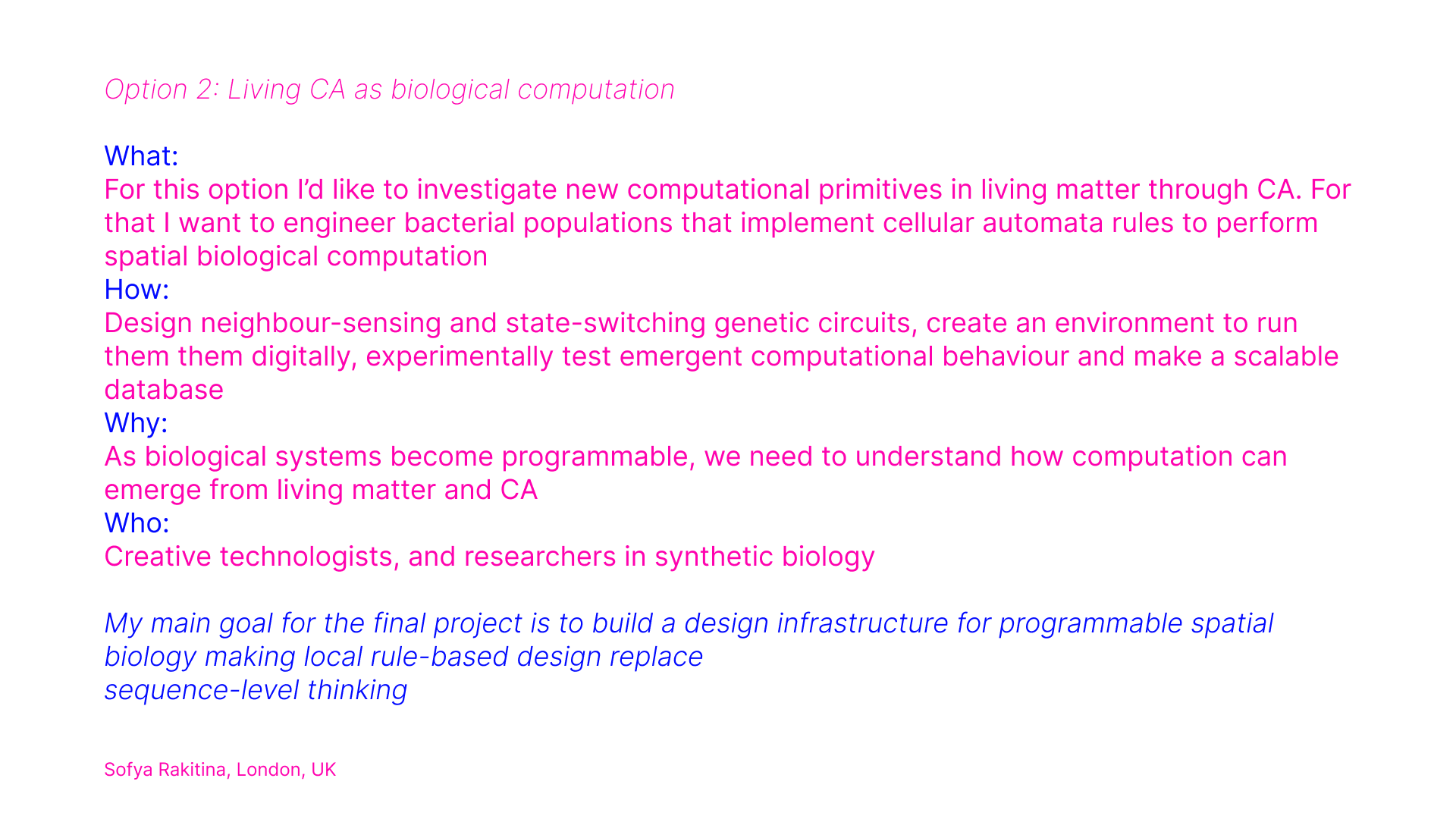
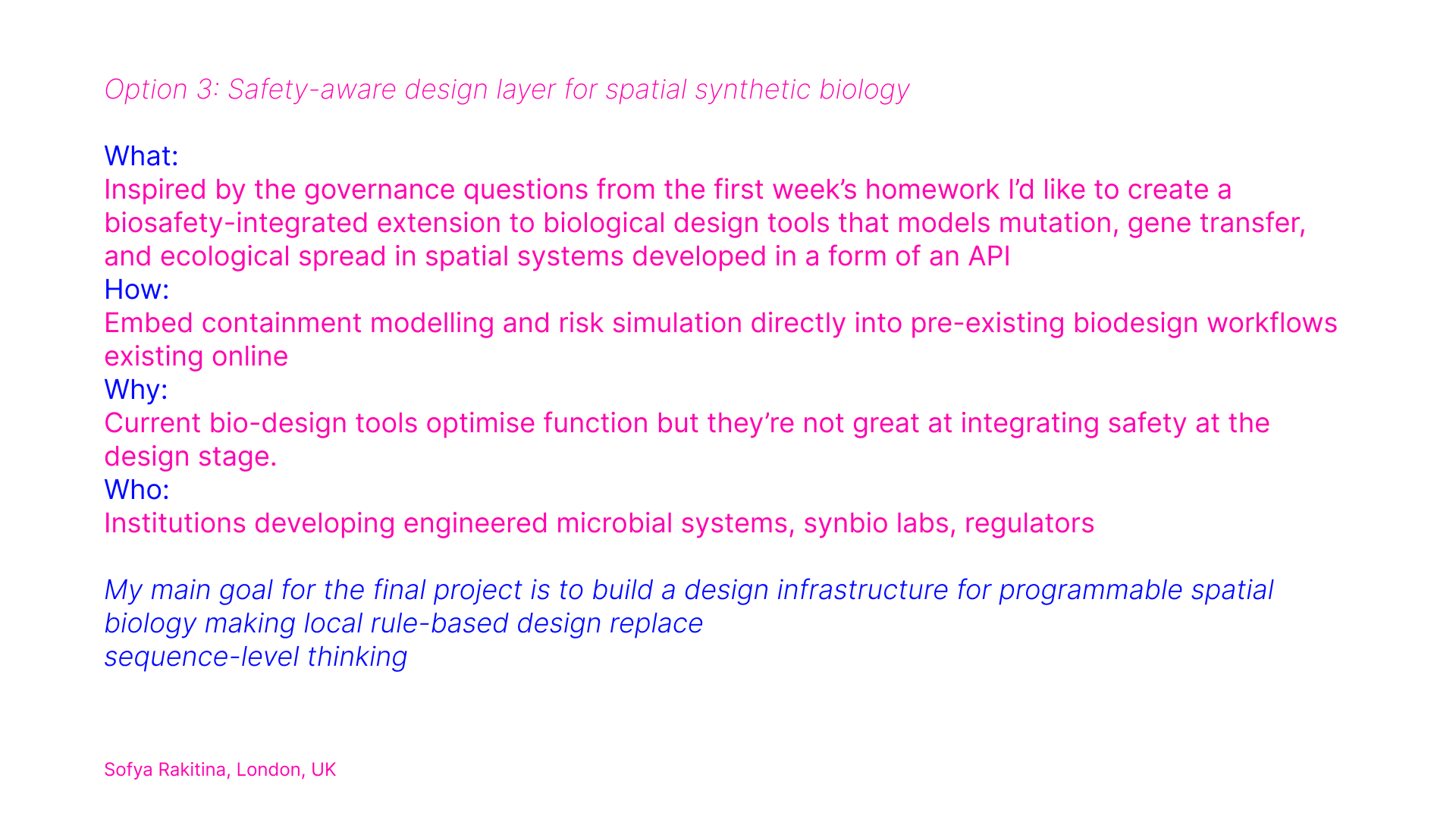
For my final project, I plan on using Opentrons to support a design, then build, test and learn pipeline for programmable living CA.
Things to do:
build libraries of sender receiver circuits with a range of parameters (I’ve done a similar thing with chi.bio before so should be straightforward). I’d also like to see how I can integrate it within the pre existing lab environment (Airtable) to get more transparent data for the future
Go through the process of general screening of spatial rule variants in plates to test pattern formation under different genetic and environmental conditions, depending on available options
In the later stages. use Cloud lab integration (e.g., Ginkgo Nebula) to scale, run large combinatorial libraries, and feed results back into the CA simulation engine for model fine tunning
All in all, this automation will increase reproducibility, enable systematic exploration of rule space, and accelerate the feedback loop between digital design and wet-lab experimentation.
I would also like to explore more of the idea using Ginkgo’s cloud lab (Nebula) to run large combinatorial libraries of CA rule variants. That would allow me to test hundreds of spatial rule configurations and feed experimental results back into the simulation engine!
Final Project Ideas: