Week 7 HW: Genetic Circuits Part II: Neuromorphic Circuits
Assignment Part 1: Intracellular Artificial Neural Networks (IANNs)
What advantages do IANNs have over traditional genetic circuits, whose input/output behaviors are Boolean functions?
- Analogue quality of computations (not just on and off, but rather treat them more like waves ->easier to work with)
- -> Thresholds finetuning works
- You can also work with more inputs simultaneously that will automatically become a weighted sum
- Which also means they can be trained like neural networks!
whereas Boolean functions are just True/False with operators AND, OR, and NOT
Describe a useful application for an IANN; include a detailed description of input/output behavior, as well as any limitations an IANN might face to achieve your goal.
Actually, mycelium described in the later parts of the homework is a great application of IANN due to its non-uniform growth, which is basically a response to chemical gradients, nutrient availability, CO₂ levels, humidity, and light. That’s all analogue and continuous signals! Therefore, we could engineer a fungal cell to use an IANN to sense its local environment and decide how to grow, giving mycelium a programmable, environmentally-responsive architecture, which is basically a CA <3 where simple local rules produce complex emergent global patterns!!
So then, for input behaviour, we have
-Local nutrient and carbon concentration sensed via metabolite-responsive promoters -CO₂ or O₂ levels -Mechanical compression (fungi lowkey already have these) -Neighbour cell density, which would act like quorum-sensing signalling molecules
Then, for output behaviour, we have
-Expression of growth-promoting genes -Expression of growth-halting genes → denser, stiffer composite in that region -Secretion of signalling molecules → coordinating behaviour with neighbouring cells
Limitations: intercellular signal noise (“local” signals may not stay local, warping and structural variability (Walter and Gürsoy (2022)), instability of speed as the IANN may lag behind rapidly changing environmental conditions
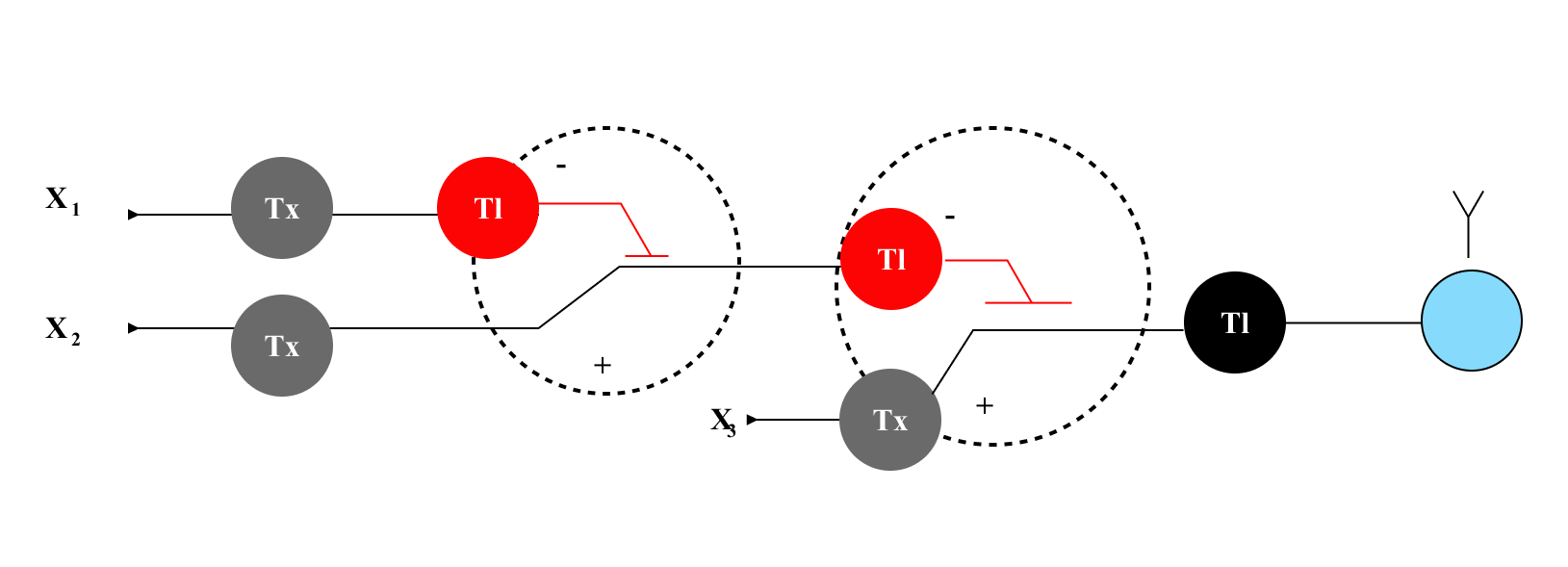
Draw a diagram for an intracellular multilayer perceptron where layer 1 outputs an endoribonuclease that regulates a fluorescent protein output in layer 2.
Here! A super quick sketch made in figma I tried to make it as close to the example as possible
Assignment Part 2: Fungal Materials
What are some examples of existing fungal materials and what are they used for? What are their advantages and disadvantages over traditional counterparts?
I ended up reading a lot about acoustic dampening and how fungal materials are used for it. So the most established fungal material is the mycelium-based composite. It is produced when the vegetative root network of fungi (mycelium), is grown on agricultural or waste plant substrates and then dried to stop growth. The resulting material has the potential to replace petrochemical-based materials within architectural systems and can serve as a biodegradable(!!!) alternative to synthetic sound-absorbing materials. Based on this paper https://pmc.ncbi.nlm.nih.gov/articles/PMC9394424/ , the acoustic performance is genuinely competitive. Mycelium-based composites cultivated on shredded and fine cardboard can both be considered sound-absorbing materials and have the potential to compete with the performance of synthetic sound absorbers as both sample groups outperformed a polypropylene acoustic panel at low frequencies (125 Hz, 250 Hz, 500 Hz). An earlier study found that even the lowest-performing substrate, 100% cotton bur fibre, still yielded higher than 70% acoustic absorption at 1000 Hz.
Advantages over traditional counterparts like fibreglass or stone wool are primarily environmental. As for disadvantages, performance is variable and hard to control because mycelium growth is sensitive to humidity, temperature, and other things.
What might you want to genetically engineer fungi to do and why? What are the advantages of doing synthetic biology in fungi as opposed to bacteria?
I’d be so interested in researching further applications for acoustics. Making a speaker out of a part made out of fungi would be really interesting from a sound perspective. Like mycelium composites are already being used as acoustic panels because their fibrous, porous structure absorbs and diffuses sound well.
It’s so much easier to create a mater out of fungi. They are cheaper and easier to grow at scale. You can also also mold it, control its density, and at the end harvest a structured composite
Assignment Part 3: First DNA Twist Order
So, my order is the LuxI/LuxR sender-receiver circuit: the LuxI expression cassette (constitutive promoter + LuxI + terminator) and the LuxR receiver cassette (LuxR + pLux promoter + GFP + terminator)
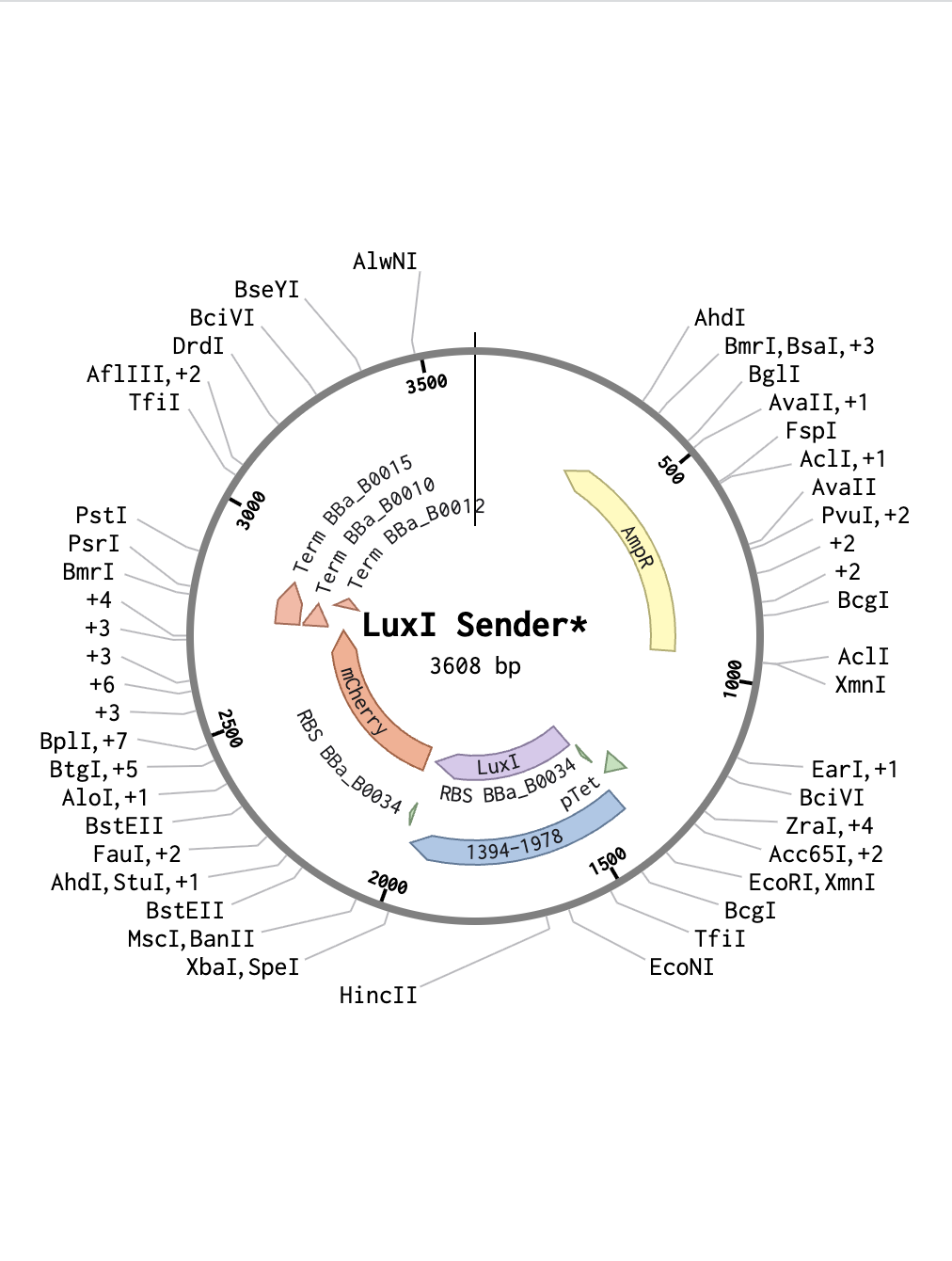
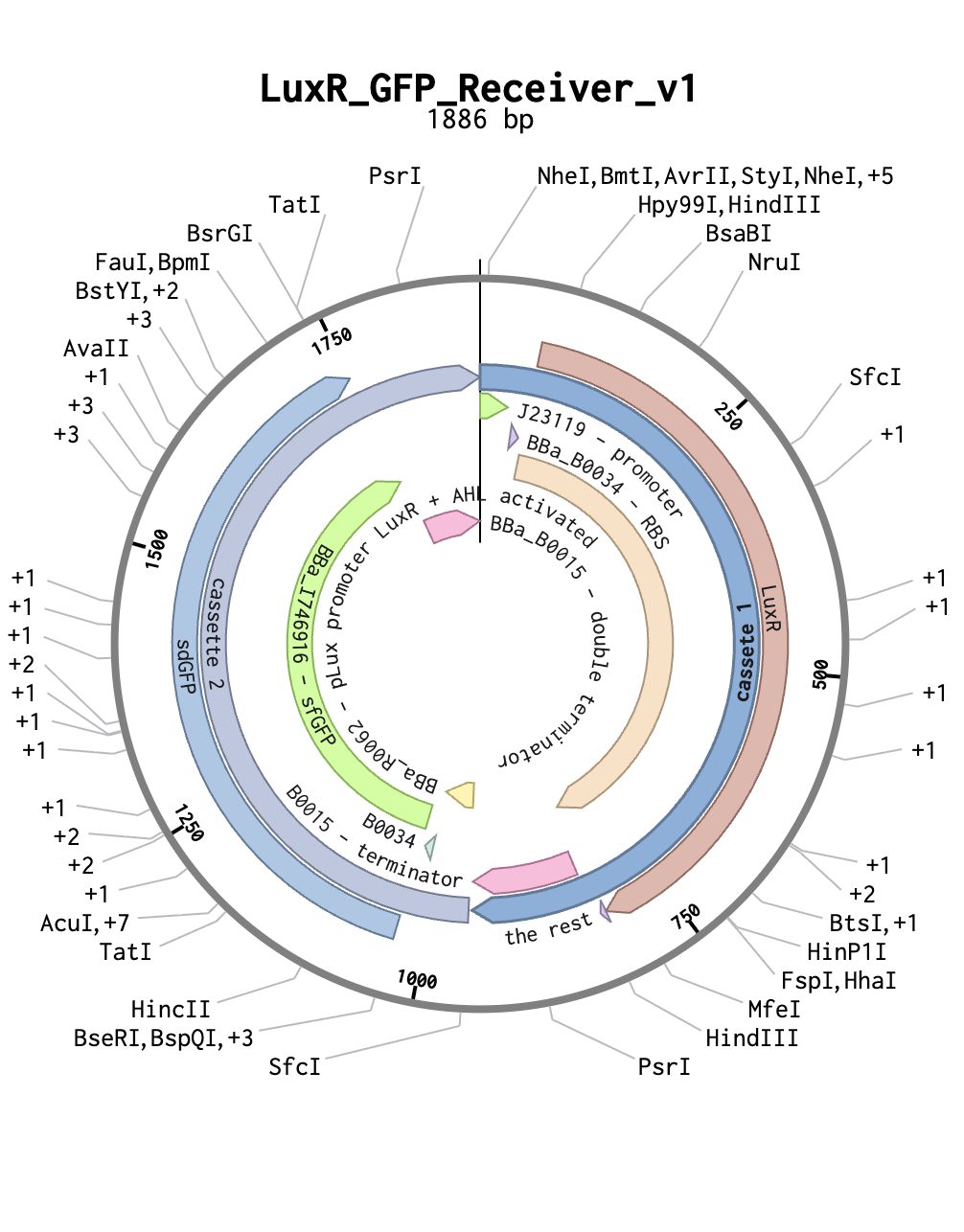
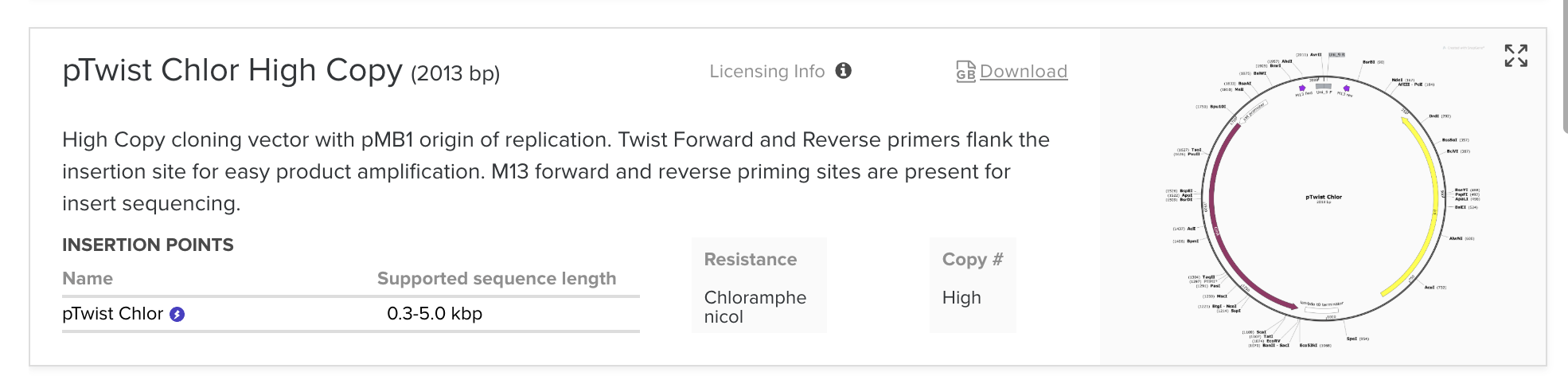
For a backbone vector, the construct will be synthesized in the pTwist Chlor High Copy backbone which is a high-copy pMB1-origin plasmid with chloramphenicol resistance
https://pmc.ncbi.nlm.nih.gov/articles/PMC9394424/ https://www.mdpi.com/2313-7673/7/3/100