Week 9 HW: Cell-Free Systems
Homework Part A: General and Lecturer-Specific Questions
General homework questions
Explain the main advantages of cell-free protein synthesis over traditional in vivo methods, specifically in terms of flexibility and control over experimental variables. Name at least two cases where cell-free expression is more beneficial than cell production.
As the reaction happens outside living cells, you have much more flexibility and control over experimental variables!
To be more specific, the biggest difference is the promoter. In cell-free protein synthesis, a T7 promoter is often preferred because T7 RNA polymerase is readily added or already present in the extract, making transcription simple and highly controllable. And this is why we have a much more precise control over transcription This doesn’t happen with real bacteria, as gene expression is tied to cell growth phase, metabolism and others. That also means that prototyping is faster as you can propagate the plasmid in E. coli, then purify plasmid DNA, then add it to cell-free protein synthesis and be kinda done within so much faster
Two cases where cell-free expression is more beneficial than cell production:
- unstable proteins degraded in vivo
- toxic proteins, where something might kill bacteria before enough protein accumulates or like if one needs to do any sort of rapid screening
Describe the main components of a cell-free expression system and explain the role of each component.
- Cell Extract (Lysate). It provides the machinery for transcription/translation
- Genetic Template (DNA or mRNA). Contains the gene encoding the target protein.
- Energy Regeneration System. Sustain long-term protein synthesis through supplying ATP/GTP
- Amino Acids and Building Blocks. Needed for polypeptide synthesis
- Buffer and Salts. Stabilise the reaction environment and optimise enzyme function and others
Why is energy provision regeneration critical in cell-free systems? Describe a method you could use to ensure continuous ATP supply in your cell-free experiment.
Transcription and translation consume ATP super fast -> ATP is quickly depleted. To avoid that a common method is adding PEP with pyruvate kinase (Calhoun and Swartz, 2007)
Compare prokaryotic versus eukaryotic cell-free expression systems. Choose a protein to produce in each system and explain why.
Prokaryotic cell-free systems - rapid, high-yield production of simple proteins -> Green fluorescent protein (GFP) (small, soluble, no need for complicated glycosylation) Eukaryotic systems - complex proteins requiring proper folding and post-translational modification -> Erythropoietin (EPO) (requires specific disulfide bonds and glycosylation)
How would you design a cell-free experiment to optimize the expression of a membrane protein? Discuss the challenges and how you would address them in your setup.
To express a membrane protein, I would use a eukaryotic cell-free system with liposomes. Then I’d also include chaperones, and optimise reaction conditions to promote proper folding and membrane insertion while preventing aggregation.
Imagine you observe a low yield of your target protein in a cell-free system. Describe three possible reasons for this and suggest a troubleshooting strategy for each.
Low yield may result from ATP depletion (->add an energy regeneration system), protein misfolding (->include chaperones or membrane mimetics), or poor template quality(->would be solved by optimising template design and reaction conditions)
Homework question from Kate Adamala
Design an example of a useful synthetic minimal cell as follows: Pick a function and describe it.
For this mini project/ question, I’d like to explore how synthetic minimal cells for the wols of biocensors specifically, I’d like to look into the possibilities of heavy metal detection in water. It would be also interesting to explore what’s possible to be done after the detection as a form of capturing it
What would your synthetic cell do? What is the input and what is the output?
The synthetic cell would function as a heavy metal detector targeting mercury (Hg²⁺) contamination in water. It will first sense dissolved Hg²⁺ through a metal-responsive transcription factor, then synthesise both a fluorescent reporter (so you can see the signal) and a metal-binding protein to physically capture the mercury.
Input Hg²⁺ ions in the surrounding aqueous environment Output GFP fluorescence, which would act as a quantitative detection signal
Could this function be realized by cell-free Tx/Tl alone, without encapsulation?
No, as it would be ineffective
Could this function be realized by genetically modified natural cell?
Yes, it’s possible to use E.coli but that wouldn’t be safe for the environment.
Describe the desired outcome of your synthetic cell operation.
The desired outcome would be a real-time fluorescent detection of mercury contamination (+passive remediation!)
Design all components that would need to be part of your synthetic cell.
- PURE system - E. coli Tx/Tl machinery
- MerR + PmerT-DNA - Hg²⁺ sensor + promoter
- GFP - fluorescent reporter
- Metallothionein - Hg²⁺ binding protein
- ATP regen (creatine-P / CK) - energy source
What would be the membrane made of?
DPPC (structural bilayer backbone), cholesterol (reduced passive permeability), DSPE-PEG2000PE (for stability in water), DPhPC (help with protein reconstitution)
What would you encapsulate inside? Enzymes, small molecules.
Genetic material: A linear DNA expression cassette encoding gfp and MT1 (human metallothionein-1) under a single MerR-regulated PmerT promoter — both genes transcribed as a bicistronic message driven by the same mercury-sensing switch. Tx/Tl machinery: PURE system (PUREfrex 2.0 or similar), providing all ribosomes, elongation factors, tRNAs, aminoacyl-tRNA synthetases, and RNA polymerase needed for in-vesicle protein synthesis. Pre-loaded proteins/small molecules:
MerR transcription factor (pre-expressed and loaded — it is the sensor that detects Hg²⁺ and activates PmerT) Creatine phosphate + creatine kinase (ATP regeneration system to power the PURE system) All 20 amino acids and NTP mix RNase inhibitor (to protect mRNA during synthesis)
Which organism your Tx/Tl system will come from? Is bacterial OK, or do you need a mammalian system for some reason? (hint: for example, if you want to use small molecule modulated promoters, like Tet-ON, you need mammalian)
A bacterial PURE system is the right choice here because all genes are prokaryotic (merR, merB, gfp, MT1 with bacterial codon optimization),
How will your synthetic cell communicate with the environment? (hint: are substrates permeable? or do you need to express the membrane channel?)
Through MerB and MscL
Experimental details List all lipids and genes. (bonus: find the specific genes; for example, instead of just saying “small molecule membrane channel” pick the actual gene.)
Lipids:
- DPPC (Avanti Polar Lipids )
- Cholesterol (Sigma C8667)
- DSPE-PEG2000
- DPhPC
Genes / DNA Cassettes:
- merR Uniprot P0A3C3
- merB Uniprot P0A393
- gfp Uniprot P42212
- MT1 Uniprot P04731
- mscL Uniprot P0A742
How will you measure the function of your system?
- In vitro validation (to consider dose-response fluorescence, mercury sequestration, Tx/Tl confirmation, membrane integrity controls)
- Then test the same synthetic cells against Pb, Cd, Cu, Zn, and Fe at equivalent concentrations
- No-MerR negative control (cells assembled without the MerR protein but with the PmerT-gfp cassette should be no flouresebce)
- Environmental validation through spiked water sample test
Homework question from Peter Nguyen
Freeze-dried cell-free systems can be incorporated into all kinds of materials as biological sensors or as inducible enzymes to modify the material itself or the surrounding environment. Choose one application field — Architecture, Textiles/Fashion, or Robotics — and propose an application using cell-free systems that are functionally integrated into the material. Answer each of these key questions for your proposal pitch: Write a one-sentence summary pitch sentence describing your concept.
I’m also really interested in how acoustics work and operate. I know there’s been a lot of recent development with mycelium-based material research for speakers, but for this project, I’d like to look into wall panels, which you can find a lot in music venues. In most cases, such venues require a specific setup for the type of music that’s going to be played, and this would solve this issue. I imagine them being updated with using freeze-dried cell-free enzymes to modify material porosity/stiffness in response to sound frequency and humidity, optimising acoustics in real-time for different performances.
How will the idea work, in more detail? Write 3-4 sentences or more.
The panels contain freeze-dried cell-free systems with mechanosensitive promoters and enzymes that degrade polymers in the material matrix. When sound waves vibrate the material and ambient humidity activates the system -> the enzymes modify the panel’s density and porosity. High-frequency performances trigger different enzymatic pathways than bass-heavy music, creating frequency-specific acoustic reflection. The material could shift from absorptive (for loud rock) to reflective (for classical) over the course of hours.
What societal challenge or market need will this address?
Live music venues struggle with “one-size-fits-all” acoustics; a room great for orchestras sounds terrible for others. Acoustic treatment is expensive and static. This addresses the massive live music industry with adaptive infrastructure that reduces the need for costly manual reconfiguration.
How do you envision addressing the limitation of cell-free reactions (e.g., activation with water, stability, one-time use)?
One could use multiple “generations” of enzymes with different activation thresholds. Early activators work on first moisture exposure, but reserve populations activate only after pH changes from initial reactions, creating extended activity. Incorporate hygroscopic materials that capture atmospheric moisture in humid London venues to enable repeated activation cycles.
Homework question from Ally Huang
Provide background information that describes the space biology question or challenge you propose to address. Explain why this topic is significant for humanity, relevant for space exploration, and scientifically interesting. (Maximum 100 words)
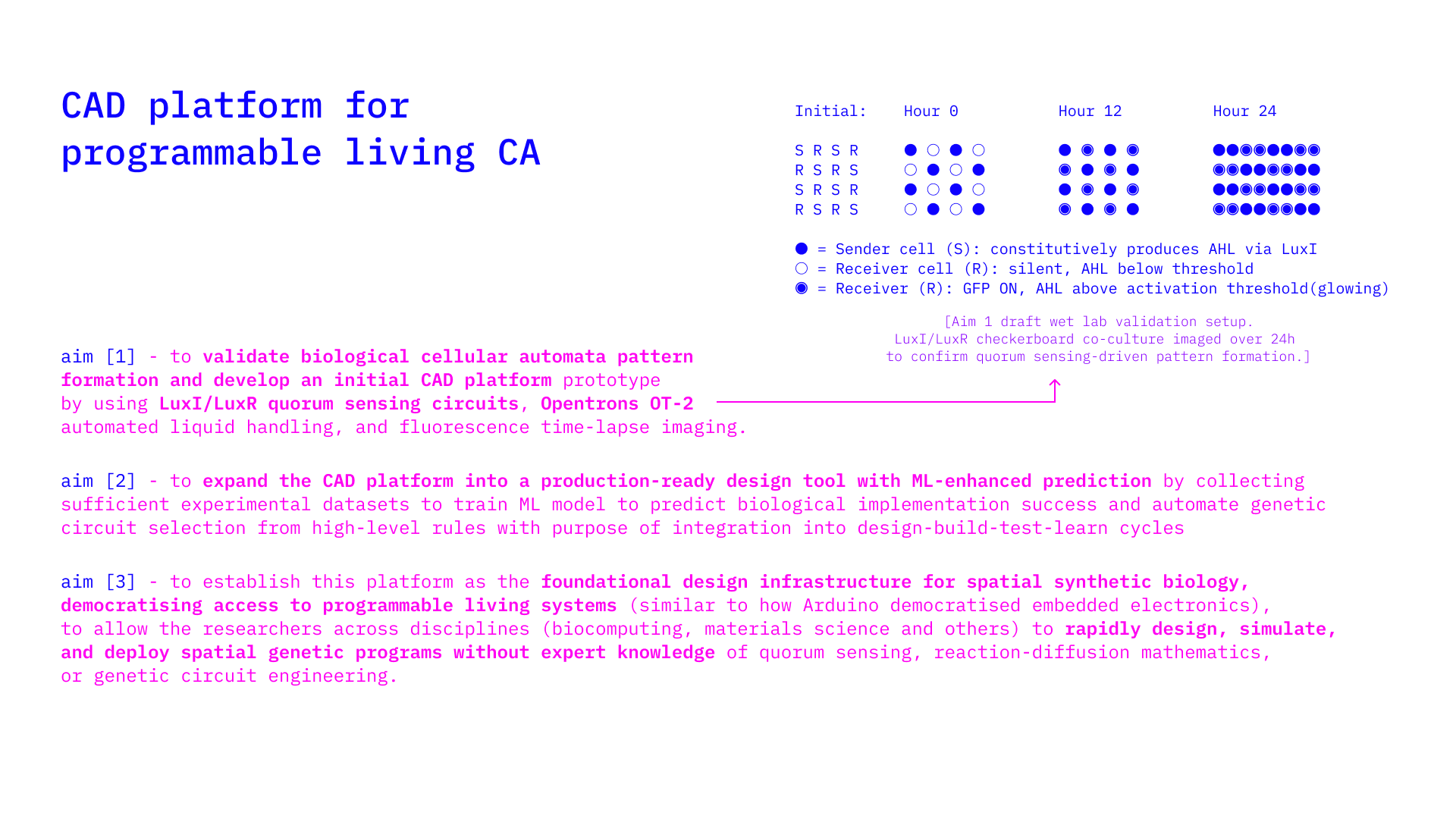
When in space, astronauts lose quite a bit of their bone density 1-2%, which is the same thing as having osteoporosis on Earth for a year. Therefore, it’s important to understand how bone-building and bone-resorbing cells operate for long missions in space. There is a chance that cellular automata could have an answer for that. With CA, we could simulate spatial-temporal patterns of bone remodelling to predict how mechanical unloading disrupts the delicate balance between mineralisation and resorption. This research could inform is of possible countermeasures
Name the molecular or genetic target that you propose to study. Examples of molecular targets include individual genes and proteins, DNA and RNA sequences, or broader -omics approaches. (Maximum 30 words)
The RANK/RANKL/OPG signalling pathway regulating osteoblast-osteoclast communication (RUNX2, osteocalcin, collagen type I).
Describe how your molecular or genetic target relates to the space biology question or challenge your proposal addresses. (Maximum 100 words)
The RANK/RANKL/OPG pathway controls bone remodelling balance. In microgravity, mechanical unloading downregulates osteoblast activity (reduced RUNX2 expression) while RANKL signalling increases osteoclast formation. Cellular automata can model how local cell-cell signalling rules—based on real gene expression data from spaceflight experiments—produce emergent bone microarchitecture patterns.
Clearly state your hypothesis or research goal and explain the reasoning behind it. (Maximum 150 words)
Altered RANK/RANKL/OPG expression ratios in microgravity create spatial signalling gradients that, when modelled using cellular automata rules, will reproduce bone loss patterns observed in astronaut imaging studies. Traditional biomechanical models miss the discrete cellular interactions driving remodelling. Cellular automata excel at capturing emergent behaviour from simple local rules.
Outline your experimental plan - identify the sample(s) you will test in your experiment, including any necessary controls, the type of data or measurements that will be collected, etc. (Maximum 100 words)
Samples: Analyse existing NASA GeneLab datasets from microgravity analogue rodent hindlimb unloading experiments, measuring RANK/RANKL/OPG expression in bone tissue at multiple timepoints. Controls: Earth-gravity parameter sets; randomised signalling gradients. Data collected: Bone volume fraction, trabecular thickness, connectivity metrics from CA output; compare against μCT imaging data from actual experiments.
Homework Part B: Individual Final Project
Bibliography
Calhoun, K.A. and Swartz, J.R. (2007). Energy Systems for ATP Regeneration in Cell-Free Protein Synthesis Reactions. In Vitro Transcription and Translation Protocols, pp.3–17. doi:https://doi.org/10.1007/978-1-59745-388-2_1.