Week 11 HW: Bioproduction & Cloud Labs
Part A: The 1,536 Pixel Artwork Canvas | Collective Artwork
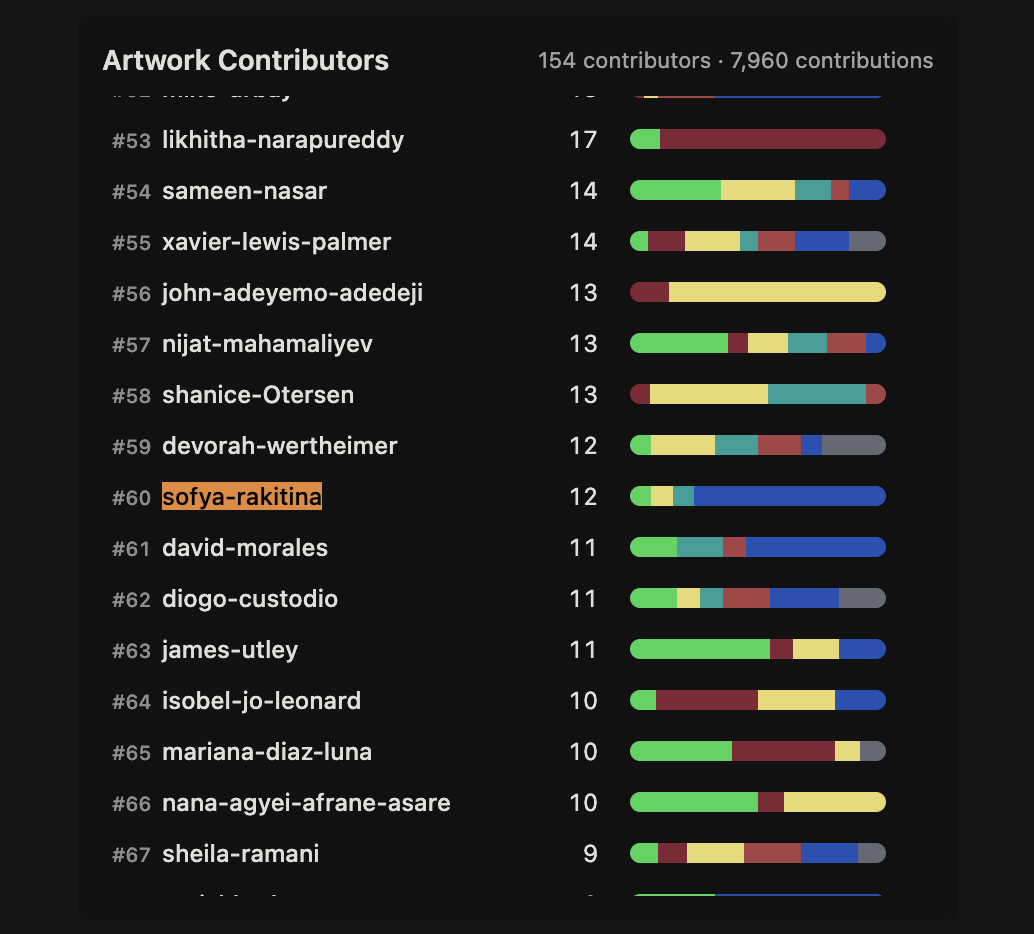
At this point, I’m not entirely sure what I’ve contributed to, as the artwork changed quite a lot. I’ve added a few yellow and green pixels when we first got access to the board, but as time went it changed so much that I don’t think any of them were left in the same spots. I did like the collaborative aspect of it, but going forward, I kind of wish everyone could contribute to just one/two pixels that couldn’t be overwritten. That would make the pointing-out aspect of it so much easier
Part B: Cell-Free Protein Synthesis | Cell-Free Reagents
E. coli Lysate Provides the cellular machinery for transcription and translation, including ribosomes, tRNAs, translation factors, and other essential proteins.
Salts/Buffer
Potassium Glutamate Acts as the primary osmolyte to maintain ionic strength and pH stability in the reaction mixture.
HEPES-KOH pH 7.5 Maintains optimal pH for enzyme activity and protein synthesis throughout the reaction.
Magnesium Glutamate Provides essential Mg²⁺ cofactor. Responsible for ribosome function, translation factors, and RNA stability.
Potassium phosphate monobasic & dibasic Work together as a phosphate buffer system. Maintains pH stability and provide inorganic phosphate for nucleotide synthesis.
Energy/Nucleotide System
Ribose: A pentose sugar that serves as the sugar backbone for nucleotide synthesis
Glucose: Provides metabolic energy and carbon source
AMP, CMP, GMP, UMP Nucleoside monophosphates serve as building blocks for RNA synthesis during transcription. They are recycled during the reaction
Guanine A purine base that can be salvaged and converted into GMP. Gives an alternative route for guanine nucleotide synthesis when needed
Translation Mix (Amino Acids)
17 Amino Acid Mix Provides the standard amino acids (minus Tyr and Cys, which are listed separately) needed for protein synthesis during translation(!)
Tyrosine & Cysteine Amino acids requiring special handling (Tyr for fluorescent protein variants, Cys to prevent oxidation or for selenomethionine incorporation). They are also needed for protein synthesis during translation though
Additives
Nicotinamide: Acts as a precursor for NAD⁺/NADH. Needed for essential cofactors for energy metabolism within the cell-free system.
Backfill
Nuclease Free Water: Dissolves all components and serves as the reaction medium. The goal of nuclease-free formulation is to prevent degradation of RNA transcripts.
Main Differences:
1-hour PEP-NTP vs. 20-hour NMP-Ribose-Glucose Master Mixes The 1-hour optimised PEP-NTP master mix uses PEP and NTPs, which provide rapid, readily available energy and nucleotides for quick transcription/translation reactions with high yields but shorter reaction windows. In contrast, the 20-hour NMP-Ribose-Glucose master mix uses NMPs + glucose and ribose, for a more sustainable, self-regenerating system where nucleotides and energy are generated on-demand through metabolic pathways - > reaction continues for much longer periods BUT! longer reaction times to reach similar protein yields.
The longer format is designed for extended protein synthesis reactions, while the PEP-NTP system is optimised for speed
Part C: Planning the Global Experiment | Cell-Free Master Mix Design
Part 1: Biophysical/Functional Properties of Each Fluorescent Protein
sfGFP can fold in under 10 minutes, making it one of the fastest-maturing green fluorescent proteins.
mRFP1 is described as a somewhat slowly-maturing monomer with low acid sensitivity.
mKO2 is an orange fluorescent protein with moderate acid sensitivity
In mTurquoise2, the reaction with oxygen is a rate-determining step
mScarlet is a red fluorescent protein with moderate acid sensitivity, a fluorescence lifetime of 3.9 ns (which the highest value recorded to date for other red mRFPs) also generally highest calculated brightness in the mRFP spectral class.
Electra2 is a flavin-based fluorescent protein. fluorescence intensity is independent of molecular oxygen.
Part 2: Hypothesis for Optimization
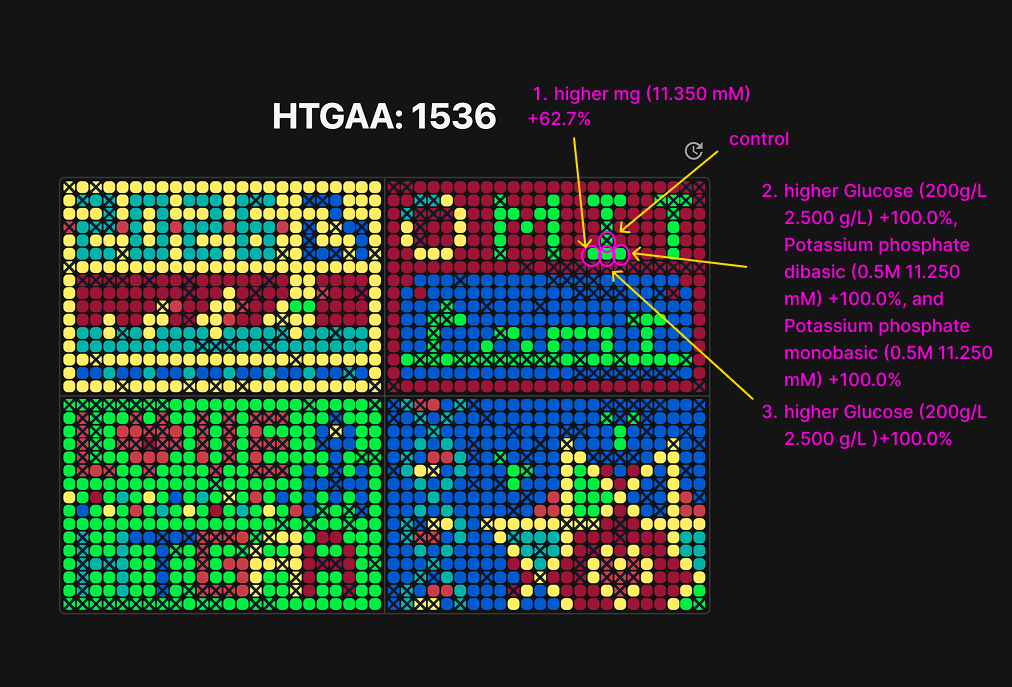
So, for my hypothesis, I’d like to check whether fluorescence in sfGFP increases most when glucose and phosphate are added together, suggesting energy regeneration (not just translation) can be the limiting factor over long incubations. My guess here is that increasing magnesium concentration will enhance sfGFP fluorescence up to an optimal point (well 1), while simultaneous increases in glucose and phosphate (well 2) will further boost fluorescence over 36 hours through improving sustained energy regeneration. I also added just an increased glucose well (well 3) as another control to further support this hypothesis. This is based on research done for CFPS studies. Especially through Silverman et al. (2026) where they performed multi-dimensional optimization and emphasized Mg²⁺ and phosphate as key variables. They also showed that replacing GMP with guanine+ribose works (so transcription will succeed in all our conditions even though GMP is omitted). Then, Xu et al. (2026) found that single-component tweaks often had no effect, but certain pairs (e.g. sugar+phosphate) did, guiding us to test glucose+phosphate together