Week 7 — Genetic Circuits Part II: Neuromorphic Circuits
Assignment Part 1: Intracellular Artificial Neural Networks (IANNs)
1 What advantages do IANNs have over traditional genetic circuits, whose input/output behaviors are Boolean functions?
Advantages of IANNs over the Boolean functions are noise tolerance and scalability. They allows adaptability and simultaneous integration of multiple signals.
2 Describe a useful application for an IANN; include a detailed description of input/output behavior, as well as any limitations an IANN might face to achieve your goal.
The application: Programming E. coli bacteria to selectively detect and destroy pathogenic bacterial colonies within the human gut.
Input: The concentration levels of two specific signaling molecules secreted by pathogens (such as AHL and autoinducer-2). These molecules enter E. coli and activate or inhibit the promoters of the genetic circuit.
Output: The synthesis and secretion of an antimicrobial peptide that kills only the target pathogens. Production triggers only if the weighted sum of both chemical inputs exceeds a specific threshold of bacterial density.
Limitations: Metabolic Load: Maintaining and running the genetic circuit consumes ATP and ribosomes, reducing the replication rate of the engineered E. coli compared to native gut flora.
Signal Decay: The natural degradation of repressor proteins over time shifts the network weights, potentially causing false-positive activations in the absence of an actual infection.
Draw a diagram for an intracellular multilayer perceptron where layer 1 outputs an endoribonuclease that regulates a fluorescent protein output in layer 2.
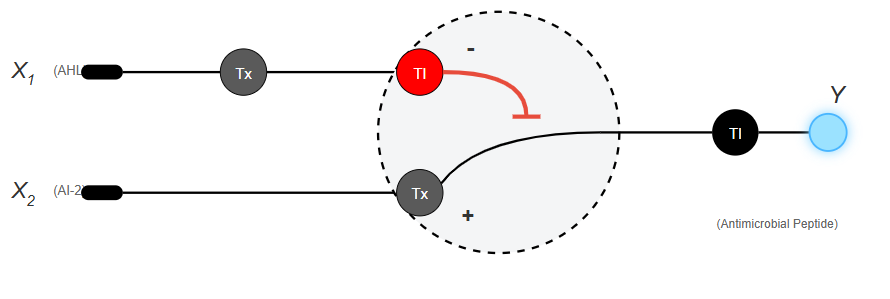
- AI generate image for the aplication.
What are some examples of existing fungal materials and what are they used for? What are their advantages and disadvantages over traditional counterparts?
Fungal materials are mainly created from mycelium. This is a dense, root-like network of thread-like filaments (hyphae) that grows beneath mushrooms. Mycelium is feed on agricultural byproducts like hemp hurdles, sawdust, or cottonseed hulls. It binds the substrate into a solid, lightweight composite matrix.
What might you want to genetically engineer fungi to do and why? What are the advantages of doing synthetic biology in fungi as opposed to bacteria?
I want to engineer fungi to produce proteins or useful compounds and secrete them efficiently. Fungi are very good hosts for manufacturing complex biological products. They are often better than bacteria at managing protein folding and secretion, and are better suited for synthetic biology applications for some eukaryotic proteins.
The main advantage of doing synthetic biology in fungi, as opposed to bacteria, is that fungi are eukaryotic. So they can sometimes process proteins in a way that is more similar to what happens in higher organisms. They can also be powerful industrial producers, especially if the goal is to produce something that needs to be secreted into the environment.