Week 11 — Bioproduction & Cloud Labs
Part A: The 1,536 Pixel Artwork Canvas | Collective Artwork
I did not have a chance to contribute, but I will try to become a TA this fall! 😉
Part B: Cell-Free Protein Synthesis | Cell-Free Reagents
Referencing the cell-free protein synthesis reaction composition (the middle box outlined in yellow on the image above, also listed below), provide a 1-2 sentence description of what each component’s role is in the cell-free reaction.
E. coli Lysate:
-BL21 (DE3) Star Lysate (includes T7 RNA Polymerase)
The BL21 (DE3) Star Lysate, which already contains T7 RNA Polymerase, gives you all the essential parts needed to make proteins—things like ribosomes, tRNAs, and translation factors. On top of that, the T7 RNA polymerase inside it makes sure your target gene gets copied a lot, especially when it’s driven by a T7 promoter.
Salts/Buffer:
-Potassium Glutamate It’s the main way to get potassium, which is needed to keep the cell’s salt levels just right. This helps ribosomes stay stable and allows protein building to continue. Meanwhile, glutamate works as a suitable partner ion inside the cell.
-HEPES-KOH pH 7.5 Functions as a chemical buffer to maintain a stable, physiological pH (7.5) during the reaction, preventing acidification from metabolic byproducts.
-Magnesium Glutamate Supplies essential $Mg^{2+}$ ions required for stabilizing ribosome structure, enabling mRNA-tRNA interactions, and acting as a cofactor for metabolic enzymes.
-Potassium phosphate monobasic -Potassium phosphate dibasic
Supplies essential $Mg^{2+}$ ions required for stabilizing ribosome structure, enabling mRNA-tRNA interactions, and acting as a cofactor for metabolic enzymes.
Energy / Nucleotide System:
-Ribose Serves as a core sugar backbone precursor to regenerate the ribose rings needed for continuous de novo nucleotide synthesis.
-Glucose Acts as a primary, cost-effective metabolic energy source that undergoes glycolysis to regenerate the ATP and GTP required for transcription and translation.
-AMP -CMP -GMP -UMP Serve as monophosphate nucleotide precursors (NMPs) that are enzymatically phosphorylated by the lysate into active NTPs (ATP, CTP, UTP, GTP) for RNA transcription and translational energy.
-Guanine Functions as a nucleobase precursor to specifically supplement and backfill the guanosine pool, preventing GTP depletion during extended incubation periods.
Translation Mix (Amino Acids):
-17 Amino Acid Mix Supplies the standard, readily soluble building blocks required for the ribosome to assemble the nascent polypeptide chain.
-Tyrosine Supplemented separately due to its poor solubility at neutral pH, ensuring an adequate supply of this specific amino acid for translation.
-Cysteine Supplemented separately because it easily oxidizes into cystine in solution, requiring careful concentration management to maintain proper disulfide bond dynamics and translation efficiency.
Additives:
-NicotinamideActs as a precursor and stabilizing agent for nicotinamide adenine dinucleotide ($NAD^+$ / $NADH$) cofactors, supporting the metabolic enzymes driving energy regeneration.
-BackfillFunctions as the ultra-pure solvent matrix used to bring the reaction to its exact final volume, ensuring all individual components are diluted to their precise, optimal working concentrations. It is kept variable to account for differing volumes of added DNA or mRNA templates while maintaining absolute reaction consistency.
-Nuclease Free WaterServes as the ultra-pure solvent matrix to bring the entire master mix to its precise final volume without introducing degrading nucleases.
Describe the main differences between the 1-hour optimized PEP-NTP master mix and the 20-hour NMP-Ribose-Glucose master mix shown in the Google Slide above. (2-3 sentences)
The 1-hour mix uses phosphoenolpyruvate (PEP) and nucleotide triphosphates (NTPs) to give a fast shot of energy. But this reaction doesn’t last long, mostly because it runs out of ingredients and waste products build up quickly. On the other hand, the 20-hour mix relies on nucleoside monophosphates (NMPs), Ribose, and Glucose. These help kickstart other ways the body makes energy, like glycolysis, which lets it keep producing ATP and building proteins steadily over a much longer period.
Bonus question: How can transcription occur if GMP is not included but Guanine is?
In order to perform transcription, nucleotides are essential, as mentioned earlier. Ideally, addition of dephosphorylated nucleotides would have been ideal to making RNA but that would take a long time in a test tube. This is because RNA synthesis is not restricted until dephosphorylated nucleotides are made. Therefore, even under the given experiment, transcription occurs due to the presence of cellular extract (endogenous nucleotide salvage pathway enzymes like hypoxanthine-guanine phosphoribosyltransferase (HGPRT) in the extract). These enzymes are responsible for the formation of GMP. In these reactions, guanine is taken from the cellular extract and is converted into GMP by the action of. Part C: Planning the Global Experiment | Cell-Free Master Mix Design
1 Given the 6 fluorescent proteins we used for our collaborative painting, identify and explain at least one biophysical or functional property of each protein that affects expression or readout in cell-free systems. (Hint: options include maturation time, acid sensitivity, folding, oxygen dependence, etc) (1-2 sentences each)
sfGFP (Superfolder GFP) sfGFP has superior folding kinetics and stability and matures well even under suboptimal cell-free conditions, reducing the likelihood of aggregation compared to standard GFPs.
-mRFP1 (Monomeric Red Fluorescent Protein 1) This protein is relatively slow to mature and has a high incidence of incomplete chormophore maturation (resulting in a green-like intermediate), which can decrease the final fluorescent red output in short or unoptimized reactions.
mKO2 (Monomeric Kusabira Orange 2) mKO2 shows very high protein brightness, and good halftime and signal-to-background, but it has a strictly oxygen-dependent maturation, so low-oxygen or well-based workflows will be problematic.
-mTurquoise2 Improved version of cyan fluorescent protein with high quantum yield and photostability, but very sensitive to quenching and pH shifts found in cell-free lysate preparations.
mScarlet-I An engineered monomeric red protein with very high brightness but with the potential problem of strong metal ion (Ca^{} and Fl^{}) sensitivity as well as being sensitive to acidification (pH < 6.5), making it susceptible to the effects of acidic metabolic byproducts that build up over time and dim fluorescence.
Electra2 An engineered protein with fast folding kinetics and very fast maturation, it is one of the most fast-folding proteins we have tested, and extremely useful for real-time imaging, although its robustness relative to some other proteins, including sfGFP, may be limited, with reduced stability over 36 hours.
2 Create a hypothesis for how adjusting one o2 r more reagents in the cell-free mastermix could improve a specific biophysical or functional property you identified above, in order to maximize fluorescence over a 36-hour incubation. Clearly state the protein, the reagent(s), and the expected effect.
To boost the fluorescence of mScarlet-I over the 36-hr incubation period, adding 50 mM HEPES (pH 7.4) to the master mix on top of the existing 50 mM (final concentration of 100 mM HEPES) will help. The enzymes within the cell-free extract utilize sugars and convert them into acidic byproducts, lowering the pH. Through this process, the acid-sensitive mScarlet-I chromophore will dim within the cell mix.
3 The second phase of this lab will be to define the precise reagent concentrations for your cell-free experiment. You will be assigned artwork wells with specific fluorescent proteins and receive an email with instructions this week (by April 24). You can begin composing master mix compositions here.
A cell-free reaction needs certain concentrations of analytical reagents for transcription to happen without dropping in pH or running out of energy substrates. The 2 μL that will be used as a Metabolic & Buffer Optimization Cocktail will be spent from the Custom Reagent Supplements.
Standard 2X Master Mix (10 μL): contains the baseline components (Amino acids, NTPs, tRNA, Magnesium Glutamate, Potassium Glutamate, and an initial energy source like PEP). Custom Reagent Supplement (2 μL): optimized to contain HEPES buffer (pH 8.0) and additional PEP (Phosphoenolpyruvate). This 2 μL supplement is designed to maintain a stable pH environment and provide extra energy to ensure transcription/translation does not halt prematurely during the 36-hour run.
4 The final phase of this lab will be analyzing the fluorescence data we collect to determine whether we can draw any conclusions about favorable reagent compositions for our fluorescent proteins. This will be due a week after the data is returned (date TBD!). The reaction composition for each well will be as follows:
-6 μL of Lysate
-10 μL of 2X Optimized Master Mix from above
-2 μL of assigned fluorescent protein DNA template
-2 μL of your custom reagent supplements
-Total: 20 μL reaction
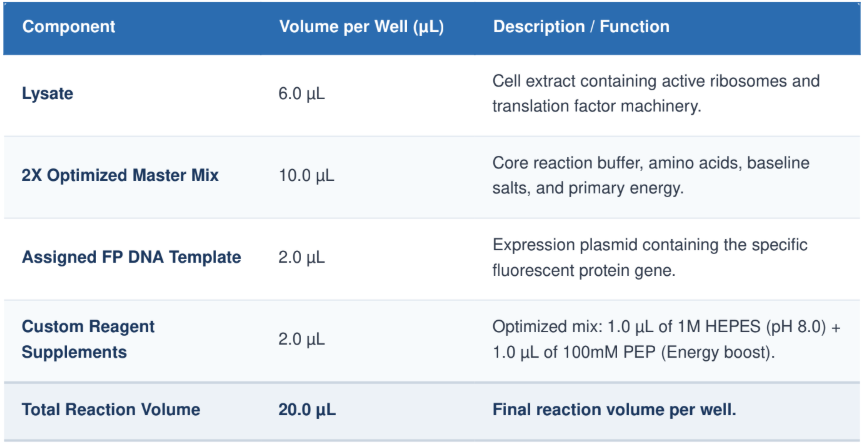
Proposed Analytical Framework: The fluorescence data collected during the 36-hour incubation process will be analyzed in terms of the Kinetic Curves (Fluorescence Intensity vs. Time) of the wells intended for different master mixes and reagent conditions, as is typical for this type of homogenous assay.
From this set of kinetic curves, the following key metrics will be evaluated to determine what master mixes and reagent modifications are optimal and/or appropriate to use in subsequent experiments:
Maximum Fluorescence Intensity : To compare the relative total yield of protein across the different master mix modifications.
Reaction Lifespan (Slope Plateaus): To determine at what point in time the reaction reaches the end of the reaction (i.e., at what hour does the slope of the curve start showing a plateau, indicating that the chemical reaction is finished). If a custom master mix plateau extends later (e.g., the custom master mix plateau is at hour 24 instead of hour 12), this suggests that our proposed custom biophysical supplement successfully extended the energy availability or stabilized the pH. The lifetime of the reactions should similarly be compared across the different proteins to determine if the energy-buffering supplement was selective (i.e., it improves stability for acid-sensitive proteins but does not affect more-stable proteins), and thus.