Homework

Weekly homework submissions:

  • Week 1 HW: Principles and Practices

    Question 1: First, describe a biological engineering application or tool you want to develop and why. This could be inspired by an idea for your HTGAA class project and/or something for which you are already doing in your research, or something you are just curious about. DNA is the rulebook of life! Imagine it as small lego pieces, building up the entire empire of a human body. But, what if we can pick out the lego pieces and assemble them in different, never-thought-before ways, to unlock new functions and outcomes ?! This is the potential of engineering synthetic genetic circuits! I am intrigued by the possibility of engineering our desired outcome by designing genetic circuits that can alter or control it.

  • Week 2 HW: DNA Read-Write-Edit - Pre Lecture Prep

    Pre-Lecture Prep Homework Questions from Professor Jacobson: 1 Machinery of nature, for copying DNA is called polymerase. What is the error rate of polymerase? How does this compare to the length of the human genome. How does biology deal with that discrepancy? The error rate for the error correcting polymerase is approximately 1 in 10^6 base pairs. The human genome is about 3 billion base pairs in lenght, meaning that without correction, a single round of replication can result in approximately 3000 errors per cell division.

  • Week 2 HW: DNA Read-Write-Edit - Post Lecture Learnings

    Part 0: Basics of Gel Electrophoresis Attend or watch all lecture and recitation videos. Optionally watch bootcamp. Status: Completed. Part 1: Benchling & In-silico Gel Art See this week’s lab protocol “Gel Art: Restriction Digests and Gel Electrophoresis” for details. Overview: 1 Make a free account at benchling.com 2 Import the Lambda DNA. 3 Simulate Restriction Enzyme Digestion with the following Enzymes: a EcoRI b HindIII c BamHI d KpnI e EcoRV f SacI g SalI 4 Create a pattern/image in the style of Paul Vanouse’s Latent Figure Protocol artworks. 5 You might find Ronan’s website a helpful tool for quickly iterating on designs!

  • Week 3 HW: Lab Automation

    Assignment: Python Script for Opentrons Artwork I used the GUI coordinates to prepare this code: Post Lab Questions: One of the great parts about having an automated robot is being able to precisely mix, deposit, and run reactions without much intervention, and design and deploy experiments remotely.

  • Week 4 HW: Protein Design - Part 1

    Part A: Conceptual Questions 1. How many molecules of amino acids do you take with a piece of 500 grams of meat? (on average an amino acid is ~100 Daltons) On average, if we assume that 25% of meat is protein, then we would be taking 500*0.25 = 125 g of protein intake. With an average of 100 Da per amino acid as it’s molecular weight, the total number of moles of amino acids become 1.25 moles. Multiplying with the Avagadro’s number, we get roughly seven hundred fifty-two sextillion (7.528 * 10^23) molecules !!

  • Week 5: Protein Design - Part II

    SOD Peptide Design from Pranam Superoxide dismutase 1 (SOD1) is a cytosolic antioxidant enzyme that converts superoxide radicals into hydrogen peroxide and oxygen. In its native state, it forms a stable homodimer and binds copper and zinc. Mutations in SOD1 cause familial Amyotrophic Lateral Sclerosis (ALS). Among them, the A4V mutation (Alanine → Valine at residue 4) leads to one of the most aggressive forms of the disease. The mutation subtly destabilizes the N-terminus, perturbs folding energetics, and promotes toxic aggregation. Your challenge: a. Design short peptides that bind mutant SOD1. b. Then decide which ones are worth advancing toward therapy.

  • Week 6: Genetic Circuits - Part I: Assembly Technologies

    DNA Assembly 1. What are some components in the Phusion High-Fidelity PCR Master Mix and what is their purpose? Standard Phusion 2X Master Mix contains the following essential components: Phusion High-Fidelity DNA Polymerase: A specialized, proofreading enzyme coupled to a processivity-enhancing domain. Its purpose is to catalyze DNA synthesis with high speed and extremely low error rates. dNTPs (dATP, dCTP, dGTP, dTTP): The nucleotide building blocks required by the polymerase to synthesize the new complementary DNA strands. Phusion HF Buffer: An optimized reaction buffer containing MgCl2. Magnesium (Mg2+) acts as an important cofactor for the DNA polymerase enzyme, stabilizing the reaction and facilitating the smooth incorporation of dNTPs. 2. What are some factors that determine primer annealing temperature during PCR?

  • Week 7: Genetic Circuits - Part II: Neuromorphic Circuits

    Intracellular Artificial Neural Networks (IANNs) What advantages do IANNs have over traditional genetic circuits, whose input/output behaviors are Boolean functions? IANNs outperform traditional Boolean circuits by using sophisticated, brain-like processing, with significant molecular noise reduction. Their pros include analog integration, noise filtering, pattern recognition and efficiency. By processing continuous chemical gradients compared to “on/off” signals, thus allowing cells to respond to the exact intensity of a stimulus. By integrating multiple signals, they are more robust against the random molecular fluctuations (noise) seen of the cytoplasm. IANNs can identify complex biomarker signatures, without needing a high number of logic gates. They can achieve higher computational power with fewer genetic parts, reducing the metabolic burden on the host. Describe a useful application for an IANN; include a detailed description of input/output behavior, as well as any limitations an IANN might face to achieve your goal.

  • Week 9: Cell-Free Systems

    Explain the main advantages of cell-free protein synthesis over traditional in vivo methods, specifically in terms of flexibility and control over experimental variables. Name at least two cases where cell-free expression is more beneficial than cell production. Flexibility and Control: Since there is no cell membrane, the system is an open environment, where we can directly manipulate concentrations of substrates, add non-canonical amino acids, or introduce specific inhibitors/activators with no worries about cellular transport or toxicity. Case 1: Toxic Proteins: Many proteins, such as antimicrobial peptides or certain enzymes, are lethal to host cells. CFPS allows the production of these proteins. Case 2: Rapid Prototyping: In vivo methods need time-consuming cloning, transformation, and cell culture. CFPS use’s linear DNA as a template, reducing the time from days to hours. Describe the main components of a cell-free expression system and explain the role of each component. Cell Extract (Crude Lysate): It contains ribosomes, aminoacyl-tRNA synthetases, translation factors, and tRNAs. Energy and Buffer Systems: This includes ATP and GTP , an energy regeneration substrate (like Phosphoenolpyruvate), and essential ions (Mg2+ and K+) to maintain enzymatic activity and pH. Genetic Template and Building Blocks: DNA provides the instructions, while the 20 standard amino acids provide the raw material for the protein chain. Why is energy provision regeneration critical in cell-free systems? Describe a method you could use to ensure continuous ATP supply in your cell-free experiment. Protein synthesis is energetically expensive. ATP is consumed rapidly for amino acid activation and ribosome movement, and it is also naturally degraded by other enzymes in the extract.

  • Week 10: Advanced Imaging and Measurement Technology

    Final Project For your final project: Please identify at least one (ideally many) aspect(s) of your project that you will measure. It could be the mass or sequence of a protein, the presence, absence, or quantity of a biomarker, etc. Please describe all of the elements you would like to measure, and furthermore describe how you will perform these measurements. What are the technologies you will use (e.g., gel electrophoresis, DNA sequencing, mass spectrometry, etc.)? Describe in detail.

  • Week 11: Bioproduction & Cloud Labs

    The 1,536 Pixel Artwork Canvas | Collective Artwork While I don’t exactly remember what I did in the artwork, since I forgot to note it down, I remember making 2-10 edits in the artwork. It took me a little too much time to understand what was exactly happening, but I loved the whole project and the experience of doing it.

Subsections of Homework

Week 1 HW: Principles and Practices

Welcome! Welcome!

Question 1: First, describe a biological engineering application or tool you want to develop and why. This could be inspired by an idea for your HTGAA class project and/or something for which you are already doing in your research, or something you are just curious about.

DNA is the rulebook of life! Imagine it as small lego pieces, building up the entire empire of a human body. But, what if we can pick out the lego pieces and assemble them in different, never-thought-before ways, to unlock new functions and outcomes ?! This is the potential of engineering synthetic genetic circuits! I am intrigued by the possibility of engineering our desired outcome by designing genetic circuits that can alter or control it.

My (Initial) Vision:
I would like to build a multi-input theragnostic circuit for ovarian cancer, given the fact that, inspite of being the one of the deadliest gynaecological cancers, it does not have a means for early detection, leading to late diagnosis and poor outcomes.

Where would it operate? The circuit can be delivered directly to cancer cells, by nanoparticles or viral vectors.
Where is it meant to be used? Upon successful testing in laboratories and passing clinical trials, it can be used as a part of clinical cancer treatments.

Desired Characteristics: The gene circuit must be able to…
1 Take in multiple inputs.
2 Detect the condition and inform us upon detection.
3 Inform us if the condition is not detected.
4 Secrete/produce chemicals that slow down/aid in the slowing down of the progression of the condition.

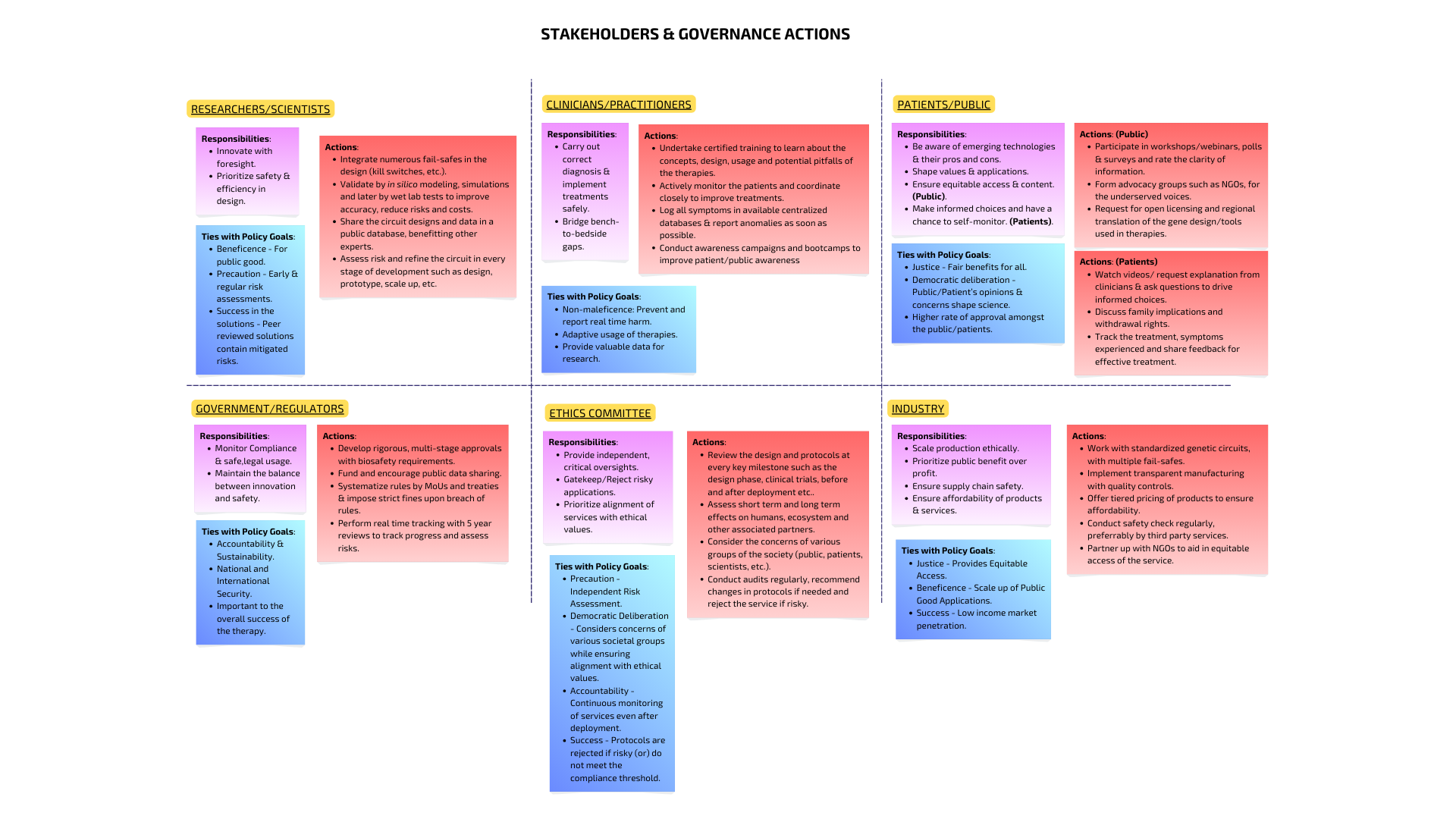
A Wise Man Once said… A Wise Man Once said…Stakeholders & Governance Actions Stakeholders & Governance Actions

Question 2: Describe one or more governance policy goals related to ensuring this application contributes to an ethical future & prevents harm.

Some governance policy goals are described below. For others, kindly refer to the attached image!

Goal 1: Precaution/ Biosecurity
Rigorous audits of safety during each phase of design, validation and implementation, offers a high chance of mitigating risks and evaluating the feasibility of the therapy. Here’s how it might look:
Researchers and Industries can incorporate multiple fail-safes combined with regular safety monitoring to make the therapy harmless, incase it fails to perform.
Ethics Committee can provide an independent review of the therapy at each stage, critically assessing designs and recommending changes to reject risky therapies and promote the safe designs.
Government/Regulators can assess the design by subjecting it to tiered evaluations and systematize rules for such services, ensuring national security and safety.
Clinicians can verify the diagnosis multiple times before prescribing the treatment ensuring that it is the right fit for the patient.

Goal 2: Transparency
Transparency in the design of the circuit, the protocols adopted and the data used can bring safety improvements and enable collective oversight. Here is how it might look:
Researchers can share the data after screening in public databases, enabling other experts to spot missed flaws, improve the protocols and design or even create new knowledge based upon this data.
Clinicians logging symptoms in centralized/ government enabled databases with real time tracking, can aid in efficient treatment along with eaarly detection of abnormalities.
Public rating of the information clarity and consideration of public concerns by ethical committees can drive faster improval and a high acceptance rate from the public.
Patients can also be enabled to make informed choices, when they are clear in how their data is being used and how the therapy works.

Goal 3: Equitable Access
This goal ensures that the therapy reaches to all populations, avoiding unreasonable risk burdens on some/vulnerable groups. Here are some ways it can occur:
Industry can offer tiered pricing for different populations while also partnering with advocacy groups such as NGOs, to reach a large and wider market.
The government can mandate tiered pricing from industries, set price caps on services or offer subsidies by which they can reach out to low income populations.
Fun fact: Singaporean government already does this by subsidizing 75% of the gene therapy costs by bulk deals!
The public can request regional translations of the materials and aid in equitable access.

Question 3: Describe at least three different potential governance actions by considering the purpose, design, assumptions, and risks of failures & “success”. Draw upon your existing knowledge and a little additional digging, and feel free to use analogies to other domains such as 3D printing, drones, financial system, etc.
Purpose: What is done now and what changes are you proposing?
Design: What is needed to make it “work”? Consider the actor(s) involved - who must opt in, fund, approve, or implement?
Assumptions: What could you have wrong? Incorrect assumptions? Uncertainties?
Risks of Failures & Success: How might this fail, including any unintended consequences of the “success” of your proposed actions?

Action 1: Incorporation of Multiple (atleast 2) Fail-Safes
Purpose: To prevent the activation of circuit outside specific conditions, preventing harm, contamination and weaponization.
Design: A proposed method is to include a light inducible activation/inactivation. We can also design circuits which stops gene expression if proteins/markers belonging exclusively to healthy cells are detected.
Assumptions: Independent kill switches, No cross reactions, function reliably in lab and in vivo conditions.
Risks of Failure:
Failure of one or both kill switches.
Failure to activate or inactivate circuits by light when needed.
Failure to choose exclusive proteins belonging to only healthy cells.
Success:
Key switches activate as intended.
Inactivation in healthy cells as intended.
Reliable and predictable behaviour in lab and in vivo conditions.

Action 2: Public Database
Purpose: Collective safety debugging enabling global experts to spot missed flaws and enable transparency, preventing bioweaponization.
Design: Centralized registry with tiered access where non-sensitive designs are public and risky sequences are screened.
Assumptions: Responsible actors, Biosecurity screening networks, Safety as transparency are balancedly prioritized.
Risks of Failure:
Misuse of the database leading to weaponization.
Success:
Less/No Biosecurity incidents.
Peer improvements leading to improval of therapy protocols and design.
High public acceptance and approval rates.

Action 3: Tiered Pricing
Purpose: Tiered pricing enables quality care for all populations of the society, regardless of their incomes and other differences.
Design: Indutry partnerships with NGOs, Government enforced bulk deals and subsidies and encouragement by ethical committees to develop community beneficial plans can be useful.
Assumptions: Industry prioritizes health and accepts low margins, Global coordination of governments.
Risks of Failure:
Unofficial sources release the therapy designs and services.
Corporate pressure causes price cap weakening by the government.
Therapy quality degrades in accordance to the prices fixed.
Success:
Significant low income market penetration within a short time span (e.g. 5 years)
Therapy is considered a public good and not a luxury.

Please refer to the other governance actions in the image!

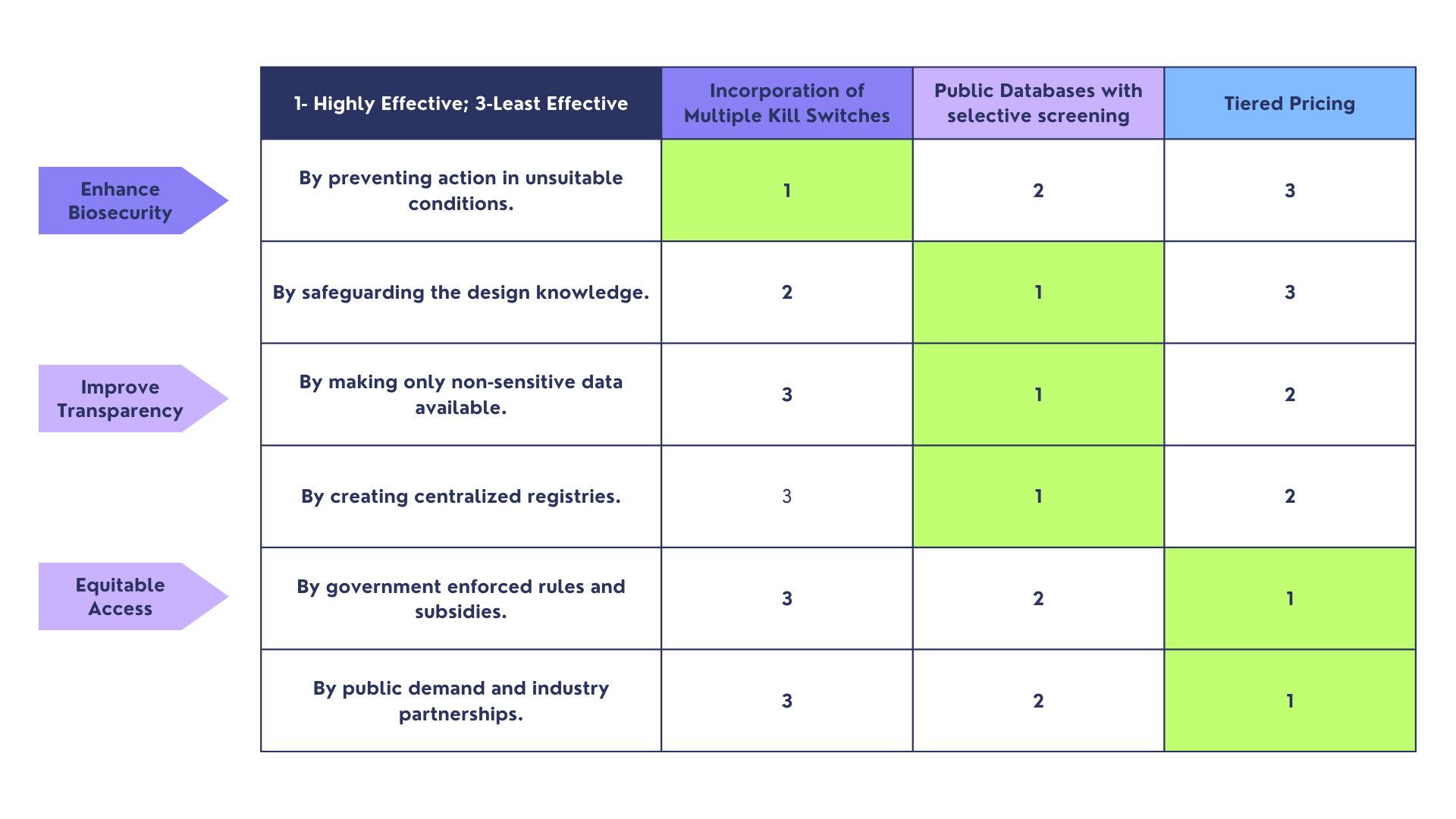
Question 4: Score each of your governance actions against your rubric of policy goals.

Ranking of Governance Actions Ranking of Governance Actions

Question 5: Based on scores, describe which governance option or combination of options, you would prioritize, and why. Outline any trade-offs you considered as well as assumptions and uncertainties. Think about your audience - very local (MIT, Cambridge Mayoral Office), to national (President or Head of a Federal Agency), to international (United Nations Office of the Secretary-General)

Based on the table, I would prioritize incorporation of multiple kill switches for enhancing biosecurity, creating public databases with selective screening to achieve biosecurity and improve transparency and opt for tiered pricing to ensure equitable access of the therapy to all.

References:
1 WHO Health Ethics and Governance: https://r.search.yahoo.com/_ylt=Awrx.ztbaYtpOQIAv7O7HAx.;_ylu=Y29sbwNzZzMEcG9zAzEEdnRpZAMEc2VjA3Ny/RV=2/RE=1771953756/RO=10/RU=https%3a%2f%2fwww.who.int%2fteams%2fhealth-ethics-governance%2fgovernance/RK=2/RS=wajsNkQcjNltVnvz6DvebVhvzic-
2 Genetically stable kill-switch using “demon and angel” expression construct of essential genes: https://doi.org/10.3389/fbioe.2024.1365870
3 Advances in Synthetic Biology and Biosafety Governance: https://doi.org/10.3389/fbioe.2021.598087

Tools Used:

1 Canva - For preparing the Stakeholders & Governance Actions chart and Ranking chart.
2 Pinterest - For obtaining the Cover Images.
3 Perplexity AI - To understand the questions & their concepts, and for refining answer phrases. (Ethics in biology is a very new area for me, so I used AI to understand the field, concepts and given questions. I also used AI to polish the answers and ensure usage of correct terminology. However, the essence of the answer was not prepared using AI.)
Prompt Used: I want to explore ethics and governance policies for a novel genetic circuit design. However, I am a beginner to these fields. Give me a general overview of the subject and give me examples of concepts to begin with, and also tell me the ways in which I can structure a writeup.

Thank you!