Week 7: Genetic Circuits - Part II: Neuromorphic Circuits
Intracellular Artificial Neural Networks (IANNs)
- What advantages do IANNs have over traditional genetic circuits, whose input/output behaviors are Boolean functions?
IANNs outperform traditional Boolean circuits by using sophisticated, brain-like processing, with significant molecular noise reduction. Their pros include analog integration, noise filtering, pattern recognition and efficiency.
- By processing continuous chemical gradients compared to “on/off” signals, thus allowing cells to respond to the exact intensity of a stimulus.
- By integrating multiple signals, they are more robust against the random molecular fluctuations (noise) seen of the cytoplasm.
- IANNs can identify complex biomarker signatures, without needing a high number of logic gates.
- They can achieve higher computational power with fewer genetic parts, reducing the metabolic burden on the host.
Describe a useful application for an IANN; include a detailed description of input/output behavior, as well as any limitations an IANN might face to achieve your goal.
A compelling application for an IANN is a precision-targeted “classifier” for heterogeneous cancer cells, which is engineered to process multi-input signature of intracellular microRNAs (miRNAs) to differentiate between healthy, premalignant and cancer cells, as well as between their subtypes.
Behavior:
- The inputs consist of the concentration levels of a panel of 5–10 different miRNAs (where some are upregulated in cancer, others downregulated). These molecules bind to synthetic mRNA transcripts and act as weighted inputs. The intracellular processing involves these inputs either promoting or inhibiting the translation of a central “hidden layer” of transcription factors. The output would be the production of a pro-effector protein or a bioluminescent reporter. If the weighted sum of the miRNA inputs exceeds a specific threshold that matches the cancer signature the network was trained for, the circuit can trigger cell death, remaining safe otherwise.
Limitations of IANNs in Synthetic Biology:
- Maintaining expression of multiple neurons can drain a cell’s resources and efficiency, causing the circuit to slow down.
- Finding unique biological parts that don’t interfere with the cell’s native machinery, or with each other, is a significant problem needing further research.
- Here, weights are determined by biochemical affinities and decay rates. Fine-tuning them through directed evolution or DNA sequence modification is labor-intensive and sensitive to environmental (temperature and pH) changes.
- Unlike electronic circuits, IANN can cause latency between the sensing and the execution of the output, since it relies only on diffusion and synthesis of proteins.
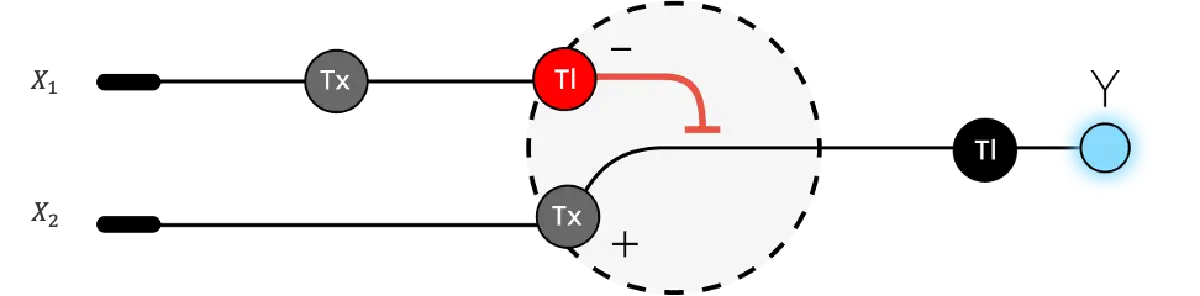
- Below is a diagram depicting an intracellular single-layer perceptron where the X1 input is DNA encoding for the Csy4 endoribonuclease and the X2 input is DNA encoding for a fluorescent protein output whose mRNA is regulated by Csy4. Tx: transcription; Tl: translation. Draw a diagram for an intracellular multilayer perceptron where layer 1 outputs an endoribonuclease that regulates a fluorescent protein output in layer 2.
Input/Output Behavior:
- Inputs : X1 could be driven by a promoter active only in healthy cells, while X2 can be driven by a pan-cancer promoter.
- The Weight (Processing): The Csy4 endoribonuclease can act as the processing node. When X1 is high (healthy cell), Csy4 is transcribed (Tx) and translated (Tl). Csy4 then recognizes specific hairpins on the X2 mRNA and cleaves it.
- Output: The output (e.g., a fluorescent protein or a death ligand) only accumulates if the inhibitory pressure from X1 is low. Thus, Y signals are detected only when the healthy-cell marker is absent or downregulated.
Limitations for Cancer Therapy
- If X1 expression is slightly low in healthy cell due to natural variation, Y might be produced, leading to false positives, causing cell death.
- The Csy4 enzyme has a maximum processing speed. If X2 mRNA levels are extremely high, they can overwhelm the available Csy4, causing the circuit to lose its ability and result in an incorrect output.
- The time required for X1 to be transcribed, translated, and then find/cleave the X2 mRNA might create a delay. Thus, the decision must be made faster than the cell’s metabolic shifts or dilution of the circuit via division, in rapidly dividing cells.
- Achieving the precise threshold required for a perceptron is difficult, which includes balancing the DNA copy numbers and the binding affinity of Csy4 to its RNA target to ensure the circuit activates at the exact biomarker concentration.
Fungal Materials
- What are some examples of existing fungal materials and what are they used for? What are their advantages and disadvantages over traditional counterparts?
Fungal materials, specifically mycelium-based composites (MBCs), are shifting from sustainable experiments to mainstream industrial applications, representing a new category of grown materials.
| Material Type | Primary Uses |
|---|---|
| Packaging Foams | Biodegradable alternatives to Styrofoam for electronics (e.g., used by IKEA and Dell). |
| Myco-Leather | Sustainable “animal-free” leather for fashion (shoes, handbags, watch straps). |
| Acoustic/Thermal Panels | Fire-resistant insulation and sound-dampening tiles in sustainable architecture. |
| Myco-Bricks | Lightweight, non-load-bearing construction blocks for temporary or small structures. |
Advantages over traditional counterparts (Plastics, Leather, Concrete):
- Fungi sequester carbon as they grow and utilize agricultural waste (sawdust, hemp) as food.
- They decompose in weeks, whereas plastics take centuries.
- It is naturally more fire-retardant than petroleum-based foams without needing toxic chemicals.
- Growing a brick requires only biological metabolic energy, whereas their counterparts have massive energy requirements.
Disadvantages:
- It has lower compressive strength, compared to clay bricks, thus providing limited applications as of now.
- Fungal materials are porous and absorb moisture, leading to structural degradation or mold, unless specially treated with coating materials.
- Ensuring every batch has the exact same density and strength is harder than in a chemical factory.
- What might you want to genetically engineer fungi to do and why? What are the advantages of doing synthetic biology in fungi as opposed to bacteria?
We can use synthetic biology to turn fungi into living factories by engineering them as:
- To remain dormant in a building and reactivate to grow and plug cracks when exposed to moisture.
- Designing fungi to express enzymes that break down specific pollutants like heavy metals or microplastics in soil.
- Modifying the fungal genome so it produces specific dyes or colors alongside growth, thus eliminating the need for toxic tanning/dyeing processes.
Advantages of Fungi over Bacteria for Synthetic Biology:
- Unlike single-cell bacteria, fungi form macroscopic, 3D structures.
- Fungi can secrete various molecules in large amounts when required, where they have evolved to pump out massive amounts of enzymes into their environment to digest wood, making them preferrable for large-scale protein or material production.
- Fungi are eukaryotes, thus can perform complex protein folding and modifications that bacteria simply cannot do, acting as better expression systems.
- Fungi can grow on low-cost, solid-state agricultural waste (straw, husks), whereas most industrial bacteria require expensive, sterile liquid broths, making them very convenient and economic.
Thank You!