Week 1 HW: Principles and Practices
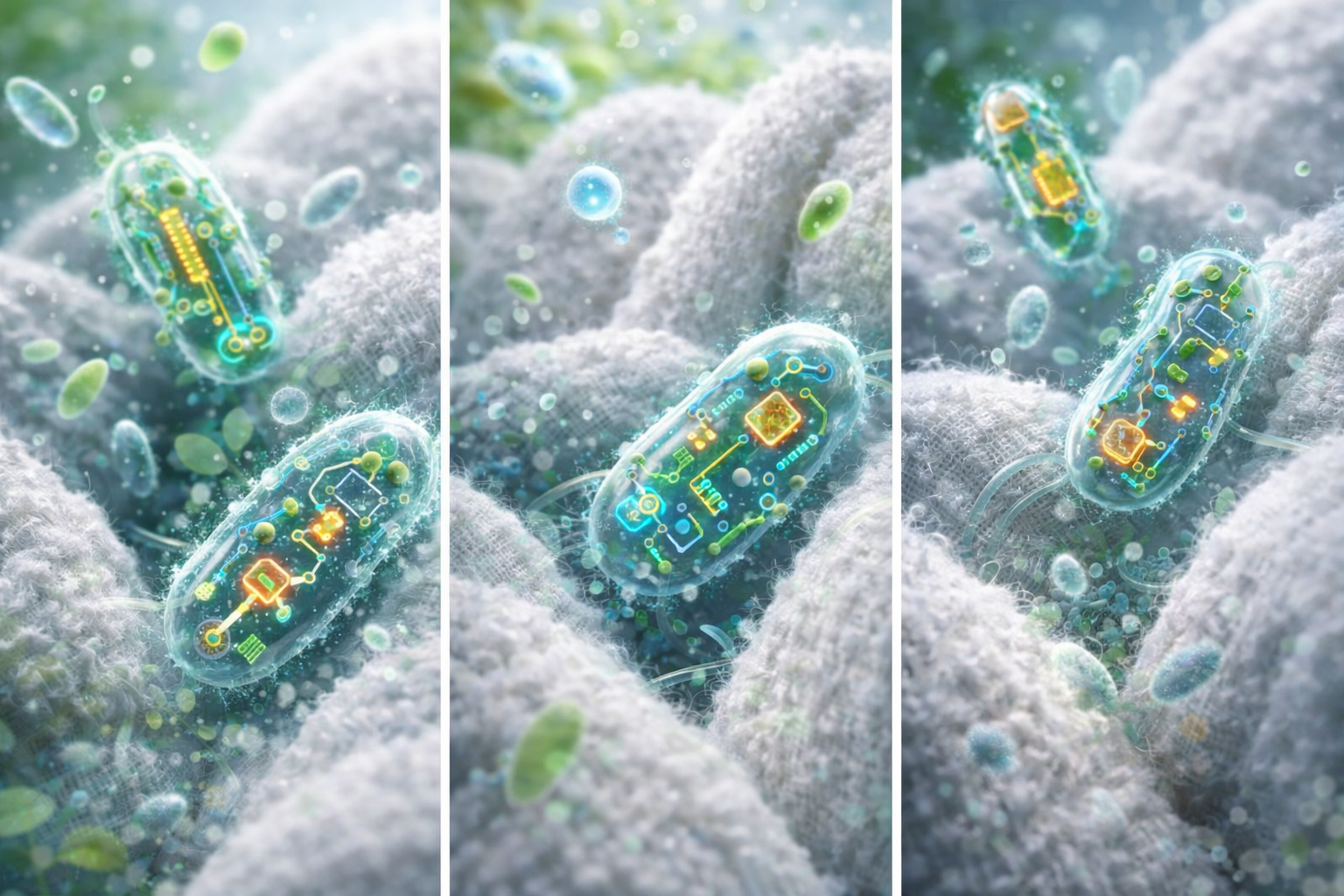
Living Modified Organism(LMO) Cotton Textiles That Maintain Hygiene and Emit Pleasant Scents
This application envisions a cotton-based textile integrated with genetically engineered microorganisms that are designed to function stably on the fabric surface. These microorganisms would metabolize organic compounds derived from human sweat and skin debris—such as fatty acids, ammonia, and keratin degradation byproducts—thereby maintaining hygiene and reducing odor formation.
Unlike conventional approaches that rely on antimicrobial chemicals or synthetic fragrances, this system would operate as an engineered living material, in which biological activity is deliberately programmed to occur only within a non-natural environment (the textile itself). Conventional perfumes and detergents repeatedly introduce chemically stable, exogenous compounds that may unintentionally interfere with human endocrine systems or disrupt the skin microbiome through persistent and non-selective exposure.
In contrast, genetically engineered microorganisms can be designed to activate only in specific physiological contexts and to simultaneously regulate both the production and degradation of fragrance-related compounds, thereby reducing the structural risks associated with continuous, indiscriminate chemical exposure. However, this approach also introduces ethical, safety, and governance challenges related to long-term human contact, environmental release, and biological containment.
Governance and Policy Goals for Living Cotton Textiles in KR :: “To Ensure Biosafety and Biosecurity”
a) Prevent disruption of the human skin microbiome
b) Minimize risks of unintended environmental dissemination
c) Ensure users are fully informed that the product contains living, engineered organisms
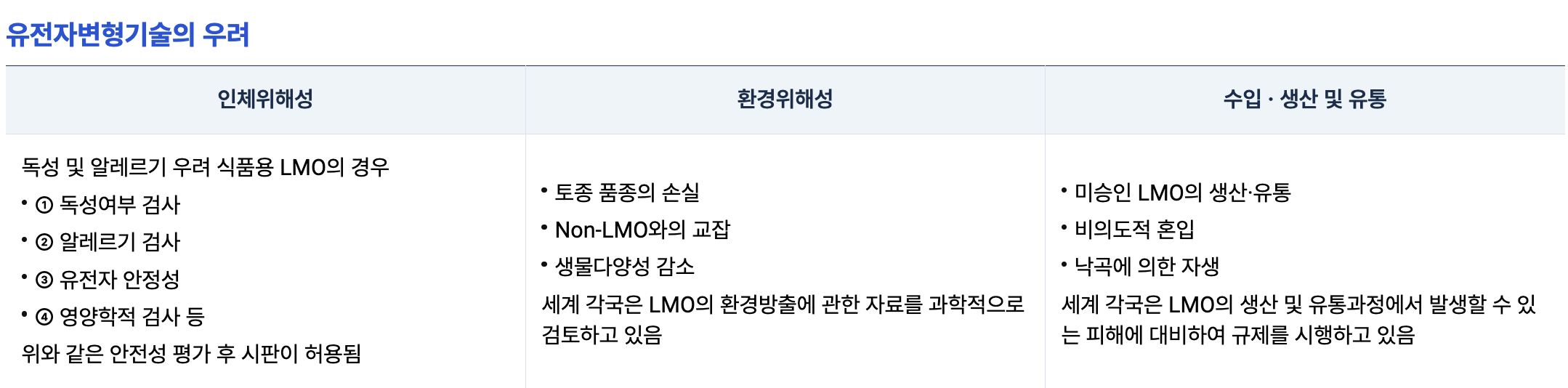 {ref.}
*ref1. https://www.nifs.go.kr/portal/pcon0000260/systa/actionConts.do
{ref.}
*ref1. https://www.nifs.go.kr/portal/pcon0000260/systa/actionConts.do
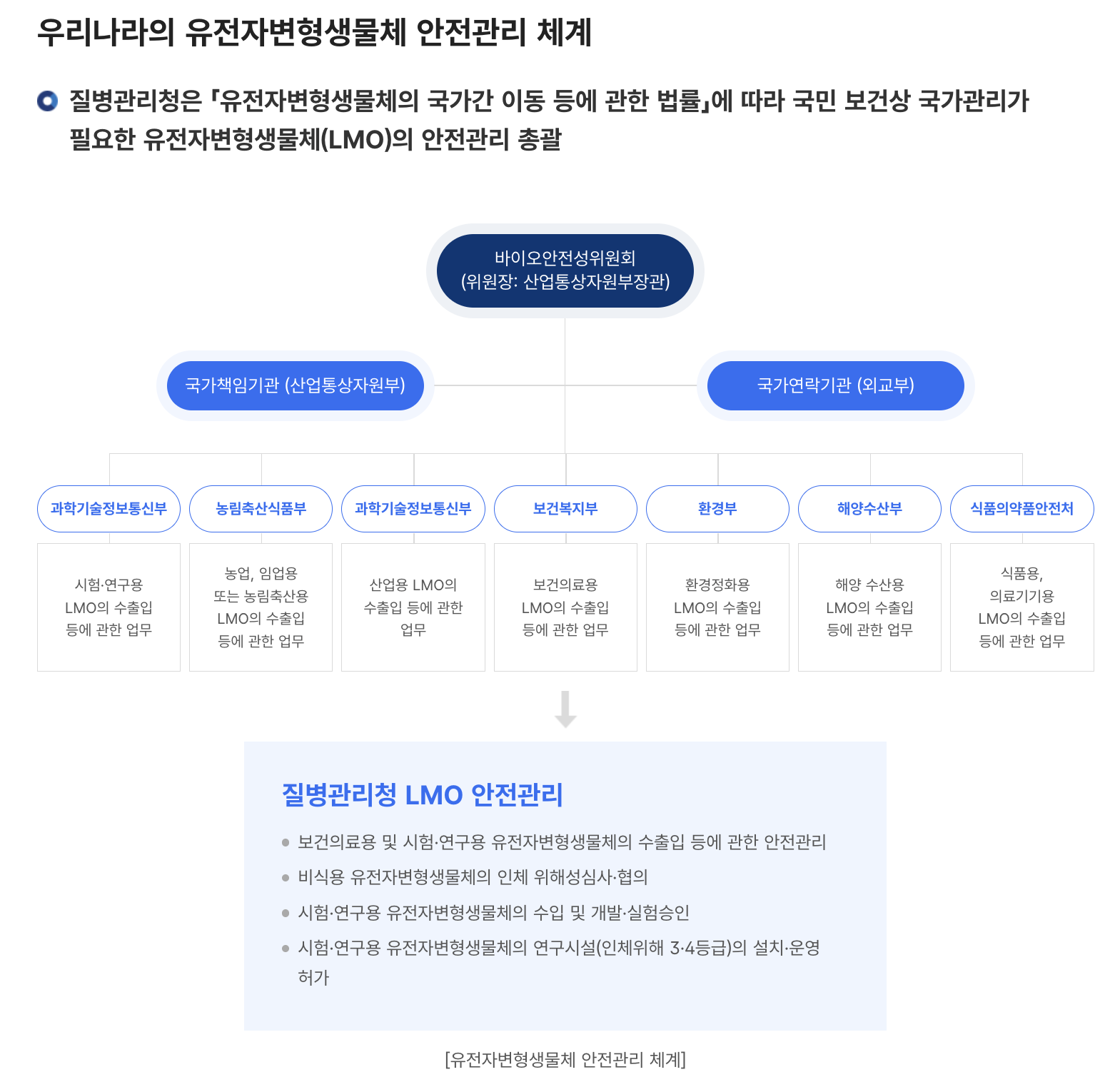 {ref.}
*ref2. https://www.kdca.go.kr/kdca/3469/subview.do
{ref.}
*ref2. https://www.kdca.go.kr/kdca/3469/subview.do
option 1) Technical Containment via Textile-Dependent Microbial Design
Purpose:
Biosafety guidance tends to be general (prevent acute harm, prevent release), without microbiome-specific containment requirements for long-duration skin contact consumer products. Thus, require microbiome-protective technical containment for living textiles. Engineered microbes must be textile-restricted in survival, localization, and activity, and demonstrably non-colonizing to skin.
Design:
Self-limiting activity circuit
- Fail-safe kill switch triggered off-textile
- Localization constraint (stay on fiber, not on skin)
Actors:
- Developers (design + testing)
- Independent labs/IRB-like review bodies (protocol audit)
- Regulators/standards bodies
Risks of Failure and “Success”:
- Failure could result in unintended persistence or adaptation
- Even successful containment may create long-term, poorly understood human–microbe interactions
{ref.}The Skin Microbiome: Current Techniques, Challenges, and Future Directions *https://pmc.ncbi.nlm.nih.gov/articles/PMC10223452/
option 2) Mandatory Environmental Impact Assessment for Synthetic Biology Applications (LMOs)
Purpose:
In addition to general biosafety guidelines(합성생물학 육성 방안, 2025. 3. 11.), require application-specific assessment of impacts on the realease of living cotton textiles products intended for prolonged skin contact.
Introduce a mandatory, application-specific Environmental Impact Assessment (EIA) for LMOs, to proactively evaluate environmental risks unique to engineered biological systems, in addition to compliance with existing chemical regulations.
{ref.} 합성생물학 육성 방안 (Ministry of Science and ICT 회부 2024. 9. 11. 상정 2024. 11. 20. 처리 2025. 3. 11.) *https://opinion.lawmaking.go.kr/gcom/nsmLmSts/out/2203884/detailRP
Design:
Require an Environmental Impact Assessment prior to deployment for synthetic biology applications with potential environmental exposure
- Environmental persistence and degradation pathways
- Potential spread beyond intended containment
- Interaction with natural ecosystems and microbial communities
Actors:
- Developers in Academia/Industry (conduct and submit EIA)
- Korea Disease Control and Prevention Agency (KDCA) / Ministry of Science and ICT (MSIT)
- Environmental and chemical safety authorities
Risks of Failure and “Success”:
- EIA may become a procedural formality without capturing dynamic biological risks
- Increased compliance burden may disadvantage smaller research groups or startups
- Insufficient data to assess long-term ecological effects
option 3) User-Centered Governance Through Labeling and Disclosure
Purpose:
Consumers are often unaware of the biological mechanisms underlying novel products (esp. GMO/LMO). This option prioritizes transparency and informed consent.
Design:
Clear labeling would indicate the presence of engineered microorganisms, describe their function, and provide guidance for use and disposal.
Actors:
- Manufacturers
- Consumer protection authorities
Assumptions:
Users will engage with and understand disclosed information
Risks of Failure and “Success”:
- Information overload may lead to disregard
- Transparency may unintentionally provoke public anxiety or resistance
| Does the option: | Option 1 | Option 2 | Option 3 |
|---|---|---|---|
| Enhance Biosecurity | |||
| • By preventing incidents | 1 | 2 | 3 |
| • By helping respond | 3 | 2 | 1 |
| Foster Lab Safety | |||
| • By preventing incident | 1 | 2 | n/a |
| • By helping respond | 3 | 3 | n/a |
| Protect the environment | |||
| • By preventing incidents | 1 | 1 | 3 |
| • By helping respond | 3 | 2 | 2 |
| Other considerations | |||
| • Minimizing costs and burdens to stakeholders | 1 | 3 | 2 |
| • Feasibility? | 3 | 2 | 1 |
| • Not impede research | 3 | 3 | 2 |
| • Promote constructive applications | 1 | 2 | 2 |
Drawing on the scoring results, Option 1—technical containment through precisely engineered microbial circuits—emerges as the most feasible and effective governance priority.
It consistently scores highest in preventing biosecurity, laboratory, and environmental incidents while minimizing costs and avoiding unnecessary constraints on research. By embedding safety directly into genetic and circuit-level design, this approach addresses risks at their source rather than relying on external oversight or post hoc responses.
Although it offers limited capacity for incident response, this reflects a deliberate and ethically preferable trade-off; systems designed to fail safely reduce the need for downstream intervention. While this strategy assumes long-term stability of engineered circuits and involves uncertainty around evolutionary dynamics, it provides a practical foundation that can later be complemented by regulatory review and transparency measures, making it the most realistic starting point for governing synthetic biology applications with close human and environmental interfaces.
…ethical concerns that arose: GMO라는 용어나 개념은 음식과 관련이 있어서인지 매우 친숙하게 느껴졌는데, 미생물을 유전적으로 변형한 LMO라는 개념은 처음 알게 되었다. 또한, 유전자변형미생물의 환경에 대한 영향은 더욱 판단하기 어려울 것으로 보여져서, 앞으로 합성생물학 제품들이 개발됨에 따라 많은 규제와 이슈들이 있을 것으로 생각된다.