Your Documentation should help you - and others - to understand the topic. Don’t be afraid to add things that don’t work. Show your failures - and how you overcame them. Your Documentation should be a description of the amazing journey you are on!
recitation video note
about homework
13.50: outline etical concerns everyweeks
final project arc begins today (you’ll have to refine it again and again)
32.30 be creative u can imagine things
34.29 david kong comment on overall
project ideas and governance
36.30 : it sounds like a, you know, whatever, a simple question, like, how do we make it good?
38 ++ webpage
1 hr 06 : end for the main recitation
interesting ideas
programmable cell
30.27: biotic game
learn about radio durans (moss)
slime mold 34.00
35 bio printing for nutrient capture
35.40: Bio Cryptocurrency
bioprotos
biocryptoprints
kong: policy goals = how to make it good?/ maximally beneficial for people and the planet e.g. minimize illicit trading, ensure stability
non-fungible plants -> NFT -> …
my ideas
Wearable devices for detecting stress hormones, toxins in blood vein
Wearable devices for synthesis L-Theanine, a compound founded in green tea, known for it’s cognitive boost property)
Wearable devices for synthesis curcumin, a compound with anti-inflammatory and antioxidant properties
Low-cost pm2.5 biosensor
Slime mold simulation
Biotic Game platform
DAW or Music Tracker linked with bio-sensor
HW
Class Assignment — DUE BY START OF FEB 10 LECTURE
First, describe a biological engineering application or tool you want to develop and why. This could be inspired by an idea for your HTGAA class project and/or something for which you are already doing in your research, or something you are just curious about.
answer:
Brainstorm note: I do have a few areas that seems interesting for me but don’t know how to build them
idea
IRL impact (personal pov)
Seems fun
difficulty
Wearable devices for detecting stress hormones, toxins in blood vein
⭐⭐⭐
⭐⭐
?
Wearable devices for synthesis L-Theanine, a compound founded in green tea, known for it’s cognitive boost property)
⭐⭐⭐
⭐⭐
?
Wearable devices for synthesis curcumin, a compound with anti-inflammatory and antioxidant properties
⭐⭐⭐
⭐⭐
?
Low-cost pm2.5 biosensor
⭐⭐⭐⭐ (in my country)
⭐
?
Slime mold simulation
⭐⭐
⭐⭐
?
Biotic Game platform
⭐⭐
⭐⭐⭐
?
DAW or Music Tracker linked with bio-sensor
⭐⭐
⭐⭐⭐
?
(for this week) I want to build a Music Making machine that user have to manipulate bio-related things (can be from a wetlab or a simulation) to generate sound (e.g. put some substance to agar plate with specific biosensor, let it detect and produce some substance (or light) to get analog signal » digitalize it » produce sound)
I have no background in music production but It would be cool to learning biology and wet lab procedures via learning about music production.
Next, describe one or more governance/policy goals related to ensuring that this application or tool contributes to an “ethical” future, like ensuring non-malfeasance (preventing harm). Break big goals down into two or more specific sub-goals. Below is one example framework (developed in the context of synthetic genomics) you can choose to use or adapt, or you can develop your own. The example was developed to consider policy goals of ensuring safety and security, alongside other goals, like promoting constructive uses, but you could propose other goals for example, those relating to equity or autonomy.
answer:
note: big scale risks: someone break the device and use it as bio-weapon’s material, something gone wrong during tools assembling process and contaminate the lab, many kids lick the device and get infected by harmful bacteria.
The use of the device must not cause any harm to the user, and any leakage of substances must not pose a danger to them.
Protect the Environment
The production of the device must not generate excessive pollution, and its disposal must be done in an environmentally friendly manner.
Easy to use and Accessibility
The device must have compact size to make it easy to be used in real life scenario.
The device can be created using low-cost materials and low-cost manufacture process.
Next, describe at least three different potential governance “actions” by considering the four aspects below (Purpose, Design, Assumptions, Risks of Failure & “Success”). Try to outline a mix of actions (e.g. a new requirement/rule, incentive, or technical strategy) pursued by different “actors” (e.g. academic researchers, companies, federal regulators, law enforcement, etc). Draw upon your existing knowledge and a little additional digging, and feel free to use analogies to other domains (e.g. 3D printing, drones, financial systems, etc.).
answer:
Purpose: What is done now and what changes are you proposing?
Design: What is needed to make it “work”? (including the actor(s) involved - who must opt-in, fund, approve, or implement, etc)
Assumptions: What could you have wrong (incorrect assumptions, uncertainties)?
Risks of Failure & “Success”: How might this fail, including any unintended consequences of the “success” of your proposed actions?
Design: we need well-automated process controlled by engineers and QA.
Assumption: human error can occurs in quality control process
Risks of Failure & Success: if we find a way to efficiently monitor machines during the creation process, then it might greatly reduce the chances of human error.
Proper disposal
Purpose: To prevent the devices from causing harm to the environment.
Design: A process to seperate the biological and electronic parts, then destroy the biological parts using heat.
Assumption: There might be many ways to properly dispose this tool without harming the environment.
Risks of Failure & Success: The biological substances may contaminates the non-biological parts
Protect the Environment
by Quality Control
same as above
by Proper disposal
same as above
Other considerations
Use low cost materials
Purpose: There are many research studies on low-cost biosensors for detecting various diseases, and we might have the way to applied those knowledge.
Design: We need knowledge and research on the production of biosensors using low-cost materials and simple processes.
Assumption: There may not yet be a discovered method for producing low-cost sensors.
Risk of Failure & Success:
Success: When there is existing research on producing sensors using low-cost materials and low-cost manufacturing.
Failure: When production requires a complex process and a high budget.
feasibility
Purpose: need to make the prototype can be finished at the end of the course.
Design: need to re-evaluate the possible tools and implementation of the project every 1-3 weeks.
Assumption: the project is feasible in simulation stage.
Risks of failure & success: the project can be more complicate than what we initially expected.
promote constructive applications
Propose: to help user use the tools to make good things.
Design: write a manual for the project and publish it online.
Assumption: we can use helps from LLM to generate proper ways to use the product.
Risks of failure & success:
Success: The manual is readable, intuitive and accurate.
Failure: The manual is not relavant.
Next, score (from 1-3 with, 1 as the best, or n/a) each of your governance actions against your rubric of policy goals. The following is one framework but feel free to make your own:
Does the option:
Biosecurity
Protect Environment
Easy to use & Accessibility
Enhance Biosecurity
• by Quality Control
1
2
3
• by Proper disposal
2
1
3
Protect the Environment
• by Quality Control
1
2
3
• by Proper disposal
1
1
3
Other considerations
• use low cost materials
3
3
1
• feasibility
3
3
1
• promote constructive applications
2
2
1
Last, drawing upon this scoring, describe which governance option, or combination of options, you would prioritize, and why. Outline any trade-offs you considered as well as assumptions and uncertainties. For this, you can choose one or more relevant audiences for your recommendation, which could range from the very local (e.g. to MIT leadership or Cambridge Mayoral Office) to the national (e.g. to President Biden or the head of a Federal Agency) to the international (e.g. to the United Nations Office of the Secretary-General, or the leadership of a multinational firm or industry consortia). These could also be one of the “actor” groups in your matrix.
answer:
I’m prioritize feasibility (it can be done in a few months) and bio-security the most for this project, because if the project is too technical and too time consuming, it might not finished on time.
Reflecting on what you learned and did in class this week, outline any ethical concerns that arose, especially any that were new to you. Then propose any governance actions you think might be appropriate to address those issues. This should be included on your class page for this week.
Assignment (Final Project) – Due as part of your Final Project presentation (not Feb 10)
As part of your final project, design one or more strategies to ensure that your project, and what it enables, contributes to growing an ethical biological future.
note:
list of my final project candidates
Wearable devices for detecting stress hormones, toxins in blood vein
Wearable devices for synthesis L-Theanine, a compound founded in green tea, known for it’s cognitive boost property)
Wearable devices for synthesis curcumin, a compound with anti-inflammatory and antioxidant properties
Low-cost pm2.5 biosensor
Slime mold simulation
Biotic Game platform
DAW or Music Tracker linked with bio-sensor <— I choose this one for this week’s assignment
I want to build a Music Making machine that user have to manipulate bio-related things (can be from a wetlab or a simulation) to generate sound (e.g. put some substance to agar plate with specific biosensor, let it detect and produce some substance (or light) to get analog signal » digitalize it » produce sound)
I have no background in music production but It would be cool to learning biology and wet lab procedures via learning about music production.
Assignment (Week 2 Lecture Prep) — DUE BY START OF FEB 10 LECTURE
In preparation for Week 2’s lecture on “DNA Read, Write, and Edit," please review these materials:
Lecture 2 slides as posted below.
The associated papers that are referenced in those slides.
In addition, answer these questions in each faculty member’s section:
Nature’s machinery for copying DNA is called polymerase. What is the error rate of polymerase? How does this compare to the
length of the human genome. How does biology deal with that discrepancy?
Error Rate: 1:10^6 , Error correction: MutS Repair System from p.14
How many different ways are there to code (DNA nucleotide code) for an average human protein? In practice what are some of the
reasons that all of these different codes don’t work to code for the protein of interest?
Choose ONE of the following three questions to answer; and please cite AI prompts or paper citations used, if any.
[Using Google & Prof. Church’s slide #4] What are the 10 essential amino acids in all animals
and how does this affect your view of the “Lysine Contingency”?
from https://jurassicpark.fandom.com/wiki/Lysine_contingency “This forced the dinosaurs to depend on lysine supplements provided by the park’s veterinary staff. In this way, dinosaurs could never escape from the park because they would never survive long without the food supplements.”
Oh, Just let them eat “meat” like what we’ve seen in movies?
[Given slides #2 & 4 (AA:NA and NA:NA codes)] What code would you suggest for AA:AA interactions?
[(Advanced students)] Given the one paragraph abstracts for these real 2026 grant programs
sketch a response to one of them or devise one of your own:
Synthetic Genomics: Options for Governance This is an older but useful report for thinking about a variety of options for the governance of biotechnology that inspired this week’s homework
National Security Commission on Emerging Biotechnology: This U.S. Congressional Commission will produce its first “comprehensive” report at the end of 2024 but has an “interim” 2023 report posted now, and they are currently soliciting input to guide national policy regulating biotech
iGEM 2020 Safety Hub: This page includes links to many useful resources including the WHO biosafety manual, the NIH guidelines and the CDC Biosafety in Microbial and Biomedical Laboratories Guide; additional information is available on the iGEM 2023 Responsibility page
Handbook for Community Biology Spaces: A handbook co-developed by community biolobabs, designed as a living document that can be updated and expanded by the community over time
DIYBio Ask a biosafety expert This page includes a portal where you can get your biosafety questions answered by professionals
Rooftop Solar and the Four Levers of Social Change: A blog post from Ethan Zuckerman considering different types of ways of regulating behavior, adopted in part from Lawrence Lessig’s book: Code 2.0, and explored in the context of energy consumption and production
Week 2 HW: DNA Read, Write, & Edit
Tasks
watch recitation
hw p1
hw p2
hw p3
hw p4
rewatch lecture
Homeworks
Benchling & In-silico Gel Art
DNA Design Challenge
Prepare a Twist DNA Synthesis Order
DNA Read/Write/Edit psets
DNA Read
(i) What DNA would you want to sequence (e.g., read) and why?
(ii) In lecture, a variety of sequencing technologies were mentioned. What technology or technologies would you use to perform sequencing on your DNA and why?
DNA Write
(i) What DNA would you want to synthesize (e.g., write) and why?
(ii) What technology or technologies would you use to perform this DNA synthesis and why?
DNA Edit
(i) What DNA would you want to edit and why?
(ii) What technology or technologies would you use to perform these DNA edits and why?
Week 3 HW: Lab Automation
Tasks
create opentron python file
submit it via google form
post lab question
submit final project idea
watch recitation
watch recitation bioclub
Short note about this class
Homework
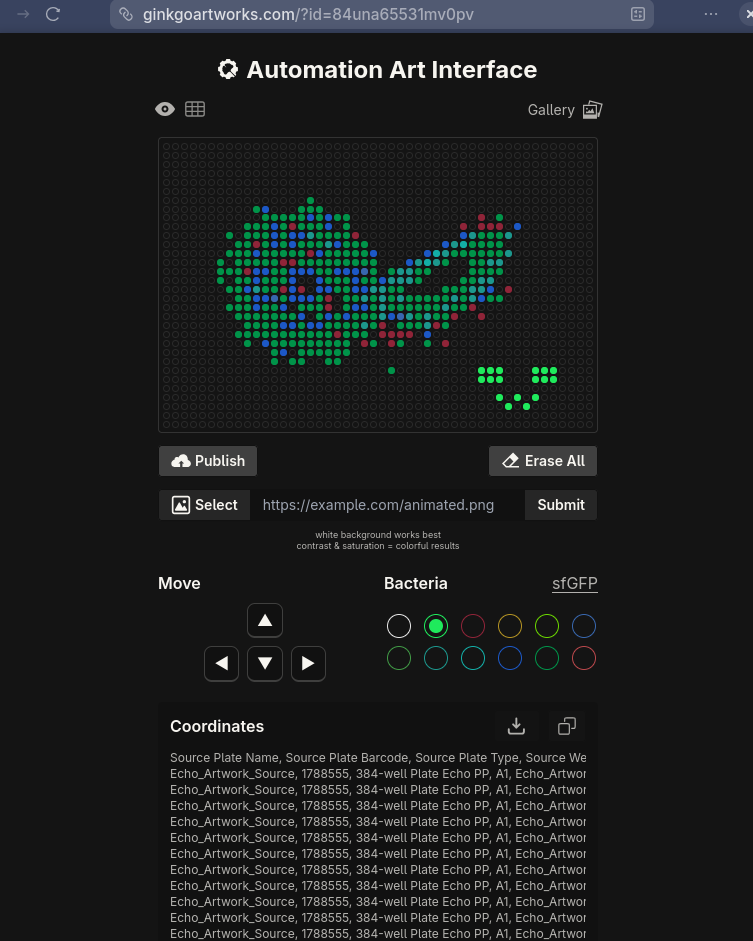
Making Opentron Art
Here is the opentron script from the previous year, written in google colab.
for this year, I want to do something new, I decide to go with the picture of 2D projected lorenz attractor.
In perfect scenario, I wish to write the script to plots 2D lorenz attractor and command opentron to draw this frame-by-frame.
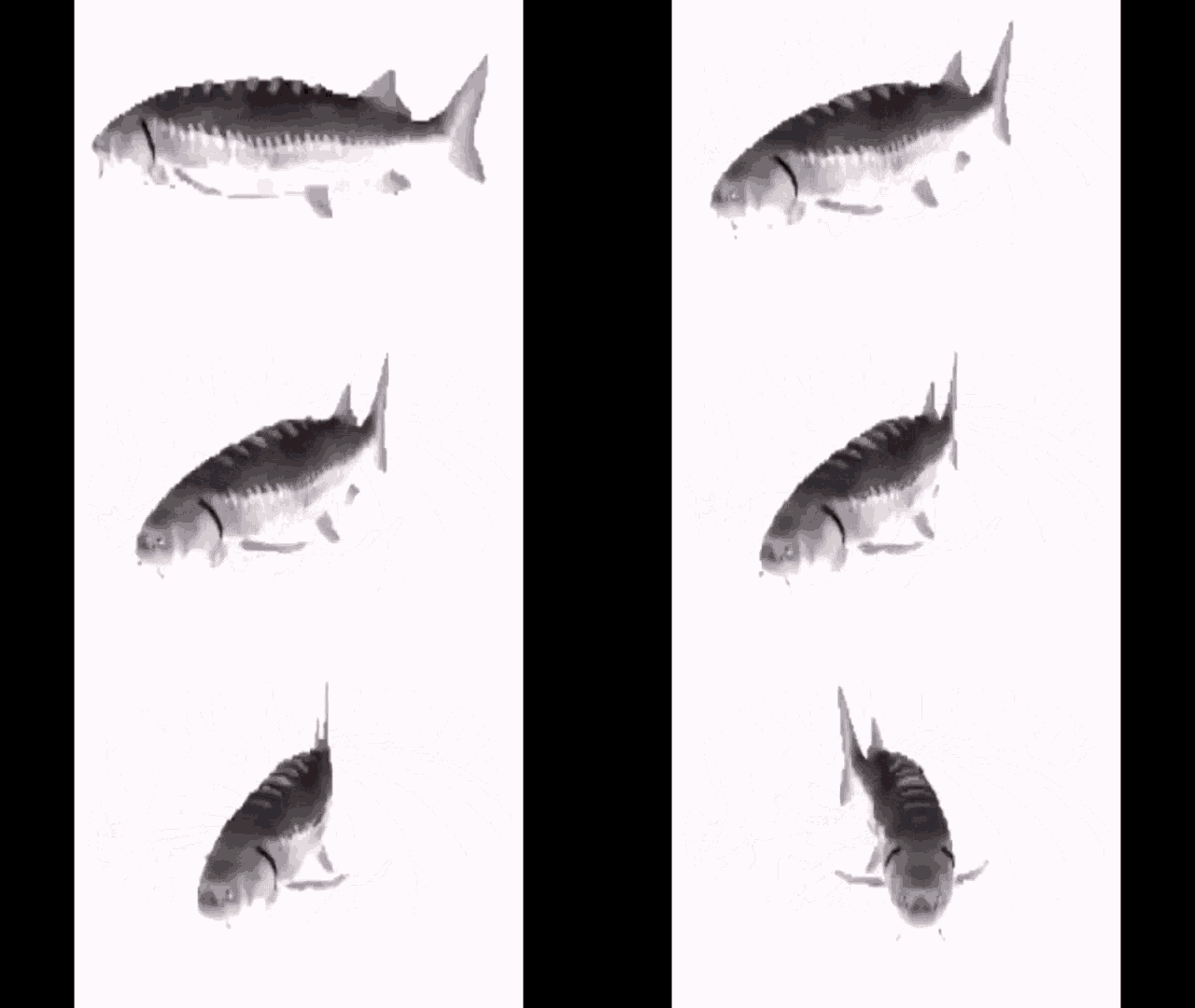
sadly, I don’t have enough time for that, so I use this image I found hene to generate the pattern.
original picture used for create this art
from this website
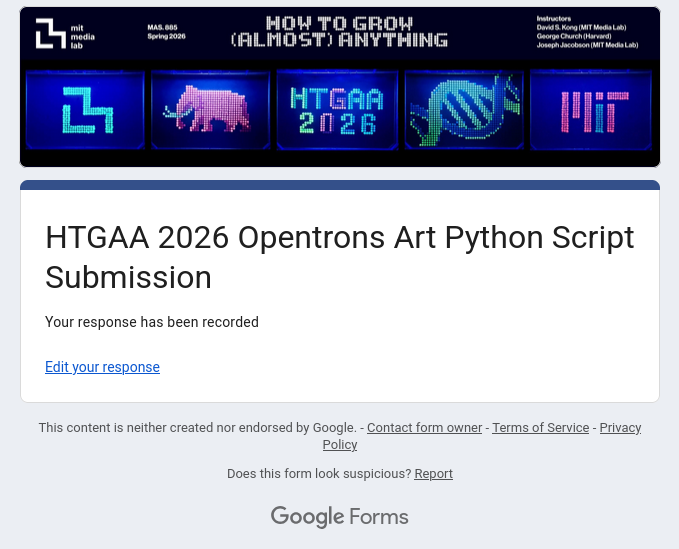
submitted!!
Post Lab Questions
(i) Find and describe a published paper that utilizes the Opentrons or an automation tool to achieve novel biological applications.
(ii) Write a description about what you intend to do with automation tools for your final project. You may include example pseudocode, Python scripts, 3D printed holders, a plan for how to use Ginkgo Nebula, and more. You may reference this week’s recitation slide deck for lab automation details.