Week 7: Genetic Circuits Pt 2
Intrancellular Artificial Neural Networks (IANNs)
(Question 1) IANNs have the advantagae of providing a more nuanced approach to using genetic circuits by allowing continuous input and output response, where as genetic circuits, which use Boolean logic, often respond in a more binary manner.
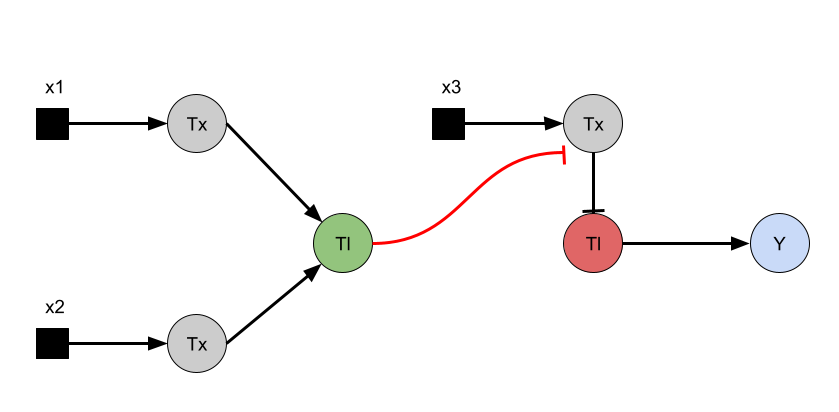
(Question 2) The introduction of IANNs raised an interesting question in my individual project idea. Since my final project involves the design of a genetic circuit that can sense and then respond to the formation of fibrotic scarring, IANNs could be used as a more sophisticated approach to this problem by increasing the specificity of the circuit to only activate in a truly fibrotic wound microenvironment. In my original circuit, I had aimed to have part of my circuit sense both STAT3 and NF-kB as a trigger to secrete the anti-fibrotic factor, decorin. However, by incorporating IANN instead, I could further decrease the noise from transient inflammatory spikes through encoding three synthetic transcription factors whose expression is driven by STAT3, NF-kB, TGF-B, and HIF-1a promoters respectively. The second section of my genetic circuit would then be placed under a promoter that would require the binding of all three synthetic transcription factors.
While this approach does allow for more specificity, it raises a few logistical terms in terms of cassette size. Originally, I was planning on using the piggyBac transposon system in order to integrate my circuit into the fibroblast genome. However, this IANN would greatly increase the size of my circuit, by nearly double, making it must less reliable to use as a transposon cassette.
(Question 3)
Fungal Materials
(Question 1) One application of fungal materials that caught my attention was their use as packaging foam by companies such as Ecovative [1]. This company aims to reduce traditional packing foam made from EPS and styrofoam through molding mycellium composites within the molds of their desired packaging shapes. I thought this was quite a unique approach as it offers a more ecofriendly alternative as well as a low density that is comparable to EPS foams. However, I could see that this could have scalability issues as it takes time grow the mycellium, which may result in higher coasts.
(Question 2) A unqiue characteristic of fungi is their ability to “heal themselves” and their 3D microstructure. In this regard, I think that taking advantage of these aspects, it would be interesting to make living tissue engineering scaffolds or living wound dressings, which could secrete a variety of proteins or even drugs.
Some advantages of using fungi over bacteria for synthetic biology could include that fungi are able to perform post-translational function, which could allow important implications in producing functional proteins. Another interesting aspect is that fungi allow the product to have its own native 3D shape, which could further have implications in the fiber density and the branching of the mycellium.
First DNA Twist Order
Due to the complexity of my proposed genetic circuit, it is unfortunately unable to be ordered using Twist. While pieces of it could be ordered and then manually pieced together using Gibson or Golden Gate, due to my lack of access to the lab, the node and I decided not to proceed with the Twist order.