Group Final Project
Proposal: Increasing Stability of the MS2 L Protein
Objective
The goal of this project is to identify and engineer mutations in the L protein of the ssRNA phage MS2 bacteriophage that increase its structural stability while preserving its lytic function in Escherichia coli. Improving protein stability may enhance its functional lifetime and overall efficiency during infection.
Proposed Tools and Approaches
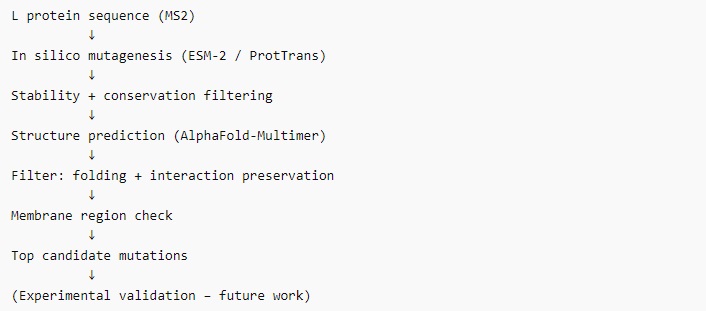
To systematically explore the mutational landscape of the L protein, we propose a computational pipeline combining sequence-based and structure-based methods.
First, we will use protein language models (PLMs), including ESM-2, to perform in silico mutagenesis. The model enable high-throughput evaluation of single-residue substitutions and provide likelihood-based scores (e.g., LLR) that reflect the compatibility of mutations with evolutionary constraints. This allows us to identify mutations that are potentially stabilizing while maintaining overall sequence plausibility.
Next, we will employ AlphaFold-Multimer to predict the structural consequences of selected mutations. This step will be used to assess whether candidate variants preserve proper folding, tertiary structure, and potential interaction interfaces. In particular, we will examine how mutations affect protein conformation, heterotypic interactions, and membrane association.
Rationale
The L protein likely relies on specific protein–protein interactions and membrane-associated behavior to mediate lysis. Therefore, increasing stability alone is insufficient; mutations must also preserve these functional interactions. By integrating PLM-based predictions with structural modeling, we aim to prioritize mutations that improve stability without disrupting key biological functions.
Selected Mutations and Rationale
Five candidate mutations were selected based on positive LLR scores and additional structural considerations:
Q13N (soluble region): A conservative polar substitution (Gln → Asn) that may subtly modify hydrogen-bonding networks without destabilizing the fold. This mutation could influence interactions with host factors such as DnaJ.
E24K (soluble region): A charge-reversal mutation (negative → positive) that significantly alters surface electrostatics, potentially affecting chaperone binding or interaction interfaces.
I48L (TM region): A highly conservative hydrophobic substitution expected to stabilize helix packing within the membrane while preserving structural integrity.
S51A (TM region): Removal of a polar residue within the transmembrane domain, likely improving membrane compatibility and reducing unfavorable interactions.
Q68L (TM region): Increased hydrophobicity in the C-terminal TM region, potentially enhancing oligomerization and pore-forming capability.
Membrane association analysis
Since L is likely membrane-associated:
- predict transmembrane or hydrophobic regions;
- avoid destabilizing mutations in these domains
Expected Outcome
- Identification of candidate stabilizing mutations
- A ranked list of variants for future experimental validation
- Improved understanding of L protein structure–function relationship
Potential Pitfalls
Despite the strengths of this approach, several limitations remain. First, both PLMs and structure prediction tools are inherently probabilistic, and predicted stabilizing mutations may still disrupt lytic function. Second, the mechanism of L-mediated lysis is not fully understood and does not follow classical pathways such as peptidoglycan inhibition. As a result, subtle but critical interactions may not be captured by current computational models.
Pipeline Schematic