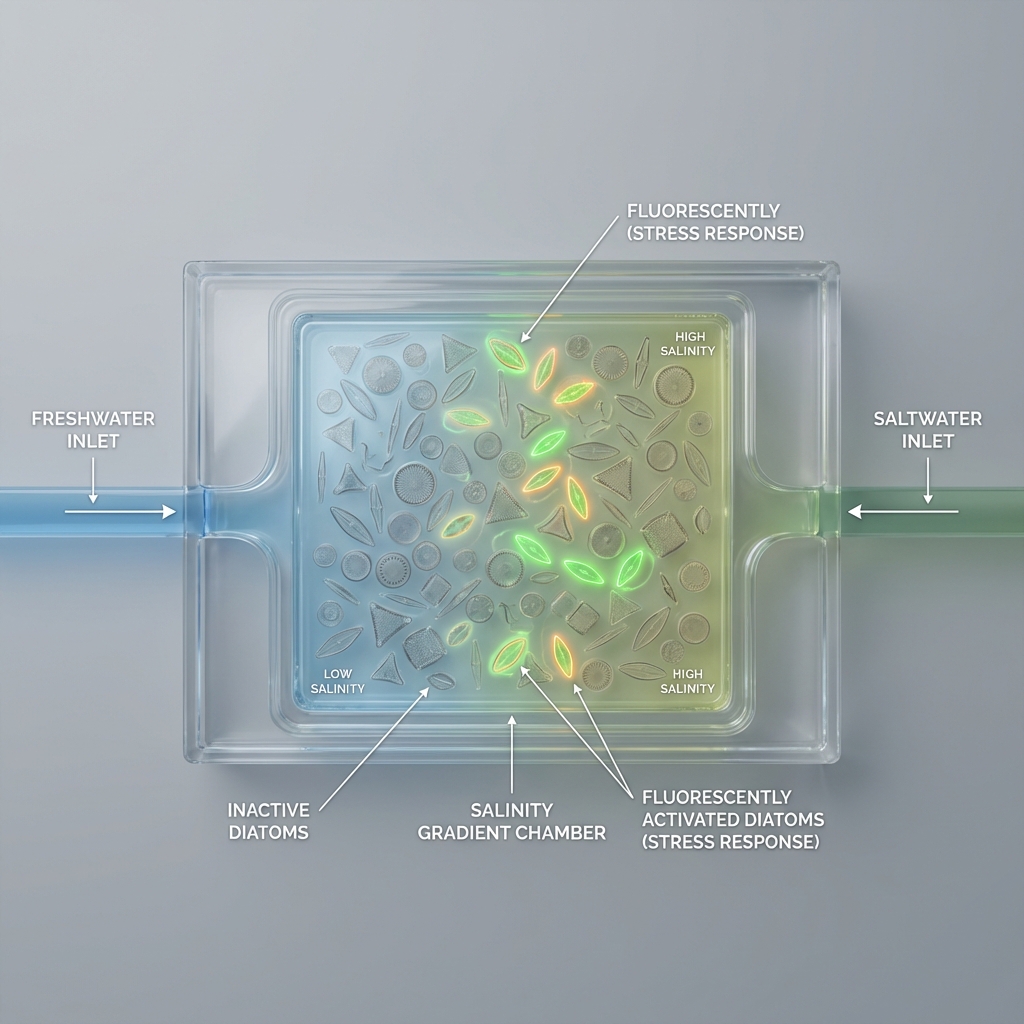
ABSTRACT The project explores how diatoms adapt to rapidly changing salinity in transitional environments such as river plumes, where freshwater mixes with seawater. These zones are increasingly important under climate change, as shifting salinity patterns affect microbial survival and ecosystem stability. Understanding how diatoms respond at molecular and structural levels is critical, as they play a key role in global oxygen production and biogeochemical cycles.
Proposal: Increasing Stability of the MS2 L Protein Objective
The goal of this project is to identify and engineer mutations in the L protein of the ssRNA phage MS2 bacteriophage that increase its structural stability while preserving its lytic function in Escherichia coli. Improving protein stability may enhance its functional lifetime and overall efficiency during infection.
Subsections of Projects
Individual Final Project
ABSTRACT
The project explores how diatoms adapt to rapidly changing salinity in transitional environments such as river plumes, where freshwater mixes with seawater. These zones are increasingly important under climate change, as shifting salinity patterns affect microbial survival and ecosystem stability. Understanding how diatoms respond at molecular and structural levels is critical, as they play a key role in global oxygen production and biogeochemical cycles.
The overall objective is to model and visualize adaptive mechanisms in diatoms under osmotic stress. The project hypothesizes that changes in ion transport and stress-response pathways can be linked to observable shifts in cell behavior and morphology, including frustule structure.
To address this, the project will
design a controlled salinity gradient using a microfluidic chip;
simulate adaptive mutations in key proteins using computational tools;
visualize stress-response activation using a fluorescent reporter system such as GFP
The expected outcome is an integrated scientific and visual framework that connects molecular adaptation with environmental transitions, offering both biological insight and a platform for interdisciplinary exploration.
Aim 1: Experimental Aim
The first aim of my final project is to model and visualize stress-response activation in diatoms under controlled salinity gradients by utilizing a microfluidic chip system, fluorescent reporter constructs (e.g., GFP linked to stress-response genes), and computational protein design tools such as ESM-based models and AlphaFold for simulating adaptive mutations in ion transport and stress-related proteins.
Aim 2: Development Aim
The second aim is to extend this system by experimentally validating computationally predicted adaptive mutations, integrating optimized genetic constructs into diatom cells, and improving the microfluidic platform to allow long-term observation of adaptive dynamics and potential evolutionary changes across multiple generations.
Aim 3: Visionary Aim
The third aim is to translate laboratory-based insights into real-world environmental applications by developing strategies to enhance the salinity tolerance of diatoms in transitional ecosystems such as river plumes and estuaries. In the long term, this could contribute to maintaining ecosystem balance, supporting primary productivity, and strengthening the role of diatoms in global carbon and oxygen cycles.
BACKGROUND
Diatoms are key primary producers in aquatic ecosystems and contribute significantly to global carbon fixation and oxygen production. In transitional environments such as river plumes and estuaries, diatoms are exposed to rapid and often extreme fluctuations in salinity, requiring efficient adaptive responses. Previous studies have shown that osmotic stress in microalgae activates ion transport systems and stress-response pathways that regulate intracellular ion balance and protect cellular structures.[1] For example, research on salinity stress in diatoms demonstrates that ion transporters and compatible solute pathways play a central role in maintaining cellular homeostasis under changing environmental conditions.
Additionally, the change in the morphology of diatom frustules during the transition between freshwater and marine conditions is analyzed, as well as its dependence on genetic and environmental factors that determine adaptive mechanisms.[2]
[1] - Diatom community response to inland water salinization: a review, C. Stenger-Kovács, V. B. Béres, K. Buczkó, K. Tapolczai, J. Padisák, G. B. Selmeczy & E. Lengyel/Published: 26 April 2023, pages 4627–4663, (2023)
[2] - Kamakura, S. et al. Morphological plasticity in response to salinity change in the euryhaline diatom Pleurosira laevis (Bacillariophyta). J. Phycol.58, 631–642 (2022)
Group Final Project
Proposal: Increasing Stability of the MS2 L Protein
Objective
The goal of this project is to identify and engineer mutations in the L protein of the ssRNA phage MS2 bacteriophage that increase its structural stability while preserving its lytic function in Escherichia coli. Improving protein stability may enhance its functional lifetime and overall efficiency during infection.
Proposed Tools and Approaches
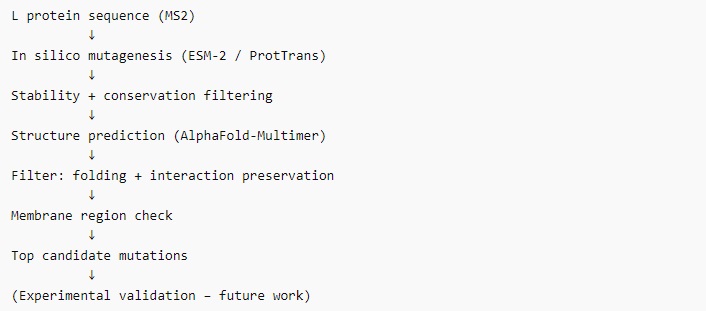
To systematically explore the mutational landscape of the L protein, we propose a computational pipeline combining sequence-based and structure-based methods.
First, we will use protein language models (PLMs), including ESM-2, to perform in silico mutagenesis. The model enable high-throughput evaluation of single-residue substitutions and provide likelihood-based scores (e.g., LLR) that reflect the compatibility of mutations with evolutionary constraints. This allows us to identify mutations that are potentially stabilizing while maintaining overall sequence plausibility.
Next, we will employ AlphaFold-Multimer to predict the structural consequences of selected mutations. This step will be used to assess whether candidate variants preserve proper folding, tertiary structure, and potential interaction interfaces. In particular, we will examine how mutations affect protein conformation, heterotypic interactions, and membrane association.
Rationale
The L protein likely relies on specific protein–protein interactions and membrane-associated behavior to mediate lysis. Therefore, increasing stability alone is insufficient; mutations must also preserve these functional interactions. By integrating PLM-based predictions with structural modeling, we aim to prioritize mutations that improve stability without disrupting key biological functions.
Selected Mutations and Rationale
Five candidate mutations were selected based on positive LLR scores and additional structural considerations:
Q13N (soluble region): A conservative polar substitution (Gln → Asn) that may subtly modify hydrogen-bonding networks without destabilizing the fold. This mutation could influence interactions with host factors such as DnaJ.
E24K (soluble region): A charge-reversal mutation (negative → positive) that significantly alters surface electrostatics, potentially affecting chaperone binding or interaction interfaces.
I48L (TM region): A highly conservative hydrophobic substitution expected to stabilize helix packing within the membrane while preserving structural integrity.
S51A (TM region): Removal of a polar residue within the transmembrane domain, likely improving membrane compatibility and reducing unfavorable interactions.
Q68L (TM region): Increased hydrophobicity in the C-terminal TM region, potentially enhancing oligomerization and pore-forming capability.
Membrane association analysis
Since L is likely membrane-associated:
predict transmembrane or hydrophobic regions;
avoid destabilizing mutations in these domains
Expected Outcome
Identification of candidate stabilizing mutations
A ranked list of variants for future experimental validation
Improved understanding of L protein structure–function relationship
Potential Pitfalls
Despite the strengths of this approach, several limitations remain. First, both PLMs and structure prediction tools are inherently probabilistic, and predicted stabilizing mutations may still disrupt lytic function. Second, the mechanism of L-mediated lysis is not fully understood and does not follow classical pathways such as peptidoglycan inhibition. As a result, subtle but critical interactions may not be captured by current computational models.