This lab covered standard pipetting and dilution practices. Being an online student, I did not perform the protocol in person. I did refer to the links below to refresh my learning: Significant Figures crash course Dilution Problems, Chemistry, Molarity & Concentration Examples, Formula & Equations
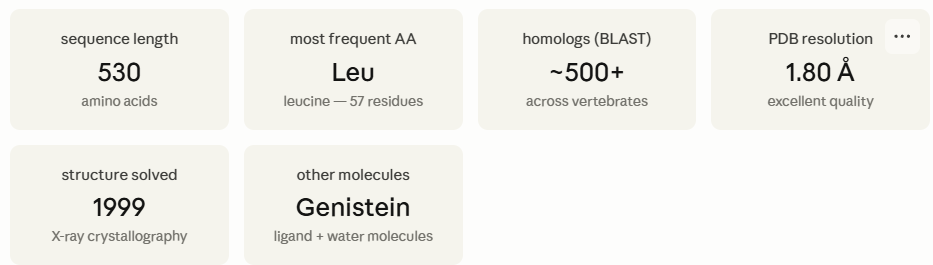
1: Estrogen Receptor Beta (Human) Selected because of its direct relevance to endometriosis, PCOS, and female reproductive health. PDB ID: 1QKM
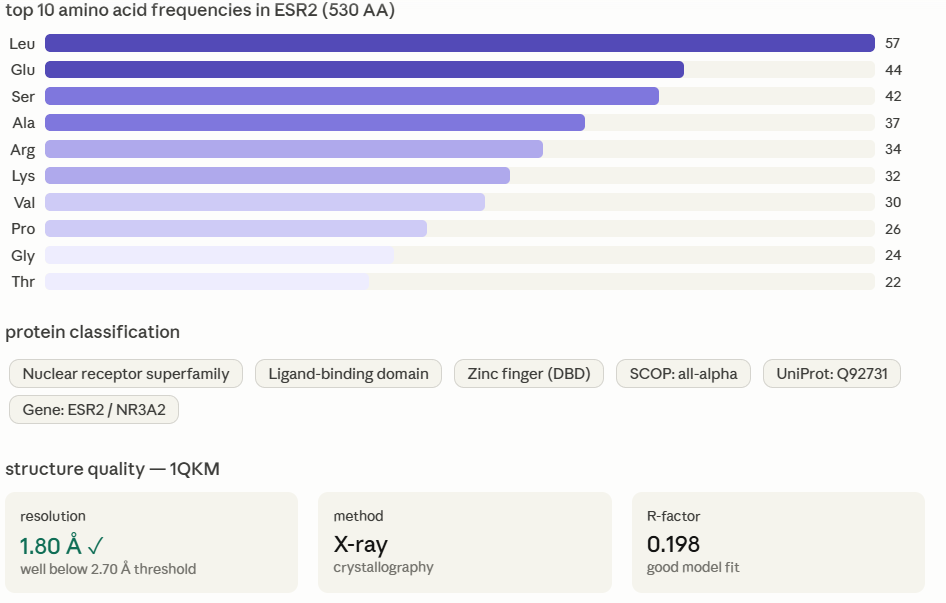
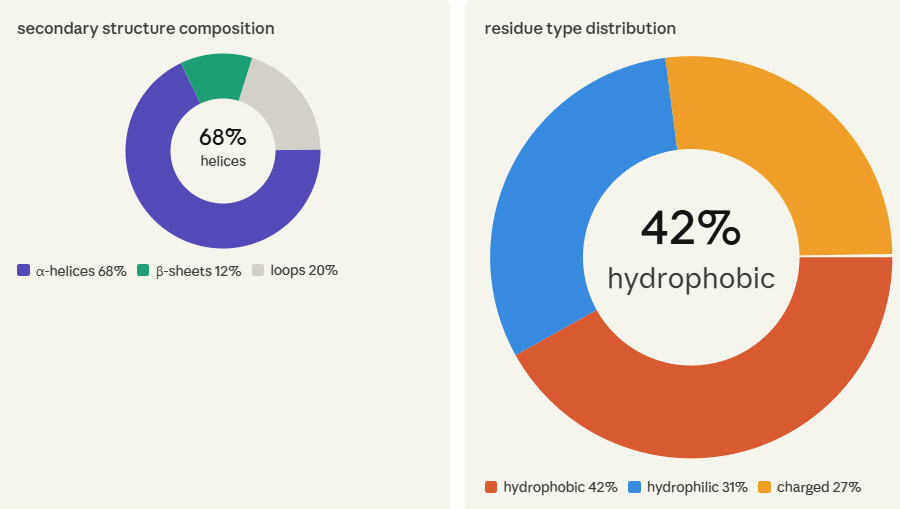
Information about ESR2 from PDB site Protein Classification and Amino acid frequencies Protein structure quality graphs
While during the class I was not able to attend in real time. I caught up the node’s discussion via the recordings upload on the Victoria Node space. I also tried to use Claude to see what it spits out, a lot of irregularity. I also sought help from peers like Aarushi Mishra and under her direct help I attempted several times to create a competitive switch.
After several failed attempts, I decided to move forward from this, as I theoretically understand how neuromorphic circuits and lipofectamine transfection work. Having worked in HEK293 transfection before. From what i understand now, The tool Neuromorphic wizard needs to be updated & calibrated to biological understand in a better way. I will be searching more about this later to see if there are better frameworks as open source to use.
Post-lab Questions 1.Which genes when transferred into E. coli will induce the production of lycopene and beta-carotene, respectively? crtE, crtB, and crtL produce lycopene. Adding crtY produces beta-carotene.
2.Why do the plasmids that are transferred into the E. coli need to contain an antibiotic resistance gene? Antibiotic resistance keeps only plasmid-containing cells alive, ensuring plasmid maintenance.
1: Estrogen Receptor Beta (Human)
Selected because of its direct relevance to endometriosis, PCOS, and female reproductive health. PDB ID: 1QKM
Information about ESR2 from PDB site
Protein Classification and Amino acid frequencies
Protein structure quality graphs
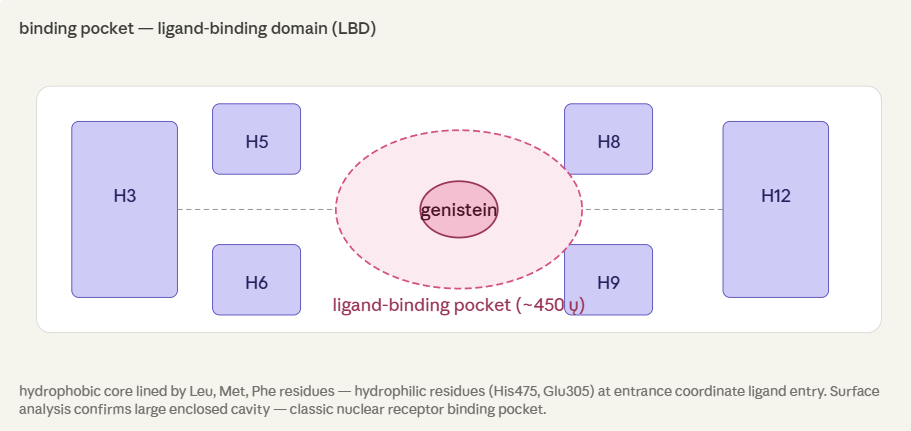
Binding Pocket Ligand
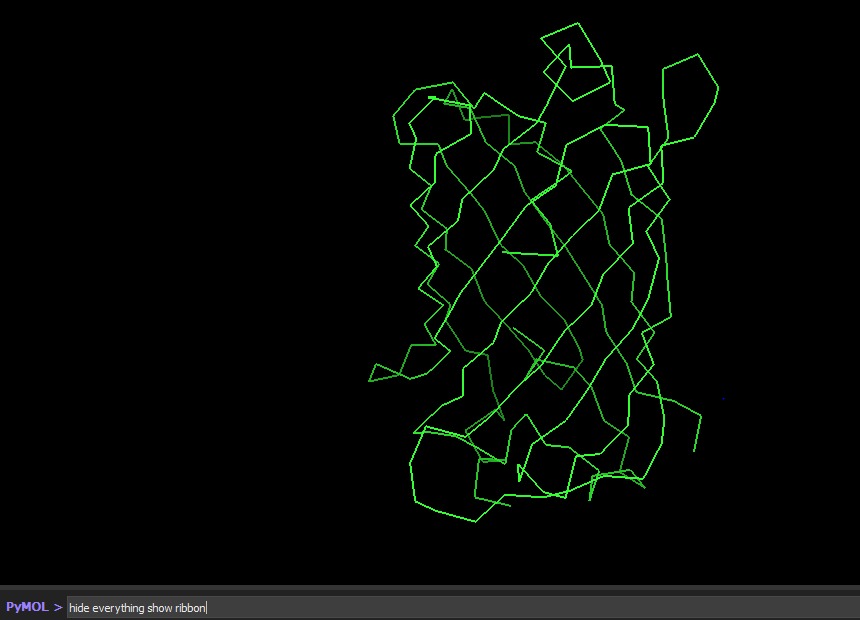
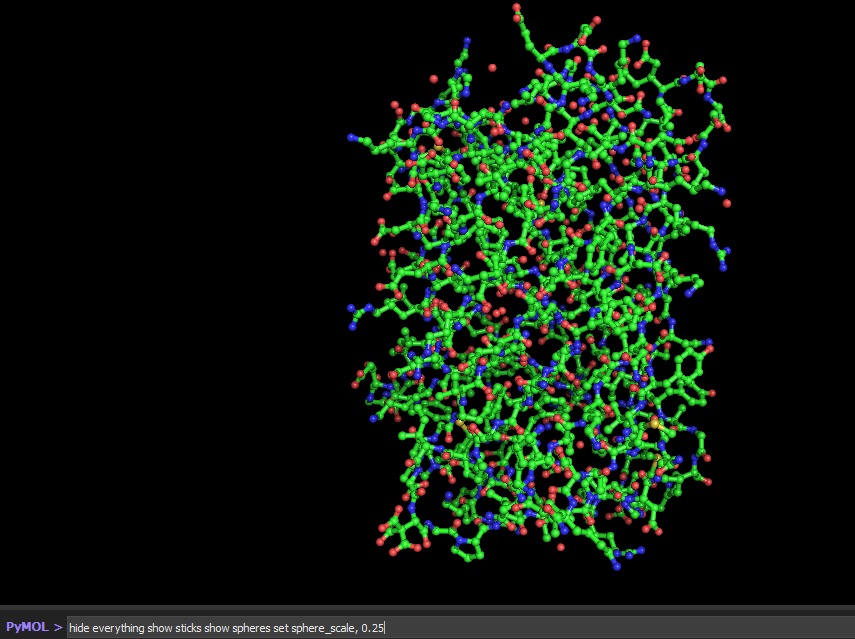
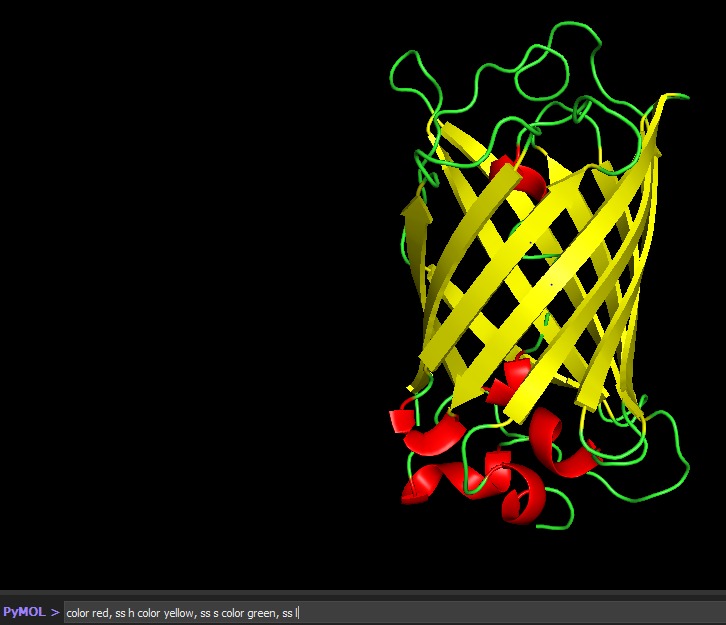
Adding visualisation to GFP protein instead of ESR2 - as i changed it for my final project -
Cartoon
Ribbon
Ball & Stick
The Secondary structure of GFP : Seems to have more helixes
Part C1. Protein Language Modeling
C1.1 Deep Mutational Scan
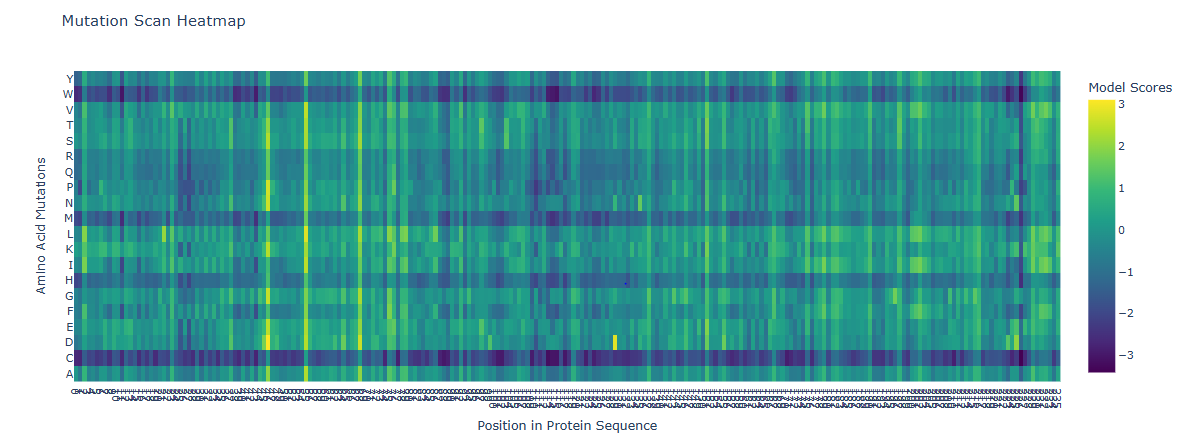
ESM2 is a protein language model trained on ~250 million protein sequences. It generates per-residue probability distributions over all 20 amino acids by learning co-evolutionary patterns from sequence context alone, without any structural input. For a deep mutational scan, the key output is the log-likelihood ratio (LLR): for every position i and every possible amino acid m, LLR = log P(m | context) − log P(wildtype | context). A strongly negative LLR means ESM2 considers that substitution evolutionarily disfavored; a near-zero or positive LLR means it is tolerated.
Running this scan across all 239 residues of GFP and all 20 amino acids produces a 239 × 20 LLR heatmap:
The most striking pattern is the sharp, strongly negative signal at the chromophore triad - Ser65, Tyr66, and Gly67. These three residues form GFP’s fluorophore through spontaneous backbone cyclization and oxidation. ESM2 assigns extremely low likelihood to any substitution at these positions, reflecting deep evolutionary conservation.
C1.2 Latent Space Analysis
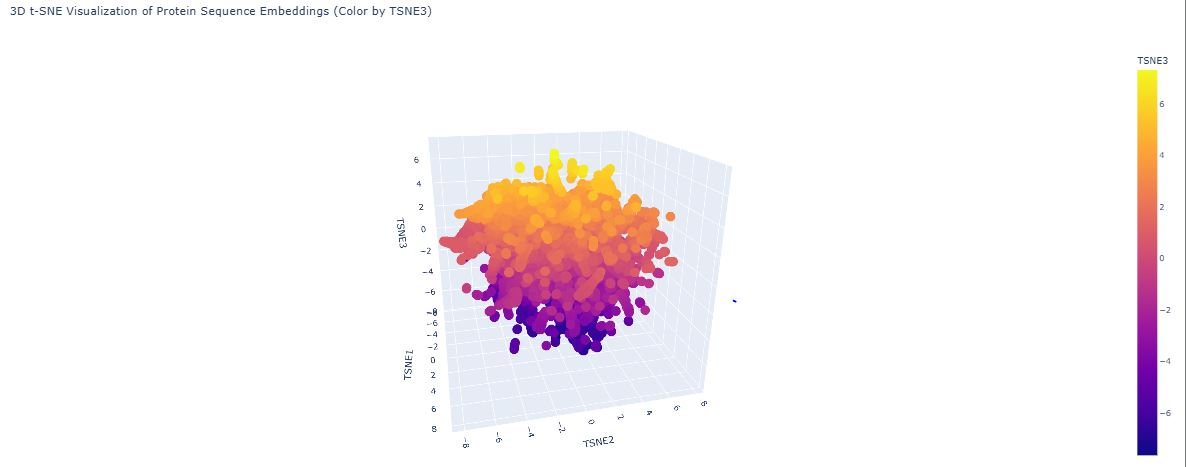
ESM2’s internal transformer layers produce high-dimensional embedding vectors (~1280 dimensions for ESM2-650M) that encode evolutionary, structural, and functional information simultaneously. Dimensionality reduction via UMAP projects these into 2D, allowing visual inspection of how proteins relate to one another:
GFP (1GFL) appears in the all-β region, consistent with its 11-stranded β-can fold. Its nearest neighbors are other fluorescent protein family members and other β-barrel proteins. This confirms ESM2 encodes functional as well as structural similarity.
C2. Protein Folding
ESMFold is a single-sequence structure predictor that bypasses multiple sequence alignments (MSAs), instead leveraging latent structural knowledge from a protein language model. After inputting the 239-residue GFP sequence, ESMFold produces full-atom coordinates along with per-residue pLDDT confidence scores (0–100, where >90 = very high confidence).
Folding a protein
( al other parts are performed as part of the final project as well , so its visible on google collab files documentation, more files cannot seem to be added here)
Week 06 Lab: Gibson Assembly
Lab not part of remote participation.
Week 07 Lab: Neuromorphic Circuits
While during the class I was not able to attend in real time. I caught up the node’s discussion via the recordings upload on the Victoria Node space.
I also tried to use Claude to see what it spits out, a lot of irregularity.
I also sought help from peers like Aarushi Mishra and under her direct help I attempted several times to create a competitive switch.
After several failed attempts, I decided to move forward from this, as I theoretically understand how neuromorphic circuits and lipofectamine transfection work. Having worked in HEK293 transfection before. From what i understand now, The tool Neuromorphic wizard needs to be updated & calibrated to biological understand in a better way. I will be searching more about this later to see if there are better frameworks as open source to use.
Week 09 Lab: Cell Free System
Lab not available for remote
Week 10 HW: Protein Design Part 1
See part of Homework in Week 10 Homework space.
Week 11 Lab: Cloud Lab
See week 11 Homework.
Week 12 Lab: Bioproduction
Post-lab Questions
1.Which genes when transferred into E. coli will induce the production of lycopene and beta-carotene, respectively?
crtE, crtB, and crtL produce lycopene. Adding crtY produces beta-carotene.
2.Why do the plasmids that are transferred into the E. coli need to contain an antibiotic resistance gene?
Antibiotic resistance keeps only plasmid-containing cells alive, ensuring plasmid maintenance.
3.What outcomes might we expect to see when we vary the media, presence of fructose, and temperature conditions of the overnight cultures?
Changing media, fructose, or temperature can affect cell growth and pigment production.
4.Generally describe what “OD600” measures and how it can be interpreted in this experiment.
OD600 measures cell density by light absorption at 600 nm. Higher OD600 means more cell growth.
5.What are other experimental setups where we may be able to use acetone to separate cellular matter from a compound we intend to measure?
Acetone can separate pigments or other acetone-soluble compounds from cell material.
6.Why might we want to engineer E. coli to produce lycopene and beta-carotene pigments when Erwinia herbicola naturally produces them?
E. coli grows faster and is easier to genetically engineer than Erwinia herbicola.
Committed Listeners
1. What are the enzymes of the carotene pathway?
The carotene pathway enzymes are CrtE, CrtB, CrtL, CrtY, and CrtZ.
2.ithin this pathway, which is the rate determining step (the step that takes the longest)? Which enzyme is responsible for this step?
The rate-limiting step is usually phytoene synthesis, controlled by CrtB.
3.The first thing to do is to decide what organism you are going to use for this (E. coli or S. cerevisiae) for production. Which would you choose and why (emphases on production differences)?
I would choose E. coli because it grows quickly and has many genetic tools.
5.A promoter starts transcription by binding RNA polymerase.
6.Promoters can be constitutive, inducible, or repressible.
7.A repressible promoter turns genes off in response to a metabolite. An inducible promoter turns genes on.
8. I would use a T7 promoter because it gives strong gene expression in strains with T7 polymerase.
Origin of Replication
1.The origin of replication is the DNA site where plasmid copying begins.
2. Origins can be high-, medium-, or low-copy number and may be relaxed or stringent.
3. Compatibility groups classify plasmids with similar replication systems that may interfere with each other.
Additional Bioparts
1. Elaborate further on other bioparts like RBS, terminators, operators you would use for a correct design and further bioproduction?
A strong RBS improves translation, terminators stop transcription, and operators control gene expression.
2.What are aptamers and riboswitches and how can they be used for metabolic tuning or engineering in prokaryotes?
Aptamers and riboswitches regulate gene expression by binding specific molecules.
3.Now what approach can be used to join all these parts together?
Gibson assembly joins DNA fragments without restriction sites, while Golden Gate is useful for modular cloning.
4. Try to elaborate further on a biosynthetic pathway you would want to engineer in E. coli for production of a metabolite or product. What use could this bio-product have? Imagine dream applications!!!
Engineered E. coli could produce medicines, biofuels, or biodegradable plastics for industrial and medical use.(if we are imagining i would want it to be engineered shroom strains that change falvours)
Yeast Engineering
1.Yeast constructs use promoters, Kozak sequences, terminators, and selection markers.
2. Safe-harbor chromosome sites are preferred for stable genome integration.
3. An integration cassette includes homology arms, promoter, gene, terminator, and selection marker.