Week 7 HW: Genetic Circuits Part 2
Assignment Part 1: Intracellular Artificial Neural Networks
What advantages do IANNs have over traditional genetic circuits, whose input/output behaviors are Boolean functions?
- IANNs have an advantage over traditional Boolean genetic circuits because they can respond to graded, noisy biological signals instead of forcing every input into a simple ON/OFF state. This makes them better for tasks like classification, where a cell needs to weigh several signals together and make a more flexible decision, while Boolean circuits are better for simpler yes/no logic.
Describe a useful application for an IANN; include a detailed description of input/output behavior, as well as any limitations an IANN might face to achieve your goal.
- One useful application would be an engineered therapeutic cell that detects a tumor-like signal pattern by integrating several biomarkers, such as hypoxia, inflammation, and growth signaling, and then turns on a treatment response only when the overall pattern matches cancer. A limitation is that real cells are noisy and variable, so it can be hard to tune the network precisely and avoid false positives, crosstalk, or unreliable behavior in different cells.
Draw a diagram for an intracellular multilayer perceptron where layer 1 outputs an endoribonuclease that regulates a fluorescent protein output in layer 2.
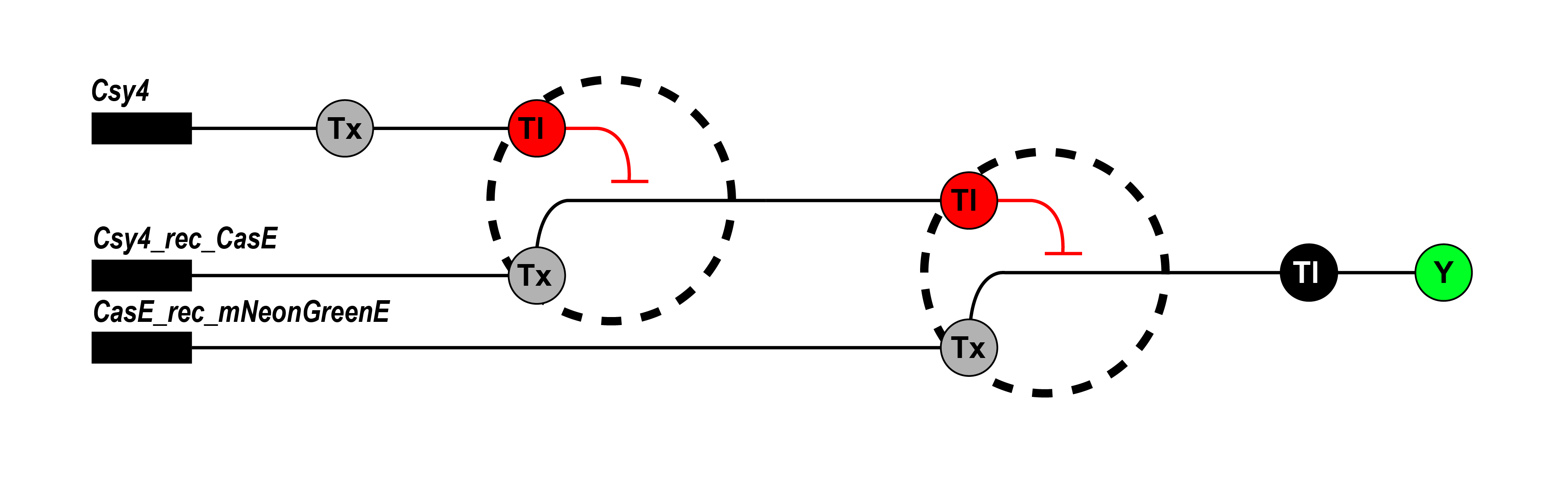
Assignment Part 2: Fungal Materials
What are some examples of existing fungal materials and what are they used for? What are their advantages and disadvantages over traditional counterparts?
- Existing fungal materials include mycelium-based packaging, insulation/building panels, leather-like materials, and fungal chitin/chitosan for wound dressings. Their main advantages are that they can be biodegradable, grown on agricultural waste, and can offer good thermal insulation, acoustic absorption, and fire resistance; their disadvantages are that they often have lower mechanical strength, high water absorption, and less standardized performance than plastics, foams, or conventional leather.
What might you want to genetically engineer fungi to do and why? What are the advantages of doing synthetic biology in fungi as opposed to bacteria?
- If I could genetically engineer fungi, I would want them to grow faster and make materials that are stronger, more water-resistant, or more functional for uses like packaging, insulation, or leather alternatives. Fungi have some advantages over bacteria for synthetic biology because they naturally form mycelial networks, can perform eukaryotic protein processing, and are often very good at secreting proteins, which makes them more suitable for material production and some complex biomolecules than bacteria.