Week 11 HW: Bioproduction & Cloud Lab
Part A: The 1,536 Pixel Artwork Canvas | Collective Artwork
- Contribute at least one pixel to this global artwork experiment before the editing ends on Sunday 4/19 at 11:59 PM EST.
A personalized URL was sent to the email address associated with your Discourse account, and you can discuss the artwork on the Discourse.
If you did not have a chance to contribute, it’s okay, just make sure you become a TA this fall! 😉
- Make a note on your HTGAA webpages, including:
what you contributed to the community bioart project (e.g., “I made part of the DNA on the bottom right plate”)
what you liked about the project, and
what about this collaborative art experiment could be made better for next year.
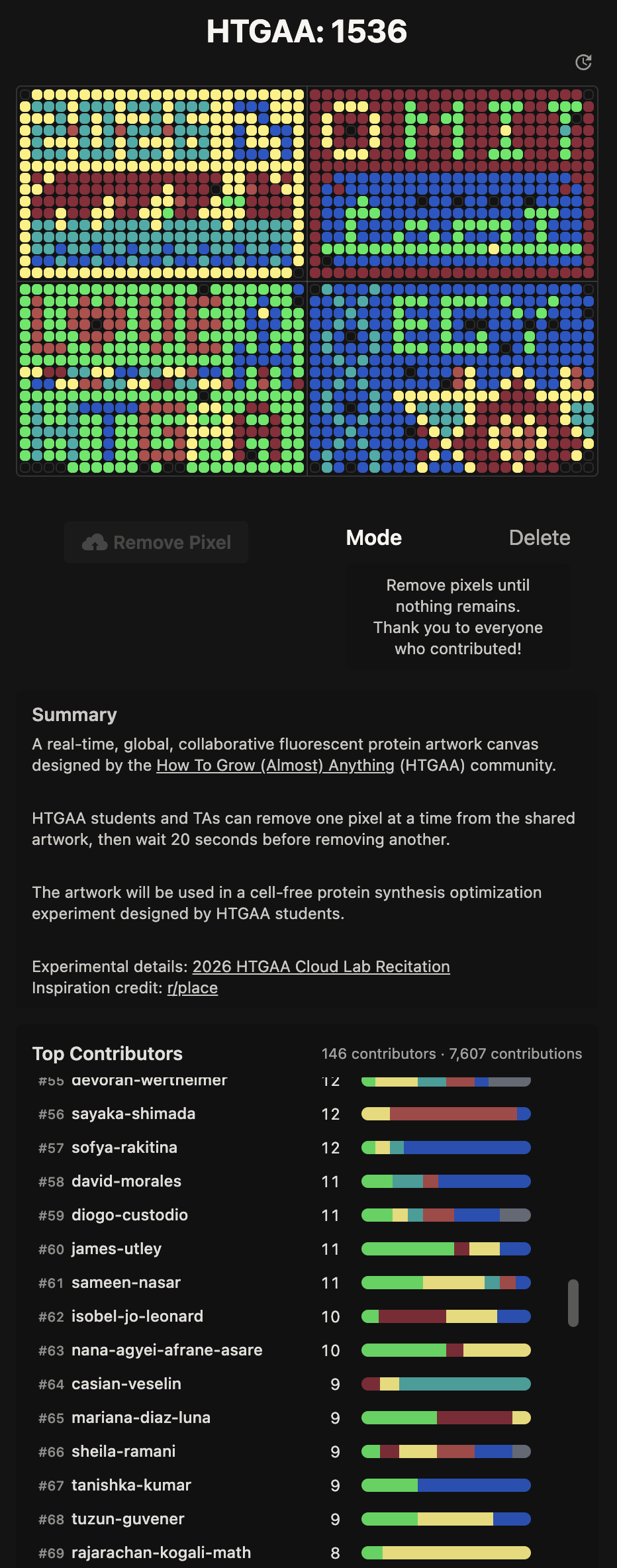
I've contributed 9 pixels in a design to support the surroundings of the heart shape in the bottom center area. However, as of now, the heart-shaped design has been changed and is no longer on the canvas. See image below, #68 tuzun-guvener.
Part B: Cell-Free Protein Synthesis | Cell-Free Reagents
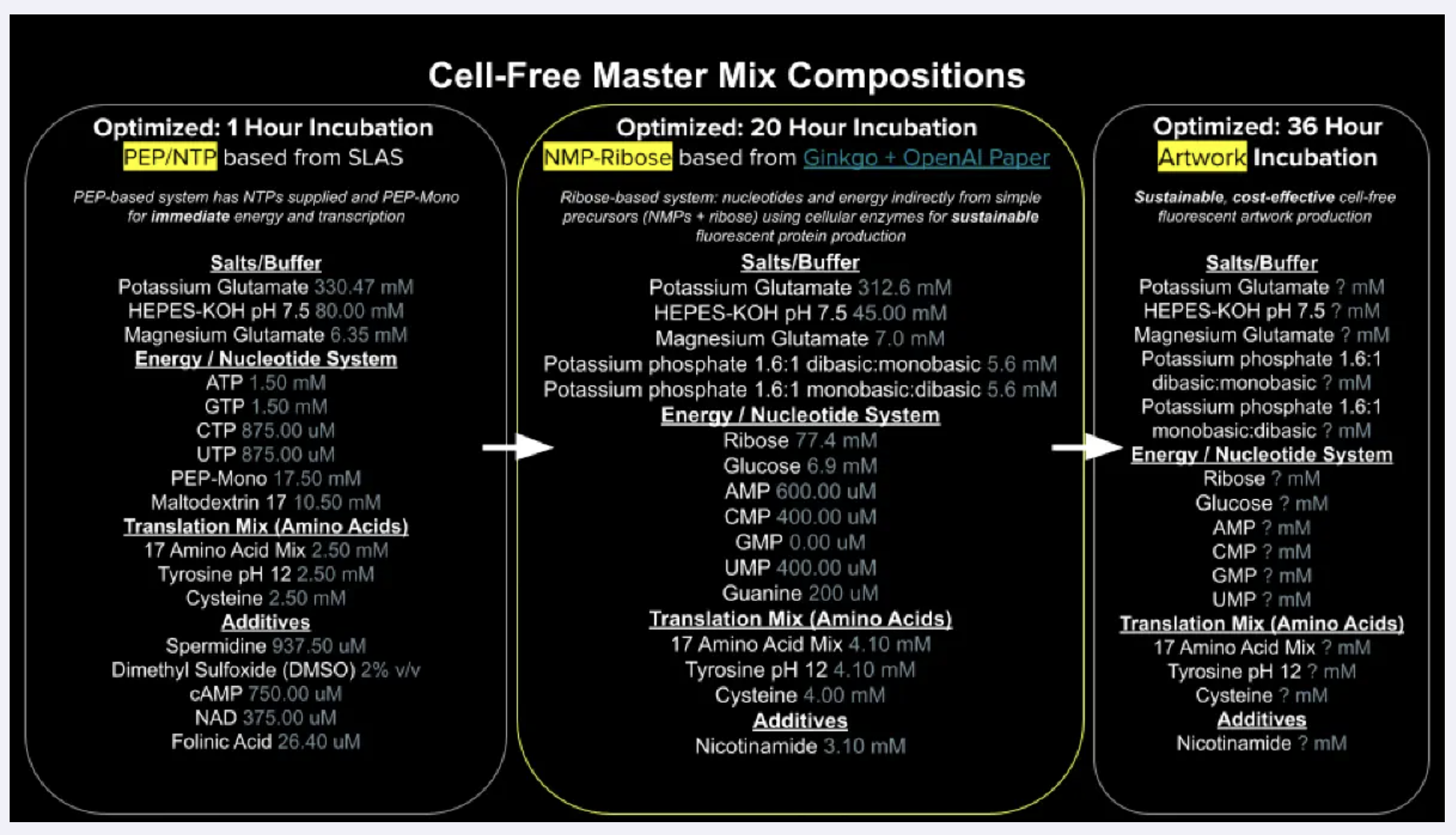
- Referencing the cell-free protein synthesis reaction composition (the middle box outlined in yellow on the image above, also listed below), provide a 1-2 sentence description of what each component’s role is in the cell-free reaction.
E. coli Lysate
- BL21 (DE3) Star Lysate (includes T7 RNA Polymerase)
The E. coli BL21 (DE3) Star Lysate provides all necessary components for transcription and translation in a cell-free protein synthesis reaction, given the design of a DNA template driving expression from a T7 promoter. The strain is engineered to have T7 RNA polymerase expressed under an IPTG-controlled promoter. Also, the strain has a "Star" mutation; one of the nucleases has a mutation (the RNase E coding region has an rne131 mutation), resulting in slowing down the degradation of mRNA, which in turn results in a better protein yield.

The rne131 mutation resides in the C-terminal and prevents degradosome formation. The enzyme still has an N-terminal catalytic domain and can destroy nucleic acids, but much more slowly. The degradosome formation is the most destructive for degrading RNA, resulting in faster degradation. Also, other nucleases are expected to be present in the BL21 (DE3) Star extract, such as RNase II, RNase III, RNase R, and RNase H. So, without the rne131 mutation, mRNA stability has a half-life of 2 - 4 min. The half-life of mRNA is extended with the rne131 mutation, but not for a long time, since other nucleases are active.
Salts/Buffer
- Potassium Glutamate
Provides molecular crowding, mimicking the inside of the cytoplasm, improving efficiency and fidelity. K⁺ ions are needed for ribosome stability and the fidelity of translation.
- HEPES-KOH pH 7.5
Maintains pH at 7.5, critical for enzyme functioning, such as T7 RNA polymerase. HEPES does not interact with metal ions, thus does not chelate Mg²⁺, and most of the time, it is a preferred buffering agent in cell-free protein synthesis reactions. The K⁺ salt version matches the other reaction components (potassium glutamate).
- Magnesium Glutamate
Provides Mg²⁺ ions, and Mg²⁺ acts as a cofactor and stabilizer for many enzymes, such as RNA polymerase, ribosomes, and in ATP hydrolysis.
- Potassium phosphate monobasic
- Potassium phosphate dibasic
The monobasic and dibasic forms of potassium phosphate both work together to maintain pH and act as buffering agents in the reaction. Also, they are the phosphate source; phosphate is needed for nucleic acid synthesis, transcription, and the synthesis of ATP, which traps energy in phosphate bonds.
Energy / Nucleotide System
- Ribose
Used in the energy-generating reactions, including the formation of ribose-5-phosphate, energy is stored in a phosphate bond. It is also used in nucleotide-triphosphate (NTP) generation. Energy is stored in triphosphate bonds. Ribose is also used for incorporation into nucleic acids as the sugar component. Ribose plays a critical role in energy generation in the extended cell-free protein synthesis reactions.
- Glucose
Used in the energy-generating reactions from glycolysis to make ATP. Like ribose, glucose has a role in replenishing energy sources in the extended cell-free protein synthesis reactions.
- AMP
- CMP
- GMP
- UMP
Nucleotide monophosphates (NMPs), AMP, CMP, GMP, and UMP, are building blocks for RNA synthesis. These are also used in energy-generating reactions, resulting in the formation of NDPs and NTPs. Energy is stored in phosphate bonds, di-phosphate, and tri-phosphate, respectively. When a cell-free protein synthesis reaction is extended, energy generation becomes critical, thus the role of NMPs.
- Guanine
Primarily provided as the purine precursor, as it cannot be synthesized. It is used for the regeneration of GTP, which is critical for GTP-requiring translation elongation factors during translation.
Translation Mix (Amino Acids)
- 17 Amino Acid Mix
- Tyrosine
- Cysteine
They are the building blocks of proteins. All 20 amino acids are needed to make a protein, to complete the cell-free protein synthesis. 17 of them can be mixed, as they are soluble in neutral pH. However, tyrosine is soluble at highly alkaline pH, so it is added separately to avoid precipitation. Cysteine can be oxidized upon air exposure, and it can also form disulfide bonds if added earlier. So, cysteine must be freshly added to the reaction. Cysteine can maintain redox balance in the reaction as well.
Additives
- Nicotinamide
Provided as a precursor for the generation of NAD⁺, maintaining redox balance, and a cofactor of enzymes. NAD⁺/NADH is used in energy metabolism, ribose metabolism, and glycolysis, which converts glucose to an energy-storage compound such as ATP. These can be important in extended cell-free protein synthesis reactions, as NAD⁺ can be replenished. Has a role in inhibiting NAD⁺-consuming enzymes (sirtuins), which can help preserve the NAD⁺ for energy metabolism, much needed for extended reactions.
Backfill
- Nuclease Free Water
Nuclease-free water is needed to make adjustments in the reaction volume, in which the reaction components can be kept at appropriate concentrations. A nuclease-free version of the water must be used to avoid external nuclease contamination, as nucleases can be present in regular water.
- Describe the main differences between the 1-hour optimized PEP-NTP master mix and the 20-hour NMP-Ribose-Glucose master mix shown in the Google Slide above. (2-3 sentences)
In the PEP-NTP master mix, energy is generated through phosphoenolpyruvate (PEP), and NTPs are provided, which are more stable but more expensive. In an hour, reaction, as fast as can be, these components directly go into the production of proteins.

In the NMP-Ribose-Glucose master mix, precursors are more stable and economical, and they continuously generate NTPs and energy. So, the system is more sustainable. Ribose, as a substrate for the pentose phosphate pathway, generates NTPs from the precursors, NMPs. Glucose, which enters glycolysis, generates ATP. Nicotinamide is used for replenishing NAD⁺/NADH. This system takes 20 h to complete synthesis, but it is more sustainable and economical.
- Bonus question: How can transcription occur if GMP is not included but Guanine is?
Guanine is converted into GMP through the purine salvage pathway, which is cost- and energy-effective due to recycling of bases, unlike de novo synthesis. In the E. coli lysate, enzymes are present to do this conversion.

Ribose enters the pentose phosphate pathway, and PRPP (phosphoribosyl pyrophosphate) is generated. Guanine and PRPP are converted into GMP by the enzyme HGPRT (hypoxanthine-guanine phosphoribosyl transferase).

Once GMP is made, the following reactions by the guanylate kinase and nucleoside diphosphate kinase produce GDP and GTP, respectively. Transcription can proceed with GTP.
Part C: Planning the Global Experiment | Cell-Free Master Mix Design
- Given the 6 fluorescent proteins we used for our collaborative painting, identify and explain at least one biophysical or functional property of each protein that affects expression or readout in cell-free systems. (Hint: options include maturation time, acid sensitivity, folding, oxygen dependence, etc) (1-2 sentences each)
sfGFP

This is a superfolder GFP. It was engineered to mature fast and has a robust folding, enabling the generation of signals quickly after translation.

mRFP1

This is a monomeric Red Fluorescent protein whose chromophore formation requires more time and oxygen. This fluorescent protein will poorly perform in low oxygen conditions.


mKO2

This is monomeric Kusabira Orange2. This protein matures slowly, requiring more than one hour (100 min). It is acid sensitive. If a cell-free system does not maintain pH or become low in pH, mKO2 will have a poor performance.

mTurquoise2

This monomeric fluorescent protein quickly matures and is highly stable at acidic conditions. With the production of strong signals, it is highly reliable.

mScarlet_I

This monomeric red fluorescent protein matures fast and bright. But it is sensitive to acidic conditions. If a cell-free system fails to maintain pH, it will not perform well.

Electra2

It is engineered to be very bright but it is dependent on oxygen for chromophore maturation. So, in low-oxygen environments, this fluorescent protein would have poor performance.
The amino acid sequences are shown in the HTGAA Cell-Free Benchling folder.
- Create a hypothesis for how adjusting one or more reagents in the cell-free mastermix could improve a specific biophysical or functional property you identified above, in order to maximize fluorescence over a 36-hour incubation. Clearly state the protein, the reagent(s), and the expected effect.
Since some of the fluorescent proteins, namely, mRFP1, mKO2, and mScarlet_I, are known to be acid sensitive, we could design the master mix with strong buffering capacity to offset low pH. We could anticipate that the energy/nucleotide system (ribose and glucose entering into metabolic pathways) will lower the pH due to acidic products being generated.

Buffering agents, mono and dibasic potassium phosphates, must be present at a concentration to hold a target pH. It would be helpful to know the titration curves of phosphate buffers over time so that they could guide us to pick the right concentration that holds the targeted pH over extended times. It is also important to keep concentrations below inhibitory levels, as excess ions can inhibit translation.

The master mix described above, a combination of monobasic and dibasic stocks, was used, 5.6 mM each, totaling 11.2 mM. Another study reported by Olsen et al. 2025 (https://doi.org/10.1101/2025.08.01.668204) used 15 mM total concentration at pH 7 for an optimal outcome. It was reported that the higher amounts are inhibitory. For 36 h incubation, I would use a 15 mM total concentration of monobasic and dibasic potassium phosphates, presumably holding the pH at 7.2 (Henderson-Hasselbalch equation).

HEPES at 45 mM concentration at pH 7.5 was used for maintaining pH and the T7 polymerase reaction for the 20 h reaction. I would use 80 mM HEPES to increase the buffering capacity for the 36 h reaction. HEPES concentrations are usually applied between 20 mM and 100 mM.

A long maturation time requirement for mRFP1 and mKO2 may not be critical in the 36 h reaction as long as pH is maintained. I anticipate that an extended reaction, such as 36 h, should be sufficient to reach maturation.

However, reactions delivering low oxygen may be an issue, so the reaction needs to be aerated for those that have high dependency on oxygen for chromophore formation, such as mRFP1 and Electra2.
The second phase of this lab will be to define the precise reagent concentrations for your cell-free experiment. You will be assigned artwork wells with specific fluorescent proteins and receive an email with instructions this week (by April 24). You can begin composing master mix compositions here.
The final phase of this lab will be analyzing the fluorescence data we collect to determine whether we can draw any conclusions about favorable reagent compositions for our fluorescent proteins. This will be due a week after the data is returned (date TBD!). The reaction composition for each well will be as follows:
- 6 μL of Lysate
- 10 μL of 2X Optimized Master Mix from above
- 2 μL of assigned fluorescent protein DNA template
- 2 μL of your custom reagent supplements
Total: 20 μL reaction
Part D: Build-A-Cloud-Lab | (optional) Bonus Assignment
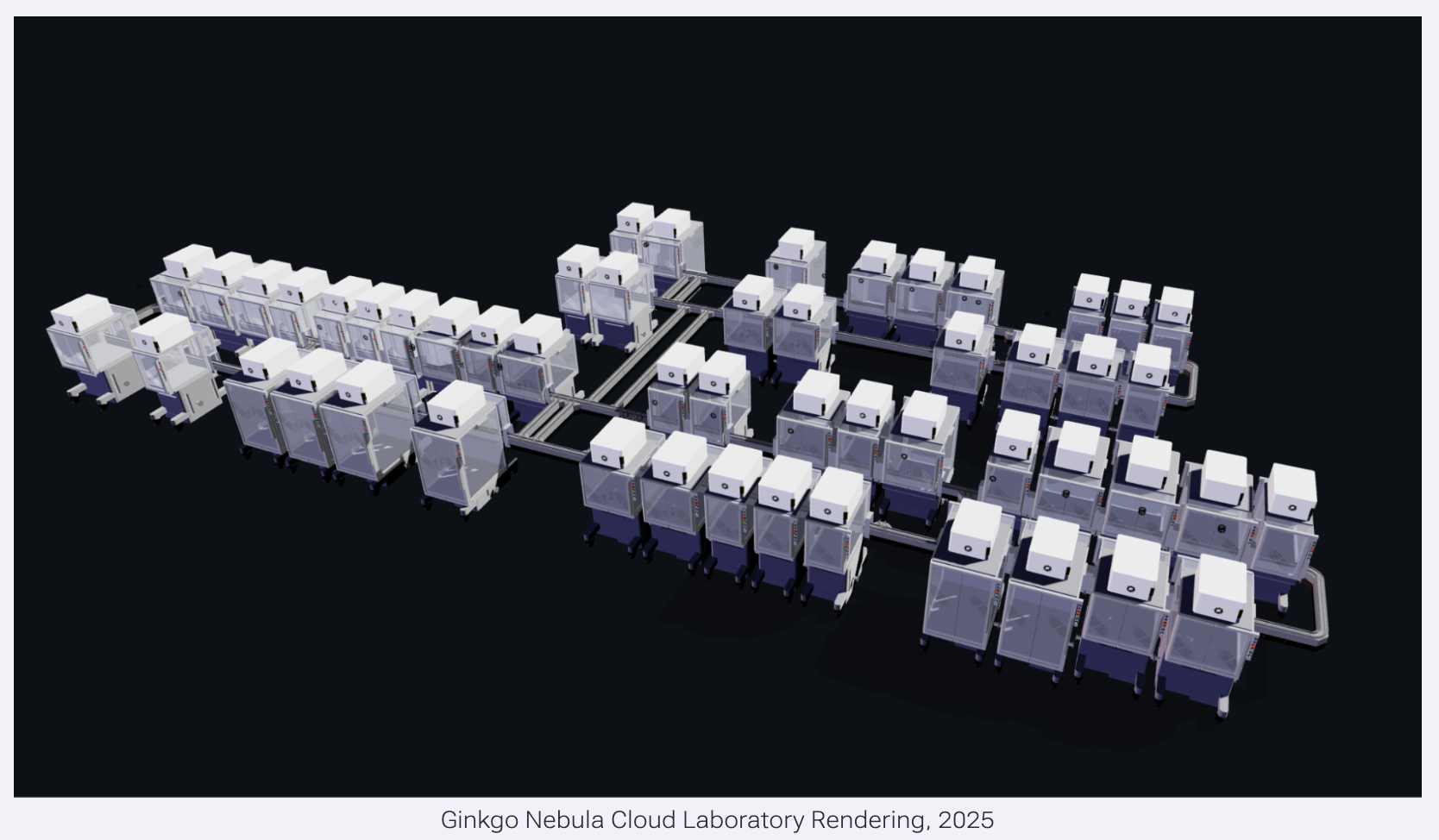
Use this simulation tool to create an interesting-looking cloud lab out of the Ginkgo Reconfigurable Automation Carts. This is just a minimal implementation so far, but I would love to see some fun designs!