Week 1 HW: Principles and Practices
At the core of the project is the development of an improved bioprinter designed for two-color bacterial printing using two strains of Escherichia coli: a non-pathogenic, non-modified strain and a genetically transformed strain carrying a plasmid encoding the expression of a color marker. This approach enables the creation of visually distinguishable bacterial images and expands both the artistic and research potential of bioprinting.
The printing process is organized according to a principle conceptually similar to offset printing, where different “layers” or channels correspond to different bacterial suspensions. This makes it possible to consider the bioprinter both as a bioengineering tool and as an experimental platform for rethinking printing technologies. An important artistic dimension lies in the reinterpretation of bacteriological photography. What if documenting bacterial growth will be actively constructed and time-based compositioned, where biological processes function as both medium and subject? The project is based on research of authorship, temporality, and the limits in working with living matter.
The project will be integrated into the educational framework of the University and will be oriented toward an open and interdisciplinary format, as the developed technology, DIY solutions, and methodological approaches are intended to be used by students, researchers, artists, and participants in citizen science.
The project’s primary goal is to foster a constructive user community, uniting students, researchers, artists, and citizen science participants through an arts & science approach. The focus is on democratizing and improving bioprinting, providing accessible tools and documentation, and integrating the project into educational courses and workshops, alongside artistic contexts. This approach promotes education and engagement among a broad audience, fosters a culture of responsible use of living and genetically modified objects, and supports interdisciplinary interactions between science and art.
Purpose: In the local context, bioprinting training courses are limited to single-color cultures, and access to the technology for a wide range of participants is limited. This project proposes two-color bacterial printing using two E. coli strains (non-pathogenic and genetically modified with a colored marker), organized according to principles similar to offset printing. This will improve bioprinting technology and create visually distinguishable images. This allows for reproducible experiments and enables artistic interpretation of bacterial photography as a research phenomenon. The goal is to expand the educational, scientific, and artistic possibilities of bioprinting and make the technology accessible to students, artists, and citizen science participants.
Design:
- DIY bioprinter working with two types of suspensions
- Genetically modified and non-pathogenic E. coli strains, safe for use at the BSL-1 educational level
- Safety and disposal protocols for working with live cultures
- Software and digital data recording to control printing steps, seeding coordinates, and subsequent image analysis
- Stakeholders: Faculty, laboratories, students, artists, and citizen science participants who must agree to and adhere to safety and ethical standards
- Funding for materials, assembly of DIY devices, and organization of courses/workshops.
Assumptions: It’s important that participants follow safety protocols and not modify strains outside of an educational context or without properly created sterile conditions. Also, sometimes the artistic aspect (for example, bacterial photography) may be perceived as science visualization, but in reality, it’s about integrating science, technology, and art through educational and research tools. And creating a DIY device, using equipment and living objects/subjects, and conducting educational courses requires funding, which can be quite a challenge.
Risks of Failure & “Success“: Biological variability in strains can make two-color printing less reproducible. There’s also the possibility of contamination by other bacteria, as well as changes within the bacteria themselves. Technical failures in a DIY bioprinter or software can compromise the accuracy and repeatability of experiments. At the same time, natural biological variability is interesting from both a scientific and artistic perspective. Research into how to improve a DIY bioprinter or learn more about a living subject offers educational and creative value.
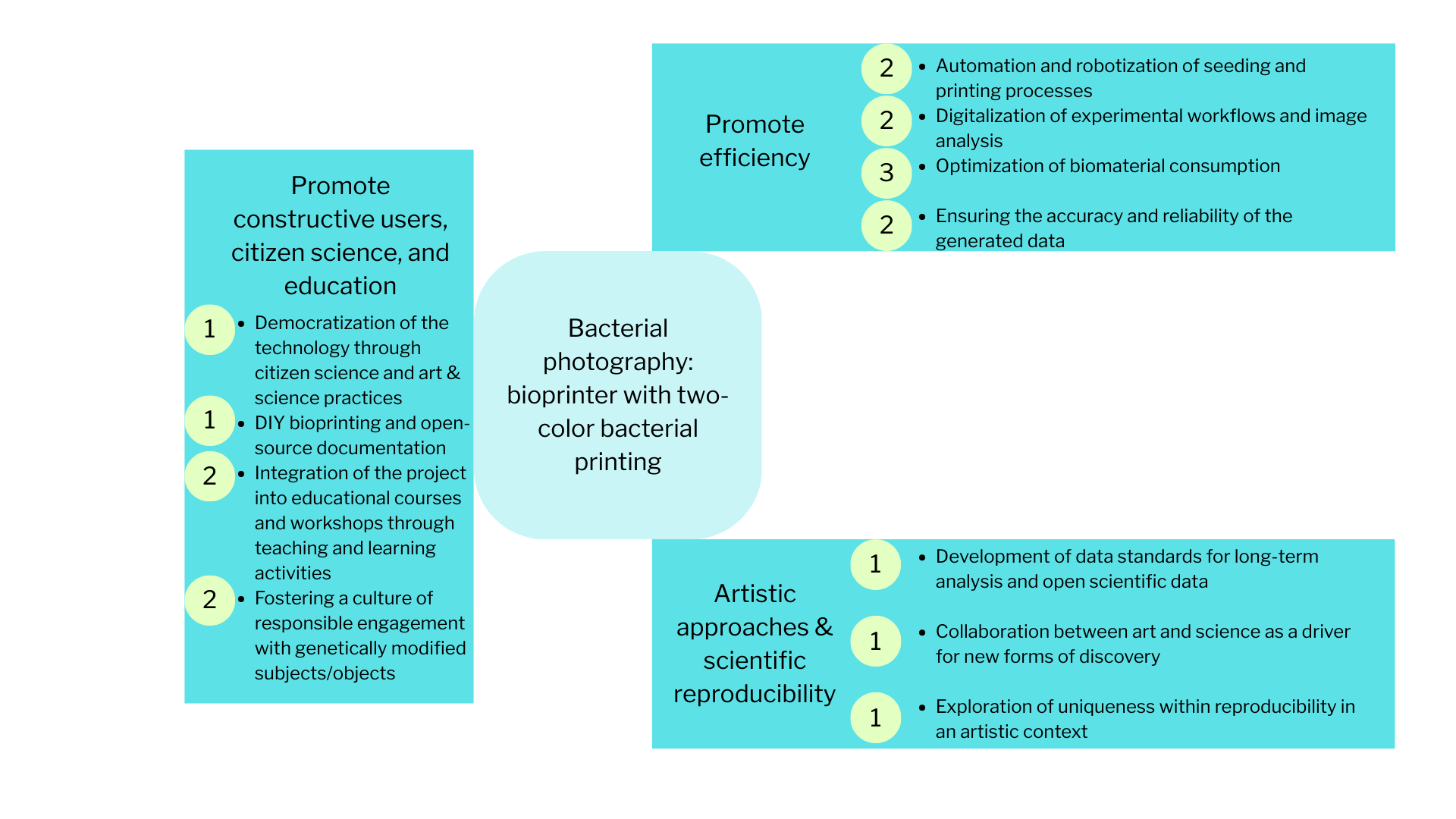
The most desirable actions are those aimed at broad audience engagement and democratization of technology. These activities have the greatest impact on the project’s success while simultaneously supporting the goals of citizen science, education, art, and science.
Homework Questions from Professor Jacobson:
- 1:106. The error rate decreases from 1:106 to 1:109, i.e. 3 thousand bp, there will be 3 thousand of these base pairs in the genome. Lead to irreversible mutations (base substitutions, insertions, or deletions). This affects the stability of the genome, causing hereditary diseases, cancer (oncogenic potential), and cellular aging. There are DNA repare systems: MutS, MutH, and MutL among prokaryotes, MSH and MLH in eukaryotes.
- For the average human protein, consisting of approximately 300-400 amino acids, there is a colossal, virtually infinite number of nucleotide coding (DNA) variants. Due to the degeneracy of the genetic code (64 codons for 20 amino acids), a single amino acid sequence can be encoded by (10^{50}-10^{100}) or more different DNA sequence variants. In practice what are some of the reasons that all of these different codes don’t work to code for the protein of interest? There will be mutations and altered more complex proteins, their function will be lost. There are conservative domains providing mRNA and/or folding stability, some functional patterns, zones marking exons/introns, start/termination of translation etc. So some sequences won’t give chemically stable, functioning or translation apropriate proteins.
Homework Questions from Dr. LeProust:
- Next Generation (Chip Based) Oligo Nucleotide Synthesis.
- Yield decrease with further synthesis steps, lower fidelity + error accumulation, hairpin / dimers / cloggs formation.
- Direct oligo synthesis is step-by-step base addition to the chain. With this technology, the yield of the full-length product decreases exponentially with each added base. Even if synthesize exact 2000 bp oligo, it would be hard to purify from, for instance, 1990 bp oligo by gel electrophoresis.
Homework Question from George Church:
- Essential amino acids are 10 organic compounds (valine, leucine, isoleucine, lysine, methionine, threonine, tryptophan, phenylalanine, histidine, arginine) that are not synthesized in the human body and must be obtained from food for muscle growth, immunity and metabolism. There is pyrrolysine also, wich occurs only in some organisms. Lysine Contigency in “Jurassic Park” movie was presented as “engineered” lack of dinosaurs’ ability to produce lysine amed to tie them to the park therritory where they could get needed supplements.