Week 11 HW: Bioproduction & Cloud Labs
Part A: The 1,536 Pixel Artwork Canvas | Collective Artwork
I contributed a one pixel on Q3 - H1 plate with mKO2 fluorescent protein, but it was overlapped by other contributions later.
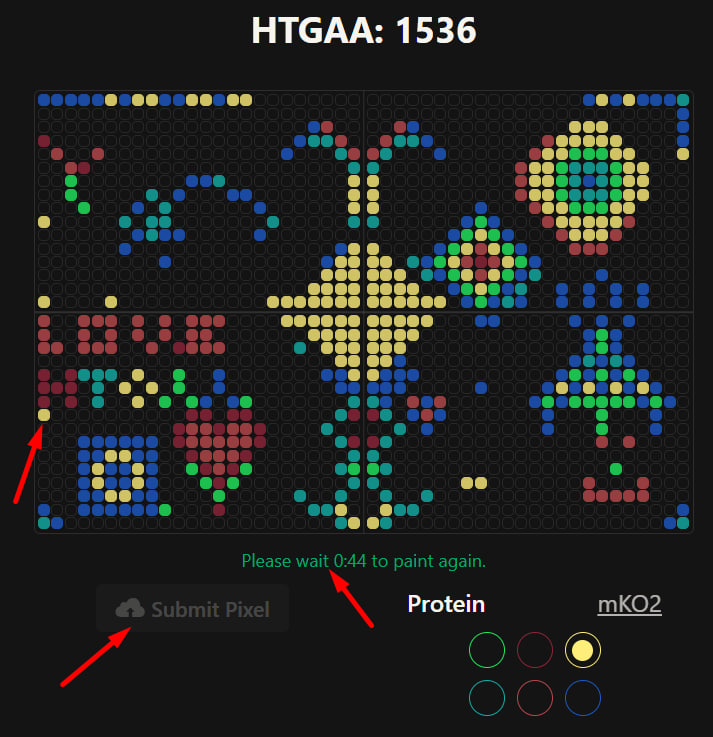
My involvement in the artwork was limited to placing a single pixel, which I used primarily to familiarize myself with the interface. I also initially assumed that the canvas had a limited number of available pixels relative to the large number of course participants. Nevertheless, I found the concept of a collaborative artwork compelling, and its implementation through a great interactive website was thoughtfully designed and inspiring. Also I found the timelapse feature particularly valuable, as it effectively illustrated both the temporal evolution of the image and the conceptual development of the artwork over time.
Part B: Cell-Free Protein Synthesis | Cell-Free Reagents
1.
E. coli Lysate Provides the core transcription–translation machinery, including ribosomes, tRNAs, aminoacyl-tRNA synthetases, metabolic enzymes, and cofactors. The BL21 (DE3) Star lysate specifically contains T7 RNA polymerase, enabling transcription from T7 promoter-driven DNA templates.
Salts / Buffer
Potassium Glutamate
Maintains intracellular-like ionic strength and supports ribosomal stability and enzymatic activity.HEPES-KOH (pH 7.5)
Buffers the reaction environment to maintain optimal pH for transcription and translation.Magnesium Glutamate
Supplies Mg²⁺ ions, essential cofactors for ribosomes, RNA polymerase, ATP-dependent enzymes, and stabilization of nucleotides.Potassium Phosphate Monobasic / Dibasic
Contribute to buffering capacity and phosphate balance, supporting nucleotide metabolism and energy regeneration pathways.
Energy / Nucleotide System
Ribose
Serves as a precursor for nucleotide biosynthesis, supporting sustained transcription.Glucose
Provides a carbon and energy source for endogenous metabolic enzymes in the lysate to regenerate ATP.AMP, CMP, GMP, UMP
Nucleotide monophosphates that are enzymatically converted into nucleotide triphosphates (ATP, GTP, CTP, UTP) required for RNA synthesis and energy transfer.Guanine
Precursor for GMP/GTP synthesis, supporting transcription and translation processes.
Translation Mix (Amino Acids)
17 Amino Acid Mix
Supplies the majority of standard amino acids required for protein synthesis.Tyrosine
Added separately due to solubility limitations; required as a substrate for protein synthesis.Cysteine
Added separately due to oxidation sensitivity; essential for protein synthesis and disulfide bond formation.
Additives
- Nicotinamide
Precursor for NAD⁺ biosynthesis, supporting redox balance and metabolic reactions required for sustained energy regeneration.
Backfill
- Nuclease-Free Water
Adjusts the final reaction volume while preventing degradation of DNA or RNA templates.
2.
The 1-hour PEP-NTP system directly supplies phosphoenolpyruvate (PEP) and nucleotide triphosphates (NTPs), enabling rapid, high-level protein production but limiting reaction duration due to fast energy depletion. In contrast, the 20-hour NMP-Ribose-Glucose system relies on nucleotide monophosphates and simple carbon sources that are enzymatically converted into active nucleotides and ATP, allowing slower yet sustained protein expression through metabolic energy regeneration.
Part C: Planning the Global Experiment | Cell-Free Master Mix Design
1.
sfGFP (superfolder GFP) is engineered for highly efficient folding and rapid maturation, making it particularly robust in cell-free systems. Its fast chromophore formation allows fluorescence to appear quickly, which improves signal reliability during short incubations.
mRFP1 has a relatively slower maturation time compared to GFP variants, which can delay fluorescence readout in cell-free expression systems. In addition, red fluorescent proteins often require more efficient folding conditions to achieve maximal fluorescence.
mKO2 is an orange fluorescent protein with relatively fast maturation among orange/red fluorophores, which improves early fluorescence detection. However, it is somewhat sensitive to acidic conditions, meaning pH fluctuations in the reaction can reduce fluorescence intensity.
mTurquoise2 is a cyan fluorescent protein with very high quantum yield and brightness, producing strong fluorescence even at moderate expression levels. Proper folding is important for maintaining its efficient chromophore structure and high signal output.
mScarlet-I is a bright red fluorescent protein with improved folding efficiency and photostability, but it still requires longer maturation times than GFP-like proteins. In cell-free systems, prolonged energy availability is important to allow complete chromophore maturation and maximal fluorescence.
Electra2 is a fluorescent protein optimized for specific spectral or functional properties, but its fluorescence output can depend strongly on oxygen availability because chromophore maturation requires oxidation reactions. Limited oxygen diffusion in dense cell-free reactions may therefore reduce fluorescence efficiency.
2.-4.
Cell-Free protein expression optimization strategy
This experiment aims to optimize fluorescence output in a cell-free expression system over a 36-hour incubation by systematically targeting limiting biochemical factors. I selected two fluorescent proteins with distinct maturation kinetics:
- sfGFP (fast-folding, rapid maturation)
- mScarlet-I (slow maturation, higher dependence on sustained expression)
To maintain interpretability, a controlled experimental design is used, where each protein is optimized along a single dominant axis:
- translation efficiency (Mg²⁺) for sfGFP
- energy availability for mScarlet-I
1) sfGFP Optimization (Translation-Limited Regime)
Fluorescence output of sfGFP is primarily limited by translation efficiency. Increasing magnesium glutamate concentration will enhance ribosome stability and catalytic activity, resulting in increased protein yield and fluorescence. Because sfGFP folds efficiently and matures rapidly, fluorescence output is expected to scale with total protein synthesis rather than maturation time.
Experimental Design (4 wells)
| Well | Mg²⁺ concentration (mM) |
|---|---|
| 1 | 7 (baseline) |
| 2 | 9 |
| 3 | 11 |
| 4 | 13 |
Expected Outcome
- enhance translation rate
- increase total sfGFP yield
- produce higher fluorescence intensity
2) mScarlet-I Optimization (Energy-Limited Regime)
Fluorescence output of mScarlet-I is limited by energy availability over extended incubation. Increasing glucose and ribose concentrations will prolong ATP regeneration, enabling sustained protein synthesis and improved chromophore maturation. mScarlet-I requires extended translation time and post-translational chromophore maturation. Thus, system longevity is the dominant constraint.
Experimental Design (4 wells)
| Well | Glucose (g/L) | Ribose (g/L) |
|---|---|---|
| 5 | 1.25 (baseline) | 11.6 (baseline) |
| 6 | 2.5 | 11.6 |
| 7 | 1.25 | 16 |
| 8 | 2.5 | 16 |
Expected Outcome
- extend reaction lifetime
- increase cumulative protein production
- allow more complete chromophore maturation
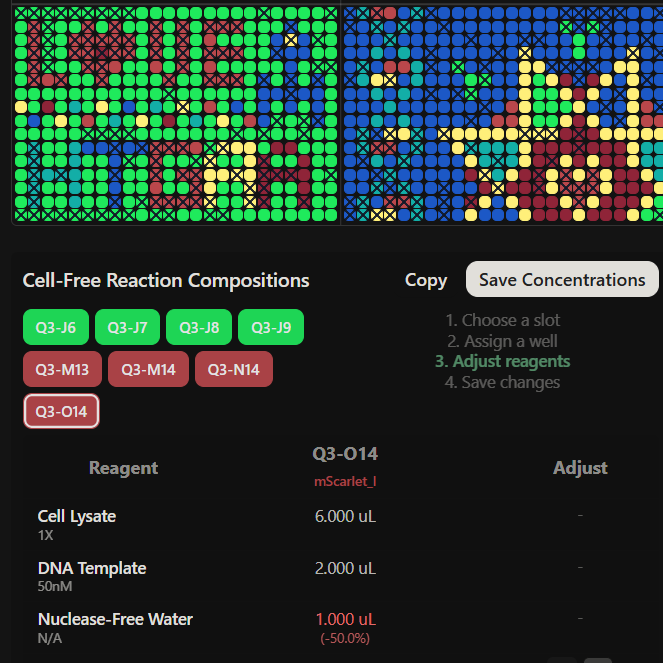 Assigned wells and adjusted reagents