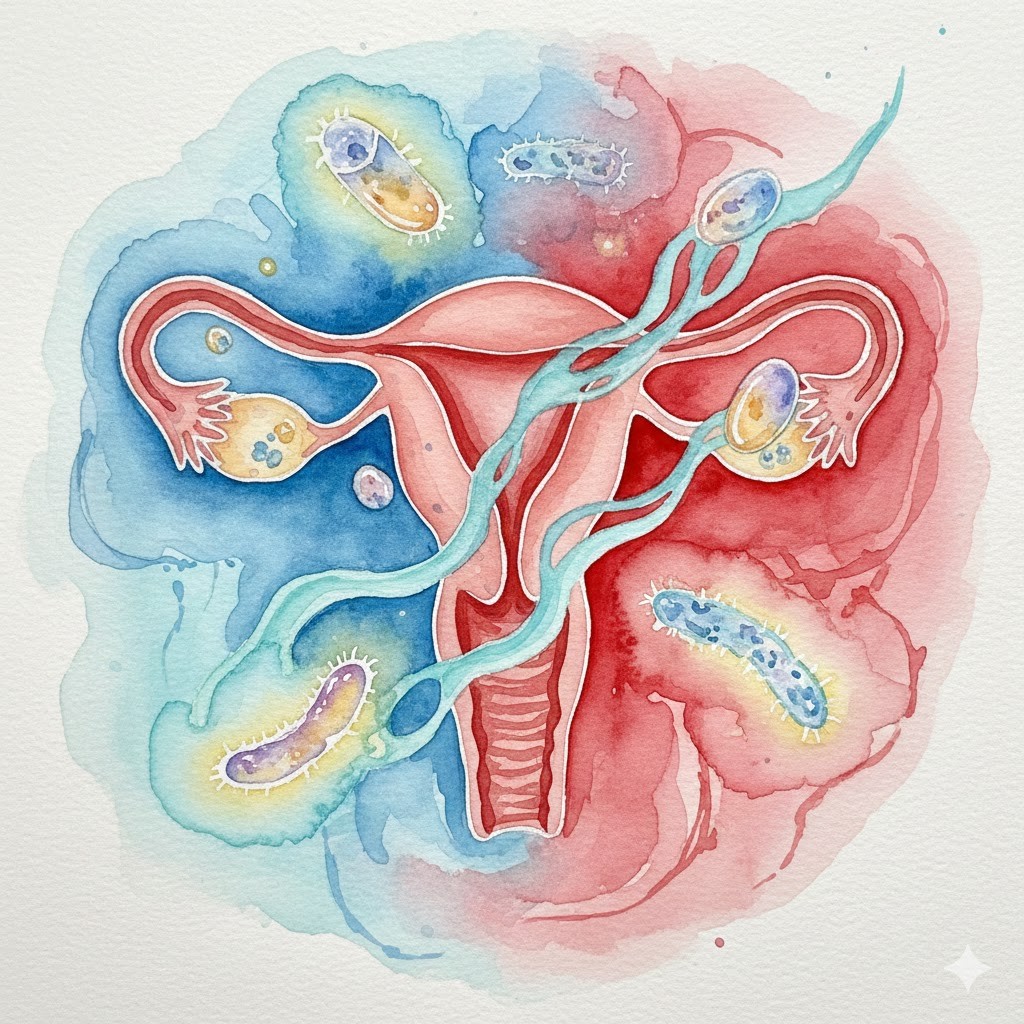
Homework for Week 2: read–write–edit toolkit: sequencing and synthesis workflows, restriction digests and gel electrophoresis, and early genome-editing frameworks.
Question 1:First, describe a biological engineering application or tool you want to develop and why. This could be inspired by an idea for your HTGAA class project and/or something for which you are already doing in your research, or something you are just curious about.
Answer: I’m pursuing a PhD in which my daily work revolves around bacterial engineering. I work with both model and non-model strains, mainly within the probiotic field, though not yet in therapeutic applications. However, there is a challenge that many women, including myself, have faced since puberty: menstrual pain. In Argentina, we often say “estoy indispuesta” during that week—literally, “I’m unwell.” But it shouldn’t have to be that way.
Scientific literature provides strong evidence supporting the use of natural compounds to alleviate dysmenorrhea. Natural compounds like ginger, turmeric, fennel, and lavender have been widely studied as non-pharmacological alternatives. Probiotics, on the other hand, are known to modulate the gut–reproductive axis, and growing evidence links gut dysbiosis to menstrual pain and endometriosis. This intersection between microbiome research and women’s health represents a promising direction for developing new engineered probiotic tools to help manage dysmenorrhea naturally. https://publishing.emanresearch.org/Journal/FullText/6163
Question 2:Next, describe one or more governance/policy goals related to ensuring that this application or tool contributes to an “ethical” future, like ensuring non-malfeasance (preventing harm). Break big goals down into two or more specific sub-goals. Below is one example framework (developed in the context of synthetic genomics) you can choose to use or adapt, or you can develop your own. The example was developed to consider policy goals of ensuring safety and security, alongside other goals, like promoting constructive uses, but you could propose other goals for example, those relating to equity or autonomy.
Answer: For my engineered probiotic tool designed to alleviate dysmenorrhea by modulating the gut-reproductive axis, I propose governance/policy goals focused on ensuring non-maleficence (preventing harm) and promoting equity in access, adapting the synthetic genomics framework to the therapeutic microbiome context. These goals ensure the innovation contributes to an ethical future by prioritizing clinical safety and social inclusion.
Goal 1: Ensure non-maleficence (preventing harm).
This minimizes risks from live modified probiotics, such as unintended colonization or immune interactions.
Sub-goal 1.1: Mandate preclinical testing for persistence and dissemination in vitro/in vivo models (e.g., intestinal and reproductive organoids), enforcing strict viability limits (e.g., <1% survival after 7 days post-administration).
Sub-goal 1.2: Establish post-market surveillance for adverse effects in vulnerable populations (e.g., those with endometriosis or during pregnancy), aligned with GRAS guidelines from regulatory bodies like FDA/EMA.
Goal 2: Promote equity in access and constructive uses.
This prevents exacerbation of global health disparities by ensuring broad, inclusive benefits.
Sub-goal 2.1: Prioritize inclusive clinical trials that recruit diverse demographics (age, ethnicity, socioeconomic status) to validate efficacy across populations and prevent biased outcomes.
Sub-goal 2.2: Develop culturally sensitive informed consent frameworks, including multilingual education on risks/benefits to empower user autonomy and avoid coercive applications.
Question 3:Next, describe at least three different potential governance “actions” by considering the four aspects below (Purpose, Design, Assumptions, Risks of Failure & “Success”). Try to outline a mix of actions (e.g. a new requirement/rule, incentive, or technical strategy) pursued by different “actors” (e.g. academic researchers, companies, federal regulators, law enforcement, etc). Draw upon your existing knowledge and a little additional digging, and feel free to use analogies to other domains (e.g. 3D printing, drones, financial systems, etc.).
Purpose: What is done now and what changes are you proposing?
Design: What is needed to make it “work”? (including the actor(s) involved - who must opt-in, fund, approve, or implement, etc)
Assumptions: What could you have wrong (incorrect assumptions, uncertainties)?
Risks of Failure & “Success”: How might this fail, including any unintended consequences of the “success” of your proposed actions?
Answer:
Action 1: New Rule – Required Persistence Tests Before Trials (Federal Regulators)
Purpose: Probiotics now get simple safety reviews under Generally Recognized as Safe rules, but engineered ones need better checks for spreading in the body. This rule requires tests using organoids (mini-organs) before human trials.
Design: Agencies like the Food and Drug Administration or European Medicines Agency handle this through online submissions. Researchers and companies pay for lab tests and get approval only if strains survive less than 1% after 7 days outside the body.
Assumptions: Organoids fully mimic real human microbiomes; regulators can review quickly.
Risks of Failure & “Success”: Tests might use flawed models and slow down helpful treatments. If too strict, it could block safe innovations, much like early drone rules delayed useful tech.
Action 2: Funding Incentive – Grants for Diverse Clinical Trials (Governments and Foundations)
Purpose: Current trials often focus on wealthy groups; this offers grants to include people of different ages, ethnicities, and incomes for fairer results.
Design: Governments and foundations provide extra funding. Companies and academics submit diversity plans, tracked with enrollment targets and public reports.
Assumptions: More diversity means better results for everyone; teams will chase grants over profits.
Risks of Failure & “Success”: Plans might look good on paper but exclude people anyway, wasting money. Success could force small researchers to compete unfairly.
Action 3: Monitoring Strategy – Public Adverse Event Database (International Health Organizations)
Purpose: Probiotics currently lack centralized tracking of side effects after use; this creates an open database for users and doctors to report issues in real time.
Design: Groups like the World Health Organization or Centers for Disease Control run it as a simple app or website. Companies must link it to product labels, and regulators review data yearly to update guidelines.
Assumptions: People will report problems accurately and often; data stays private enough for users.
Risks of Failure & “Success”: Low reporting could miss rare issues, delaying fixes. If too popular, it might spark unnecessary panic over minor side effects, like social media amplifying rare vaccine concerns.
Question 4:Next, score (from 1-3 with, 1 as the best, or n/a) each of your governance actions against your rubric of policy goals. The following is one framework but feel free to make your own:
Does the option:
Option 1
Option 2
Option 3
Enhance Biosecurity
• By preventing incidents
1
3
2
• By helping respond
2
3
1
Foster Lab Safety
• By preventing incident
2
3
3
• By helping respond
3
3
1
Protect the environment
• By preventing incidents
1
3
3
• By helping respond
2
3
1
Other considerations
• Minimizing costs and burdens to stakeholders
2
1
1
• Feasibility?
1
1
1
• Not impede research
2
1
2
• Promote constructive applications
1
1
2
Question 5:Last, drawing upon this scoring, describe which governance option, or combination of options, you would prioritize, and why. Outline any trade-offs you considered as well as assumptions and uncertainties. For this, you can choose one or more relevant audiences for your recommendation, which could range from the very local (e.g. to MIT leadership or Cambridge Mayoral Office) to the national (e.g. to President Biden or the head of a Federal Agency) to the international (e.g. to the United Nations Office of the Secretary-General, or the leadership of a multinational firm or industry consortia). These could also be one of the “actor” groups in your matrix.
Reflecting on what you learned and did in class this week, outline any ethical concerns that arose, especially any that were new to you. Then propose any governance actions you think might be appropriate to address those issues. This should be included on your class page for this week.
Answer: I recommend prioritizing a combination of Action 1 (Required Persistence Tests) and Action 3 (Public Adverse Event Database) for federal regulators like the Food and Drug Administration or European Medicines Agency, with Action 2 (Diverse Trial Grants) as a supporting incentive from governments and foundations. This mix delivers comprehensive coverage: prevention via testing, rapid response via reporting, and equity via funding.
Action 1 stops problems early (top scores for biosecurity and environment prevention).
Action 3 tracks issues fast after use (best for response across safety areas).
Together, they average the strongest scores (~1.8). Action 2 helps by funding trials and cutting costs so rules don’t hurt small labs.
Trade-offs
Safety vs. Speed: Tests add time upfront (Action 1), but the database speeds fixes later (Action 3).
Cost vs. Coverage: Database is cheap, but needs people to report; grants make tests affordable.
Skip Action 2 alone—it’s great for fairness but weak on stopping harm.
Assumptions & Uncertainties
Assume regulators can handle reviews without delays and people report side effects often.
Uncertainty: Lab models might miss real body effects;
Low reports could weaken tracking.
Week 2: DNA read, write and edit
** Assignment (Week 2 Lecture Prep) — DUE BY START OF FEB 10 LECTURE**
Homework Questions from Professor JacobsonNature’s machinery for copying DNA is called polymerase. What is the error rate of polymerase? How does this compare to the length of the human genome. How does biology deal with that discrepancy?
Answer: DNA polymerase typically makes 1 mistake per 10⁶ nucleotides (1:10⁶) during replication. The human genome is roughly 3.2 billion base pairs (3.2 × 10⁹ bp or 3.2 Gbp), which is much larger than the raw error rate would suggest, so without correction, thousands of errors could accumulate per replication. But biology is smart:
Many polymerases have a 3’→5’ exonuclease activity that can remove incorrectly added nucleotides immediately.
After replication, mismatch repair systems scan the DNA and fix remaining errors. Together, these mechanisms reduce the effective error rate to ~1 mistake per 10⁹–10¹⁰ nucleotides, ensuring genome integrity.
How many different ways are there to code (DNA nucleotide code) for an average human protein? In practice what are some of the reasons that all of these different codes don’t work to code for the protein of interest?
Answer: Number of coding possibilities:
The genetic code is degenerate, meaning most amino acids are encoded by multiple codons.
An average human protein is roughly 400 amino acids long.
Since each amino acid can be coded by 1–6 codons, the total number of possible DNA sequences is huge (roughly ~10¹⁹⁰–10²⁰⁰ possible sequences for a 400-amino acid protein).
Why not all codes work in practice:
Codon bias: Some codons are preferred over others in human cells for efficient translation. Using rare codons can slow down protein production or cause misfolding. Thats why when you work with a certain microorganism you have to make sure you codon optimize the sequence for that particular organism.
mRNA structure: Certain sequences can form strong secondary structures (hairpins) that interfere with translation or stability. There are online tools that helps you calculate that probability.
Regulatory signals: Some sequences might accidentally create splice sites, ribosome binding problems, or cryptic start/stop codons.
Protein folding: Synonymous codons can affect the speed of translation, which in turn affects co-translational protein folding.
GC content and stability: Extremes in GC or AT content can make the mRNA unstable or harder to transcribe.
Homework Questions from Dr. LeProust:What’s the most commonly used method for oligo synthesis currently?
Why is it difficult to make oligos longer than 200nt via direct synthesis?
Why can’t you make a 2000bp gene via direct oligo synthesis?
Answer: Chip-based oligonucleotide synthesis is widely used for high-throughput synthesis of many short DNA sequences (oligos) in parallel.
Why difficult to make oligos >200nt:
Stepwise synthesis errors: Each nucleotide is added one at a time, and the efficiency is less than 100% per step (~99–99.5%), so errors accumulate.
Purity drops with length: Longer oligos have more incomplete or incorrect sequences, making them unreliable above ~200 nucleotides.
Why you can’t make a 2000bp gene directly: Direct synthesis of 2000 base pairs would require stitching together ~10 oligos of 200nt each (or many more if using shorter oligos).
Error rate accumulation: The chance that a full-length sequence is error-free is low.
Solution in practice: Genes of this length are assembled from shorter oligos using assembly methods such as PCR assembly, Gibson assembly, or Golden Gate assembly.
Homework Question from George Church:Choose ONE of the following three questions to answer; and please cite AI prompts or paper citations used, if any.
Question: Using Google & Prof. Church’s slide #4, what are the 10 essential amino acids in all animals and how does this affect your view of the “Lysine Contingency”?
Answer: Animals require certain amino acids from their diet because they cannot synthesize them internally. These essential amino acids include Histidine, Isoleucine, Leucine, Lysine, Methionine, Phenylalanine, Threonine, Tryptophan, Valine, and in some cases Arginine. Lysine, being one of these essential amino acids, is already universally required for survival, so designing a “Lysine Contingency” is not particularly practical, as organisms cannot grow without it anyway. In contrast, Arginine is considered conditionally essential; most adults can produce it internally, but under stress, rapid growth, or other special conditions, dietary intake becomes necessary. Choosing Arginine as a contingency could therefore be more effective in a synthetic biology or containment context, because an engineered organism could be designed to depend on external Arginine, providing a controllable mechanism for survival. This comparison highlights how the essentiality of an amino acid determines whether it can realistically be used for biocontainment strategies.
Part 1: Benchling & In-silico Gel Art
See the Gel Art: Restriction Digests and Gel Electrophoresis protocol for details. Overview:
Make a free account at benchling.com
Import the Lambda DNA.
Simulate Restriction Enzyme Digestion with the following Enzymes:
    EcoRI
    HindIII
    BamHI
    KpnI
    EcoRV
    SacI
    SalI
Create a pattern/image in the style of Paul Vanouse’s Latent Figure Protocol artworks.
You might find Ronan’s website a helpful tool for quickly iterating on designs!
Answer:
Part 3: DNA Design Challenge3.1. Choose your protein.
In recitation, we discussed that you will pick a protein for your homework that you find interesting. Which protein have you chosen and why? Using one of the tools described in recitation (NCBI, UniProt, google), obtain the protein sequence for the protein you chose.
Answer:
I chose the NorR transcription factor. It binds specifically to NO molecules.
Nitric oxide is a classic sign of acute inflammation and oxidative stress in uterine tissue. So when NO is present, it binds to NorR, the protein changes shape and activates a specific promoter (called PnorV). The idea is that the latter activates the expression of some anti-inflammatory protein (for which I am still looking for ideas).
It was difficult to find the sequence. Finally, I found a paper where they listed the nucleotides in the supplementary material. I copied the sequence into Benchling, selected it, and did a blast. I found it was in Escherichia coli strain MC1061 chromosome. And enter the protein ID: /protein_id=“YBO70461.1”
3.2. Reverse Translate: Protein (amino acid) sequence to DNA (nucleotide) sequence.
The Central Dogma discussed in class and recitation describes the process in which DNA sequence becomes transcribed and translated into protein. The Central Dogma gives us the framework to work backwards from a given protein sequence and infer the DNA sequence that the protein is derived from. Using one of the tools discussed in class, NCBI or online tools (google “reverse translation tools”), determine the nucleotide sequence that corresponds to the protein sequence you chose above.
Answer:
As previously said, I already had the DNA sequence, but I either way tried a tool to reverse translate the protein sequence to DNA. I’ve used: Reverse Translate
Reverse Translate results
Results for 504 residue sequence “YBO70461.1 nitric oxide reductase transcriptional regulator NorR [Escherichia coli]” starting “MSFSVDVLAN”
reverse translation of YBO70461.1 nitric oxide reductase transcriptional regulator NorR [Escherichia coli] to a 1512 base sequence of most likely codons.
atgagctttagcgtggatgtgctggcgaacattgcgattgaactgcagcgcggcattggc
catcaggatcgctttcagcgcctgattaccaccctgcgccaggtgctggaatgcgatgcg
agcgcgctgctgcgctatgatagccgccagtttattccgctggcgattgatggcctggcg
aaagatgtgctgggccgccgctttgcgctggaaggccatccgcgcctggaagcgattgcg
cgcgcgggcgatgtggtgcgctttccggcggatagcgaactgccggatccgtatgatggc
ctgattccgggccaggaaagcctgaaagtgcatgcgtgcgtgggcctgccgctgtttgcg
ggccagaacctgattggcgcgctgaccctggatggcatgcagccggatcagtttgatgtg
tttagcgatgaagaactgcgcctgattgcggcgctggcggcgggcgcgctgagcaacgcg
ctgctgattgaacagctggaaagccagaacatgctgccgggcgatgcgaccccgtttgaa
gcggtgaaacagacccagatgattggcctgagcccgggcatgacccagctgaaaaaagaa
attgaaattgtggcggcgagcgatctgaacgtgctgattagcggcgaaaccggcaccggc
aaagaactggtggcgaaagcgattcatgaagcgagcccgcgcgcggtgaacccgctggtg
tatctgaactgcgcggcgctgccggaaagcgtggcggaaagcgaactgtttggccatgtg
aaaggcgcgtttaccggcgcgattagcaaccgcagcggcaaatttgaaatggcggataac
ggcaccctgtttctggatgaaattggcgaactgagcctggcgctgcaggcgaaactgctg
cgcgtgctgcagtatggcgatattcagcgcgtgggcgatgatcgctgcctgcgcgtggat
gtgcgcgtgctggcggcgaccaaccgcgatctgcgcgaagaagtgctggcgggccgcttt
cgcgcggatctgtttcatcgcctgagcgtgtttccgctgagcgtgccgccgctgcgcgaa
cgcggcgatgatgtgattctgctggcgggctatttttgcgaacagtgccgcctgcgccag
ggcctgagccgcgtggtgctgagcgcgggcgcgcgcaacctgctgcagcattatagcttt
ccgggcaacgtgcgcgaactggaacatgcgattcatcgcgcggtggtgctggcgcgcgcg
acccgcagcggcgatgaagtgattctggaagcgcagcattttgcgtttccggaagtgacc
ctgccgaccccggaagtggcggcggtgccggtggtgaaacagaacctgcgcgaagcgacc
gaagcgtttcagcgcgaaaccattcgccaggcgctggcgcagaaccatcataactgggcg
gcgtgcgcgcgcatgctggaaaccgatgtggcgaacctgcatcgcctggcgaaacgcctg
ggcctgaaagat
3.3. Codon optimization.
Answer:
Once a nucleotide sequence of your protein is determined, you need to codon optimize your sequence. You may, once again, utilize Google for a “codon optimization tool”. In your own words, describe why you need to optimize codon usage. Which organism have you chosen to optimize the codon sequence for and why?
Page said: 404 not found. But in my case i would like to use E.coli as my host organism, and the protein is already from E.coli. So no need for optimizing. In case I later decide to use other bacteria, this optimization will be necessary.
(i) What DNA would you want to sequence (e.g., read) and why? This could be DNA related to human health (e.g. genes related to disease research), environmental monitoring (e.g., sewage waste water, biodiversity analysis), and beyond (e.g. DNA data storage, biobank).
(ii) In lecture, a variety of sequencing technologies were mentioned. What technology or technologies would you use to perform sequencing on your DNA and why?
Also answer the following questions:
Is your method first-, second- or third-generation or other? How so?
What is your input? How do you prepare your input (e.g. fragmentation, adapter ligation, PCR)? List the essential steps.
What are the essential steps of your chosen sequencing technology, how does it decode the bases of your DNA sample (base calling)?
What is the output of your chosen sequencing technology?
Answer:
I want to sequence two types of DNA:
Synthetic Plasmid DNA: After assembling the genetic cassette i will sequencing to ensure that there are no frameshift mutations or errors in the codons. I would use Sanger Sequencing for this. Sanger is first generation (chain termination)
E. coli Nissle 1917 Genome (Post-editing): If I decide to integrate the circuit into the bacterial chromosome, I need to sequence the entire genome to confirm that the insertion occurred at the desired locus and that there were no off-target effects that compromise the safety of the probiotic. I would use Oxford Nanopore Technologies for whole genome verification.Nanopore is third generation (real-time single molecule).
From both, I will receive a FASTQ file containing the read sequences and their quality scores.
5.2 DNA Write
(i) What DNA would you want to synthesize (e.g., write) and why? These could be individual genes, clusters of genes or genetic circuits, whole genomes, and beyond. As described in class thus far, applications could range from therapeutics and drug discovery (e.g., mRNA vaccines and therapies) to novel biomaterials (e.g. structural proteins), to sensors (e.g., genetic circuits for sensing and responding to inflammation, environmental stimuli, etc.), to art (DNA origamis). If possible, include the specific genetic sequence(s) of what you would like to synthesize! You will have the opportunity to actually have Twist synthesize these DNA constructs! :)
I want to synthesize a genetic sensor-response circuit for the relief of menstrual pain. The goal is to create a “living therapeutic” that detects nitric oxide (NO) and secretes analgesic peptides.
5.3 DNA Edit
(i) What DNA would you want to edit and why? In class, George shared a variety of ways to edit the genes and genomes of humans and other organisms. Such DNA editing technologies have profound implications for human health, development, and even human longevity and human augmentation. DNA editing is also already commonly leveraged for flora and fauna, for example in nature conservation efforts, (animal/plant restoration, de-extinction), or in agriculture (e.g. plant breeding, nitrogen fixation). What kinds of edits might you want to make to DNA (e.g., human genomes and beyond) and why?
Answer:
I want to edit the genome of the bacterium E. coli Nissle 1917.
Reason: For greater stability and safety, I want to integrate the NO sensor circuit directly into the bacterium’s chromosome (a neutral site) rather than keeping it in a plasmid. This prevents the loss of the circuit and eliminates the need to use antibiotics to keep the plasmid inside the women.
(ii) What technology or technologies would you use to perform these DNA edits and why?
Answer:
I would use the Lambda Red homologous recombination system because it allows for the direct exchange of large DNA fragments through homology in a very efficient manner in microorganisms.
Some notes
Practice
Dilution Practice 1
Scenario: The stock concentration of a mystery substance (MS) is 5 M. Calculate how to dilute to 100 µM (0.1 mM): Use sequential 1:499 and 1:99 dilution steps for accurate preparation. Step 1: Dilute 5 M (5,000,000 µM) to 10,000 µM (500x dilution). Step 2: Dilute 10,000 µM to 100 µM (100x dilution).
Dilution Practice 2
Scenario: The stock concentration of a mystery substance (MS) is 5 M. Calculate how to dilute to 100 µM (0.1 mM):
Use sequential 1:499 and 1:99 dilution steps for accurate preparation.
Step 1: Dilute 5 M (5,000,000 µM) to 10,000 µM (500x dilution).
Step 2: Dilute 10,000 µM to 100 µM (100x dilution).
Dilution Practice 2
The stock concentration of a mystery substance (MS) is 5 M.
If the molar mass of MS is 532 g/mol, what’s the concentration of the stock concentration in g/mL? To make your life easier, you can use one of many online calculators.
You will perform a serial dilution to get 100 uM of MS. Devise a plan to dilute a 5 M MS solution to 100 uM. How many dilution steps will we need? Which tubes should we use? Which pipettes?
Fill out the following chart to prepare a final reaction with 60 uL reaction volume. Why did we make 100 uM MS if we actually need 40 uM MS? Why not prepare 40 uM in serial dilutions?
Keeping a 100 µM stock as your working standard gives flexibility, longer shelf life, and higher precision for multiple experiments.