Week 1 HW: Principles and Practices

1. Biological engineering application: The development of various therapies in which they employ stem cells in Peru, to treat neurodegenerative diseases and chronic diseases. Along with this the appropriate regulations for this type of therapy. -> Why I chose this application: Because in Peru there is an increase in the development of various clinical therapies for diseases that have been very expensive to access, so the emergence of stem cell applications are recent. This is also due to a problem, this is more than anything focused on the little regulation on this type of treatment, which limits the creation of more trained centers, generating a delay in the access of new therapies and research.
2. Ethical future:
- Governance and policy objectives in Peru Overall objective: To establish a comprehensive framework that ensures stem cell therapies in Peru are safe, effective, and equitably accessible across all health sectors—both private and public—while fostering sustainable development of regenerative medicine in the country.
In addition, a specific and clear regulation must also be provided, which must be supervised by one or more public entities. Also to have control over the misleading commercial use of stem cells without clinical evidence, in order to provide health security for patients in the face of medical fraudulence. Finally, the approach of accessibility and equity, since what is expected to be achieved through the creation of centers with stem cell therapies is to facilitate access to these therapies in public and private hospitals, avoiding that they are only for sectors of high purchasing power those who have access to these therapies, this would help to reduce a gap in the health system that every year continues to be larger.
3. Governance Actions
| Governance actions | Purpose | Design | Assumptions | Risks of Failure & “Success” |
|---|---|---|---|---|
| Option 1: Creation and implementation of a specific and explicit regulation focused on stem cell therapies. | Regulate the development and application of therapies, through various regulations and standards in which clinical evidence is provided prior to their use in humans, avoiding exposing patients to treatments that are not viable. | The Ministry of Health should approve regulations and require researchers to conduct clinical trials for new therapies. | It should be assumed that the Ministry of Health has sufficient budget to create a supervisory and oversight body. There may be resistance from clinics or private entities offering unregulated therapies. | If it “fails”, treatments without evidence will continue to exist, harming the lives of patients. If it “succeeds”, it could increase the cost and delay promising therapies, especially in terms of reducing the health care gap. |
| Option 2: Sanctions for clinics that offer treatments without scientific support or violate patient confidentiality. | Preventing medical and scientific fraud, seeking to ensure that patients receive safe treatments, without affecting their integrity. | Creating a supervisory unit within the Ministry of Health focused primarily on inspecting clinics and hospitals that provide such treatment. Instead of failing to comply with what is necessary, fines should be established and establishments closed. | It is assumed that patients are aware of the regulations that will be established and can report any type of infraction. | If it “fails”, medical fraud will continue, affecting many more patients, generating large-scale economic loss. If it is “successful”, some clinics could operate clandestinely, but it would be quicker to recognize whether they are fraud or not. |
| Option 3: Development of a program for equitable access therapies in public hospitals. | Ensure that most patients with chronic diseases have access to advanced therapies without high costs, especially in the public health system. | The Ministry of Health should finance local research in each region of Peru, along with allowing national hospitals to offer therapies regulated by the regulations that are sought to be established. Obtain joint cooperation, universities, research centers and hospitals to promote research in this sector. | It is assumed that there is sufficient infrastructure and personnel who can be trained to carry out these therapies safely. In any case, an investment in the private sector in conjunction with research centers at the national level would be assumed. | If it “fails”, only the wealthy will be able to access these treatments. If it “succeeds”, demand may exceed the capacity of the health system, but it would be sought to channel it to make it accessible to the majority of citizens. |
4. Evaluation of Governance Actions
(Score from 1-3, with 1 as the best and 3 the least effective)
| Governance actions (options) | Ethics | Accessibility | Equitative | Biosecurity | Promote investigation | Reduce breach in health system |
|---|---|---|---|---|---|---|
| Creation and implementation of a specific and explicit regulation | 1 | 1 | 2 | 1 | 1 | 1 |
| Sanctions for clinics that offer treatments without scientific support | 1 | 1 | 2 | 1 | 2 | 3 |
| Development of a program for equitable access therapies | 2 | 1 | 1 | 1 | 2 | 1 |
5. DRAW AND THE BEST OPTION
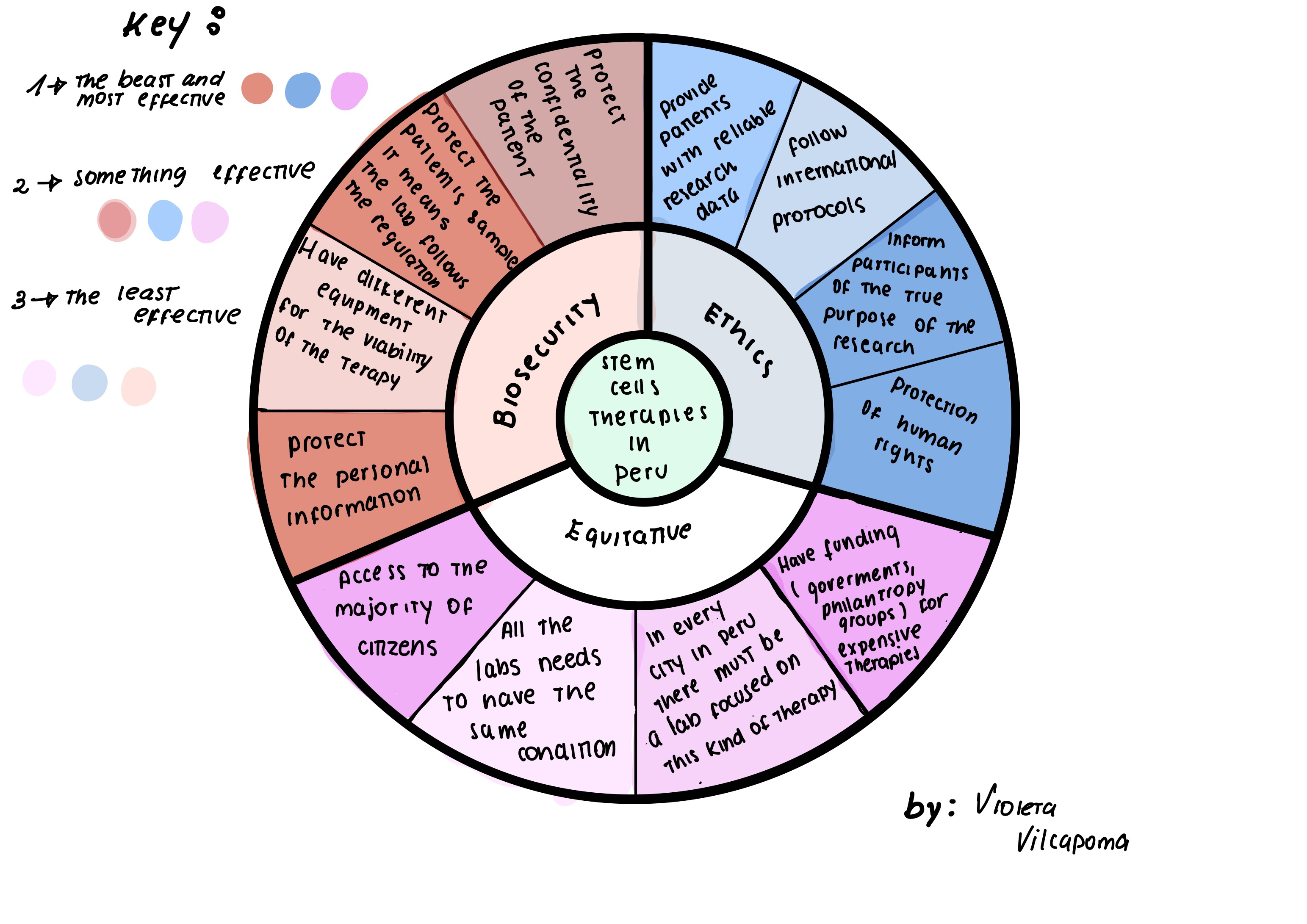
The best option→ Creation and implementation of a specific and explicit regulation focused on stem cell therapies.
Justification: It is essential to establish clear and precise regulations, in order to avoid risks for patients
Second option→ Development of a program for equitable access therapies in public hospitals.
Justification: Since stem cell therapies are expensive, there is a need to generate and promote greater investment and infrastructure development.
Third option → Sanctions for clinics that offer treatments without scientific support or violate patient confidentiality.
Justification: Seeking to prevent medical fraud and ensure that only viable and safe therapies are offered to patients across the country.
AUDIENCE :
This proposal is addressed to the Ministry of Health, which is responsible for implementing regulations, standards and properly supervising the correct application of cell therapies in Peru.
REFLECTION
When I think back on our class conversations about ethics and safety, one ethical issue really stuck with me: the idea of “Therapeutic Misconception” and how desperate patients’ hope can be exploited. Honestly, before doing this assignment, I always thought stem cell regulations were just red tape—like bureaucratic obstacles or technical checkboxes researchers had to deal with. But now I understand there’s something much deeper going on ethically. When people are vulnerable and desperately searching for treatments, especially when they’re running out of options, they can end up being sold therapies that haven’t actually been proven to work.
PRE-LECTURE ABOUT CLASS 2
SLIDES ABOUT PROFESSOR JACOBSON
-Question 1 When biological polymerase copies DNA, it makes about 1 mistake per million base pairs (1:10^6).Since the human genome has around 3.2 billion base pairs, that error rate would mean every time one of my cells divides, it would introduce over 3,000 mistakes if there weren’t any correction mechanisms. There’s a 3’-5’ exonuclease that catches and removes errors during DNA synthesis, and then the MutS repair system acts as a backup to fix any mismatches that slipped through afterward. Together, these mechanisms keep my genetic information stable across cell divisions.
-Question 2 The average human protein is about 345 amino acids long (roughly 1036 base pairs of DNA). Because the genetic code is redundant, there are approximately 3^345 different DNA sequences that could produce the same protein—an astronomically large number. However, most of these sequences don’t actually work well in practice. Some fold into secondary structures like hairpins that block the copying machinery.
SLIDES ABOUT DR.LEPROUST -Question 1 The method that’s most commonly used today is called the phosphoramidite method, or phosphoramidite chemistry. From what I learned, this technique was developed back in 1981 by a researcher named Caruthers, and it’s still the gold standard in the industry. It’s used for both the traditional column-based synthesis approach and the newer silicon-based platforms that companies are working with now.
-Question 2 Even though each individual base might attach with really high efficiency, small errors happen at every single step of the process. By the time you reach 200 nucleotides, the percentage of molecules that are perfect and full-length has fallen to around 37% or even lower.
-Question 3 When I think about the cumulative error rate logic, the probability of building a perfect 2000 base pair molecule one base at a time is essentially zero. That’s why in practice, when scientists need to manufacture long genes, they don’t try to synthesize them directly. Instead, they make shorter verified fragments (oligos) and then assemble those pieces together to build the full-length gene.
SLIDES ABOUT DR.CHURCH There are 10 amino acids that humans can’t make on their own and have to get from food -> Phenylalanine (F), Valine (V), Threonine (T), Tryptophan (W), Isoleucine (I), Methionine (M), Histidine (H), Arginine (R), Leucine (L), and Lysine (K). The “Lysine Contingency” is a weak biocontainment strategy because lysine is already essential to all animals.