Week 07 HW: Genetic Circuits II
Genetic Circuits II
1.What advantages do IANNs have over traditional genetic circuits, whose input/output behaviors are Boolean functions?
Traditional genetic circuits function as digital logic gates, processing inputs in a strictly binary manner — a signal is either present or absent, ON or OFF. While this approach is sufficient for simple regulatory tasks, it is inherently limited in its capacity to handle the complexity characteristic of many biological environments. Intracellular Analog Neural Networks (IANNs) offer several notable advantages over this paradigm. For example, IANNs operate on continuous, graded signals which is typically the concentration of transcription factors, proteins, or regulatory RNAs, it could rather than discrete binary states. This allows them to perform sophisticated pattern recognition and non-linear classification that Boolean logic gates are fundamentally incapable of. Also, IANNs can assign differential weights to distinct inputs, enabling the circuit to be more responsive to certain signals than others, which more accurately reflects the nuanced regulatory logic observed in natural biological systems.
2.Describe a useful application for an IANN; include a detailed description of input/output behavior, as well as any limitations an IANN might face to achieve your goal.
It has many application for an IANN, and it is the highly specific detection of cancerous cells coupled with selective activation of a pro-drug therapy. In this system, we have different inputs such as X₁, X₂, X₃… that it would correspond to the intracellular concentrations of several cancer-associated microRNAs (miRNAs) or protein biomarkers. Crucially, while any one of these biomarkers may be present at low levels in healthy tissue, their specific combinatorial pattern and relative concentrations constitute a signature unique to the target cancer cell type. The IANN would process these inputs through weighted connections across its layers, integrating the signals in a manner analogous to a perceptron. If the combined weighted output surpasses a defined threshold which is the indicating that the cancer signature has been recognized, the for the final output (Y) would be the expression of an enzyme such as nitroreductase, which converts a systemically administered, non-toxic pro-drug into its cytotoxic active form, selectively eliminating the cancerous cell.
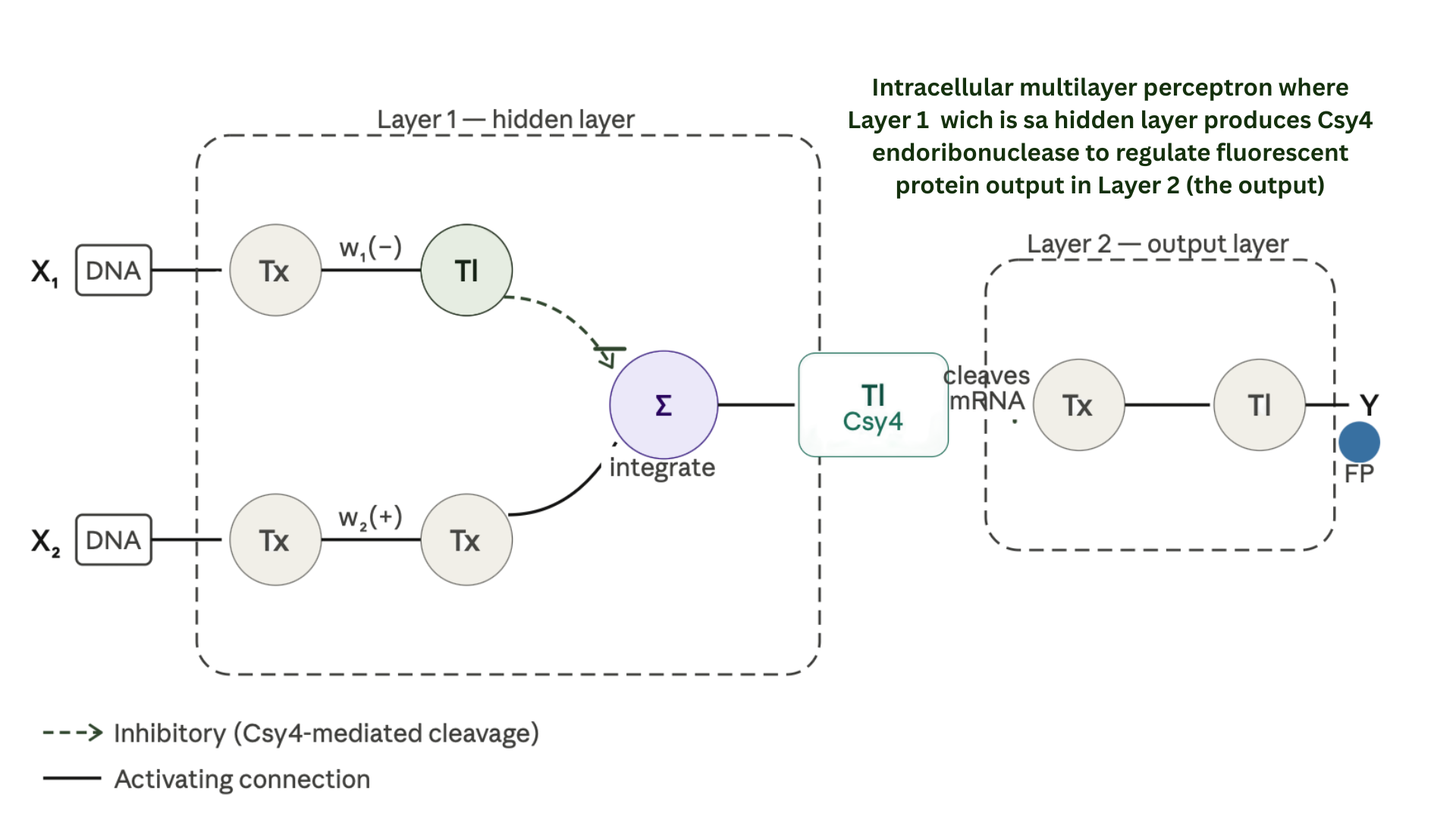
3.Below is a diagram depicting an intracellular single-layer perceptron where the X1 input is DNA encoding for the Csy4 endoribonuclease and the X2 input is DNA encoding for a fluorescent protein output whose mRNA is regulated by Csy4. Tx: transcription; Tl: translation.
SECOND PART
a. What are some examples of existing fungal materials and what are they used for? What are their advantages and disadvantages over traditional counterparts?
Existing fungal materials include mycelium-based biofilters, myco-bricks, and fungal leather. Mycelium biofilters can be used to filter pollutants from industrial runoff, acting as reactive matrices capable of absorbing metals instead of using only activated carbon. Myco-bricks are grown from agricultural waste and fungi, and can be used in construction for thermal and acoustic insulation. Fungal leather, such as Mylo or Reishi, is being developed as a sustainable alternative to animal or synthetic leather in fashion.
Their main advantages are that they are biodegradable, can be produced from organic waste, and have a lower environmental impact than conventional materials. However, they also have some limitations: they are less durable than traditional materials, can be sensitive to extreme humidity if they are not sealed, and in some cases still need further development to reach the same mechanical resistance or large-scale production capacity.
b. What might you want to genetically engineer fungi to do and why? What are the advantages of doing synthetic biology in fungi as opposed to bacteria?
This project proposes the genetic modification of fungi to secrete optimized MerA/MerB enzymes and express metallothioneins capable of sequestering mercury within fungal vacuoles. As eukaryotic organisms, fungi possess chaperones and advanced protein-folding machinery compared to bacteria, which may enhance the stability and functionality of complex proteins such as MerA, reducing the formation of inactive intracellular aggregates. The use of fungi offers several advantages over bacteria. Their filamentous structure, composed of hyphae, allows the mycelium to anchor itself to contaminated soil, whereas bacteria can be easily washed away by water flow. This enables fungi to form a persistent physical barrier in polluted environments. Furthermore, fungi generally show greater tolerance to acidic and toxic conditions and are capable of secreting large amounts of proteins, making them promising platforms for mercury bioremediation.