week-03 HW: Lab-automation
Lecture Overview – Lab Automation and Biosensors
Introduction
This week’s lecture focused on lab automation and biosensors, two technologies that are transforming modern life sciences research. Together, they enable scientists to run experiments faster, more accurately, and at a much larger scale than traditional manual laboratory techniques.
Automation reduces human error and increases throughput, while biosensors allow researchers to observe biological changes in real time. These tools are particularly valuable in areas such as drug discovery, synthetic biology, and molecular diagnostics.
Lab Automation
Why Automation Matters
Traditional laboratory experiments often involve manual pipetting, where researchers transfer very small volumes of liquid between wells or tubes. While precise, manual work is:
- Time-consuming
- Physically repetitive
- Prone to human error
- Difficult to scale for large experiments
Lab automation addresses these limitations by using robotic systems to handle liquid transfers and experimental workflows.
Key Advantages
- Speed – Automated systems can run experiments continuously and much faster than manual methods.
- Accuracy and Precision – Robotic pipettes can consistently transfer extremely small volumes with high reproducibility.
- High Throughput – Multiple experimental conditions can be tested simultaneously.
- Reproducibility – Automated protocols reduce variability between experiments and researchers.
These capabilities are especially important in drug discovery and biological screening, where thousands of chemical compounds or genetic variants may need to be tested against biological targets.
Robotic Pipetting and Parallel Testing
One major application of automation is robotic pipetting platforms. These systems can:
- Dispense microlitre or nanolitre volumes of liquids
- Follow programmable experimental protocols
- Operate on multi-well plates (such as 96-well or 384-well plates)
This enables parallel experimentation, where many experimental conditions are tested simultaneously in a compact layout.
For example, researchers can:
- Test multiple drug candidates against a biological target
- Compare different genetic modifications
- Measure biological responses across a range of concentrations
Because each well contains a different experimental condition, researchers can gather large datasets from a single automated run.
One platform discussed in the lecture is Opentrons, an open-source robotic pipetting system. It allows researchers and students to:
- Program laboratory protocols using code
- Automate repetitive liquid-handling tasks
- Prototype experimental workflows quickly
This system will also be used in the Art & Design homework, where we will get to explore creative and experimental uses of automated pipetting.
Biosensors
What Are Biosensors?
Biosensors are biological or bioengineered systems that detect and report changes inside living cells or biological environments.
They provide real-time feedback about biological processes such as:
- Gene expression (RNA production)
- DNA activity
- Protein interactions
- Metabolic changes
- Cellular stress or environmental signals
By translating biological activity into a detectable signal, biosensors allow scientists to monitor what is happening inside cells during experiments.
Fluorescent Proteins and Visual Signals
One of the most widely used biosensing methods relies on fluorescent proteins.
Scientists have discovered and engineered proteins that emit visible light when exposed to specific wavelengths of ultraviolet (UV) or blue light. These proteins glow in different colours, including:
- Green
- Red
- Yellow
- Cyan
By linking fluorescent proteins to specific biological mechanisms, researchers can create systems where a biological event produces a visible signal.
Example
A genetic circuit might be designed so that:
- When a particular gene is activated → a fluorescent protein is produced
- The cell begins to glow under UV light
- The colour or brightness indicates the level of activity
This allows researchers to visually track biological changes during experiments without destroying the sample.
Fluorescent biosensors are widely used in:
- Cell biology
- Synthetic biology
- Drug testing
- Biomedical research
Automation Systems Covered in the Lecture
1. Microfluidics (Electrowetting Systems)
Microfluidic systems manipulate very small volumes of liquid (often nanolitres or picolitres) within tiny channels or droplets.
An electrowetting system moves droplets across a surface using controlled electric fields. By changing electrical signals, the system can:
- Move droplets
- Merge droplets
- Split droplets
- Mix reagents
Advantages
- Extremely small reagent volumes
- Rapid reaction times
- Highly parallel experimentation
- Compact experimental platforms
Microfluidics is often used in high-throughput screening and diagnostic devices.
2. Opentrons
Opentrons is a robotic liquid-handling platform designed for laboratory automation.
Key features include:
- Programmable pipetting protocols
- Compatibility with standard labware (multi-well plates, tubes, etc.)
- Open-source software and hardware design
- Accessible pricing compared with industrial lab robots
Because it is programmable, experiments can be designed as automated workflows, allowing researchers to run complex procedures with minimal manual intervention.
3. Nebula
Nebula is another automation platform designed for distributed and cloud-connected laboratory experimentation.
These types of systems enable:
- Remote experiment control
- Automated experimental pipelines
- Integration with digital lab notebooks and data analysis systems
By combining automation with networked infrastructure, platforms like Nebula support scalable experimentation and collaborative research environments.
Key Takeaways
- Lab automation dramatically increases experimental speed, precision, and scalability.
- Robotic pipetting systems allow researchers to run many experiments simultaneously in multi-well plates.
- Biosensors, particularly fluorescent protein systems, provide real-time insight into biological processes.
- Technologies such as microfluidics, Opentrons, and Nebula represent different approaches to automating laboratory workflows.
Together, these technologies are reshaping how modern biological research is conducted, enabling larger experiments, faster discoveries, and more reproducible science.
Homework: Opentrons Design Challenge
The main task for this homework is to design an art using the opentrons automation art website and then implement this into a python program that the opentrons pipetting machine can then use to pipette it onto an agar plate - the design will then glow different colours (Blue,pink and purple for LifeFabs assigned colours) under UV light to show case a living E. Coli artwork of our design.
Step 1: Making a design using the automartion art designer website by Ronan
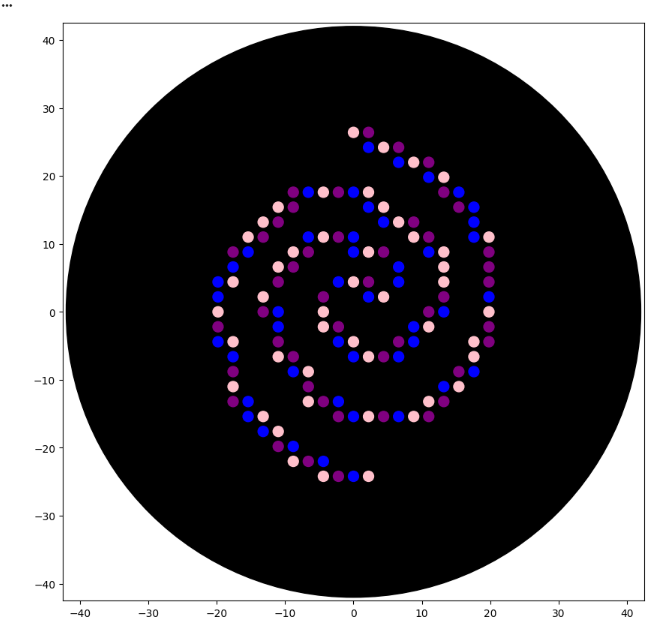
Step 2: Next step was to implement these coordinates into the python program, I struggled a bit at the start but with the help of claude code I found my way around issues I ran into
Heres my code for reference: