week-07-hw-genetic-circuits-part-ii
Assignment Part 1: Intracellular Artificial Neural Networks (IANNs)
What advantages do IANNs have over traditional genetic circuits, whose input/output behaviors are Boolean functions?
Advantages include the fact that since IANNs connections between nodes can have varying continuous weightages this is very important when it comes to modelling the effect a gene has on a biological outcome as its very likely that they hold a non-linear relationship and so being able to model for this discrepancy is important as boolean functions assume two discrete states which isnt the case.
Describe a useful application for an IANN; include a detailed description of input/output behavior, as well as any limitations an IANN might face to achieve your goal.
An intracellular artificial neural network (IANN) can be applied in precision cancer therapy, where engineered cells classify disease states and trigger drug delivery only under specific conditions. Inputs include continuous biological signals such as oncogene expression, microRNA profiles, and hypoxia levels, which are integrated through a multilayer gene regulatory network. Each input is weighted, and a nonlinear response (e.g. sigmoidal gene activation) enables pattern recognition rather than simple Boolean logic. If a threshold is reached, the output may be the expression of a therapeutic protein or induction of apoptosis, ensuring high specificity and minimal off-target effects.
However, IANNs face limitations including biological noise affecting reliability, scalability challenges due to circuit complexity and crosstalk, slow response times from gene expression dynamics, evolutionary instability of engineered systems, and practical constraints in safely delivering large genetic circuits into target cells. And so this may hint that they still need to be optimised and improved before actual clinical usage.
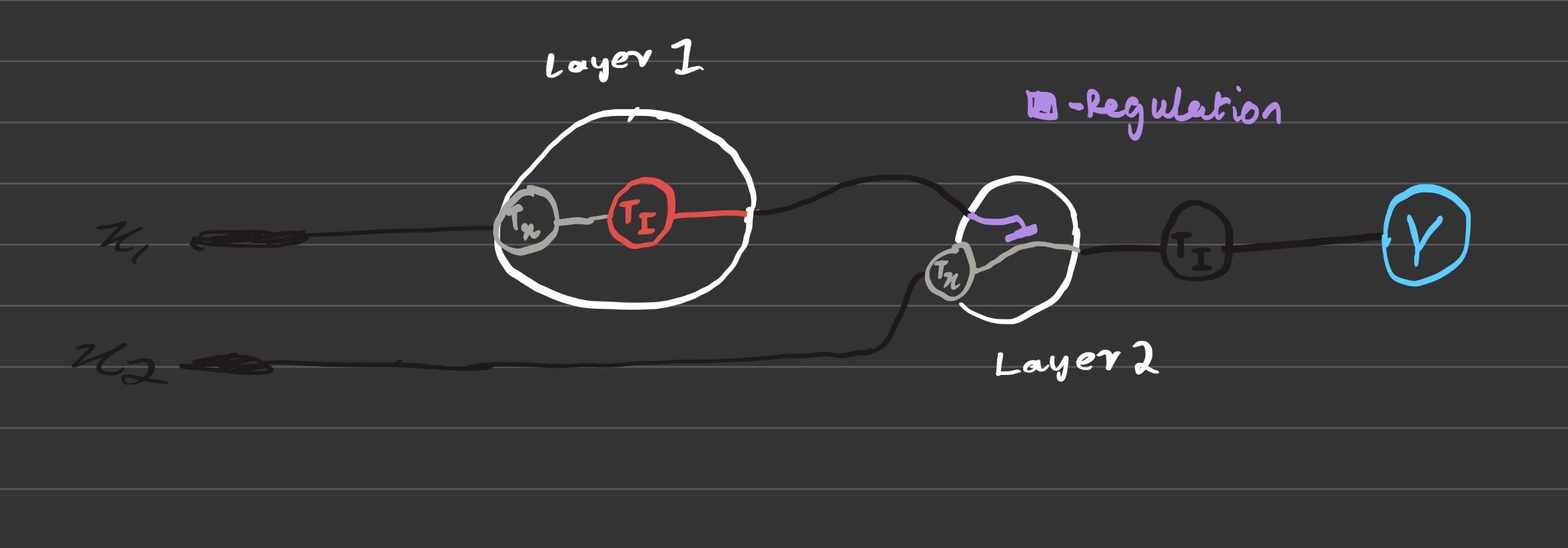
I made the given process a multi layer IANN, where x1 = input DNA coding for CSy4 endoribonuclease, x2 = DNA encoding for flourescent output. I thought to make x2 pass through the second node as the input as it hadnt really a function in the first one, not too sure if that is correct but I then proceeded to pass the output of the endoribonuclease translated via X1 to act as a regulator indicated in purple for the expression of the GFP of the final protein which is then transcribed and translated as the final output.
Assignment Part 2: Fungal Materials
What are some examples of existing fungal materials and what are they used for? What are their advantages and disadvantages over traditional counterparts?
Mycelium is an example of a fungal material with a wide range of applications. It is used to produce sustainable materials such as insulation panels and biodegradable packaging, as well as leather alternatives for products like shoes and bags. It is also utilised in food production as mycoprotein, a protein-rich alternative to meat. Additionally, mycelium plays a role in environmental cleanup through mycoremediation, where it can break down plastics and toxic chemicals, acting as a natural recycling system. Fungal materials are sustainable, biodegradable, and low-energy to produce, making them environmentally friendly compared to plastics and leather. However, they generally have lower mechanical strength, durability, and moisture resistance than traditional materials. Additionally, they face scalability and consistency challenges, as production is less standardised than conventional manufacturing.
What might you want to genetically engineer fungi to do and why? What are the advantages of doing synthetic biology in fungi as opposed to bacteria?
Compared to bacteria, fungi offer several advantages as they are eukaryotic systems, like humans, enabling correct protein folding and post-translational modifications required for many therapeutic proteins. Combined with their efficient secretion pathways, this makes them highly suitable for producing pharmaceuticals and enzymes for drug discovery. However, there are limitations, as fungi are slower growing, which can impact scalability, and are generally more complex to genetically engineer than bacteria, increasing the barrier to entry.