week-10-hw-imaging-and-measurement
Final project Homework
Waters Part 1 - Molecular Weight
- Using the website https://web.expasy.org/compute_pi/ it can be calculated that the molecular weight of the given eGFP Sequence:
MVSKGEELFTG VVPILVELDG DVNGHKFSVS GEGEGDATYG KLTLKFICTT GKLPVPWPTL VTTLTYGVQC FSRYPDHMKQ HDFFKSAMPE GYVQERTIFF KDDGNYKTRA EVKFEGDTLV NRIELKGIDF KEDGNILGHK LEYNYNSHNV YIMADKQKNG IKVNFKIRHN IEDGSVQLAD HYQQNTPIGD GPVLLPDNHY LSTQSALSKD PNEKRDHMVL LEFVTAAGIT LGMDELYKLE HHHHHH
It can be seen that the molecular weight is 28007.60 when the entire protein genome code is considered, slightly less when the His-purification tag ad the linker are accounted for at 26,941.15 Daltons.
- I found this question a bit confusing but got the idea that because different molecules may be protonated to differing extents this means that they will have different mass:charge ratios and so what were calculating for is the most abundantly-averaged mass of the eGFP?
I chose the peaks 875.4421 and 903.7148 as they seemed most abundant and were adjacent to one another and substituting their values into the equation given gave the following molecular weight Z:
(m/z)n = 875.4421 (m/z)n+1 = 903.7148
Z= 30.97 == 31
The peak at 903.7148 is the 31+ charge state The peak at 875.4421 is the 32+ charge state
So then using the 31+ peak M = z((m/z)n - 1.0073) M = 31(903.7148 -1.0073) M = 31(902.7075)
M=27983.93 Da
Accuracy = (27983.93 - 28006.26 ) / 28006.26
= -0.000797
= -0.08%
OPTIONAL PART II DO
Waters Part III - Peptide mapping
Lysine (K): 20 Arginine(R): 6
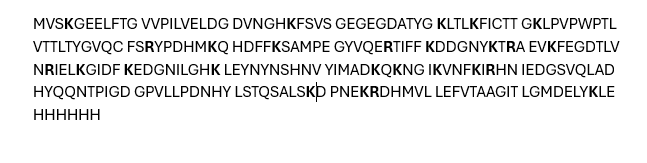
There are 19 total peptide sequences achieved from the cleavage via trypsin:

There are 19 peaks over 10%. Yes, both end up at 19!
Using the peak values from figure 5b of 526.25918 & 525.76712to calculate the charge state.
526.25918 - 525.76712 = .49206 1/.49206 = 2.0322
Therefore charge state = 2
From the comparison of charge states, the peptide was identified as having a single charge state of 1050. Therefore, the peptide is likely FEGDTLVNR, which has a mass of 1050.5214 and corresponds to positions 115–123.
The mass accuracy was calculated using the following equation:

This gives a mass accuracy value of 2.83 ppm.
Waters Part IV - Oligomers
The 8FU Didecamer at 8.33 MDa is the dominant peak — by far the most abundant species in solution, which makes sense as it’s the canonical native assembly state of KLH
The small offsets between expected and measured masses (e.g. 8.0 vs 8.33 MDa) are real and expected — they reflect glycosylation, post-translational modifications, and bound cofactors like copper that aren’t captured in the bare polypeptide masses in Table 1
The 4.013 MDa peak is close to but not exactly the 7FU decamer — it likely corresponds to an 8FU half-decamer (10 × 400 kDa = 4.0 MDa), which is a known dissociation product
The small peaks below 2 MDa (0.1982, 0.79, 1.52) are likely individual subunits or small subcomplexes
Waters Part V
- The theoretical molecular weight of the protein is 27,875.41 Da (excluding the start codon, average MW)
- The intact LC-MS measurement came in at 27,919.93 Da
- That gives a mass error of ~1,597 ppm — which is extremely large; anything above ~10-20 ppm is considered a poor match in intact mass analysis
- Based on this, the protein is very unlikely to be eGFP