Week 7 — Genetic Circuits Part II: Neuromorphic Circuits
Table of Contents
Assignment Part 1: Intracellular Artificial Neural Networks (IANNs)
1. What advantages do IANNs have over traditional genetic circuits, whose input/output behaviors are Boolean functions?
Intracellular Artificial Neural Networks (IANNs) provide several advantages compared to traditional Boolean genetic circuits.
Traditional genetic circuits generally operate using discrete ON/OFF logic gates such as: AND, OR, NOT, NAND. These systems are powerful for simple decision-making but are limited when dealing with:
- noisy biological signals,
- continuous gradients,
- or complex nonlinear relationships.
In contrast, IANNs can process information in a graded and weighted manner, similarly to artificial neural networks in machine learning. Instead of binary responses, IANNs can integrate multiple inputs with different strengths and produce continuous outputs. This allows:
- analog computation,
- pattern recognition,
- signal integration,
- adaptive responses,
- and more robust behavior in noisy biological environments.
Another advantage is scalability. As Boolean circuits become larger, they often suffer from:
- metabolic burden,
- crosstalk,
- and combinatorial complexity.
Neural-network-inspired architectures may allow more compact and flexible computation using weighted interactions between regulators such as:
- transcription factors,
- endoribonucleases,
- or RNA regulators.
Finally, IANNs are conceptually closer to biological systems themselves, which rarely behave as strictly binary systems and instead rely heavily on gradients, thresholds, and probabilistic regulation.
2. Describe a useful application for an IANN
One useful application for an intracellular artificial neural network would be a programmable therapeutic cell capable of detecting complex disease states from multiple biomarkers.
For example, engineered immune or bacterial cells could monitor combinations of:
inflammatory markers, cancer-associated metabolites, hypoxia, pH, or signaling molecules.
Instead of responding to a single threshold, the IANN could integrate weighted biological inputs and classify whether the cellular environment corresponds to a pathological condition.
Example Input/Output Behavior
Inputs:
X1 = hypoxia marker X2 = inflammatory cytokine X3 = tumor-associated metabolite
Hidden layer:
weighted integration through RNA regulators or endoribonucleases
Output:
fluorescent reporter, therapeutic protein, or apoptosis-inducing signal.
The network could produce:
weak output for isolated signals, but strong activation only when a pathological combination of signals is detected.
This would reduce false positives and enable more context-aware therapies.
Limitations
Several limitations currently affect IANN implementation:
biological noise, stochastic gene expression, metabolic burden, limited orthogonal regulatory parts, slow response times, and difficulty tuning precise weights between biological components.
Another challenge is signal interference between layers, especially in large intracellular networks. Unlike electronic neural networks, biological systems are constrained by:
resource competition, molecular degradation, diffusion, and evolutionary instability.
Nevertheless, IANNs represent an important direction toward adaptive and programmable cellular computation. In biological neural-like systems, weights may emerge from molecular concentration, degradation rates, binding affinity, and diffusion dynamics rather than fixed numerical parameters.
3. Intracellular Multilayer Perceptron Diagram
Below is a conceptual diagram of a multilayer intracellular perceptron.
Layer 1 produces an endoribonuclease regulator. Layer 2 uses this regulator to modulate fluorescent protein expression.
flowchart LR

subgraph Layer1
X1[X1]
X2[X2]
ENDOA[EndoRNase A]
ENDOB[EndoRNase B]
end

subgraph Layer2
REG[Regulated mRNA]
GFP[GFP Output]
end

X1 --> ENDOA
X2 --> ENDOB

ENDOA -. repress .-> REG
ENDOB -. modulate .-> REG

REG --> GFP
In this multilayer architecture:
- the first layer processes initial biological inputs,
- the intermediate layer computes regulatory transformations,
- and the final layer controls reporter expression.
This creates hierarchical intracellular computation analogous to multilayer artificial neural networks.
Assignment Part 2: Fungal Materials
1. What are some examples of existing fungal materials and what are they used for? What are their advantages and disadvantages over traditional counterparts?
Fungal materials are biomaterials produced using fungal mycelium, the filamentous vegetative network of fungi. In recent years, mycelium-based materials have been explored as sustainable alternatives to plastics, foams, leather, textiles, and construction materials.
Examples include:
Mycelium packaging materials Companies such as Ecovative produce mycelium-based packaging as an alternative to expanded polystyrene foam. Agricultural waste is colonized by fungal mycelium, which binds the substrate into lightweight composite materials. Mycelium leather Companies such as MycoWorks and Bolt Threads develop fungal leather alternatives for fashion and upholstery. These materials imitate some properties of animal leather while avoiding animal agriculture. Construction materials Mycelium composites are explored for insulation panels, acoustic materials, and lightweight structural elements due to their low density and thermal properties. Biofabricated textiles and design objects Designers and researchers use fungal growth to create experimental furniture, wearable materials, and biohybrid artifacts.
Advantages over traditional materials include:
biodegradability, renewable feedstocks, low-energy production, carbon sequestration potential, and compatibility with circular material systems.
Unlike petroleum-derived plastics, fungal materials can often be composted at end of life and grown from agricultural waste streams.
However, fungal materials also present limitations:
lower mechanical strength, moisture sensitivity, variability between growth batches, slower production times, and challenges in large-scale industrial standardization.
Many fungal materials also require post-processing treatments to stabilize growth and improve durability, which can reduce some of their ecological advantages.
My course on mycelium
2. What might you want to genetically engineer fungi to do and why? What are the advantages of doing synthetic biology in fungi as opposed to bacteria?
Fungi could be genetically engineered to produce materials with programmable mechanical, optical, electrical, or biochemical properties.
For example, engineered fungi could:
produce conductive biomaterials, synthesize pigments or bioactive molecules, self-heal damaged structures, sense environmental changes, or generate morphologically controlled growth patterns.
In the context of biofabrication, one interesting possibility is engineering fungal mycelium to act as a living morphogenetic substrate capable of:
growing predefined architectures, responding to environmental stimuli, or integrating sensing and computation directly into materials.
Fungi are particularly interesting because they naturally form:
large-scale filamentous networks, spatially distributed structures, and mechanically coherent materials.
Compared to bacteria, fungi offer several advantages for synthetic biology:
Multicellular and filamentous growth Fungi naturally generate large interconnected structures that are better suited for material fabrication than bacterial colonies. Complex extracellular matrices Fungi produce chitin, glucans, hydrophobins, and other structural polymers useful for biomaterials. Mechanical robustness Mycelial networks can create macroscopic materials with structural integrity. Spatial morphogenesis Fungal growth inherently involves branching, differentiation, and environmental adaptation. Compatibility with biofabrication Fungi can directly colonize scaffolds and substrates to generate large objects.
Bacteria, on the other hand, are generally:
easier to engineer genetically, faster to grow, and better characterized molecularly.
However, bacteria usually lack the large-scale structural organization naturally found in fungal mycelium.
Because of this, fungi occupy a particularly interesting space between:
organism, material, and morphogenetic fabrication system.
This makes fungal synthetic biology highly relevant for:
sustainable manufacturing, living materials, biohybrid systems, and programmable ecological fabrication.
Assignment Part 3: First DNA Twist Order
DNA Design Challenge — Insert Design Submission
For the DNA Design Challenge, I designed an expression cassette based on the tyrosinase Tyr1 gene from Bacillus megaterium for heterologous expression in Komagataeibacter rhaeticus.
The goal of this construct is to enable the biosynthesis of eumelanin within bacterial cellulose pellicles, following the strategy demonstrated by Walker et al. (2024).
Expression Cassette Design
The insert was designed as a complete bacterial expression cassette including:
Promoter → RBS → tyr1 CDS → Stop Codon → Terminator
More specifically:
Element Function pJ23104 constitutive promoter continuous transcription BBa_B0034 RBS translation initiation codon-optimized tyr1 CDS tyrosinase production TAA stop codon translation termination BBa_B0015 terminator transcription termination
The Tyr1 coding sequence was codon-optimized for K. rhaeticus expression.
Backbone Vector and DNA Assembly
The Tyr1 expression cassette was assembled and visualized in Benchling using the pTwist Amp High Copy plasmid backbone, a common commercial cloning vector used for DNA synthesis and sequence delivery.
The plasmid contains:
an ampicillin resistance marker (ampR) a high-copy bacterial origin of replication multiple cloning sites compatible with downstream assembly workflows
The Tyr1 insert was positioned within the cloning region of the plasmid to simulate a synthesis-ready construct.
Benchling Assembly
The construct includes:
promoter ribosome binding site (RBS) Tyr1 coding sequence terminator
and represents a conceptual expression cassette for eumelanin biosynthesis in Komagataeibacter rhaeticus.
Insert-Level View
The translation view confirms:
correct reading frame, continuous open reading frame, and proper placement of the coding sequence downstream of the promoter and RBS.
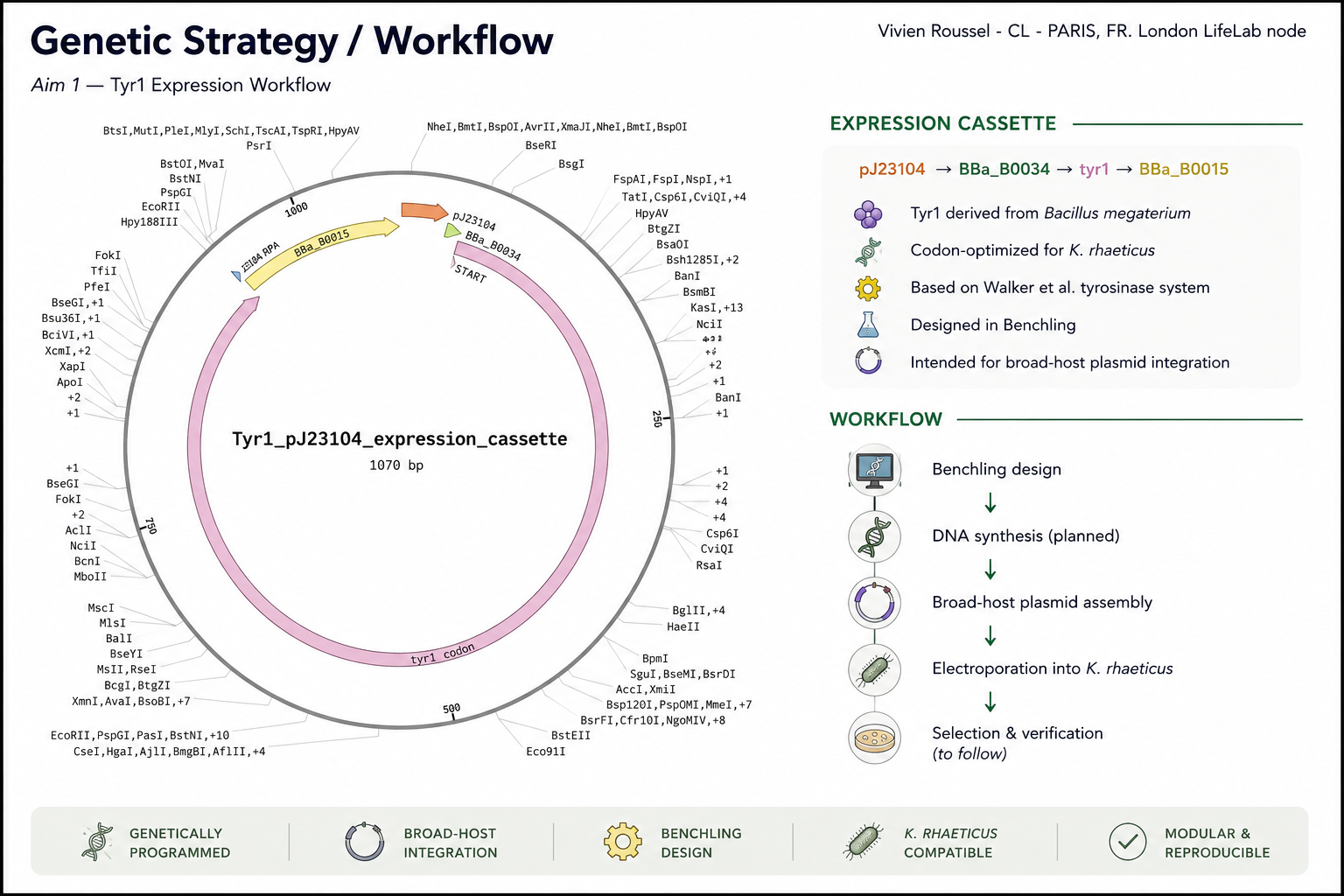
Benchling Design
The sequence and construct architecture were designed in Benchling:
https://benchling.com/s/seq-cSFfevSwjHFxf6KwwXGx?m=slm-D8VDordW2oyuqdI6bH4r
Experimental Status
The computational and sequence design stages were completed. However, due to limitations in available infrastructure and wet-lab logistics during the course, the full DNA synthesis and cloning workflow was not experimentally completed within the class timeline.
Nevertheless, the construct architecture closely follows experimentally validated systems reported in: Walker et al., 2024 — Self-pigmenting textiles grown from cellulose-producing bacteria with engineered tyrosinase expression.