Week 09 HW: Cell-free system
Table of Contents
Homework question from Kate Adamala - Design Synthetic Minimal Cell Genetic Circuits
Homework question from Peter Nguyen - Freeze-Dried Cell-Free Systems for Living Textile Interfaces
Homework Part A: General and Lecturer-Specific Questions
1. Explain the main advantages of cell-free protein synthesis over traditional in vivo methods, specifically in terms of flexibility and control over experimental variables. Name at least two cases where cell-free expression is more beneficial than cell production.
Cell-free protein synthesis (CFPS) allows protein production outside living cells by using extracted cellular machinery such as ribosomes, enzymes, and cofactors. Unlike in vivo systems, CFPS provides direct control over reaction conditions without needing to maintain cell viability.
Major advantages include:
rapid prototyping of genetic constructs, precise control over temperature, pH, salts, cofactors, and energy supply, easier incorporation of non-natural amino acids, absence of cellular toxicity constraints, direct access to the biochemical environment.
Because there is no membrane barrier or growth requirement, researchers can manipulate the system much more freely than in living organisms.
Cell-free systems are especially beneficial for:
Toxic proteins Some proteins damage or kill host cells during expression. CFPS bypasses this limitation because no living organism must survive the production process. Membrane proteins Membrane proteins are difficult to express in vivo because they often misfold or aggregate in cells. Cell-free systems allow controlled addition of liposomes, detergents, or nanodiscs to stabilize folding.
Additional applications include:
biosensing, rapid vaccine prototyping, synthetic biology circuit testing, and on-demand biomanufacturing.
2. Describe the main components of a cell-free expression system and explain the role of each component.
A cell-free expression system contains the molecular machinery necessary for transcription and translation.
Main components include:
Component Role Cell extract Contains ribosomes, tRNAs, enzymes, and translation machinery DNA or mRNA template Encodes the target protein Amino acids Building blocks for protein synthesis Nucleotides (ATP, GTP, CTP, UTP) Required for transcription and energy transfer RNA polymerase Transcribes DNA into mRNA Ribosomes Translate mRNA into protein Energy regeneration system Maintains ATP levels Cofactors and salts Stabilize enzymatic activity and folding
In bacterial systems such as E. coli extracts, the lysate already contains most endogenous translation machinery. Researchers mainly supplement substrates and energy sources.
3. Why is energy regeneration critical in cell-free systems? Describe a method you could use to ensure continuous ATP supply in your cell-free experiment.
Protein synthesis consumes very large amounts of energy, especially ATP and GTP. Without energy regeneration, ATP becomes depleted rapidly and translation stops.
Energy regeneration is critical because:
peptide bond formation requires energy, ribosome translocation consumes GTP, transcription also requires nucleotide triphosphates.
One common strategy is to use:
phosphoenolpyruvate (PEP), creatine phosphate, or glucose metabolism
as secondary energy sources.
For example, phosphoenolpyruvate can regenerate ATP through pyruvate kinase activity:
PEP + ADP → Pyruvate + ATP
Another approach uses slow glucose metabolism, which can provide more stable long-term ATP regeneration and reduce accumulation of inhibitory byproducts.
4. Compare prokaryotic versus eukaryotic cell-free expression systems. Choose a protein to produce in each system and explain why.
Prokaryotic and eukaryotic CFPS systems differ mainly in complexity, speed, and post-translational processing capabilities.
Feature Prokaryotic CFPS Eukaryotic CFPS Speed Fast Slower Cost Lower Higher Yield Often high Moderate Post-translational modifications Limited Extensive Folding complexity Simpler proteins Complex proteins
An E. coli system would be ideal for producing:
GFP, bacterial enzymes, or tyrosinase.
For example, the Tyr1 tyrosinase from Bacillus megaterium could be efficiently expressed in a bacterial CFPS system because it is a bacterial enzyme and does not require complex glycosylation.
A eukaryotic system would be preferable for:
antibodies, receptors, or human membrane proteins.
For example, expressing a human GPCR receptor would benefit from a eukaryotic lysate because these proteins require complex folding and post-translational modifications.
5. How would you design a cell-free experiment to optimize the expression of a membrane protein? Discuss the challenges and how you would address them in your setup.
Membrane proteins are difficult to express because hydrophobic transmembrane domains tend to aggregate outside lipid environments.
To optimize expression, I would:
Use a cell-free system supplemented with: liposomes, nanodiscs, or mild detergents. Lower expression temperature to reduce aggregation. Optimize magnesium and salt concentrations to stabilize translation. Add molecular chaperones if available.
The main challenges include:
aggregation, improper folding, low solubility, and instability outside membranes.
Nanodiscs are particularly useful because they mimic native membrane environments while remaining soluble.
For example, if expressing the bacterial cellulose synthase BcsA membrane complex, adding lipid nanodiscs during translation could help stabilize the transmembrane helices and preserve catalytic function.
6. Imagine you observe a low yield of your target protein in a cell-free system. Describe three possible reasons for this and suggest a troubleshooting strategy for each.
Low protein yield may result from several factors.
Possible Cause Explanation Troubleshooting Poor DNA template quality Degraded or impure DNA reduces transcription efficiency Purify DNA and verify concentration ATP depletion Translation stops when energy runs out Improve energy regeneration system Protein aggregation Misfolded proteins precipitate Lower temperature or add chaperones
Additional causes may include:
incorrect magnesium concentration, RNase contamination, or codon usage incompatibility.
For membrane proteins specifically, adding lipids or detergents may dramatically improve yield and folding stability.
Homework question from Kate Adamala - Design Synthetic Minimal Cell Genetic Circuits
1. Fluorescent Metabolic Reporter
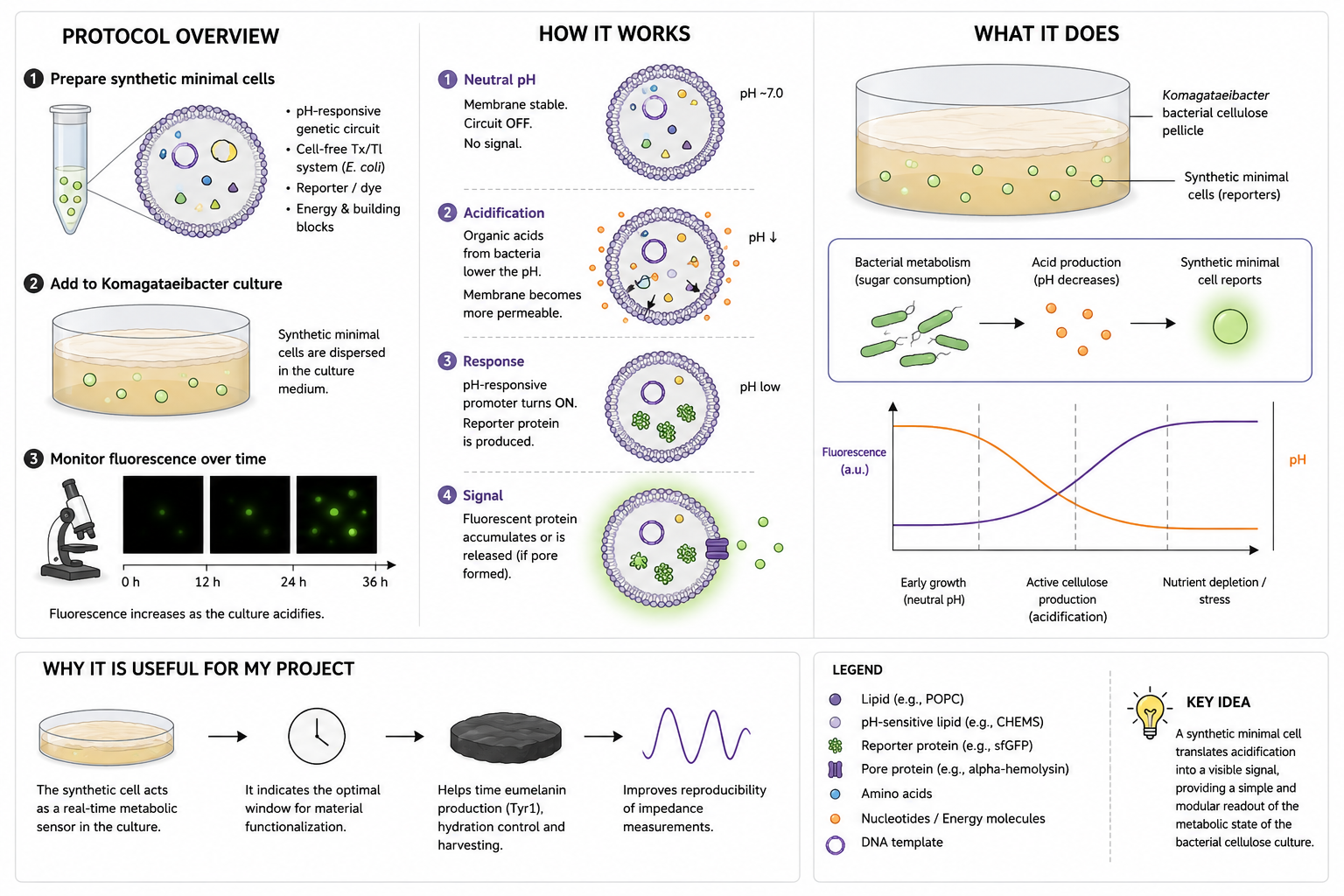
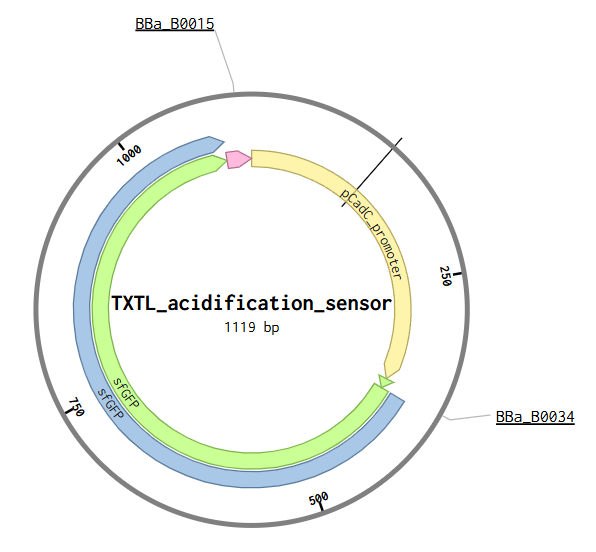
This construct represents a synthetic minimal cell designed to report the metabolic state of a Komagataeibacter bacterial cellulose culture through fluorescence.
The circuit uses the acid-responsive pCadC promoter to regulate expression of sfGFP inside a bacterial TXTL (cell-free transcription/translation) system encapsulated within a lipid vesicle. As the bacterial culture consumes sugar and progressively acidifies the medium, the promoter becomes activated and induces fluorescent protein production.
This design transforms an invisible metabolic parameter — acidification — into a visible optical signal. In the context of my final project on impedance-sensitive bacterial cellulose functionalized with Tyr1-mediated eumelanin, this synthetic minimal cell acts as a companion diagnostic system capable of indicating when the culture enters an active production or stress phase.
The system provides:
- a real-time metabolic readout,
- non-invasive monitoring,
- and a possible way to determine the optimal timing for material harvesting, hydration control, or impedance measurements.
2. Pore-Release Minimal Cell System
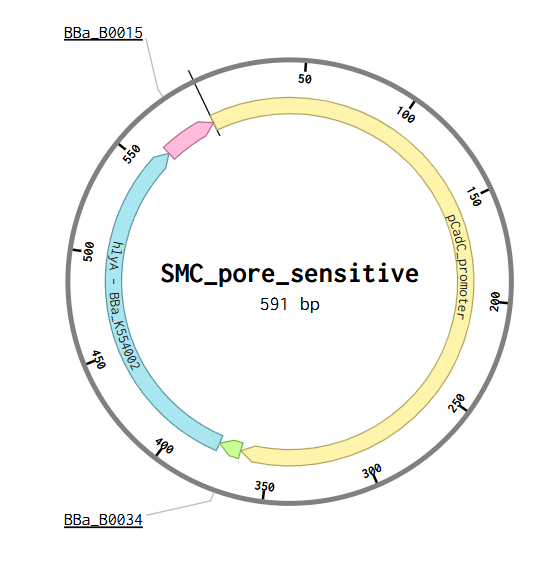
This second construct explores a different synthetic minimal cell strategy based on membrane pore formation rather than direct fluorescent protein accumulation.
Instead of expressing sfGFP, the acid-responsive promoter regulates expression of alpha-hemolysin (hlyA), a pore-forming protein. Under acidic conditions generated by bacterial metabolism, the TXTL system produces alpha-hemolysin, which forms pores in the synthetic cell membrane.
This mechanism could allow the controlled release of:
- encapsulated fluorophores,
- signaling molecules,
- ions,
- or metabolic markers.
Compared to the sfGFP design, this strategy is conceptually closer to how synthetic minimal cells are often imagined: not as fully living systems, but as programmable biochemical compartments capable of conditionally interacting with their environment.
The pore-release system could potentially provide:
- signal amplification,
- faster environmental response,
- and stronger coupling between membrane state and metabolic sensing.
Comparison Between Both Designs
| Design | Output Mechanism | Advantages | Limitations |
|---|---|---|---|
| sfGFP Reporter | Fluorescent protein production | Simple, visible, easy to interpret | Slower response due to protein maturation |
| hlyA Pore System | Membrane pore formation and fluorophore release | Faster environmental interaction, stronger protocell logic | More complex membrane behavior and leakage control |
The sfGFP design behaves more like a classical synthetic biology reporter circuit, while the hlyA system explores a more protocellular approach where the membrane itself becomes an active functional interface.
Together, these two designs explore different ways synthetic minimal cells can translate environmental metabolic changes into readable outputs.
Relation to My Final Project
These synthetic minimal cell systems were designed as speculative companion technologies for my project:
Growable Impedance-Sensitive Surface from Bacterial Cellulose via Tyr1-Mediated Eumelanin
In this context, the synthetic minimal cells do not directly produce the bacterial cellulose material. Instead, they provide an externalized metabolic sensing layer capable of monitoring:
- acidification,
- sugar consumption,
- metabolic stress,
- and active cellulose production phases.
Because impedance behavior depends strongly on hydration, ionic concentration, eumelanin deposition, and bacterial metabolic activity, such systems could help identify the optimal temporal window for material functionalization and electrochemical characterization.
More broadly, this project explores how synthetic minimal cells might function not only as biosensors, but as programmable metabolic observers embedded within living material ecologies.
Homework question from Peter Nguyen - Freeze-Dried Cell-Free Systems for Living Textile Interfaces
One-Sentence Pitch
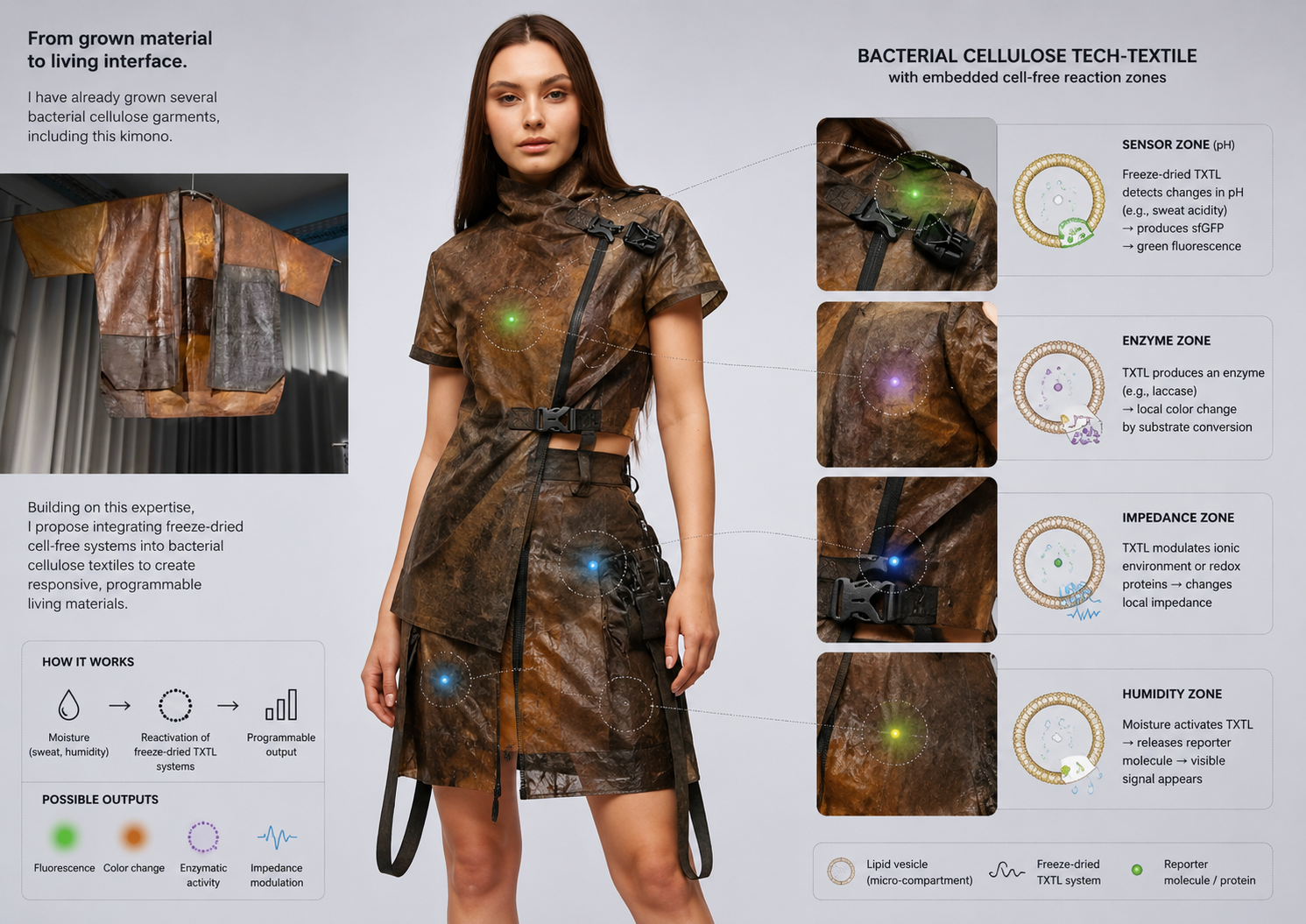
I propose a bacterial-cellulose-based textile integrating freeze-dried cell-free systems capable of locally producing visible or electrochemical responses when activated by sweat, humidity, or environmental metabolites.
Concept Description
This project explores the integration of freeze-dried TXTL (cell-free transcription/translation) systems into bacterial cellulose textiles functionalized with conductive or redox-active biomaterials such as Tyr1-mediated eumelanin.
The textile would contain embedded cell-free reaction zones distributed within the bacterial cellulose matrix. These regions would remain inactive in the dry state, preserving stability during storage and transportation. When exposed to moisture, sweat, or environmental humidity, the freeze-dried TXTL system would reactivate and produce a programmable output such as:
- fluorescence,
- color change,
- local enzymatic activity,
- or modulation of impedance behavior.
One possible implementation would use pH-sensitive or ion-sensitive genetic circuits to detect changes in skin perspiration or environmental conditions. For example, increased humidity or acidification could activate expression of chromoproteins or enzymes modifying the electrochemical behavior of the material.
Rather than treating textiles as passive substrates, this approach imagines fabrics as metabolically responsive interfaces capable of transient biochemical computation without requiring living engineered organisms.
Societal Challenge / Market Need
This concept addresses several emerging needs in wearable technology and sustainable materials research.
Current smart textiles often rely on:
- rigid electronics,
- batteries,
- non-biodegradable conductive materials,
- and difficult-to-recycle sensor architectures.
By contrast, freeze-dried cell-free systems offer:
- low-energy biosensing,
- biological programmability,
- reduced ecological persistence,
- and compatibility with biodegradable materials such as bacterial cellulose.
Potential applications include:
- health-monitoring garments,
- adaptive sportswear,
- environmental exposure indicators,
- disposable biomedical patches,
- or interactive biofabricated fashion.
The project also contributes to broader questions around ecological electronics and post-silicon material computation, where sensing and responsiveness emerge from biochemical rather than electronic processes.
Addressing Cell-Free System Limitations
One of the major limitations of freeze-dried cell-free systems is that they are often:
- activated only once,
- sensitive to hydration conditions,
- and unstable over long durations.
Several strategies could help address these challenges.
First, the bacterial cellulose matrix itself can act as a hydration regulator due to its high water retention capacity and porous nanofibrillar structure. This could help maintain localized moisture conditions and prolong TXTL activity.
Second, the cell-free reactions could be spatially compartmentalized into microcapsules or hydrogel domains embedded inside the textile. This would reduce premature activation and allow selective local responses.
Third, instead of designing continuous sensing systems, the textile could operate as a transient or event-based material:
- activated only during specific conditions,
- producing temporary readouts,
- then naturally degrading or becoming inactive afterward.
Finally, rather than competing with electronic devices in durability or computational complexity, these materials could occupy a complementary niche where biodegradability, programmability, softness, and metabolic responsiveness are more important than long-term operation.
Relation to My Research
This proposal directly connects to my ongoing work on:
Growable Impedance-Sensitive Surfaces from Bacterial Cellulose via Tyr1-Mediated Eumelanin
In this context, freeze-dried cell-free systems could provide localized biochemical sensing layers embedded inside the living material itself. Instead of adding external electronics onto bacterial cellulose, the textile would integrate programmable biochemical functions directly into the material architecture.
This opens the possibility of biofabricated interfaces where sensing, metabolism, hydration, coloration, and impedance modulation become intertwined within a single grown material ecosystem.
Homework question from Ally Huang - Mock Genes in Space Proposal — Cell-Free Radiation Stress Reporter
1. Background
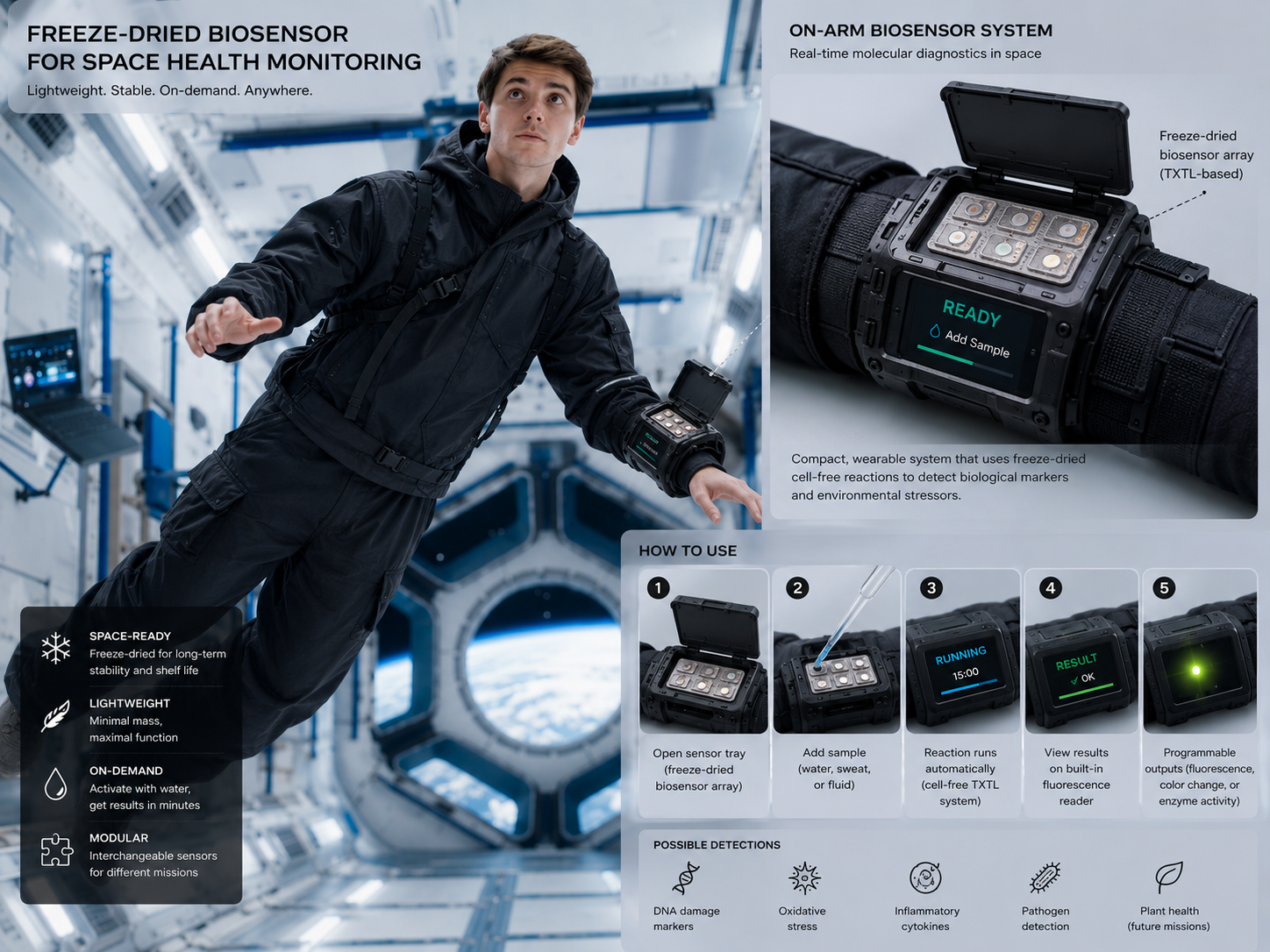
Spaceflight exposes biological systems to ionizing radiation, microgravity, and limited access to diagnostic infrastructure. Radiation can damage DNA, proteins, and cellular function, making it a major challenge for long-duration missions. A portable, freeze-dried cell-free biosensor could help astronauts detect molecular signs of radiation stress without culturing living cells. This is significant for humanity because future space exploration will require autonomous biological monitoring systems that are lightweight, stable, and easy to activate on demand.
2. Molecular or Genetic Target
DNA damage response pathway, using a synthetic promoter responsive to oxidative or DNA-damage stress driving GFP expression.
3. Relation to the Space Biology Challenge
Radiation exposure in space can generate reactive oxygen species and DNA damage. These molecular stresses activate damage-response pathways in living cells. A cell-free system cannot fully reproduce cellular repair, but it can express a reporter gene controlled by a damage-responsive regulatory element. This makes it possible to build a simplified molecular sensor that translates invisible radiation-related biochemical stress into a fluorescent output.
4. Hypothesis / Research Goal
I hypothesize that a freeze-dried BioBits® cell-free protein expression system can be used as a portable reporter for radiation-associated molecular stress. If a DNA-damage- or oxidative-stress-responsive genetic construct is exposed to radiation-mimicking conditions, then the cell-free reaction should produce a measurable fluorescent signal. The goal is to evaluate whether cell-free systems can act as lightweight biological diagnostics for space environments, where traditional cell culture is difficult, slow, and resource-intensive.
5. Experimental Plan
I would test freeze-dried BioBits® reactions containing a GFP reporter construct under different simulated stress conditions. Samples would include: no-stress control, oxidative-stress condition, UV/radiation-mimic condition, and positive GFP-expression control. Reactions would be activated with water and incubated. Fluorescence would be measured using the P51 Molecular Fluorescence Viewer. If DNA amplification is needed, the miniPCR® thermal cycler could prepare or verify target DNA templates before expression.