Week 11 - HW - Bioproduction & Cloud Labs
Table of Contents
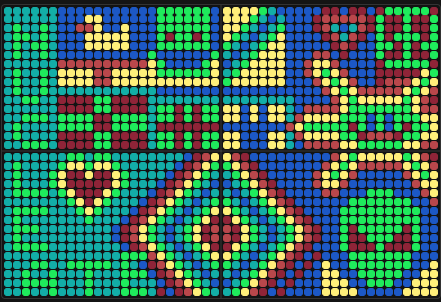
Part A — The 1,536 Pixel Artwork Canvas | Collective Artwork
Part C: Planning the Global Experiment | Cell-Free Master Mix Design
Part A — The 1,536 Pixel Artwork Canvas | Collective Artwork
Part B: Cell-Free Protein Synthesis | Cell-Free Reagents
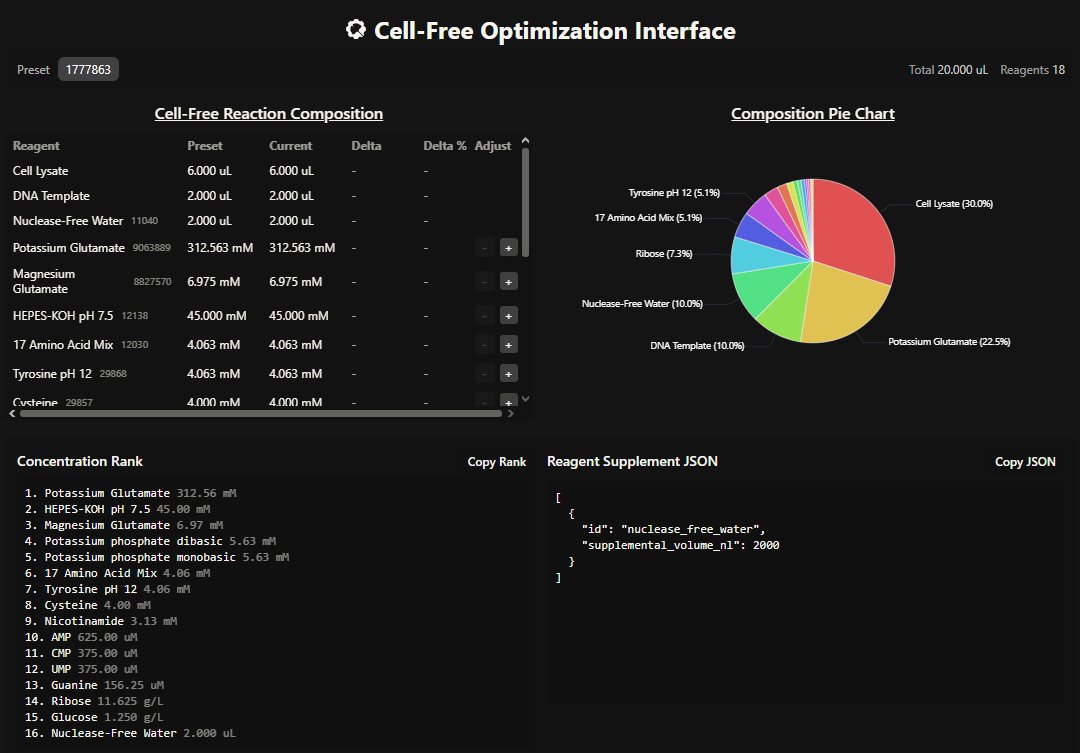
1. Referencing the cell-free protein synthesis reaction composition (the middle box outlined in yellow on the image above, also listed below), provide a 1-2 sentence description of what each component’s role is in the cell-free reaction.
E. coli Lysate
BL21 (DE3) Star Lysate (includes T7 RNA Polymerase) The lysate contains the cellular machinery required for transcription and translation, including ribosomes, enzymes, tRNAs, cofactors, and metabolic components. The integrated T7 RNA polymerase specifically drives strong transcription from T7 promoters, enabling high protein expression in the cell-free system.
Salts / Buffer
Potassium Glutamate Potassium glutamate helps reproduce the intracellular ionic environment of E. coli and stabilizes ribosomes and enzymes involved in translation. It also contributes to osmotic balance and protein folding efficiency.
HEPES-KOH pH 7.5 HEPES is a buffering agent that maintains a stable physiological pH during the reaction. Stable pH is critical because transcription and translation enzymes are highly sensitive to pH changes.
Magnesium Glutamate Magnesium ions are essential cofactors for ribosomes, RNA polymerases, ATP-dependent enzymes, and nucleotide interactions. The magnesium concentration strongly affects translation efficiency and overall reaction stability.
Potassium phosphate monobasic This phosphate salt contributes to buffering capacity and phosphate availability in the reaction. It helps stabilize biochemical conditions during prolonged incubations.
Potassium phosphate dibasic Together with the monobasic form, this salt maintains phosphate equilibrium and contributes to pH stabilization and ionic balance.
Energy / Nucleotide System
Ribose Ribose acts as a precursor for nucleotide synthesis and energy metabolism. It helps sustain transcription and translation during long incubations.
Glucose Glucose provides a metabolic energy source that supports ATP regeneration pathways within the lysate. Sustained ATP availability is essential for protein synthesis.
AMP AMP is a nucleotide precursor used in RNA synthesis and cellular energy metabolism. It contributes to maintaining nucleotide pools during transcription.
CMP CMP provides cytidine nucleotides required for RNA synthesis during transcription.
GMP GMP supplies guanosine nucleotides necessary for RNA production and nucleotide balance.
UMP UMP supplies uridine nucleotides required for mRNA synthesis.
Guanine Guanine can be recycled into guanine nucleotides and helps maintain nucleotide biosynthesis capacity in the reaction mixture.
Translation Mix (Amino Acids)
17 Amino Acid Mix This mixture supplies most amino acids required for protein synthesis by ribosomes. Continuous amino acid availability is essential for efficient translation.
Tyrosine Tyrosine is added separately because it may have lower solubility or stability in standard amino acid mixtures. It is required for synthesis of proteins containing tyrosine residues.
Cysteine Cysteine is supplied separately because it is chemically reactive and can oxidize easily. It is important for proteins containing sulfur-containing residues and disulfide bonds.
Additives
Nicotinamide Nicotinamide functions as a precursor for NAD⁺/NADP⁺ cofactors involved in metabolic and redox reactions. It supports enzymatic activity and energy regeneration pathways in the lysate.
Backfill
Nuclease Free Water Nuclease-free water is used to adjust the final reaction volume while preventing degradation of DNA and RNA by contaminating nucleases.
2. Describe the main differences between the 1-hour optimized PEP-NTP master mix and the 20-hour NMP-Ribose-Glucose master mix shown in the Google Slide above. (2-3 sentences)
The 1-hour optimized PEP-NTP master mix is designed for rapid and high-intensity protein production. It uses phosphoenolpyruvate (PEP) as a fast energy source together with complete nucleotide triphosphates (ATP, GTP, CTP, UTP), allowing immediate transcription and translation but with limited long-term stability.
In contrast, the 20-hour NMP-Ribose-Glucose master mix is optimized for slower and more sustainable protein synthesis. Instead of directly supplying high-energy nucleotides, it relies on nucleotide monophosphates (AMP, CMP, GMP, UMP), ribose, and glucose to gradually regenerate energy and nucleotide pools over time, enabling longer reaction durations and improved metabolic sustainability.
Part C: Planning the Global Experiment | Cell-Free Master Mix Design
1. Fluorescent Protein Properties Relevant to Cell-Free Expression
sfGFP sfGFP is a strong choice for cell-free expression because it is designed to fold robustly and matures very rapidly. This makes it useful as a reliable green fluorescence output, especially when expression conditions are variable or not fully optimized.
mRFP1 mRFP1 is a monomeric red fluorescent protein, but it matures more slowly than many newer red fluorescent proteins. In a cell-free system, this may delay visible fluorescence, especially in shorter incubations, although its low acid sensitivity makes it relatively stable across changing pH conditions.
mKO2 mKO2 is an orange fluorescent protein that is relatively fast-folding, but it has moderate acid sensitivity. In long cell-free reactions, pH drift could reduce fluorescence readout, so maintaining buffer stability is important.
mTurquoise2 mTurquoise2 is a cyan fluorescent protein that matures rapidly and has very low acid sensitivity. This makes it a good candidate for long incubations where pH changes might otherwise reduce fluorescence.
mScarlet-I mScarlet-I is a bright, rapidly maturing red fluorescent protein. Its high brightness makes it attractive for maximizing fluorescence output, although its moderate acid sensitivity means that pH control may still matter during long incubations.
Electra2 Electra2 is a blue fluorescent protein derived from Entacmaea quadricolor. Because blue fluorescent proteins can be more difficult to detect cleanly and may have weaker apparent brightness depending on the imaging system, signal strength and excitation/emission compatibility are especially important for readout. :contentReference[oaicite:5]{index=5}
2. Hypothesis for Master Mix Optimization
For a 36-hour incubation, I would optimize the master mix for mScarlet-I because it is bright and rapidly maturing but may be affected by pH drift over time. Increasing the buffering capacity and improving long-term energy regeneration will increase final mScarlet-I fluorescence after 36 hours.
3. Reagents to Adjust
I would increase or carefully tune:
HEPES-KOH pH 7.5
to maintain pH stability during long incubation.Glucose + ribose + NMP system
to support sustained ATP and nucleotide regeneration over time.Magnesium glutamate
to optimize ribosome activity and translation efficiency.
4. Analyzing the fluorescence
I expect that stronger pH stabilization and sustained energy regeneration will improve total protein yield and allow mScarlet-I to mature more completely. This should increase final red fluorescence intensity after 36 hours compared to a faster but shorter-lived PEP-NTP formulation.
Part D: Build-A-Cloud-Lab | (optional) Bonus Assignment