Week 7: GENETIC CIRCUITS PART II
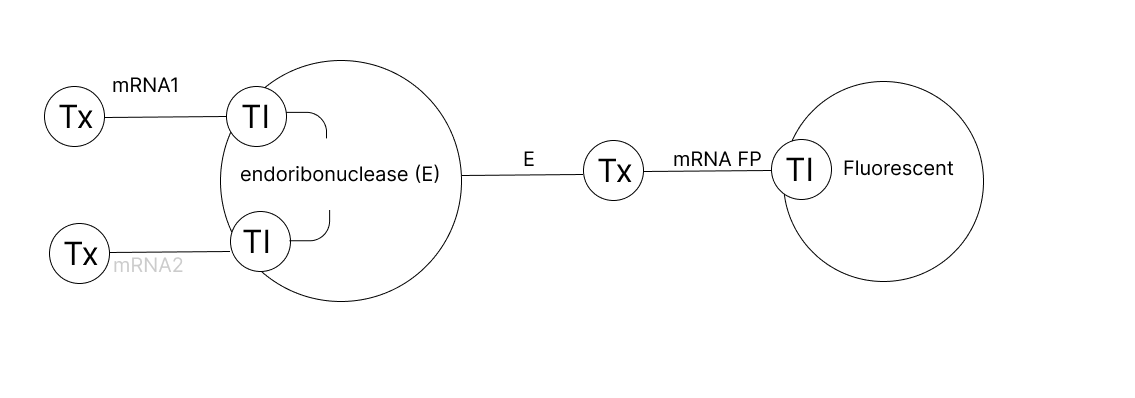
What advantages do IANNs have over traditional genetic circuits, whose input/output behaviors are Boolean functions? Traditioanl circuits use operate in binary and, or, not. IANN continuously sense and respond to the inputs instead of just their presence or absence. This makes them better suited for complex bioprocesses that vary in space and time, such as metabolically or environmentally sensitive cell behaviors. It also filters noise and variables which is ideal in fluctuating enviroment like the body.
Describe a useful application for an IANN; include a detailed description of input/output behavior, as well as any limitations an IANN might face to achieve your goal.
IANN would work well in a glucose responsive cells, that continuously monitors glucose in the body. The input would be glucose concentration from engineered glucose promoters or biosensors, the IANN would filter out noise and secrete the insulin hormone when needed.
Low glucose → low but nonzero output, avoiding sudden hypoglycemia. Rising glucose → gradually increasing insulin Sustained high glucose → sustained elevated output, but limited by saturating promoters or feedback repression to prevent toxicity.
Advantages:
- avoids the Boolean yes and no state, allowing a more responsive
- Noise Filtering allows for more accurate readings and minimises false readings
- Multiple sensing means more than one input can be engineered on the IANN
Limitations:
- Genes can mutate and change, which means the glucose monitor may not stay calibrated
- Continuous monitoring can be energy intensive
- IANN is environment dependent so will require tuning for each environment
What are some examples of existing fungal materials and what are they used for? What are their advantages and disadvantages over traditional counterparts?
Myco-leather is made from mycelium and is used for clothes, bags and accessorise. Advantages:
- biodegradable
- doesn’t require high energy to grow mycelium
- carbon negative
Disadvanages
- high start up costs
- its very hard to scale because of how long mycelium takes
- its hard to make everything consistent because it is a biological species, makes it difficult to QA.
What might you want to genetically engineer fungi to do and why? What are the advantages of doing synthetic biology in fungi as opposed to bacteria? You could genetically engineer fungi to produce stronger biomaterial, specifically addressing the disadvantages mentioned in the previous question. Engineering fungi to grow in the exact same way or to grow at an accelerated rate. Fungi has better folding/secretion of complex proteins with proper glycosylation. They can also survive more extreme conditions than bacteria. However, it is more genetically complicated compared to bacteria and there are less tools that work with fungi within bioloigy, most have been adapted to bacteria.