Wezzie Mbale — HTGAA Spring 2026
Homework
- Describe a biological engineering application or tool you want to develop and why. The oximeter, used to detect oxygen saturation, has known disparities accross different skin tones, due to the melanins ability to absorb near infered light (NIR) (Clarice). These disparaiteis result in patients or darker skin tone showing higher oxigen saturation and appearing healthier than they are. This resulted in black and hispanic patients recived delayed treated for COVID 19, due to systematic overestmation of oxygen saturation (Fawzy et al.) Genetic circuits in a synthetic biological application, that engineers DNA, RNA and protiens to programmable; functions such as biosensors that can be programmed to react to enviromental factors. I want to use this biological engineering application to engineer genetic circuits to sense a CO2 or O2 saturations in the epidermis. Using a biosensor that does not depend on NIR will increase the accuracy of oxygen readings and result in more equitable care 2. Describe one or more governance/policy goals related to ensuring that this application or tool contributes to an “ethical” future Loosly refering the TAPIC framework from the World Health Organisation, focusing on transparency, acccountability, participation, intergrity and Capacity. The below are three goals that are built on the TAPIC framework(“TAPIC”). 1. Reduce Physical and Ecological Harm Governance should ensure that engineered organisms using genetic circuits are designed with robust biosafety and biosecurity features such as kill switches that trigger cell death in inappropriate environments, or activation only under specific conditions such as defined temperature or oxygen saturation. In addition, long‑term post‑deployment monitoring of surrounding environments and exposed people, coupled with clear procedures for recalls and adverse event reporting, should be required so that emerging harms can be detected and mitigated early.
</div> </div></a> </div> <div class="card-content-text"> <ol>- Benchling & In-silico Gel Art 3. Protein Design Challenge 3.1 Protein Choice pHRed is a red fluorecent protein used to detect the pH in live cells. CO2 acts as an acid in the blood and forms carbonic acid (Garcia and Ramirez) and reduces the pH, so this can be used to create a biosensor to detect the pH of blood. Using the of pH is a more accurate data point to understand the condition of the blood and is currently done throught an artiel blood gas test (Cleveland Clinic). The protein sequence is blow NSRIATEGRIDTRFRGSIKNVTVSGENHETFDLINIFRDKSSVGIVKNLGEATITEKTSYDYTHTGDYLISATPVPFTFTEFDKLVRFSPXDFEQFESIEIQFRTKEPRGVLLFVGPDNAHTDYVCLEFYDRNLYLAFGIDGKDYRKQMNPKGTFVTTGNFHTIFIKRDRNHKFTAKFENVEVDIGDQSGHQREFGSYTYIGGIDNPSRLPWYVWSREGFVGCINYMRVNEDKYIDPRGKNNQYSGDIAGVDIGKCLNDVRHCTASHCEG
</div> </div>Part A- Conceptual Questions How many molecules of amino acids do you take with a piece of 500 grams of meat? (on average an amino acid is ~100 Daltons) Beef contains approximately 22g of protein per 100g 22 grams x 5= 110gram of protein in 500g of beef 1 Dalton ≈ 1g/mol 110g of protein / 100g/mol= 1.1mol 1.1x6.02×10²³= 6.6x10²³Part A - SOD1 Binder Peptide Design (From Pranam) FLYRWLPSRRGG Binder Pseudo Perplexity 0 WRSGVAAAAWKK 7.129399 Binder Pseudo Perplexity 0 WHYYAYAAALKE 14.080622 Binder Pseudo Perplexity 0 WLYPAYAVALGE 15.854594 Binder Pseudo Perplexity 0 HHYYVAGVAHKK 21.58328 MATKAVCVLKGDGPVQGIINFEQKESNGPVKVWGSIKGLTEGLHGFHVHEFGDNTAGCTSAGPHFNPLSRKHGGPKDEERHVGDLGNVTADKDGVADVSIEDSVISLSGDHCIIGRTLVVHEKADDLGKGGNEESTKTGNAGSRLACGVIGIAQWHSGPVXLEWWX MATKAVCVLKGDGPVQGIINFEQKESNGPVKVWGSIKGLTEGLHGFHVHEFGDNTAGCTSAGPHFNPLSRKHGGPKDEERHVGDLGNVTADKDGVADVSIEDSVISLSGDHCIIGRTLVVHEKADDLGKGGNEESTKTGNAGSRLACGVIGIAQWLYPAAAAAHKX MATKAVCVLKGDGPVQGIINFEQKESNGPVKVWGSIKGLTEGLHGFHVHEFGDNTAGCTSAGPHFNPLSRKHGGPKDEERHVGDLGNVTADKDGVADVSIEDSVISLSGDHCIIGRTLVVHEKADDLGKGGNEESTKTGNAGSRLACGVIGIAQWLYPAYAVALGE MATKAVCVLKGDGPVQGIINFEQKESNGPVKVWGSIKGLTEGLHGFHVHEFGDNTAGCTSAGPHFNPLSRKHGGPKDEERHVGDLGNVTADKDGVADVSIEDSVISLSGDHCIIGRTLVVHEKADDLGKGGNEESTKTGNAGSRLACGVIGIAQHHYYVAGVAHKK MATKAVCVLKGDGPVQGIINFEQKESNGPVKVWGSIKGLTEGLHGFHVHEFGDNTAGCTSAGPHFNPLSRKHGGPKDEERHVGDLGNVTADKDGVADVSIEDSVISLSGDHCIIGRTLVVHEKADDLGKGGNEESTKTGNAGSRLACGVIGIAQ 3 HHYYVAGVAHKK WLYPAYAVALGEWhat are some components in the Phusion High-Fidelity PCR Master Mix and what is their purpose? the Phusion High-Fidelity PCR Master Mix contains Phusion DNA polymerase, nucleotides, and an optimized reaction buffer including MgCl2 Phusion DNA polymerase is the enzyme that copies the DNA template, with high proofreading fidelity for accurate amplification. dNTPs (nucleotides) is the building blocks the polymerase incorporates into the new DNA strand. Optimized reaction buffer keeps the reaction conditions suitable for efficient polymerase activity, including pH and salt conditions.What advantages do IANNs have over traditional genetic circuits, whose input/output behaviors are Boolean functions? Traditioanl circuits use operate in binary and, or, not. IANN continuously sense and respond to the inputs instead of just their presence or absence. This makes them better suited for complex bioprocesses that vary in space and time, such as metabolically or environmentally sensitive cell behaviors. It also filters noise and variables which is ideal in fluctuating enviroment like the body.Subsections of Wezzie Mbale — HTGAA Spring 2026
Homework
Weekly homework submissions:
Week 1 : Principles and Practices
- Describe a biological engineering application or tool you want to develop and why. The oximeter, used to detect oxygen saturation, has known disparities accross different skin tones, due to the melanins ability to absorb near infered light (NIR) (Clarice). These disparaiteis result in patients or darker skin tone showing higher oxigen saturation and appearing healthier than they are. This resulted in black and hispanic patients recived delayed treated for COVID 19, due to systematic overestmation of oxygen saturation (Fawzy et al.) Genetic circuits in a synthetic biological application, that engineers DNA, RNA and protiens to programmable; functions such as biosensors that can be programmed to react to enviromental factors. I want to use this biological engineering application to engineer genetic circuits to sense a CO2 or O2 saturations in the epidermis. Using a biosensor that does not depend on NIR will increase the accuracy of oxygen readings and result in more equitable care 2. Describe one or more governance/policy goals related to ensuring that this application or tool contributes to an “ethical” future Loosly refering the TAPIC framework from the World Health Organisation, focusing on transparency, acccountability, participation, intergrity and Capacity. The below are three goals that are built on the TAPIC framework(“TAPIC”). 1. Reduce Physical and Ecological Harm Governance should ensure that engineered organisms using genetic circuits are designed with robust biosafety and biosecurity features such as kill switches that trigger cell death in inappropriate environments, or activation only under specific conditions such as defined temperature or oxygen saturation. In addition, long‑term post‑deployment monitoring of surrounding environments and exposed people, coupled with clear procedures for recalls and adverse event reporting, should be required so that emerging harms can be detected and mitigated early.
- Benchling & In-silico Gel Art 3. Protein Design Challenge 3.1 Protein Choice pHRed is a red fluorecent protein used to detect the pH in live cells. CO2 acts as an acid in the blood and forms carbonic acid (Garcia and Ramirez) and reduces the pH, so this can be used to create a biosensor to detect the pH of blood. Using the of pH is a more accurate data point to understand the condition of the blood and is currently done throught an artiel blood gas test (Cleveland Clinic). The protein sequence is blow NSRIATEGRIDTRFRGSIKNVTVSGENHETFDLINIFRDKSSVGIVKNLGEATITEKTSYDYTHTGDYLISATPVPFTFTEFDKLVRFSPXDFEQFESIEIQFRTKEPRGVLLFVGPDNAHTDYVCLEFYDRNLYLAFGIDGKDYRKQMNPKGTFVTTGNFHTIFIKRDRNHKFTAKFENVEVDIGDQSGHQREFGSYTYIGGIDNPSRLPWYVWSREGFVGCINYMRVNEDKYIDPRGKNNQYSGDIAGVDIGKCLNDVRHCTASHCEG
Part A- Conceptual Questions How many molecules of amino acids do you take with a piece of 500 grams of meat? (on average an amino acid is ~100 Daltons) Beef contains approximately 22g of protein per 100g 22 grams x 5= 110gram of protein in 500g of beef 1 Dalton ≈ 1g/mol 110g of protein / 100g/mol= 1.1mol 1.1x6.02×10²³= 6.6x10²³
Part A - SOD1 Binder Peptide Design (From Pranam) FLYRWLPSRRGG Binder Pseudo Perplexity 0 WRSGVAAAAWKK 7.129399 Binder Pseudo Perplexity 0 WHYYAYAAALKE 14.080622 Binder Pseudo Perplexity 0 WLYPAYAVALGE 15.854594 Binder Pseudo Perplexity 0 HHYYVAGVAHKK 21.58328 MATKAVCVLKGDGPVQGIINFEQKESNGPVKVWGSIKGLTEGLHGFHVHEFGDNTAGCTSAGPHFNPLSRKHGGPKDEERHVGDLGNVTADKDGVADVSIEDSVISLSGDHCIIGRTLVVHEKADDLGKGGNEESTKTGNAGSRLACGVIGIAQWHSGPVXLEWWX MATKAVCVLKGDGPVQGIINFEQKESNGPVKVWGSIKGLTEGLHGFHVHEFGDNTAGCTSAGPHFNPLSRKHGGPKDEERHVGDLGNVTADKDGVADVSIEDSVISLSGDHCIIGRTLVVHEKADDLGKGGNEESTKTGNAGSRLACGVIGIAQWLYPAAAAAHKX MATKAVCVLKGDGPVQGIINFEQKESNGPVKVWGSIKGLTEGLHGFHVHEFGDNTAGCTSAGPHFNPLSRKHGGPKDEERHVGDLGNVTADKDGVADVSIEDSVISLSGDHCIIGRTLVVHEKADDLGKGGNEESTKTGNAGSRLACGVIGIAQWLYPAYAVALGE MATKAVCVLKGDGPVQGIINFEQKESNGPVKVWGSIKGLTEGLHGFHVHEFGDNTAGCTSAGPHFNPLSRKHGGPKDEERHVGDLGNVTADKDGVADVSIEDSVISLSGDHCIIGRTLVVHEKADDLGKGGNEESTKTGNAGSRLACGVIGIAQHHYYVAGVAHKK MATKAVCVLKGDGPVQGIINFEQKESNGPVKVWGSIKGLTEGLHGFHVHEFGDNTAGCTSAGPHFNPLSRKHGGPKDEERHVGDLGNVTADKDGVADVSIEDSVISLSGDHCIIGRTLVVHEKADDLGKGGNEESTKTGNAGSRLACGVIGIAQ 3 HHYYVAGVAHKK WLYPAYAVALGE
Week 6: GENETIC CIRCUITS PART I
What are some components in the Phusion High-Fidelity PCR Master Mix and what is their purpose? the Phusion High-Fidelity PCR Master Mix contains Phusion DNA polymerase, nucleotides, and an optimized reaction buffer including MgCl2 Phusion DNA polymerase is the enzyme that copies the DNA template, with high proofreading fidelity for accurate amplification. dNTPs (nucleotides) is the building blocks the polymerase incorporates into the new DNA strand. Optimized reaction buffer keeps the reaction conditions suitable for efficient polymerase activity, including pH and salt conditions.
Week 7: GENETIC CIRCUITS PART II
What advantages do IANNs have over traditional genetic circuits, whose input/output behaviors are Boolean functions? Traditioanl circuits use operate in binary and, or, not. IANN continuously sense and respond to the inputs instead of just their presence or absence. This makes them better suited for complex bioprocesses that vary in space and time, such as metabolically or environmentally sensitive cell behaviors. It also filters noise and variables which is ideal in fluctuating enviroment like the body.
Subsections of Homework
Week 1 : Principles and Practices
1. Describe a biological engineering application or tool you want to develop and why.
The oximeter, used to detect oxygen saturation, has known disparities accross different skin tones, due to the melanins ability to absorb near infered light (NIR) (Clarice). These disparaiteis result in patients or darker skin tone showing higher oxigen saturation and appearing healthier than they are. This resulted in black and hispanic patients recived delayed treated for COVID 19, due to systematic overestmation of oxygen saturation (Fawzy et al.) Genetic circuits in a synthetic biological application, that engineers DNA, RNA and protiens to programmable; functions such as biosensors that can be programmed to react to enviromental factors. I want to use this biological engineering application to engineer genetic circuits to sense a CO2 or O2 saturations in the epidermis. Using a biosensor that does not depend on NIR will increase the accuracy of oxygen readings and result in more equitable care2. Describe one or more governance/policy goals related to ensuring that this application or tool contributes to an “ethical” future
Loosly refering the TAPIC framework from the World Health Organisation, focusing on transparency, acccountability, participation, intergrity and Capacity. The below are three goals that are built on the TAPIC framework(“TAPIC”).1. Reduce Physical and Ecological Harm
Governance should ensure that engineered organisms using genetic circuits are designed with robust biosafety and biosecurity features such as kill switches that trigger cell death in inappropriate environments, or activation only under specific conditions such as defined temperature or oxygen saturation. In addition, long‑term post‑deployment monitoring of surrounding environments and exposed people, coupled with clear procedures for recalls and adverse event reporting, should be required so that emerging harms can be detected and mitigated early.2. Reduce Risk of Misuse
Governance should aim to professionalise work with genetic circuits by requiring practitioners to belong to a professional body that manages licensing, training, ongoing awareness, and a code of conduct, similar to a Hippocratic‑style commitment to beneficence and non‑malfeasance. Manufacturers and design platforms could also be required to register with this body and to participate in systematic flagging of genetic designs that have plausible dual‑use or biological‑weapon potential, creating a structured mechanism to prevent intentional misuse.3. Transparency and Acccountability
Governance should prioritise clear, accessible education for consumers and end‑users of products containing engineered organisms, to reduce misunderstanding, misuse, and conspiracy‑driven opposition that can undermine legitimate, beneficial applications. Legal and regulatory policies should be evidence‑based and explicitly focused on reducing physical and ecological harm, with expert‑led advisory structures to minimise the lag between innovation and oversight and to prevent premature or inappropriate deployment of genetic‑circuit applications.
3. Describe at least three different potential governance “actions” by considering the four aspects (Purpose, Design, Assumptions, Risks of Failure & “Success”)
A Mandatory Professional Board
Purpose The closest board that currently does this is European Board of Medical Genetics, but they prioritise standardising biological engineering laboratories. Multiple regional boards specifically for synthetic engineering can be developed to standardise and regulate protein designs.
Design Governmental bodies such as the NHS, MHRA, academics and researchers would all have to opt in. Research institutions such as the Research Council, could fund research in safety and regulations of synthetic biology.
Assumptions
That professionals would want have regulations on a relatively new field.
Regulations would keep up with the pace of the researchRisk of Failure or Success
Failure - knowledgable experts can opt to manufacture their designs abroad to skip legal or regulatory requirements. Too much regulations could stiffen innovation in the field
Success - knowledgable experts only work on designs that are for the betterment of humanity and design intentional and reliable bio-securitiesExpert Led Legalisation
Purpose Currently the legislation is dated compared to current technologies and research. An Expert led legislation task force can consult, draft and spearhead legislation to create current guard rails within the field.
Design The most suitable experts in synthetic biology, biosecurity, environmental scientists and biology will need to be bought together.
The government would need to establish this task force alongside the regulators and legal bodies.Assumptions
A small task force would increase and improve the legislations and not create legislation from a narrow perspective
Experts will keep up to date with technologies in the overall field, outside of their expertise.Risk of Failure or Success
Failure - Expert bias, legislation could be geared to benefiting specific interest and funding instead of safety
Success - Unintended results maybe that funding only goes to research that aligns with the legislation, leaving little room for explorations of the field. There may also be an over standardisation of procedures, which stiffens innovation and development.Longterm Post Deployment Observations
Purpose Currently the monitoring of engineered organisms can be short term and project specific. The proposed change would mandate schemes for all applications utilising engineered organism to observe humans bodies, workplaces and the environment long term.
Design This will require a clear triggers for when monitoring is mandatory (any use of genetic circuits that could affect health, ecosystems, or critical infrastructure over time).
Defined institutional roles, where developers design monitoring plans, regulators set and approve standards, and health/environmental authorities collect and report data.
Supporting infrastructure, including registries linking deployments to surveillance systems and predefined protocols for incident reporting, investigation, and corrective actions such as recalls or added containment.
Assumptions
Funding will be sustained for a long period of time
Consumers would be comfortable with long term monitoringRisk of Failure or Success
Failure - Poorly design monitoring forms/questions that do not accurately may miss key interactions
Poorly analysis of the collected data Success - Unintended results maybe long term observations increases the cost of research and costs out SME and smaller researching companies.
May put of researchers exploring products using engineered organisms.4. Score (from 1-3 with, 1 as the best, or n/a) each of your governance actions against your rubric of policy goals.
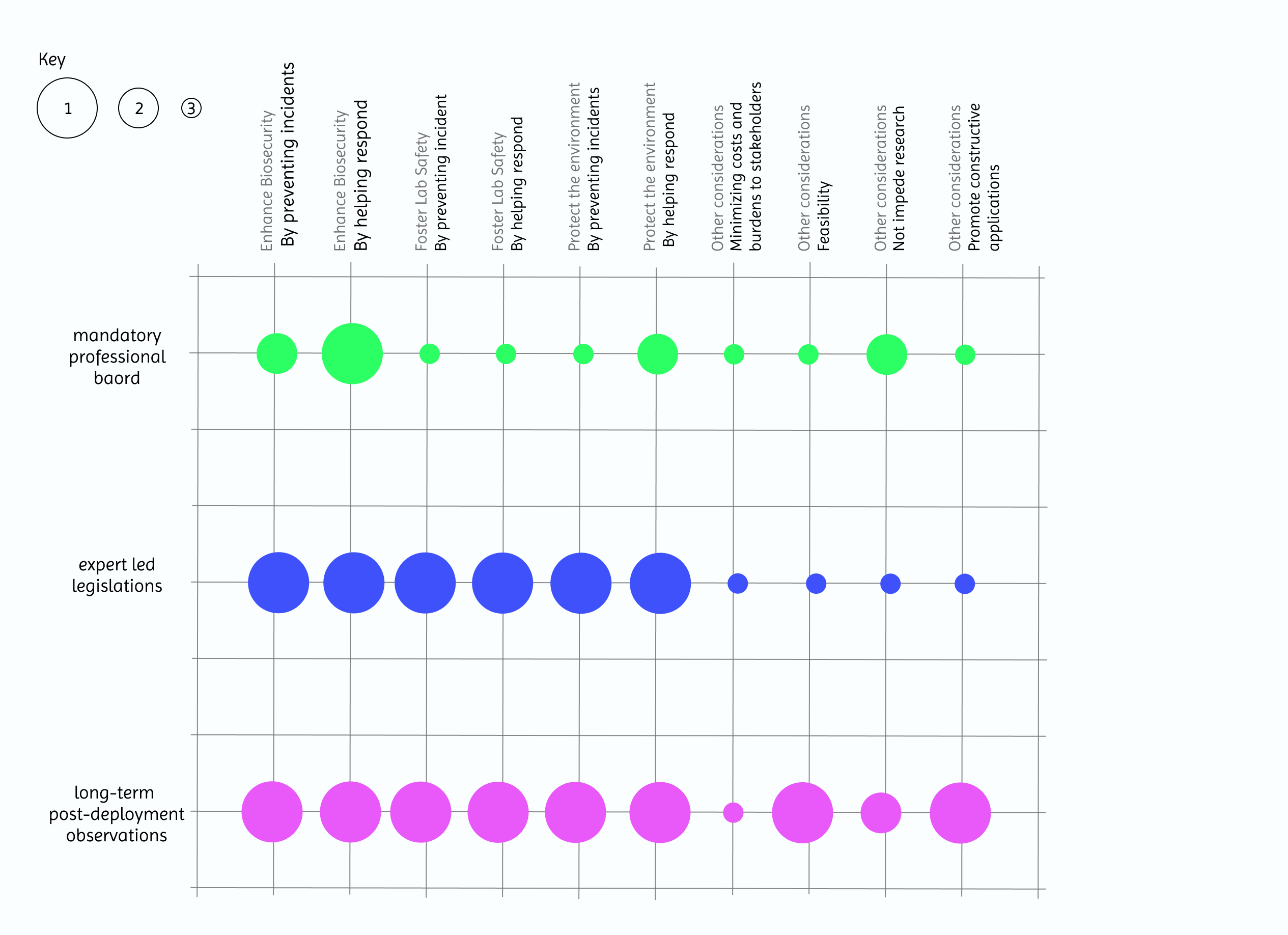 x
x5. Drawing upon this scoring, describe which governance option, or combination of options, you would prioritize, and why
I would prioritise a combination of expert‑led legislation as the backbone, complemented by mandatory professional board. This pairing best balances safety, adaptability, and innovation by using law to set system‑wide guard rails and the board to shape day‑to‑day professional practice.
Expert‑led legislation should be the primary mechanism because it can create clear, democratically anchored guard rails that apply to all actors, including companies and international collaborators, not just individual professionals. A standing task force can iteratively update rules as genetic circuit technologies evolve, reducing the risk that regulation becomes outdated, and it provides enforcement tools such as licensing conditions and penalties that a professional board alone would lack.
A professional board then works as a complementary layer rather than the sole gatekeeper, helping to standardise training, codes of conduct, and norms of good practice that go beyond what law can specify in detail. Positioned as mandatory for certain high‑risk roles but lighter‑touch for early‑stage research, it can translate high‑level legal requirements into everyday standards without over‑burdening the entire field.
Key Trade Offs
- Legislation reaches a broader set of actors (industry, international partners, “grey zone” labs), while a board mainly governs recognised professionals.
- Law can be slower and more rigid; boards are more agile but narrower in reach.
- A strong board, if too rigid, can discourage unconventional research paths or push work abroad.
- A purely legal approach, if too heavy, can slow innovation and make investment less attractive.
- Combining them allows: laws to set minimum safety baselines, while the board supports safe experimentation within those boundaries.
- If the board is the main gatekeeper, experts might relocate or collaborate in jurisdictions without such requirements.
- If legislation is too detailed and centralised, it may lock in certain approaches and make it hard for new methods or smaller researchers to compete.
- The combination allows the law to focus on outcomes (e.g., risk thresholds, accountability) and the board on evolving best practice, reducing the pressure on either to micromanage everything.
Assumptions
Governments are willing to create and properly resource an expert task force, and to revisit legislation regularly rather than treating it as “one‑and‑done.”
The task force includes not just technical experts but also ethicists and public-interest voices, reducing the risk of narrow or captured perspectives.
Professionals in synthetic biology see value in collective standards and reputation, so they opt into (and help shape) a board rather than treating it purely as a burden.
Both mechanisms can coordinate: legal frameworks recognise the board, and the board’s standards are compatible with statutory rules.
Remaining uncertainties
It’s uncertain how much influence a national or regional board can have when work, code, and designs are easily shared across borders.
Both the task force and the board risk lagging behind rapid technical change; success depends on continuous renewal and good links to cutting‑edge research, not just one‑off appointments.
There is a risk that combined requirements (membership + compliance with evolving law) burdens small labs, start‑ups, or institutions in lower‑income settings, unless support mechanisms are built in.
Lecture Prep
Homework Questions from Professor Jacobson
- The error rate is 1:10*6 with 3.2 million base pairs in the human genome. MutS repair system
- Theres approximatly 1,036 base pairs and some reasons why all of these different codes don’t work to code for the protein of interest is because high GC content creates stable structures that can interfere with transcription and translation, Some sequences create RNase cleavage sites, repetitive sequences, extreme GC content, and secondary structures make both chemical synthesis and PCR assembly difficult and different organisms prefer certain codons over others, affecting translation efficiency.
Homework Questions from Dr. LeProust
- Phosphoramidite chemistry is the dominant method which involves: Deprotection, Base coupling, Capping and Oxidation. Each cycle takes approximately 5 minutes, and a single machine can produce roughly 0.5 Mbp per year.
- The yeild decreases, due to decoupling effects when the oligos exceed 200nt
- The yield would make it redundant and the error rate would be too high.
Homework Question from George Church
For question three answer click hereReferece
Works CitedBrophy, Jennifer A N, and Christopher A Voigt. “Principles of Genetic Circuit Design.” Nature Methods, vol. 11, no. 5, 29 Apr. 2014, pp. 508–520, https://doi.org/10.1038/nmeth.2926.
Clarice.“Inaccurate Oxygen Readings: The Problem with Pulse Oximeters.” Baylor College of Medicine Blog Network, 19 Aug. 2022, blogs.bcm.edu/2022/08/19/inaccurate-oxygen-readings-the-problem-with-pulse-oximeters/.
Fawzy, Ashraf, et al. “Racial and Ethnic Discrepancy in Pulse Oximetry and Delayed Identification of Treatment Eligibility among Patients with COVID-19.” JAMA Internal Medicine, vol. 182, no. 7, 1 July 2022, pp. 730–738, jamanetwork.com/journals/jamainternalmedicine/fullarticle/2792653#:~:text=Conclusions%20and%20Relevance%20The%20results, https://doi.org/10.1001/jamainternmed.2022.1906.
Kelle, Alexander. “Ensuring the Security of Synthetic Biology—towards a 5P Governance Strategy.” Systems and Synthetic Biology, vol. 3, no. 1-4, 10 Oct. 2009, pp. 85–90, https://doi.org/10.1007/s11693-009-9041-8.Müller, Marik M., et al.
“Genetic Circuits in Synthetic Biology: Broadening the Toolbox of Regulatory Devices.” Frontiers in Synthetic Biology, vol. 3, 7 Mar. 2025, https://doi.org/10.3389/fsybi.2025.1548572.“TAPIC.” Eurohealthobservatory.who.int, eurohealthobservatory.who.int/themes/observatory-programmes/governance/tapic.Week 2: DNA Read/Write/Edit :
1. Benchling & In-silico Gel Art
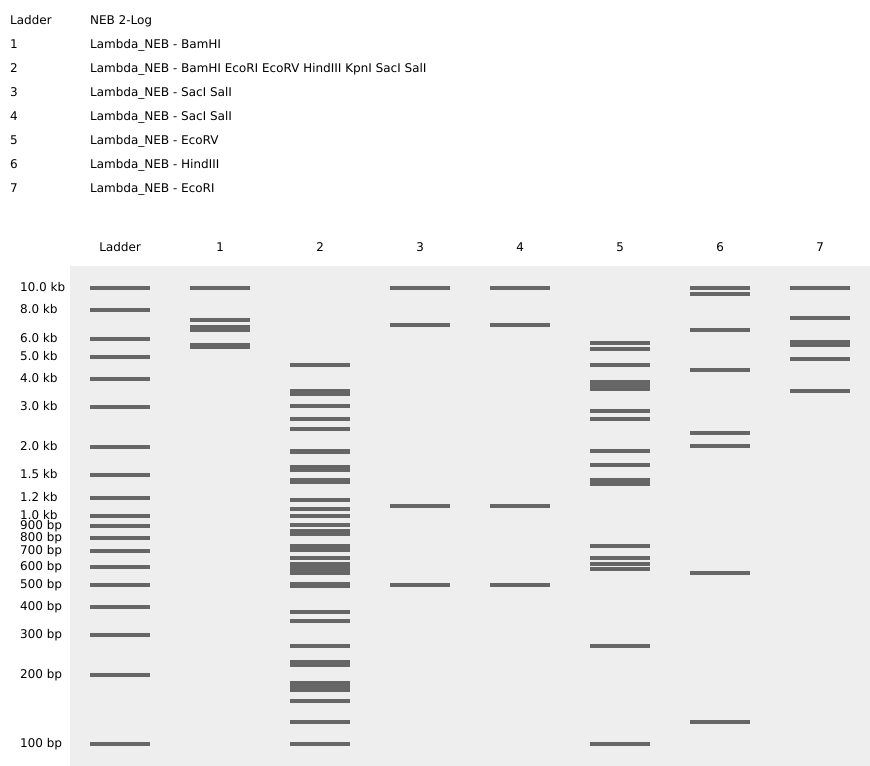
3. Protein Design Challenge
3.1 Protein Choice pHRed is a red fluorecent protein used to detect the pH in live cells. CO2 acts as an acid in the blood and forms carbonic acid (Garcia and Ramirez) and reduces the pH, so this can be used to create a biosensor to detect the pH of blood. Using the of pH is a more accurate data point to understand the condition of the blood and is currently done throught an artiel blood gas test (Cleveland Clinic). The protein sequence is blow
NSRIATEGRIDTRFRGSIKNVTVSGENHETFDLINIFRDKSSVGIVKNLGEATITEKTSYDYTHTGDYLISATPVPFTFTEFDKLVRFSPXDFEQFESIEIQFRTKEPRGVLLFVGPDNAHTDYVCLEFYDRNLYLAFGIDGKDYRKQMNPKGTFVTTGNFHTIFIKRDRNHKFTAKFENVEVDIGDQSGHQREFGSYTYIGGIDNPSRLPWYVWSREGFVGCINYMRVNEDKYIDPRGKNNQYSGDIAGVDIGKCLNDVRHCTASHCEG3.2 Reverse Translate: Protein (amino acid) sequence to DNA (nucleotide) sequence. Using bioinformatics.com i reversed the protein into the below DNA sequence
aacagccgcattgcgaccgaaggccgcattgatacccgctttcgcggcagcattaaaaacgtgaccgtgagcggcgaaaaccatgaaacctttgatctgattaacatttttcgcgataaaagcagcgtgggcattgtgaaaaacctgggcgaagcgaccattaccgaaaaaaccagctatgattatacccataccggcgattatctgattagcgcgaccccggtgccgtttacctttaccgaatttgataaactggtgcgctttagcccgnnngattttgaacagtttgaaagcattgaaattcagtttcgcaccaaagaaccgcgcggcgtgctgctgtttgtgggcccggataacgcgcataccgattatgtgtgcctggaattttatgatcgcaacctgtatctggcgtttggcatt gatggcaaagattatcgcaaacagatgaacccgaaaggcacctttgtgaccaccggcaactttcataccatttttattaaacgcgatcgcaaccataaatttaccgcgaaatttgaaaacgtggaagtggatattggcgatcagagcggccatcagcgcgaatttggcagctatacctatattggcggcattgataacccgagccgcctgccgtggtatgtgtggagccgcgaaggctttgtgggctgcattaactatatgcgcgtgaacgaagataaatatattgatccgcgcggcaaaaacaaccagtatagcggcgatattgcgggcgtggatattggcaaatgcctgaacgatgtgtcgccattgcaccgcgagccattgcgaaggcThe concensus sequence
aaywsnmgnathgcnacngarggnmgnathgayacnmgnttymgnggnwsnathaaraaygtnacngtnwsnggngaraaycaygaracnttygayytnathaayathttymgngayaarwsnwsngtnggnathgtnaaaayytnggngargcnacnathacngaraaracnwsntaygaytayacncayacnggngaytayytnathwsngcnacnccngtnccnttyacnttyacngarttygayaarytngtnmgnttywsnccnnnngayttygarcarttygarwsnathgarathcarttymgnacnaargarccnmgnggngtnytnytnttygtnggnccngayaaygcncayacngaytaygtntgyytngarttytaygaymgnaayytntayytngcnttyggnathgayggnaargaytaymgnaarcaratgaayccnaarggnacnttygtnacnacnggnaayttycayacnathttyathaarmgngaymgnaaycayaarttyacngcnaarttygaraaygtngargtngayathggngaycarwsnggncaycarmgngarttyggnwsntayacntayathggnggnathgayaayccnwsnmgnytnccntggtaygtntggwsnmgngarggnttygtnggntgyathaaytayatgmgngtnaaygargayaartayathgayccnmgnggnaaraayaaycartaywsnggngayathgcnggngtngayathggnaartgyytnaaygaygtnmgncaytgyacngcnwsncaytgygarggn
3.3 Codon optimization Optimisation is necessary because genetic code is degenrate so the same amino acid can come from multiple codons. Optimising ensures the codons used are the most compatible for the host. Prokayotes also would not need post transcriptional modifications like eukrayotes cells because DNA in prakoyotes cells are within the same cell walls as ribosomes, it does not require the 5’ capping,3 Poly-A tail and splicing modifications. Using envectorbuilder.com i optimised this for yeast.
GCTGCTTGTGCTGGTTGTTGTGGTTGTGCTACAACTGGTTGTGGTGCTTGTTGTGGTGCAGCTGGTGGTTGTTGTGGTTGTGCTACTACCGGTGCAACTGCTTGTTGTTGTGGTTGTACTACTACTTGTGGTTGTGGCGGCTGTGCAGGTTGTGCAACTACTGCAGCTGCAGCAGCTTGTGGTACCGGTGCATGTTGTGGTACTGGTGCTGGTTGTGGAGGTTGCGGTGCTGCAGCCGCCTGTTGTGCTACAGGTGCAGCTGCATGCTGTACAACTACTGGTGCTACCTGTACAGGTGCTACAACTGCTGCTTGTGCAACAACAACTACTACATGTGGTTGTGGTGCAACTGCCGCTGCTGCAGGTTGTGCTGGTTGTGGTACAGGTGGTGGTTGTGCTACTACTGGTACTGGTGCTGCTGCCGCTGCTTGTTGTACTGGTGGAGGTTGTGGTGCTGCAGGTTGTGGTGCATGTTGTGCTACAACCGCATGTTGCGGTGCAGCCGCTGCTGCAGCATGTTGTGCAGGTTGTACAGCTACAGGTGCAACAACAGCAACTGCTTGTTGTTGTGCTACTGCTTGTTGTGGTGGTTGTGGTGCAACTACAGCTACATGTACTGGCGCTACAACTGCTGGTTGTGGTTGTGGTGCTTGTTGTTGTTGTGGTGGTACCGGTTGTTGTGGTACCACTACTGCATGTTGTACTACTACTGCTTGTTGTGGTGCTGCAACAACTACTGGTGCTACCGCTGCTGCTTGTACAGGTGGTACAGGATGTGGTTGTACAACTACTGCTGGTTGTTGCTGTGGTGGTGCTACAACTACAACTGGCGCTGCTTGTGCAGGTACTACTACCGGTGCTGCAGCTGGTTGTGCTACTACTGGTGCAGCCGCAACTACATGTGCTGGTACTACTACTTGTGGTTGTGCTTGTTGTGCAGCTGCTGGTGCTGCATGTTGCGGTTGTGGTTGTGGTGGTTGTGGTACCGGCTGCACTGGTTGTACAGGTACTACTACGGGTACAGGTGGTGGTTGTTGCTGTGGCGGTGCAACTGCTGCATGTGGTTGTGGTTGTGCTACCGCATGTTGCGGTGCTACTACTGCTACAGGTACAGGTACCGGTTGCTGTACCGGTGGTGCTGCTACAACAACTACAGCTACAGGTGCCACATGTGGTTGTGCTGCTTGTTGTACTGGTACTGCAACGTGCACAGGTGGTTGTGGTACAACTACTGGCGGTTGTGCTACTACTGGTGCTACTGGTGGTTGCGCAGCTGCCGGTGCAACTACAGCTACATGTGGTTGTGCTGCTGCATGTGCAGGTGCTACTGGTGCAGCATGCTGTTGTGGTGCTGCAGCTGGTGGTTGTGCTTGTTGTACAACTACAGGTACTGGTGCATGTTGCGCTTGTTGTGGTGGTTGTGCAGCTTGTACAACTACTTGTGCTACAGCGTGCTGTGCAACAACTACTACAACAGCTACTACTGCTGCAGCTTGTGGTTGTGGTGCAACTTGTGGTTGTGCTGCGTGTTGCGCTACTGCTGCTGCTACTACTACAGCATGTTGTGGTTGTGGTGCAGCAGCTACTACAACTGGTGCTGCTGCTGCTTGTGGAACAGGTGGTGCTGCCGGTACCGGTGGTGCGACAGCTACTACTGGTGGTTGCGGTGCTACCTGTGCTGGTGCTGGCTGTGGTGGTTGTTGCGCCACCTGTGCTGGTTGTGGTTGCGGTGCAGCCACTACAACAGGTGGTTGTGCAGGTTGTACTGCCACTGCTTGTTGTACGGCCACTGCCACTACTGGTGGTTGTGGTGGTTGTGCTACAACCGGTGCTACAGCTGCATGTTGTTGTGGTGCTGGTTGTTGTGGTTGTTGTACTGGTTGTTGTGGTACAGGTGGTACTGCTACTGGTACTGGCACCGGTGGTGCTGGTTGTTGCGGTTGTGGAGCTGCTGGTGGATGTACTACAACTGGTACAGGTGGTGGTTGCACTGGTTGTGCTACTACTGCTGCTTGTACCGCCACTGCTACAGGTTGTGGTTGTGGTACAGGTGCTGCATGTGGTGCAGCCGGTGCTACTGCAGCAGCCACTGCCACTGCAACAACTGGTGCTACTTGTTGCGGTTGTGGTTGTGGTGGTTGTGCAGCTGCTGCAGCTTGCGCAGCTTGTTGTGCCGGTACTGCAACAGCTGGTTGTGGCGGTTGCGGTGCAACAGCTACTACAGGTTGCGGTGGTGGTTGTGGTACAGGTGGTGCTACTGCTACAACAGGTGGATGTGCTGCCGCTACTGGTTGTTGTACTGGTGCAGCATGTGGTGCAACTGGTACTGGAACTTGTGGTTGTTGTGCCACTACTGGTTGTGCTTGTTGCGGTTGCGGAGCTGGATGTTGTGCTACTACTGGTTGTGGTGCAGCTGGTGGTTGTTGA
3.4 Protien Sythesis
Next step would require turning sythesising this DNA, using twist, to produce a tube of the sythesised DNA. For cell dependant sythesis, this has been optimised for yeast so the most cost effect method would be to use chemical transformation can be done to get the DNA into the yeast. This works by mixing the DNA with calcium chloride to neutralise the negative charges in the plasmid in an ice bath. This is then moved from the ice bath to 42º for 45s and then back to ice(A and Je). The change in tempreture creates a pressurised enviroment that pulls the DNA into the yeast. Once the DNA is in the yest, it begins transcription and enzymes create the matching mRNA which ribosomes read to assemble the amino acids to fold the protein. Cell free production would use ribosomes, enzymes and ATP’s in a test tube. The ribosomes should immedietly start tranlating and transcibing the DNA into protein.4. Twist Orders
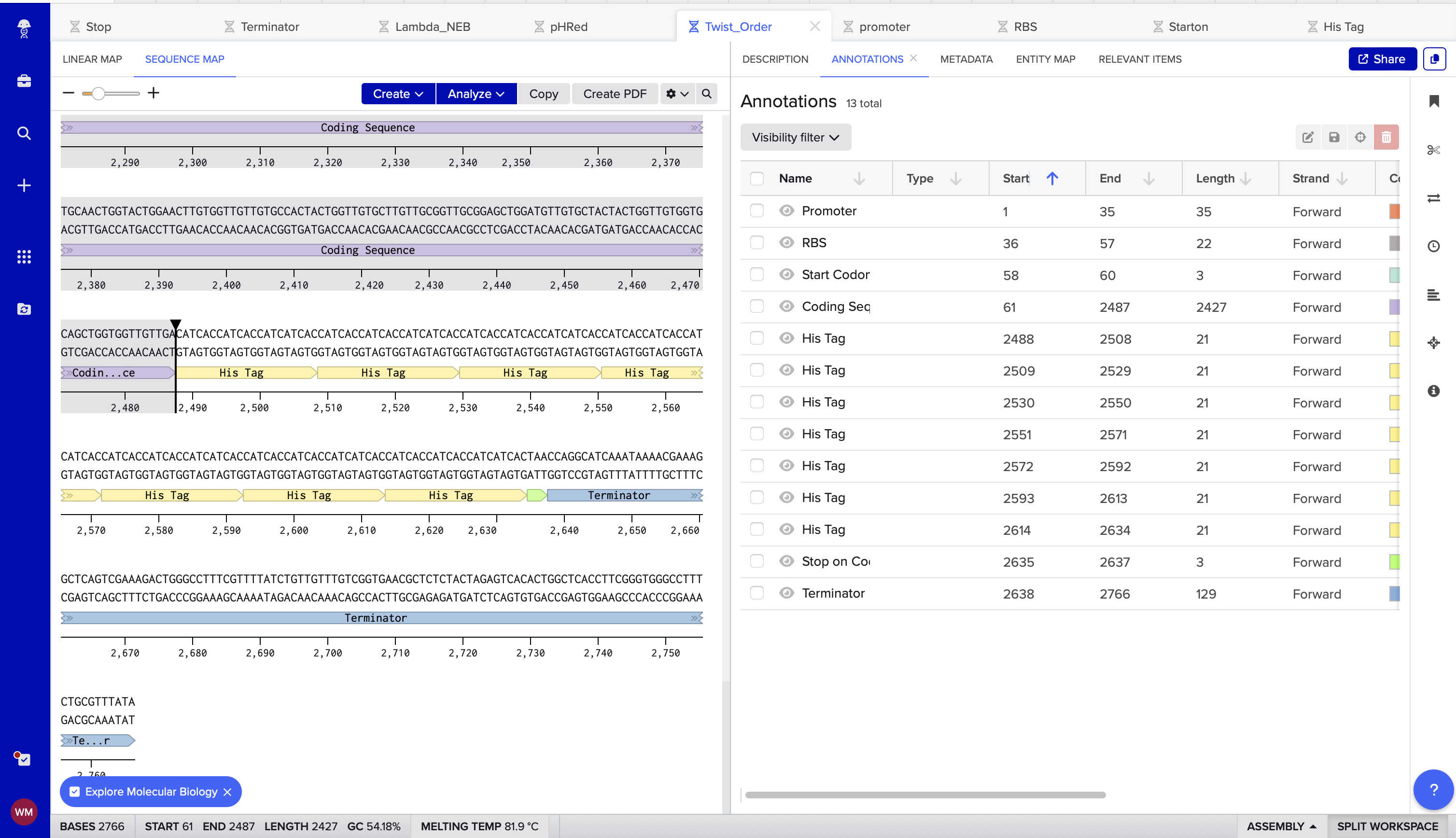 Link to Benchling click [here] (https://benchling.com/s/seq-4NHKPQMzr1XF9FPeLKLG?m=slm-T6K9Zspozrn2EITqbIXm)
For the vectors i will use pTwist PIC9K which has ampicilin resistance. I couldnt create a twist account as it said “Registration cannot be completed at this time”
5. DNA Reading
Week 3: Homework
Week 4: PROTEIN DESIGN PART I
Part A- Conceptual Questions
How many molecules of amino acids do you take with a piece of 500 grams of meat? (on average an amino acid is ~100 Daltons)
Beef contains approximately 22g of protein per 100g 22 grams x 5= 110gram of protein in 500g of beef 1 Dalton ≈ 1g/mol 110g of protein / 100g/mol= 1.1mol 1.1x6.02×10²³= 6.6x10²³Why do humans eat beef but do not become a cow, eat fish but do not become fish?
Why are there only 20 natural amino acids?
20 seems to be is the most optimum, photochemically. It is stable enough to build functioning proteins. There are 64 possible condons that need to work with 20 amino acids making it robost to minimise mutations. Having more would make it difficult to create suitable tRNA.
Can you make other non-natural amino acids? Design some new amino acids.
Where did amino acids come from before enzymes that make them, and before life started?
If you make an α-helix using D-amino acids, what handedness (right or left) would you expect?
Can you discover additional helices in proteins?
Why are most molecular helices right-handed?
*Why do β-sheets tend to aggregate?
What is the driving force for β-sheet aggregation?
Week 5: Protien Design 2
Part A - SOD1 Binder Peptide Design (From Pranam)
FLYRWLPSRRGG
Binder Pseudo Perplexity 0 WRSGVAAAAWKK 7.129399
Binder Pseudo Perplexity 0 WHYYAYAAALKE 14.080622
Binder Pseudo Perplexity0 WLYPAYAVALGE 15.854594
Binder Pseudo Perplexity0 HHYYVAGVAHKK 21.58328
MATKAVCVLKGDGPVQGIINFEQKESNGPVKVWGSIKGLTEGLHGFHVHEFGDNTAGCTSAGPHFNPLSRKHGGPKDEERHVGDLGNVTADKDGVADVSIEDSVISLSGDHCIIGRTLVVHEKADDLGKGGNEESTKTGNAGSRLACGVIGIAQWHSGPVXLEWWX
MATKAVCVLKGDGPVQGIINFEQKESNGPVKVWGSIKGLTEGLHGFHVHEFGDNTAGCTSAGPHFNPLSRKHGGPKDEERHVGDLGNVTADKDGVADVSIEDSVISLSGDHCIIGRTLVVHEKADDLGKGGNEESTKTGNAGSRLACGVIGIAQWLYPAAAAAHKX
MATKAVCVLKGDGPVQGIINFEQKESNGPVKVWGSIKGLTEGLHGFHVHEFGDNTAGCTSAGPHFNPLSRKHGGPKDEERHVGDLGNVTADKDGVADVSIEDSVISLSGDHCIIGRTLVVHEKADDLGKGGNEESTKTGNAGSRLACGVIGIAQWLYPAYAVALGE
MATKAVCVLKGDGPVQGIINFEQKESNGPVKVWGSIKGLTEGLHGFHVHEFGDNTAGCTSAGPHFNPLSRKHGGPKDEERHVGDLGNVTADKDGVADVSIEDSVISLSGDHCIIGRTLVVHEKADDLGKGGNEESTKTGNAGSRLACGVIGIAQHHYYVAGVAHKK
MATKAVCVLKGDGPVQGIINFEQKESNGPVKVWGSIKGLTEGLHGFHVHEFGDNTAGCTSAGPHFNPLSRKHGGPKDEERHVGDLGNVTADKDGVADVSIEDSVISLSGDHCIIGRTLVVHEKADDLGKGGNEESTKTGNAGSRLACGVIGIAQ
3 HHYYVAGVAHKK

WLYPAYAVALGE

WHYYAYAAALKE

WRSGVAAAAWKK

FLYRWLPSRRGG

Week 6: GENETIC CIRCUITS PART I
What are some components in the Phusion High-Fidelity PCR Master Mix and what is their purpose? the Phusion High-Fidelity PCR Master Mix contains Phusion DNA polymerase, nucleotides, and an optimized reaction buffer including MgCl2
Phusion DNA polymerase is the enzyme that copies the DNA template, with high proofreading fidelity for accurate amplification.
dNTPs (nucleotides) is the building blocks the polymerase incorporates into the new DNA strand.
Optimized reaction buffer keeps the reaction conditions suitable for efficient polymerase activity, including pH and salt conditions.
MgCl2 provides magnesium ions, which are required as a cofactor for DNA polymerase function.
HF Buffer is the default high-fidelity buffer, and GC buffer is used for GC-rich or hard-to-amplify templates.
What are some factors that determine primer annealing temperature during PCR? Primer annealing temperature is mainly determined by the melting temperature of the primers: their length, GC content, and sequence composition. In practice, it is usually set a few degrees below the lower primer Tm so the primers can bind the template efficiently.
There are two methods from this class that create linear fragments of DNA: PCR, and restriction enzyme digests. Compare and contrast these two methods, both in terms of protocol as well as when one may be preferable to use over the other.
PCR makes a specific DNA fragment by copying a template with primers and a DNA polymerase. The usual workflow is template DNA, forward and reverse primers, dNTPs, polymerase, buffer, and thermocycling through denaturation, annealing, and extension. This is best when you want a fragment defined by a sequence and not just by available cut sites. or if you want to introduce mutations, tags, overlaps or add tails in the primers.
Restriction digest A restriction digest makes fragments by using restriction enzymes that cut DNA at specific recognition sites. The workflow is usually DNA plus enzyme, buffer, incubation at the enzyme’s optimal temperature, then gel purification if needed. This is ideal when you want precise cuts at known sites already present in the DNA and have compatible ends for cloning into a vector.
How can you ensure that the DNA sequences that you have digested and PCR-ed will be appropriate for Gibson cloning? For Gibson cloning, the DNA fragments you generate by PCR need to have matching homologous overlaps at their ends, and the final construct has to be designed so adjacent pieces can anneal seamlessly. In practice, that means PCR primers should add the overlap sequences, and any restriction-digested backbone should be cut so the exposed ends correspond to the intended junctions in the assembly.
How does the plasmid DNA enter the E. coli cells during transformation?
The cell membrane is temporarily made permeable usually by heat shock or electroporation, which enables the plasmid to enter the E. coli and then the plasmid replicates and expresses its genes, including antibiotic resistance markers used for selection.
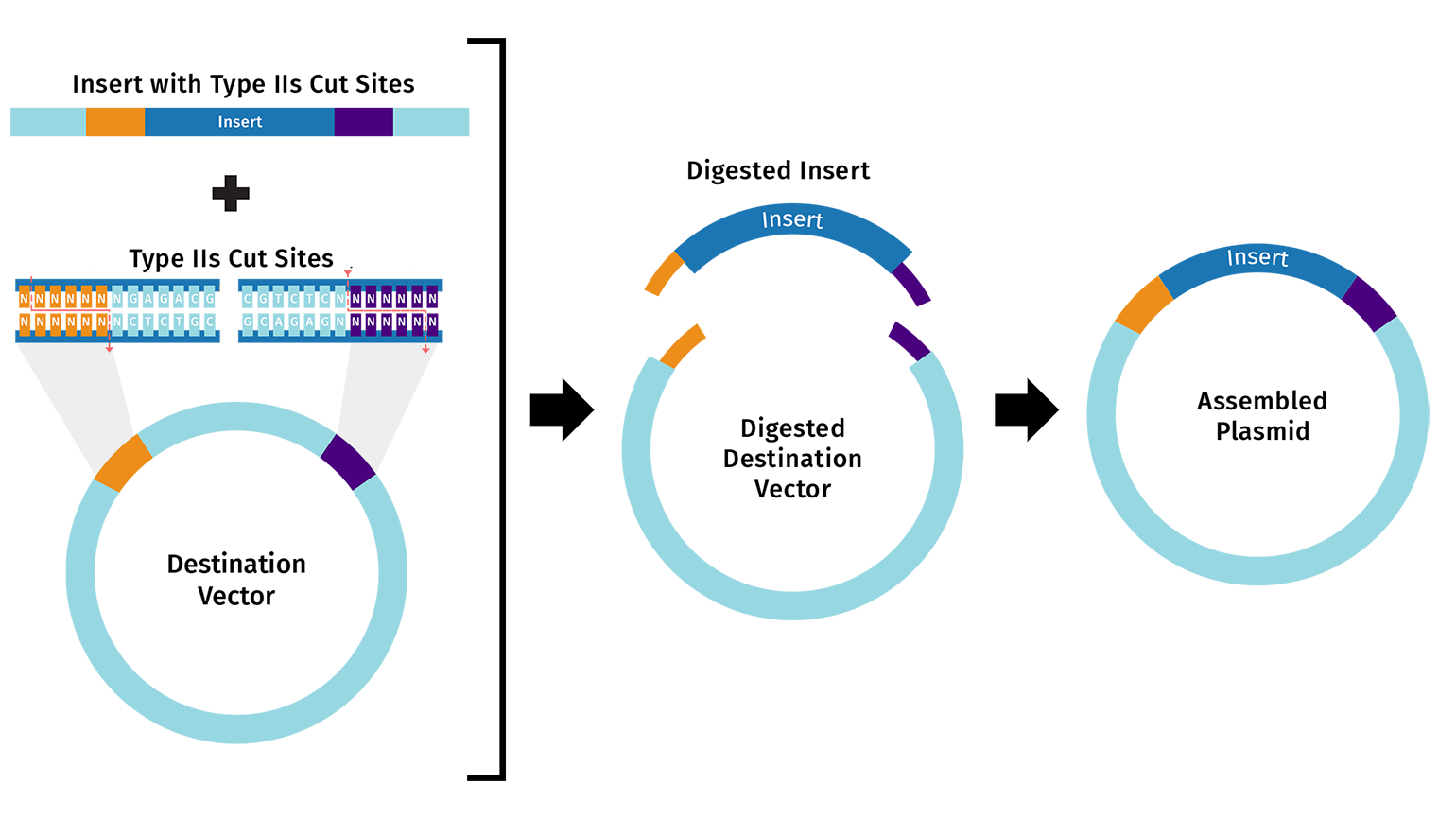
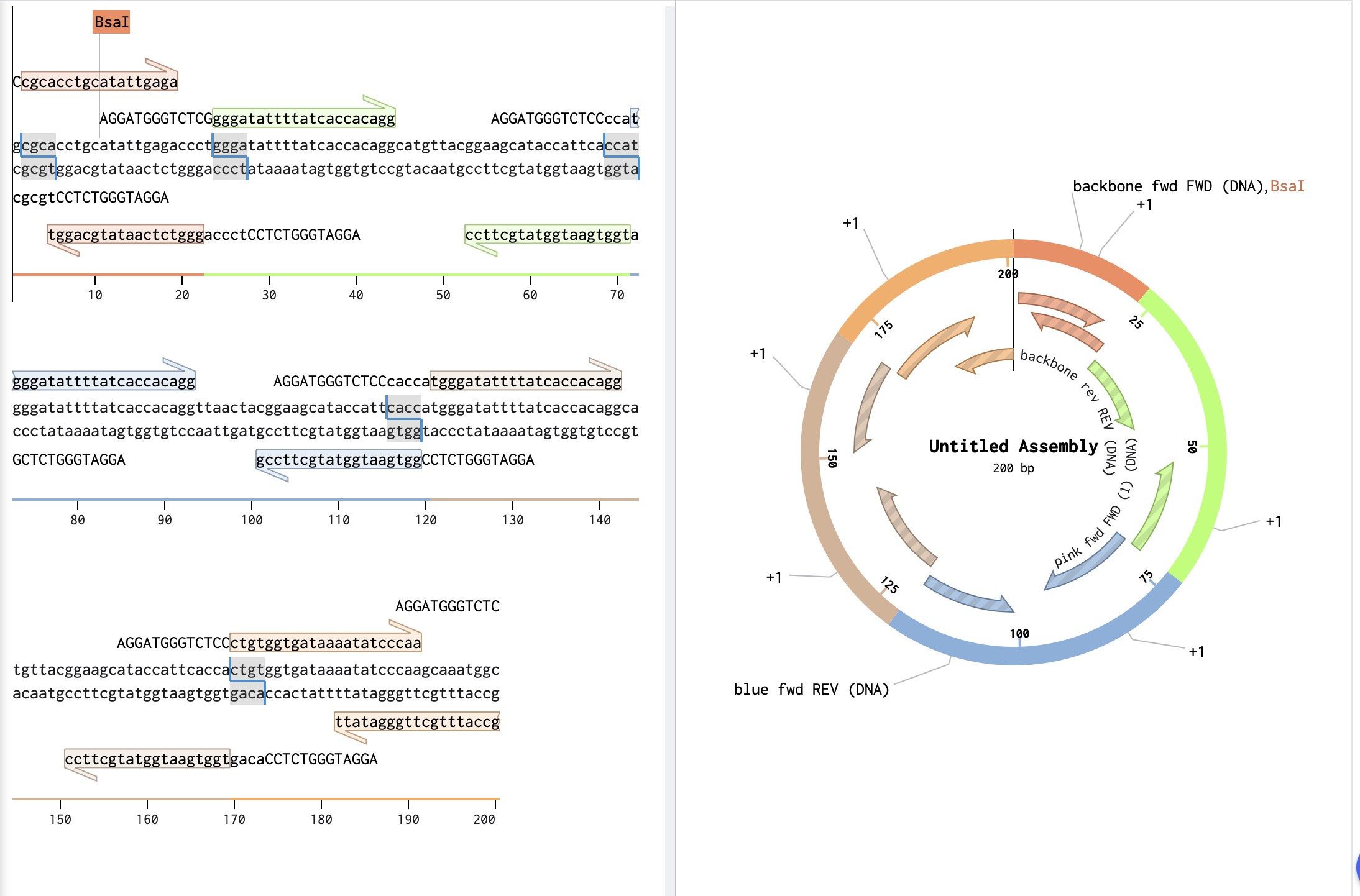
Describe another assembly method in detail (such as Golden Gate Assembly) Explain the other method in 5 - 7 sentences plus diagrams (either handmade or online). Model this assembly method with Benchling or Asimov Kernel!
Golden Gate Assembly is a cloning method that combines restriction digestion and ligation in a single reaction. It uses a Type IIS restriction enzyme plus DNA ligase in one tube to cut DNA fragments and join them in an intended order, usually with scarless junctions. It is called scarless because the final construct does not retain the restriction sites at the junctions. Golden Gate works by designing each DNA part with unique overhangs so only the correct fragments join together. It is really useful for modular, multi-part cloning and for building larger or more complex constructs than a simple one-insert ligation.
Week 7: GENETIC CIRCUITS PART II
What advantages do IANNs have over traditional genetic circuits, whose input/output behaviors are Boolean functions? Traditioanl circuits use operate in binary and, or, not. IANN continuously sense and respond to the inputs instead of just their presence or absence. This makes them better suited for complex bioprocesses that vary in space and time, such as metabolically or environmentally sensitive cell behaviors. It also filters noise and variables which is ideal in fluctuating enviroment like the body.
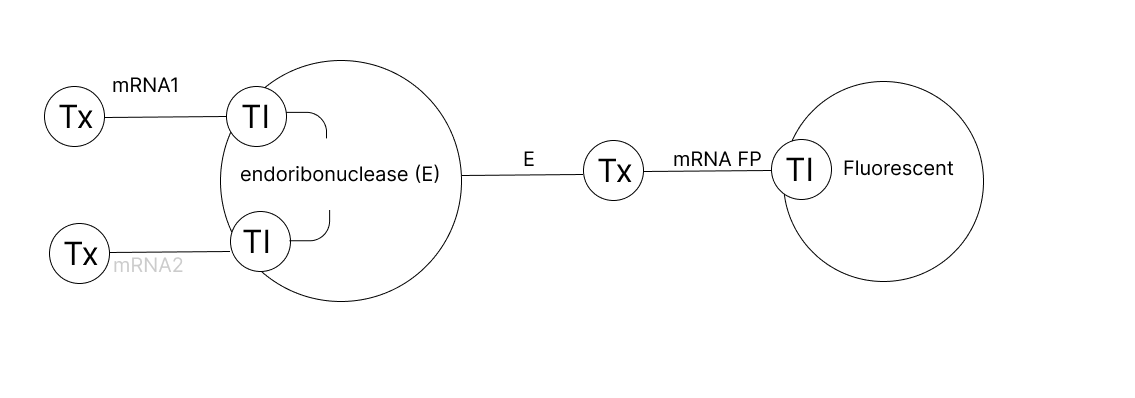
Describe a useful application for an IANN; include a detailed description of input/output behavior, as well as any limitations an IANN might face to achieve your goal.
IANN would work well in a glucose responsive cells, that continuously monitors glucose in the body. The input would be glucose concentration from engineered glucose promoters or biosensors, the IANN would filter out noise and secrete the insulin hormone when needed.
Low glucose → low but nonzero output, avoiding sudden hypoglycemia. Rising glucose → gradually increasing insulin Sustained high glucose → sustained elevated output, but limited by saturating promoters or feedback repression to prevent toxicity.
Advantages:
- avoids the Boolean yes and no state, allowing a more responsive
- Noise Filtering allows for more accurate readings and minimises false readings
- Multiple sensing means more than one input can be engineered on the IANN
Limitations:
- Genes can mutate and change, which means the glucose monitor may not stay calibrated
- Continuous monitoring can be energy intensive
- IANN is environment dependent so will require tuning for each environment
What are some examples of existing fungal materials and what are they used for? What are their advantages and disadvantages over traditional counterparts?
Myco-leather is made from mycelium and is used for clothes, bags and accessorise. Advantages:
- biodegradable
- doesn’t require high energy to grow mycelium
- carbon negative
Disadvanages
- high start up costs
- its very hard to scale because of how long mycelium takes
- its hard to make everything consistent because it is a biological species, makes it difficult to QA.
What might you want to genetically engineer fungi to do and why? What are the advantages of doing synthetic biology in fungi as opposed to bacteria? You could genetically engineer fungi to produce stronger biomaterial, specifically addressing the disadvantages mentioned in the previous question. Engineering fungi to grow in the exact same way or to grow at an accelerated rate. Fungi has better folding/secretion of complex proteins with proper glycosylation. They can also survive more extreme conditions than bacteria. However, it is more genetically complicated compared to bacteria and there are less tools that work with fungi within bioloigy, most have been adapted to bacteria.
Labs
Lab writeups:
Subsections of Labs
Week 1 Lab: Pipetting
Projects
Final projects:
Subsections of Projects
Individual Final Project
Group Final Project
Final Project Ideas