Week 3 HW: Lab Automation
This lab, we were tasked with creating a design that could be generated by an OpenTrons Liquid Handling Robot.
Assignment: Python Script for Opentrons Artwork
- Review this week’s recitation and this week’s lab for details on the Opentrons and programming it.
Done.
- Generate an artistic design using the GUI at opentrons-art.rcdonovan.com.
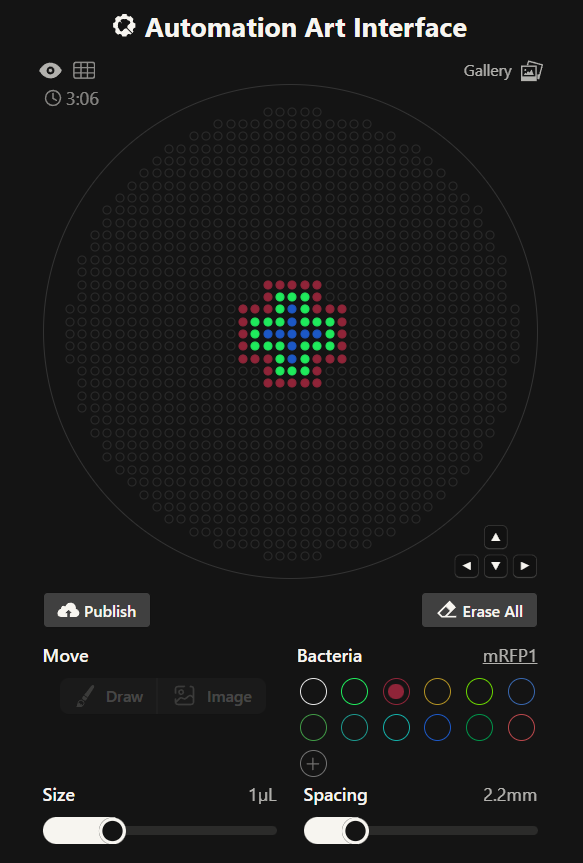
As a remote participant, I prototyped a design using the GUI at opentrons-art.rcdonovan.com.
This resulted in a layered plus symbol shown below.
- Using the coordinates from the GUI, follow the instructions in the HTGAA26 Opentrons Colab to write your own Python script which draws your design using the Opentrons.
- You may use AI assistance for this coding — Google Gemini is integrated into Colab (see the stylized star bottom center); it will do a good job writing functional Python, while you probably need to take charge of the art concept.
- If you’re a proficient programmer and you’d rather code something mathematical or algorithmic instead of using your GUI coordinates, you may do that instead.
Acknowledged
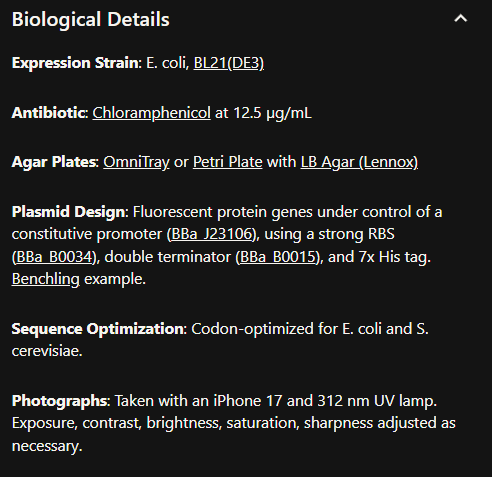
The coordinates for generating such can be found here, courtesy of RC Donovan’s tool:
sfgfp_points = [(-2.2, 6.6),(0, 6.6),(2.2, 6.6),(-2.2, 4.4),(2.2, 4.4),(-6.6, 2.2),(-4.4, 2.2),(-2.2, 2.2),(2.2, 2.2),(4.4, 2.2),(6.6, 2.2),(-6.6, 0),(6.6, 0),(-6.6, -2.2),(-4.4, -2.2),(-2.2, -2.2),(2.2, -2.2),(4.4, -2.2),(6.6, -2.2),(-2.2, -4.4),(2.2, -4.4),(-2.2, -6.6),(0, -6.6),(2.2, -6.6)] electra2_points = [(0, 4.4),(0, 2.2),(-4.4, 0),(-2.2, 0),(0, 0),(2.2, 0),(4.4, 0),(0, -2.2),(0, -4.4)] mrfp1_points = [(-4.4, 8.8),(-2.2, 8.8),(0, 8.8),(2.2, 8.8),(4.4, 8.8),(-4.4, 6.6),(4.4, 6.6),(-8.8, 4.4),(-6.6, 4.4),(-4.4, 4.4),(4.4, 4.4),(6.6, 4.4),(8.8, 4.4),(-8.8, 2.2),(8.8, 2.2),(-8.8, 0),(8.8, 0),(-8.8, -2.2),(8.8, -2.2),(-8.8, -4.4),(-6.6, -4.4),(-4.4, -4.4),(4.4, -4.4),(6.6, -4.4),(8.8, -4.4),(-4.4, -6.6),(4.4, -6.6),(-4.4, -8.8),(-2.2, -8.8),(0, -8.8),(2.2, -8.8),(4.4, -8.8)]
- If the Python component is proving too problematic even with AI and human assistance, download the full Python script from the GUI website and submit that:
Not needed, but appreciated.
- If you use AI to help complete this homework or lab, document how you used AI and which models made contributions.
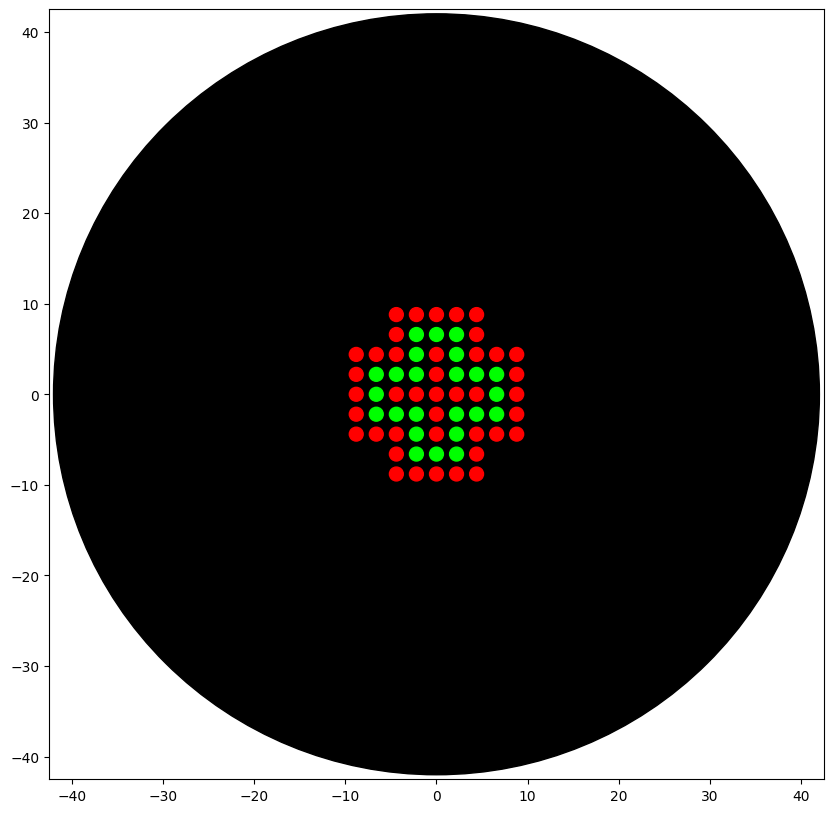
For my node, in order to work with their printer which had two colors, a modified version was created. Gemini within was tested and employed to deliver the following result.
- Sign up for a robot time slot if you are at MIT/Harvard/Wellesley or at a Node offering Opentrons automation. The Python script you created will be run on the robot to produce your work of art!
- At MIT/Harvard? Lab times are on Thursday Feb.19 between 10AM and 6PM.
- At other Nodes? Please coordinate with your Node.
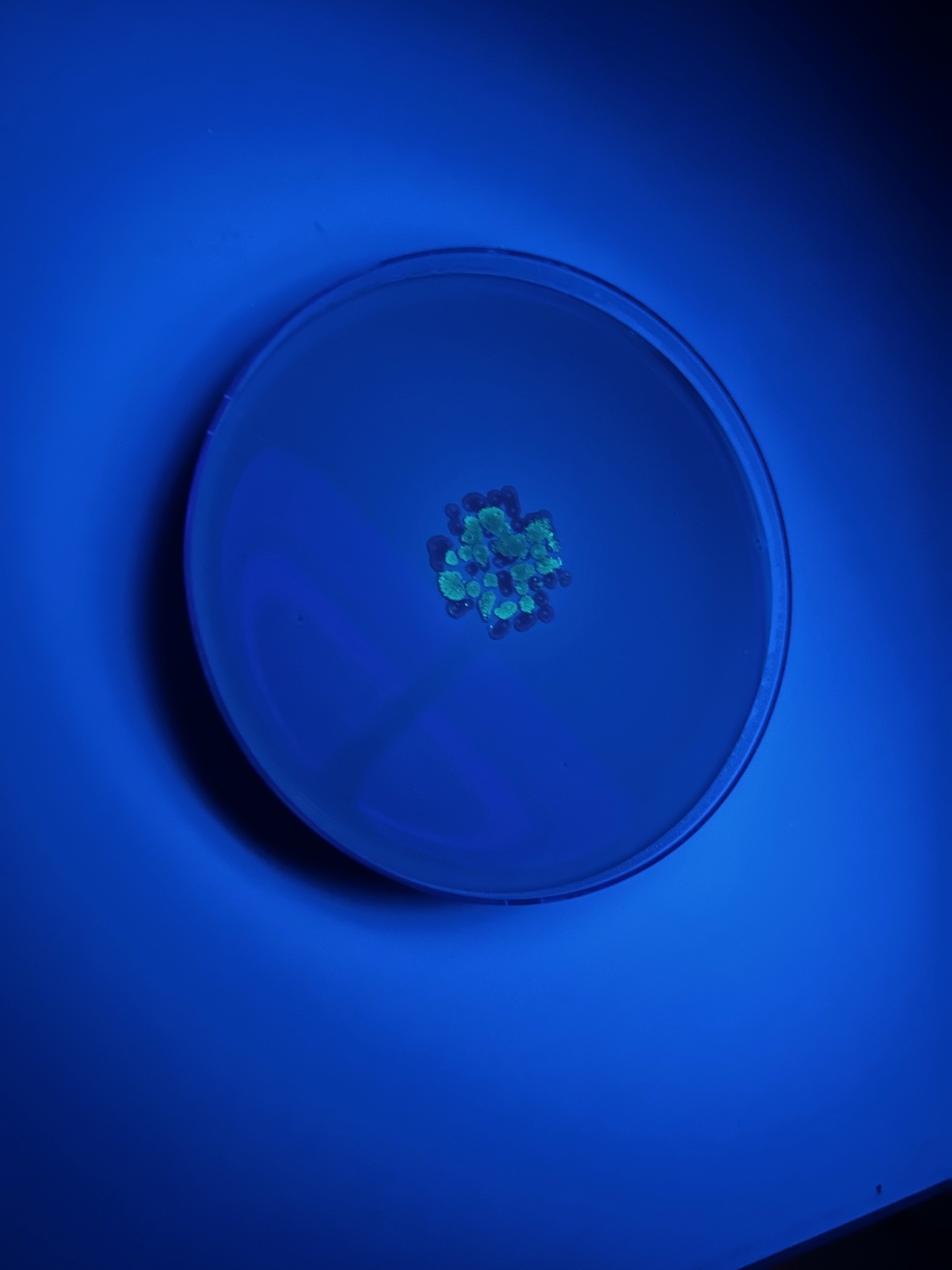
I was added to the William and Mary Node. I coordinated with Margaret and Kate for OpenTrons code submission. My code was submitted to Kate and who was then able to faciliate the printing of my design. Please see below.
- Submit your Python file via this form.
DONE.
Post-LAb Questions:
- Find and describe a published paper that utilizes the Opentrons or an automation tool to achieve novel biological applications.
DeRoo, J.B., Jones, A.A., Slaughter, C.K., Ahr, T.W., Stroup, S.M., Thompson, G.B. and Snow, C.D., 2025. Automation of protein crystallization scaleup via Opentrons-2 liquid handling. SLAS technology, 32, p.100268.
https://doi.org/10.1016/j.slast.2025.100268
This work describes an approach by which an Opentrons-2 liquid handling robot was used for automating sitting drop protein crystallization trials. This ability also improve comparability of products produced, improving studies that depend on their proper manufacture. An important detail is how the Opentrons-2 can prove a cost-effective option for laboratory operations. For example, at the time of writing, the Opentrons-2 can be purchased for around 13.5K USD vs that of a Gryphon machine at around 65K USD.
- Write a description about what you intend to do with automation tools for your final project.
I’m still forming my thoughts about how I want to effectively use automation tools for my final project.
So far, I am interested in branching off from example #2 given in the Homework and the above example, regarding screening an array of designed biosensor constructs.
One idea had in mind was towards a digital tracing project that revolves around said constructs used to track known entities.
Simply, products are given a unique ID with stored parameters. These are linked within a automation run so that each product is trackable as they are processed. One application that is probably already in use but would be fun to adapt towards something not already applied would be swappable combined wearable crystallized biosensors that are traded in daily for workers that are liable to be exposed to a particular organism and pollutant pairs.
I could use an Echo for transfer of nano-scale components. The Bravo or Opentrons-2 could be used for precise, automated pipetting ,especially of the crystals. The multiflow would be used to dispense the larger scale volume components. The PlateLoc would be helful for sealing the plates. The inheco could be used for controlled incubation. The Xpeel would be used for careful desealing of the plates. Finally, the PHERAstar could be used for reading fluorescence outputs.
Still developing this out from this branch.
Final Project Ideas
Done. My intitial Project Ideas were added:
The initial candidates were:
- Project Name: Aptly Aptamer-Based Sensor for Endocrine Disruptors
Problem: Endocrine-disrupting chemicals can persist in water at concentrations that are difficult to monitor in real time. Hypothesis: If we engineer high-affinity aptamers that selectively bind hormone-mimicking pollutants, we can detect these contaminants at environmentally relevant levels. Solution: Develop a portable biosensor that binds engineered aptamers to a measurable fluorescent or electrochemical signal for field-based detection.
Real-world Literature and Examples of Problem:
Bertram, M.G., Gore, A.C., Tyler, C.R. and Brodin, T., 2022. Endocrine-disrupting chemicals. Current Biology, 32(13), pp.R727-R730.
Pironti, C., Ricciardi, M., Proto, A., Bianco, P.M., Montano, L. and Motta, O., 2021. Endocrine-disrupting compounds: An overview on their occurrence in the aquatic environment and human exposure. Water, 13(10), p.1347.
- Project Name: NF-Lamp Lighter Deployable LAMP-Based Sensor for Naegleria fowleri
Problem: Testing for Naegleria fowleri currently requires sending water samples to a lab, which delays results and limits real-time monitoring. Hypothesis: If we combine on-site water filtration with LAMP DNA amplification, we can detect N. fowleri quickly without a full laboratory. Solution: Build a deployable mini-station that filters water, runs a LAMP test in a sealed cartridge, and sends a simple detection alert to public health officials.
Real-world Literature and Examples of Problem:
Grace, E., Asbill, S. and Virga, K., 2015. Naegleria fowleri: pathogenesis, diagnosis, and treatment options. Antimicrobial agents and chemotherapy, 59(11), pp.6677-6681.
Maciver, S.K., Piñero, J.E. and Lorenzo-Morales, J., 2020. Is Naegleria fowleri an emerging parasite?. Trends in parasitology, 36(1), pp.19-28.
https://www.cdc.gov/naegleria/about/index.html
- Project Name: LP Alert Deployable Biosensor for Legionella pneumophila in Cooling Towers
Problem: Cooling towers can grow Legionella pneumophila, and detection could be made more quickly. Hypothesis: If we combine on-site DNA amplification with CRISPR detection and an electrochemical readout, we can quickly and accurately detect L. pneumophila and avoid having to send samples to a lab. Solution: Build a deployable unit that samples cooling tower water, amplifies L. pneumophila DNA, converts detection into an electrical signal, and sends an alert to facility managers.
Real-world Literature and Examples of Problem:
Wéry, N., Bru-Adan, V., Minervini, C., Delgénes, J.P., Garrelly, L. and Godon, J.J., 2008. Dynamics of Legionella spp. and bacterial populations during the proliferation of L. pneumophila in a cooling tower facility. Applied and environmental microbiology, 74(10), pp.3030-3037.
Brigmon, R.L., Turick, C.E., Knox, A.S. and Burckhalter, C.E., 2020. The impact of storms on Legionella pneumophila in cooling tower water, implications for human health. Frontiers in Microbiology, 11, p.543589.
https://www.cdc.gov/control-legionella/php/toolkit/cooling-towers-module.html