Week 11 HW: Bioproduction & Cloud Labs
Part A: The 1,536 Pixel Artwork Canvas | Collective Artwork
- Contribute at least one pixel to this global artwork experiment before the editing ends on Sunday 4/19 at 11:59 PM EST!
A personalized URL was sent to the email address associated with your Discourse account, and you can discuss the artwork on the Discourse! If you did not have a chance to contribute, it’s okay, just make sure you become a TA this fall! 😉
Multiple pixels were contrited to Artwork Canvases. Below the CFPS and Overall Artwork Contributions are given.
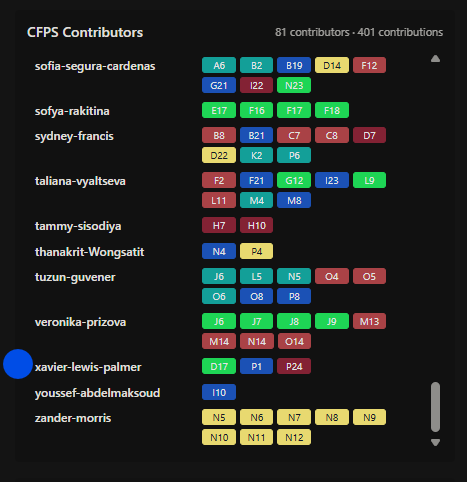
CFPS Contributions
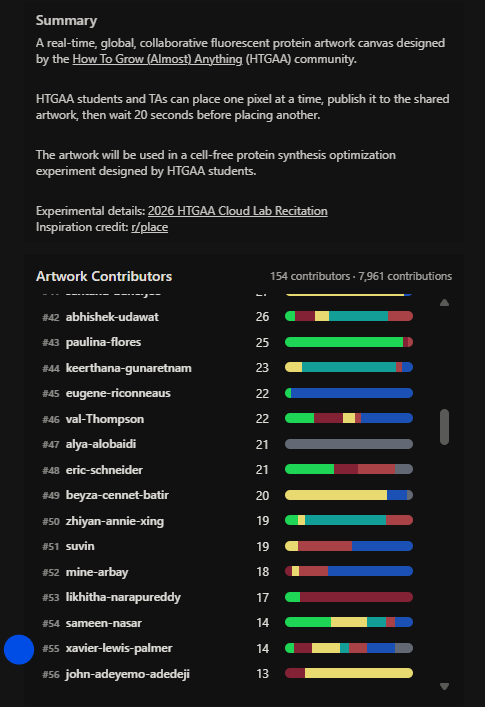
Overall Artwork Contributions
Done: Added pixels. See above.
- Make a note on your HTGAA webpages including:
Done: I added a total of 14 pixels by the end of the experiment: 12 colored pixels and 2 removal pixels.
what you contributed to the community bioart project (e.g., “I made part of the DNA on the bottom right plate”)
Done: I added a couple small details to subfeatures of some designs. The general idea was to help complete objects in progress or add a small sub-feature, visually. One example was adding a temporary light to one of the spaceships.
Contributions to a follow-up activity at Synbiobeta were done as well as shown below.

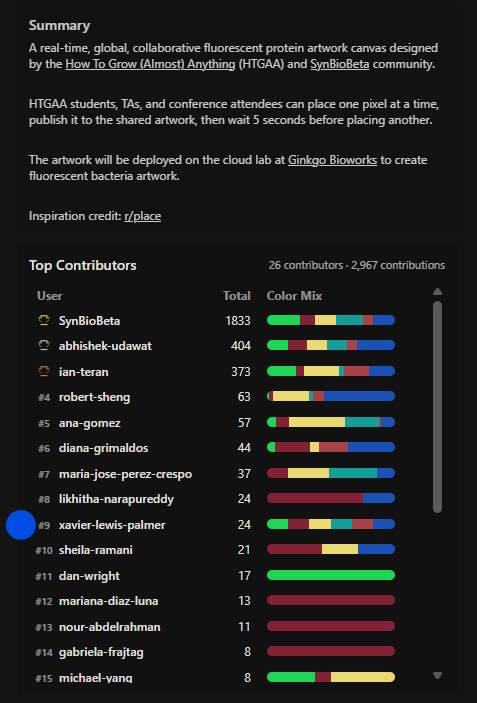
what you liked about the project, and
Done: I liked the collaborative and semi-collaborative nature of the project. There was space for those who wanted to add with coordination and space for those who wanted to add individually from their own vision. Seeing what people came up with was great, as well.
what about this collaborative art experiment could be made better for next year.
Done: To improve it, one could widen the color section, plate area, and reduce the painting refresh-time.
Part B: Cell-Free Protein Synthesis | Cell-Free Reagents
- Referencing the cell-free protein synthesis reaction composition (the middle box outlined in yellow on the image above, also listed below), provide a 1-2 sentence description of what each component’s role is in the cell-free reaction.
E. coli Lysate:
BL21 (DE3) Star Lysate (includes T7 RNA Polymerase) - This contains the core metabolic components and enyzmes for transcription and translation. The T7 RNA polymerase is needed for eventual gene transcription and mRNA towards eventual protein production.
Salts/Buffer:
Potassium Glutamate - This is a source of potassium and anions for the reaction, providing needed blance for ribosome function.
HEPES-KOH pH 7.5 - This buffer helps to maintain a stable pH, again helpful for ribosome stability.
Magnesium Glutamate - This provides Mg2+m which is helpful for enzymatic activity
Potassium phosphate monobasic - This works with Potassium dibasic as a secondary buffering system for pH stabilization.
Potassium phosphate dibasic - This works with Potassium monobasic as a secondary buffering system for pH stabilization.
Energy / Nucleotide System:
Ribose - This serves along with gluclose as energy and carbon sources to power the reactions.
Glucose - This serves along with ribose as energy and carbon sources to power the reactions.
AMP - This servves as a ATP synthesis precursor. This and the following 3 are required for RNA synthesis.
CMP - This servves as a CTP precursor.
GMP - This servves as a GTP precursor.
UMP - This servves as a UTP precursor.
Guanine - This serves a a purine base and precursor to produce guanine nucleotides.
Translation Mix (Amino Acids):
17 Amino Acid Mix - This mix supplies the amnio acids used for protein synthesis.
Tyrosine - This is key for phosphorylation but specifically vital as a substrate in forming the target protein.
Cysteine - This is separated due to its instability and is required in protein synthesis.
Additives: Nicotinamide - This functions as the NAD+ biosynthesis precursor.
Backfill: Nuclease Free Water - This serves as the solvent for the reaction.
- Describe the main differences between the 1-hour optimized PEP-NTP master mix and the 20-hour NMP-Ribose-Glucose master mix shown in the Google Slide above. (2-3 sentences)
The main differences betweem the two master mixes can be found in energy regeration, time-spent for reactions, recycling of components, qualities of metabolism engaged, and composition. Both are effective, but they serve different purposes, be it short-term production vs longer production over time. The use comes down to the context of synthesis desired.
Bonus question: How can transcription occur if GMP is not included but Guanine is?
If reaction pathways exist to convert guanine to a product that can facilitate GMP’s role, transcription can reasonably occur.
Part C: Planning the Global Experiment | Cell-Free Master Mix Design
- Given the 6 fluorescent proteins we used for our collaborative painting, identify and explain at least one biophysical or functional property of each protein that affects expression or readout in cell-free systems. (Hint: options include maturation time, acid sensitivity, folding, oxygen dependence, etc) (1-2 sentences each)
A) sfGFP - This protein is noted for its rapidly maturing weak dimer. Reference: https://www.fpbase.org/protein/superfolder-gfp/
B) mRFP1 - This protein has low acid sensitivity. Reference: https://www.fpbase.org/protein/mrfp1/
C) mKO2 - This protein is noted for its moderate acid sensitivity. Reference: https://www.fpbase.org/protein/superfolder-gfp/
D) mTurquoise2 - This protein is noted to be “a rapidly-maturing monomer with very low acid sensitivity”. Reference: https://www.fpbase.org/protein/mturquoise2/
E) mScarlet_I - This protein is noted as being a “rapidly-maturing monomer with moderate acid sensitivity.” Reference: https://www.fpbase.org/protein/mscarlet-i/
F) Electra2 - This protein is noted for reasonable molecular brightness and photostability under low-light, making it useful for live-cell imagine. References: https://www.fpbase.org/protein/electra2/, https://pmc.ncbi.nlm.nih.gov/articles/PMC9206027/, and https://www.addgene.org/179479/
- Create a hypothesis for how adjusting one or more reagents in the cell-free mastermix could improve a specific biophysical or functional property you identified above, in order to maximize fluorescence over a 36-hour incubation. Clearly state the protein, the reagent(s), and the expected effect.
Increasing HEPES-KOH (through improved maintenance of a near neutral pH) may improve the fluorescence from mKO2 over a 36-hour incubation period by stabilizing its reaction to pH and reducing pH dependent fluorescence loss.
- The second phase of this lab will be to define the precise reagent concentrations for your cell-free experiment. You will be assigned artwork wells with specific fluorescent proteins and receive an email with instructions this week (by April 24). You can begin composing master mix compositions here.
Done. 3 wells were utilized as indicated by the image below.

The codes for each are found below:
- The final phase of this lab will be analyzing the fluorescence data we collect to determine whether we can draw any conclusions about favorable reagent compositions for our fluorescent proteins. This will be due a week after the data is returned (date TBD!). The reaction composition for each well will be as follows:
6 μL of Lysate 10 μL of 2X Optimized Master Mix from above 2 μL of assigned fluorescent protein DNA template 2 μL of your custom reagent supplements Total: 20 μL reaction
Acknowledged. Reactions were made and compositions were honored.
Part D: Build-A-Cloud-Lab | (optional) Bonus Assignment
- Use this simulation tool to create an interesting looking cloud lab out of the Ginkgo Reconfigurable Automation Carts. This is just a minimal implementation so far, but I would love to see some fun designs!
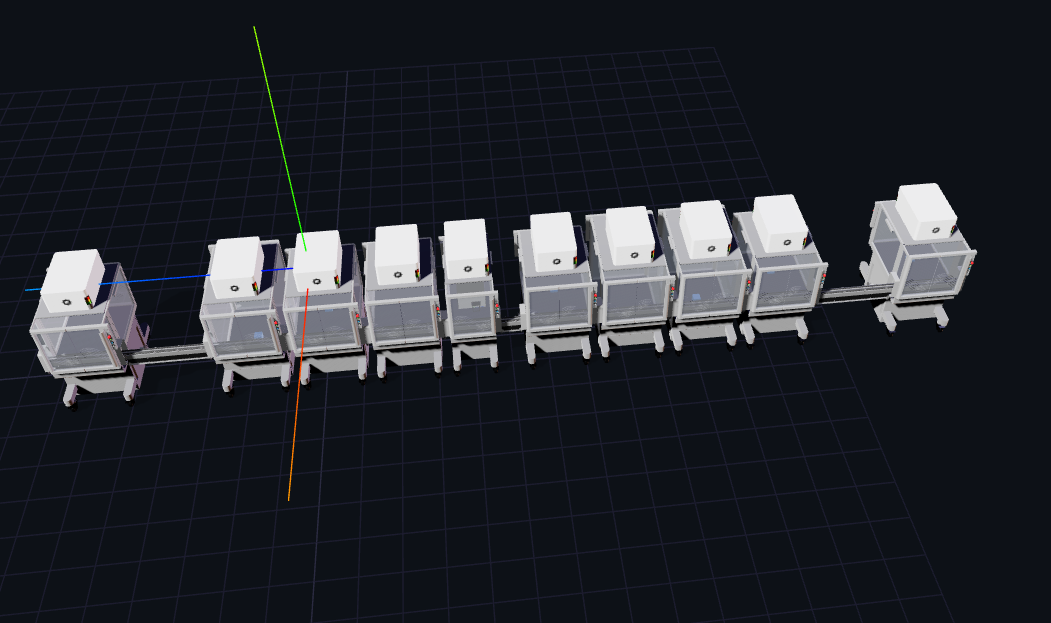
Using the simulation tool, I made a setup that mixed RACs. What follows is a RAC separated by a 1M, folloed by a mix of RACs separated by.25M, followed by another mix of RACs separated by another 1M leading to a final RAC. These are all in one line as shown below.