Week 4 Lab: Protein Design Part I
Special Note: As per (https://2026a.htgaa.org/2026a/course-pages/weeks/week-04/index.html), “Lab work this week is contained within the homework assignment below.”.
This week’s Lab work was effectively part of this week’s Homework. This is reflected in Part D of the week 4 homework but is reposted below for ease.
Part D. Group Brainstorm on Bacteriophage Engineering
As follows, the assigned work was:
- 1.Find a group of ~3–4 students
Done.
- 2.Read through the Phage Reading material listed under “Reading & Resources” below.
Done.
3.Review the Bacteriophage Final Project Goals for engineering the L Protein: *Increased stability (easiest) *Higher titers (medium) *Higher toxicity of lysis protein (hard)
Done.
4.Brainstorm Session
- Choose one or two main goals from the list that you think you can address computationally (e.g., “We’ll try to stabilize the lysis protein,” or “We’ll attempt to disrupt its interaction with E. coli DnaJ.”).
Increased stability was chosen by my group.
- Write a 1-page proposal (bullet points or short paragraphs) describing:
- Which tools/approaches from recitation you propose using (e.g., “Use Protein Language Models to do in silico mutagenesis, then AlphaFold-Multimer to check complexes.”).
- Why do you think those tools might help solve your chosen sub-problem?
- Name one or two potential pitfalls (e.g., “We lack enough training data on phage–bacteria interactions.”).
- Include a schematic of your pipeline.
Done. Our Members were: Jason Ross, Jay Handfield, Nana Agyei, Raphael Aca, and Xavier Palmer. Our team’s answers can be be found below:
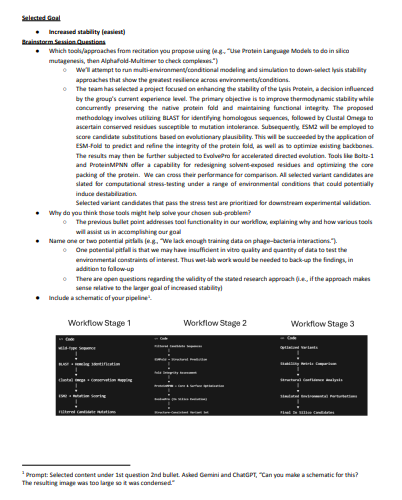
- 5.Each individually put your plan on your HTGAA website
- Include your group’s short plan for engineering a bacteriophage
Done. See the image above.