Project Title: Project Z-Freeze, HTGAA 2026: Individual Final Project Documentation Section 1: Abstract Project Z-Freeze explores whether engineered variants of the Ice Nucleation Protein (InaZ) can be computationally designed and optimized to improve controlled freezing behavior for potential use in biohybrid thermal management systems. Data centers require large amounts of energy for cooling, and many existing cooling systems rely on resource-intensive or environmentally challenging approaches. Biological phase-change systems may provide an alternative strategy for improving thermal energy management. This project focuses on InaZ, an ice nucleation protein naturally produced by Pseudomonas syringae, which promotes freezing at relatively high sub-zero temperatures by organizing water molecules into ice-forming structures.
Project Title: Project Z-Freeze, HTGAA 2026: Individual Final Project Documentation
Section 1: Abstract
Project Z-Freeze explores whether engineered variants of the Ice Nucleation Protein (InaZ) can be computationally designed and optimized to improve controlled freezing behavior for potential use in biohybrid thermal management systems. Data centers require large amounts of energy for cooling, and many existing cooling systems rely on resource-intensive or environmentally challenging approaches. Biological phase-change systems may provide an alternative strategy for improving thermal energy management. This project focuses on InaZ, an ice nucleation protein naturally produced by Pseudomonas syringae, which promotes freezing at relatively high sub-zero temperatures by organizing water molecules into ice-forming structures.
The broad objective of this project is to establish a computationally guided synthetic biology workflow for designing and ranking engineered InaZ variants capable of initiating freezing at warmer temperatures than wild-type InaZ. The hypothesis is that engineered mutations to InaZ may alter nucleation efficiency, structural feasibility, and expression compatibility in ways that shift freezing onset temperatures upward relative to a control InaZ construct.
To test this hypothesis, InaZ variant constructs and controls will be computationally designed and evaluated in silico prior to experimental validation in Escherichia coli K-12 using modular synthetic biology methods. Constructs will include a promoter, ribosome binding site, mutated InaZ coding sequence, terminator, and plasmid backbone. Candidate constructs will be assembled conceptually using Golden Gate assembly within a pSB1C3 high-copy plasmid backbone and verified using PCR, gel electrophoresis, and DNA sequencing.
Functional testing will be performed using droplet-based freezing assays in which samples are gradually cooled under controlled conditions while thermal and optical imaging monitor freezing events in real time. The primary measurement collected will be freezing onset temperature. Comparisons between negative controls, wild-type InaZ, and engineered InaZ variants will be used to evaluate whether the mutations improve ice nucleation efficiency.
SECTION 2: PROJECT AIMS
Aim 1: Experimental Aim
The first aim of my final project is to design and validate a DNA construct encoding an InaZ-derived ice nucleation protein optimized for heterologous expression and functional feasibility in E. coli by utilizing codon optimization tools, modular plasmid design, computational sequence analysis, Golden Gate assembly, PCR verification, and controlled freezing assays.
Aim 2: Development Aim
The second aim is to develop a computational framework for evaluating InaZ variants based on predicted expression efficiency, sequence stability, and structural feasibility, enabling informed selection of constructs for experimental implementation.
Aim 3: Visionary Aim
The third aim is to extend this framework into a generalized multi-parameter optimization platform capable of designing and ranking biological systems for controlled phase-transition applications and related engineering contexts.
SECTION 3: BACKGROUND
Background and Literature Context
Current Knowledge and Research Context
Ice nucleation proteins produced by Pseudomonas syringae are among the most efficient known biological nucleators of ice formation. These proteins promote freezing by organizing interfacial water molecules into ordered structures that facilitate phase transition at relatively high sub-zero temperatures (Roeters et al., 2021). Early characterization of bacterial ice nucleation proteins demonstrated that InaZ proteins possess strong nucleation activity and can significantly alter freezing behavior in aqueous systems (Wolber et al., 1986).
Research into InaZ proteins has also demonstrated that these systems can be functionally expressed in engineered bacterial platforms, supporting their compatibility with synthetic biology workflows (Kassmannhuber et al., 2017). Additional studies have explored the use of ice nucleation genes as engineered biological tools in alternative bacterial systems, further supporting the feasibility of heterologous deployment strategies (Arvanitis et al., 1995). These findings suggest that engineered InaZ systems may be adaptable for synthetic biological applications beyond their native environmental role.
At the same time, increasing computational demand has intensified interest in alternative thermal management technologies for data centers and advanced computing infrastructure. Existing cooling systems often consume substantial amounts of energy and water, motivating interest in phase-change cooling systems and bio-inspired thermal management strategies. Recent reviews of bio-inspired phase-change materials and thermal energy systems suggest that biologically informed approaches may contribute to future thermal engineering solutions (An et al., 2023; Pielichowska et al., 2025).
This project addresses the gap between naturally occurring ice nucleation proteins and engineered synthetic biology systems capable of computational optimization and functional ranking for programmable phase-transition applications. Rather than studying InaZ only as a natural biological phenomenon, Project Z-Freeze explores whether computational design, sequence optimization, and structural evaluation may be combined into a predictive framework for engineering improved nucleation behavior.
Peer-Reviewed Research Citation Summary 1
Roeters et al. (2021) investigated how ice-nucleating proteins influence the structure of interfacial water at low temperatures. Their work demonstrated that ice nucleation proteins become activated under colder conditions and organize surrounding water molecules into ordered arrangements that promote freezing. This study provided mechanistic insight into how biological nucleators initiate phase transitions more efficiently than abiotic controls. These findings support the hypothesis that engineered modifications to InaZ may alter nucleation efficiency and freezing onset behavior.
Peer-Reviewed Research Citation Summary 2
Kassmannhuber et al. (2017) demonstrated successful functional display of the InaZ ice nucleation protein on engineered bacterial ghost systems. Their work showed that InaZ proteins can remain functionally active in heterologous biological platforms and may be incorporated into engineered systems outside their native bacterial context. This study also supports the feasibility of modular synthetic biology approaches for expressing and testing engineered InaZ constructs. The research provides a relevant foundation for the construct design and expression framework proposed in Project Z-Freeze.
Novelty and Innovation
This project is novel because it combines computational protein design, synthetic biology construct engineering, and functional freezing assays to investigate whether InaZ proteins can be rationally modified to improve ice nucleation efficiency. While naturally occurring InaZ proteins have been extensively studied in environmental and biological systems, fewer studies have explored computationally guided optimization workflows for engineering InaZ variants within modular synthetic biology frameworks. Project Z-Freeze also extends beyond simple expression studies by proposing a predictive ranking system capable of evaluating variant feasibility prior to experimental implementation.
The project further expands the boundaries of synthetic biology by applying biological phase-transition systems to problems traditionally addressed through mechanical or industrial engineering solutions. Rather than viewing biological ice nucleation solely as an atmospheric or agricultural phenomenon, this project explores whether engineered nucleation systems may contribute to programmable thermal management technologies.
Why the Project Matters
Thermal management remains a major challenge for data centers and other computational infrastructure systems. Existing cooling technologies can require substantial energy consumption and water usage, creating economic and environmental concerns. Improving the efficiency of phase-change cooling systems may contribute to more sustainable approaches for controlling thermal energy transfer in high-performance computing environments.
Project Z-Freeze matters because it explores whether synthetic biology can contribute to programmable thermal management systems through engineered biological phase-transition control. If successful, engineered InaZ variants may help expand the temperature range at which controlled freezing can occur, potentially improving the flexibility of future biohybrid cooling systems. Even if the engineered variants do not outperform wild-type InaZ, the project may still contribute useful information regarding the relationship between protein structure, expression feasibility, and ice nucleation behavior.
The project may also contribute more broadly to synthetic biology by demonstrating how computational sequence optimization, modular construct engineering, and functional phenotypic assays can be integrated into a unified experimental workflow. Additionally, the predictive framework proposed in this project may eventually support the design and ranking of other biological systems intended for engineered phase-transition applications.
Ethical Implications
One ethical consideration associated with this project involves the use of genetically engineered organisms and synthetic biological systems. Although the proposed work utilizes a non-pathogenic E. coli K-12 laboratory chassis, responsible handling of engineered biological materials remains important. Ethical principles such as non-maleficence and responsibility are especially relevant because unintended environmental release or misuse of engineered organisms could create ecological or biosafety concerns (Hodgeson et al, 2025). The project must therefore prioritize proper laboratory containment, safe handling procedures, and responsible communication of results.
Another ethical consideration involves the broader implications of applying engineered biological systems to industrial infrastructure and thermal management technologies. Although biologically inspired cooling systems may provide sustainability benefits, uncertainties remain regarding scalability, ecological impact, and long-term implementation. Measures to maintain ethical responsibility include following biosafety guidelines, limiting experimental work to controlled laboratory environments, and clearly communicating uncertainties and limitations in both experimental findings and predictive computational models. Alternative approaches, including non-biological thermal technologies, should also be considered when evaluating the broader implications of the project.
References for Section 3
An, S., Shi, B., Jiang, M., Fu, B., Song, C., Tao, P., Shang, W. and Deng, T. (2023) ‘Bio-inspired phase-change and thermal management systems’, Chemical Reviews, 123(11), pp. 7081–7118. Available at: https://doi.org/10.1021/acs.chemrev.3c00136.
Arvanitis, N., Vargas, C., Tegos, G., Perysinakis, A., Nieto, J.J., Ventosa, A. and Drainas, C. (1995) ‘Development of a gene reporter system in moderately halophilic bacteria by employing the ice nucleation gene of Pseudomonas syringae’, Applied and Environmental Microbiology, 61(11), pp. 3821–3825. Available at: https://doi.org/10.1128/aem.61.11.3821-3825.1995.
Kassmannhuber, J., Rauscher, M., Schöner, L., Witte, A. and Lubitz, W. (2017) ‘Functional display of ice nucleation protein InaZ on the surface of bacterial ghosts’, Bioengineered, 8(5), pp. 488–500. Available at: https://doi.org/10.1080/21655979.2017.1284712.
Pielichowska, K., Szatkowska, M. and Pielichowski, K. (2025) ‘Thermal energy storage in bio-inspired PCM-based systems’, Energies, 18(13), pp. 1–28.
Roeters, S.J., Golbek, T.W., Bregnhøj, M. et al. (2021) ‘Ice-nucleating proteins are activated by low temperatures to control the structure of interfacial water’, Nature Communications, 12, p. 1183. Available at: https://doi.org/10.1038/s41467-021-21349-3.
Valeriani, C. (2022) ‘Deep learning for unravelling features of heterogeneous ice nucleation’, Proceedings of the National Academy of Sciences of the United States of America, 119(35), e2211295119. Available at: https://doi.org/10.1073/pnas.2211295119.
Wolber, P.K., Deininger, C.A., Southworth, M.W., Vandekerckhove, J., van Montagu, M. and Warren, G.J. (1986) ‘Identification and purification of a bacterial ice-nucleation protein’, Proceedings of the National Academy of Sciences of the United States of America, 83(19), pp. 7256–7260. Available at: https://doi.org/10.1073/pnas.83.19.7256.
SECTION 4: EXPERIMENTAL DESIGN, TECHNIQUES, TOOLS, AND TECHNOLOGY
Review literature on InaZ structure, ice nucleation mechanisms, protein engineering, and synthetic biology expression systems.
Identify candidate InaZ regions for potential mutation, codon optimization, or structural engineering.
Design wild-type and mutated InaZ coding sequences using computational sequence analysis and predictive evaluation methods.
Select modular construct components including promoter, RBS, terminator, and plasmid backbone.
Use pSB1C3 as the high-copy plasmid backbone.
Design expression constructs using Benchling or similar DNA design software.
Simulate construct organization, compatibility, and predicted expression feasibility using in silico tools.
Conceptually assemble constructs using Golden Gate assembly.
Transform constructs into E. coli K-12 or related laboratory strains.
Screen colonies using PCR and gel electrophoresis.
Verify construct identity and mutation accuracy through DNA sequencing.
Culture engineered strains under controlled laboratory conditions.
Prepare samples containing engineered InaZ constructs and controls.
Perform droplet-based freezing assays under gradual cooling conditions.
Use thermal and optical imaging to monitor freezing events.
Record freezing onset temperatures for individual droplets.
Compare freezing behavior between controls and mutated InaZ variants.
Analyze whether engineered variants shift freezing onset temperatures upward relative to wild-type InaZ and compare experimental results against computational predictions.
Expected Results
The negative control is expected to freeze at the lowest temperatures. Wild-type InaZ constructs are expected to demonstrate higher ice nucleation activity than negative controls. Successful engineered variants may demonstrate freezing onset temperatures higher than wild-type InaZ.
Relevant Techniques
Checked Techniques
Pipetting
Lab Safety
Bioethical Considerations
DNA Sequencing
DNA Construct Design
Gel Electrophoresis
Databases (GenBank, NCBI)
Use of Benchling
Chassis Selection
Registry of Standard Biological Parts
Plasmid Preparation
Bacterial Culturing
Bacterial Processing
Primer Design
PCR Reactions
Golden Gate or Gibson Assembly
Protein Design
Expanded Technique 1: DNA Construct Design
DNA construct design will be used to generate modular InaZ expression systems containing a promoter, ribosome binding site, mutated InaZ coding sequence, and terminator within a pSB1C3 plasmid backbone. Benchling and Registry of Standard Biological Parts resources will be used to organize and simulate constructs prior to assembly. Construct design will also include consideration of promoter strength, translation efficiency, and plasmid compatibility. Comparative construct design will allow systematic testing of different InaZ variants while keeping other expression components constant.
Expanded Technique 2: PCR and Gel Electrophoresis
PCR and gel electrophoresis will be used to verify the presence and approximate size of engineered InaZ constructs following assembly. PCR primers will be designed to amplify regions containing the mutated InaZ sequence. Amplified DNA fragments will be visualized through agarose gel electrophoresis to confirm expected fragment sizes. These methods will provide an initial quality-control step prior to DNA sequencing and functional freezing assays.
Industry Council Companies Associated with Project
The aspect of the project selected for validation is the design and verification of mutated InaZ DNA constructs intended for comparative freezing assays. This validation focuses on confirming that engineered constructs contain the expected promoter, RBS, InaZ variant, and terminator arrangement prior to functional testing. As this project was dry and without lab access, Digital constructs have been designed but not fully tested. The validation protocol below reflects an ideal case provided lab access is made possible.
Validation Protocol
Design mutated InaZ construct sequences using Asimov (Kernel).
Select promoter, RBS, terminator, and pSB1C3 plasmid backbone.
Design primers for PCR amplification of the construct region.
Simulate Golden Gate assembly compatibility.
Assemble constructs conceptually or experimentally.
Transform constructs into E. coli.
Select colonies using antibiotic resistance.
Perform colony PCR.
Run PCR products on agarose gels.
Compare observed DNA fragment sizes to expected construct sizes.
Submit successful constructs for DNA sequencing.
Confirm mutation presence and sequence accuracy.
Synthetic Biology Techniques Used
Hypothetical validation incorporates DNA construct design, plasmid assembly, PCR, gel electrophoresis, and DNA sequencing. DNA construct design allows modular organization of promoter, RBS, InaZ coding sequence, and terminator elements. PCR and gel electrophoresis provide rapid screening methods to evaluate whether constructs contain inserts of the expected size. DNA sequencing would be used to confirm that the mutated InaZ sequence was assembled correctly and does not contain unintended mutations.
Data and Analysis
Data generated during validation may include agarose gel images, sequencing alignments, construct maps, and simulated freezing assay data. Quantitative analysis may involve comparing freezing onset temperatures across negative controls, wild-type InaZ constructs, and engineered variants.
Challenges and Limitations
One potential challenge is that InaZ is a large and structurally complex membrane-associated protein that may not express efficiently in E. coli. High-copy plasmid expression could also increase cellular stress or affect protein folding. Another limitation is that freezing behavior may depend on protein localization and aggregation state rather than sequence changes alone. Alternative strategies could include modifying promoter strength, testing different chassis strains, or evaluating cell-free expression systems.
SECTION 6: ADDITIONAL INFORMATION
References
Alsante, A.N., Thornton, D.C.O. and Brooks, S.D. (2024) ‘[Article title not provided]’, Environmental Science & Technology, 58(10), pp. 4594–4605. Available at: https://doi.org/10.1021/acs.est.3c06835.
Arvanitis, N., Vargas, C., Tegos, G., Perysinakis, A., Nieto, J.J., Ventosa, A. and Drainas, C. (1995) ‘Development of a gene reporter system in moderately halophilic bacteria by employing the ice nucleation gene of Pseudomonas syringae’, Applied and Environmental Microbiology, 61(11), pp. 3821–3825. Available at: https://doi.org/10.1128/aem.61.11.3821-3825.1995.
Deininger, C.A., Mueller, G.M. and Wolber, P.K. (1988) ‘Immunological characterization of ice nucleation proteins from Pseudomonas syringae, Pseudomonas fluorescens, and Erwinia herbicola’, Journal of Bacteriology, 170(2), pp. 669–675. Available at: https://doi.org/10.1128/jb.170.2.669-675.1988.
Hodgson, A., Frow, E., Palmer, X.-L., Rohwer, F., Elcock, L., Johnson, A., Zimmerman, E.H. and Voigt, C. (2025) ‘1.3 Public infrastructure for analyzing and assessing beyond biocontainment biotechnologies’, Rice University. Available at: https://doi.org/10.25611/Z7YJ-EA10
Kassmannhuber, J., Rauscher, M., Schöner, L., Witte, A. and Lubitz, W. (2017) ‘Functional display of ice nucleation protein InaZ on the surface of bacterial ghosts’, Bioengineered, 8(5), pp. 488–500. Available at: https://doi.org/10.1080/21655979.2017.1284712.
Melillo, J.H., Nikulina, E., Iriarte-Alonso, M.A., Cerveny, S. and Bittner, A.M. (2022) ‘Electron microscopy and calorimetry of proteins in supercooled water’, Scientific Reports, 12(1), p. 16512. Available at: https://doi.org/10.1038/s41598-022-20430-1.
National Center for Biotechnology Information (NCBI) (n.d.) Protein database entry: CBX54760.1 hypothetical protein. Available at: https://www.ncbi.nlm.nih.gov/protein/CBX54760.1 (Accessed: 7 April 2026).
Pielichowska, K., Szatkowska, M. and Pielichowski, K. (2025) ‘Thermal energy storage in bio-inspired PCM-based systems’, Energies, 18(13), pp. 1–28.
Roeters, S.J., Golbek, T.W., Bregnhøj, M. et al. (2021) ‘Ice-nucleating proteins are activated by low temperatures to control the structure of interfacial water’, Nature Communications, 12, p. 1183. Available at: https://doi.org/10.1038/s41467-021-21349-3.
Shun, A., Shi, B., Jiang, M., Fu, B., Song, C., Tao, P., Shang, W. and Deng, T. (2023) ‘[Article title not provided]’, Chemical Reviews, 123(11), pp. 7081–7118. Available at: https://doi.org/10.1021/acs.chemrev.3c00136.
Valeriani, C. (2022) ‘Deep learning for unravelling features of heterogeneous ice nucleation’, Proceedings of the National Academy of Sciences of the United States of America, 119(35), e2211295119. Available at: https://doi.org/10.1073/pnas.2211295119.
Wolber, P.K., Deininger, C.A., Southworth, M.W., Vandekerckhove, J., van Montagu, M. and Warren, G.J. (1986) ‘Identification and purification of a bacterial ice-nucleation protein’, Proceedings of the National Academy of Sciences of the United States of America, 83(19), pp. 7256–7260. Available at: https://doi.org/10.1073/pnas.83.19.7256
pSB1C3 plasmid backbone
Restriction enzymes / Golden Gate assembly reagents
PCR reagents and primers
Agarose gel electrophoresis materials
DNA sequencing services
E. coli K-12 competent cells
Growth media and antibiotics
Pipettes and consumables
Thermal imaging system
Optical imaging camera
Controlled cooling platform
Benchling or equivalent software
Estimated project budget: variable depending on sequencing and imaging equipment availability
Special Note: Organization of the above was facilited through a combination of pre-written material and organization through Claude, Gemini, and ChatGPT.
Below is the draft version, for posterity:
Final Project Name: Project Z Freeze
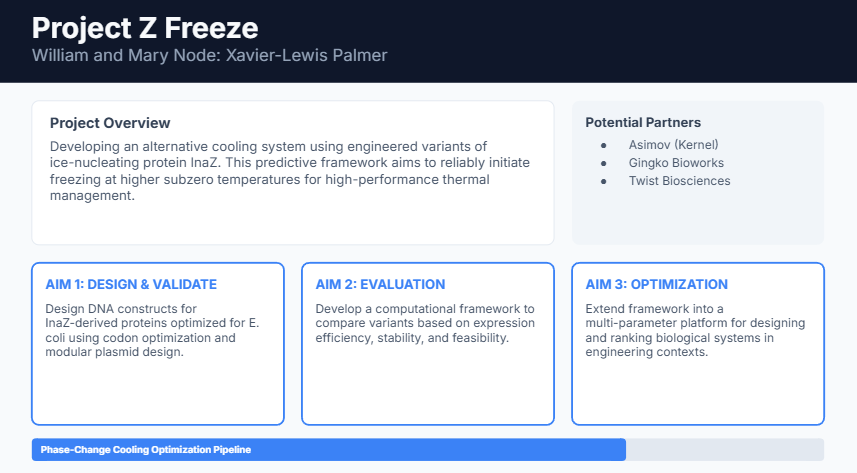
Final Project Description: Project Z Freeze aims to address limitations in current data center and general computing phase-change cooling strategies by developing an alternative system based on engineered variants of the ice-nucleating protein InaZ, designed to reliably initiate freezing at higher subzero temperatures. Through computational design, sequence optimization, and structural evaluation, this project establishes a predictive framework to rank variants for functional feasibility and heterologous expression. Ultimately, this work aims to enable programmable control of phase transitions in high-performance thermal management systems.
Aim 1: The first aim of my final project is to design and validate a DNA construct encoding an InaZ-derived ice nucleation protein optimized for expression in E. coli by utilizing codon optimization tools, modular plasmid design, and computational analysis of protein size and stability.
Aim 2: The second aim is to develop a computational evaluation framework to compare InaZ variants based on predicted expression efficiency, sequence stability, and structural feasibility, enabling informed selection of constructs for experimental implementation.
Aim 3: The third aim is to extend this framework into a generalized multi-parameter optimization platform capable of designing and ranking biological systems for controlled phase-transition applications and related engineering contexts.
Potential Companies: Asimov (Kernel), Gingko Bioworks, and Twist Biosciences
Below is an alternative presentation design that was offered via Gemini via Google Slides through enhance feature. It look neat, but I ultimately did not adopt it.
Here’s the prompt: “Redesign this slide to most effectively communicate the content. Prefer well structured visual layouts.”