week-07-hw-genetic-circuits-part-ii
Homework — DUE BY Mar 31 2PM ET
Assignment Part 1: Intracellular Artificial Neural Networks (IANNs)
1. What advantages do IANNs have over traditional genetic circuits, whose input/output behaviors are Boolean functions?
Tradicional genetic rely on Boolean logic (AND, OR, NOT), producing discrete outputs. In contrast, IAANS are inspired by the perceptron by the perceptron model, where inputs correspond to : Activation is the gene expression threshold, Inputs are molecular concentrations,Weights is regulatory strength. Some advanges are: the continuous signal precessing, wich allows graded rather than binary responses, scalability through multilayer architectures, improved classification of complex cellular states, as multiple biological signals can be integrated and weighted simultaneously.
2. Describe a useful application for an IANN; include a detailed description of input/output behavior, as well as any limitations an IANN might face to achieve your goal.
An IANN can be effectively applied to model complex biological systems such as the development of engineerred cells capable of detecting and selectively eliminating cancer cells based on multiple biological inputs. In this system, the inputs consist of abnormal levels of messeger RNA, cancer-specific proteins, and metabolic changes, which are sensed by genetic circuits as the first layer of the network.These signals are then integrated through intracellular processing layers that mimic the weighted summation and decision-making behavior of artificial neural networks, allowing the cell to classify whether a target cell is cancerous or not. The output is a targered response, such as inducing apoptosis or releasing therapeutic molecules, while on action is taken if the cell is healthy.
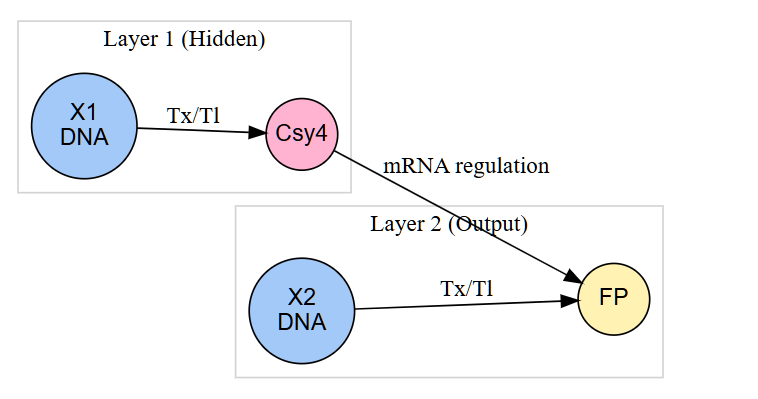
3. Below is a diagram depicting an intracellular single-layer perceptron where the X1 input is DNA encoding for the Csy4 endoribonuclease and the X2 input is DNA encoding for a fluorescent protein output whose mRNA is regulated by Csy4. Tx: transcription; Tl: translation.
Draw a diagram for an intracellular multilayer perceptron where layer 1 outputs an endoribonuclease that regulates a fluorescent protein output in layer 2.
Assignment Part 2: Fungal Materials
1. What are some examples of existing fungal materials and what are they used for? What are their advantages and disadvantages over traditional counterparts?
Mycelium composites are primarily used for sustainable packaging and thermal insulation, serving as alternatives to petroleum-based plastics like polystyrene. Mycelium leather is applied in the textile industry as eco-friendly subsite for animal leather. Also bio-bricks are using agricultural waste enhancing their sustainability. Some advantages include biodegradability, wich reduces environmental impact and low energy requirements during production compared to tradicional materials. The disadvantages are low mechanical strength and environmental sensitivity to environmental conditions like moisture and longer production times.
2. What might you want to genetically engineer fungi to do and why? What are the advantages of doing synthetic biology in fungi as opposed to bacteria?
I want to explore more about the development of living biosensors and bioremediation sytems capable of detecting and degrading environmental pollutants or pathogens. For instance, fungi can be engineered to express florescent reporter proteins in response to toxins, heavy metlas or infection biomarkers in livestock. ALso fungi can be modified to produce degradative enzymes such as ligninases ans cellulases, enebling the breakdown of persistent organix pollutants.Compared to bacteria, fungi offer several key advantages in synthetic biology: The eukaryotic organization is enable complex post-traslational modifications required for functional proteins. 3D mycelial growth distributed sensing ans biofabrication. High protein secretion capacity for industrial enzyme production.
REFERENCES:
- Pandi, A., Koch, M., Voyvodic, P.L. et al. Metabolic perceptrons for neural computing in biological systems. Nat Commun 10, 3880 (2019). https://doi.org/10.1038/s41467-019-11889-0
- Nilsson, A., Peters, J.M., Meimetis, N. et al. Artificial neural networks enable genome-scale simulations of intracellular signaling. Nat Commun 13, 3069 (2022). https://doi.org/10.1038/s41467-022-30684-y
- IA PROMBTS: I use deepseek and ChatGPT for generate the image 1
- Analyze the current state of fungal engineering in synthetic biology. What are the main applications, limitations, and future directions?
- Compare genetically engineered fungi and bacteria in terms of metabolic capacity, protein production, and environmental robustness. What are the key advantages of fungi?
- Critically analyze the scalability of fungal-based materials. What are the technical and economic barriers to industrial production?
- Explain how intracellular artificial neural networks (IANNs) are implemented in biological systems. How do they differ from traditional genetic circuits?
- Describe how molecular components (e.g., promoters, ribozymes, endoribonucleases) can be used to implement weights and activation functions in IANNs.
Assignment Part 3: First DNA Twist Order
Review the Individual Final Project documentation guidelines. Submit this Google Form with your draft Aim 1, final project summary, HTGAA industry council selections, and shared folder for DNA designs. DUE MARCH 20 FOR MIT/HARVARD/WELLESLEY STUDENTS Review Part 3: DNA Design Challenge of the week 2 homework. Design at least 1 insert sequence and place it into the Benchling/Kernel/Other folder you shared in the Google Form above. Document the backbone vector it will be synthesized in on your website.