Week11 HW: BIOPRODUCTION AND CLOUD LABS
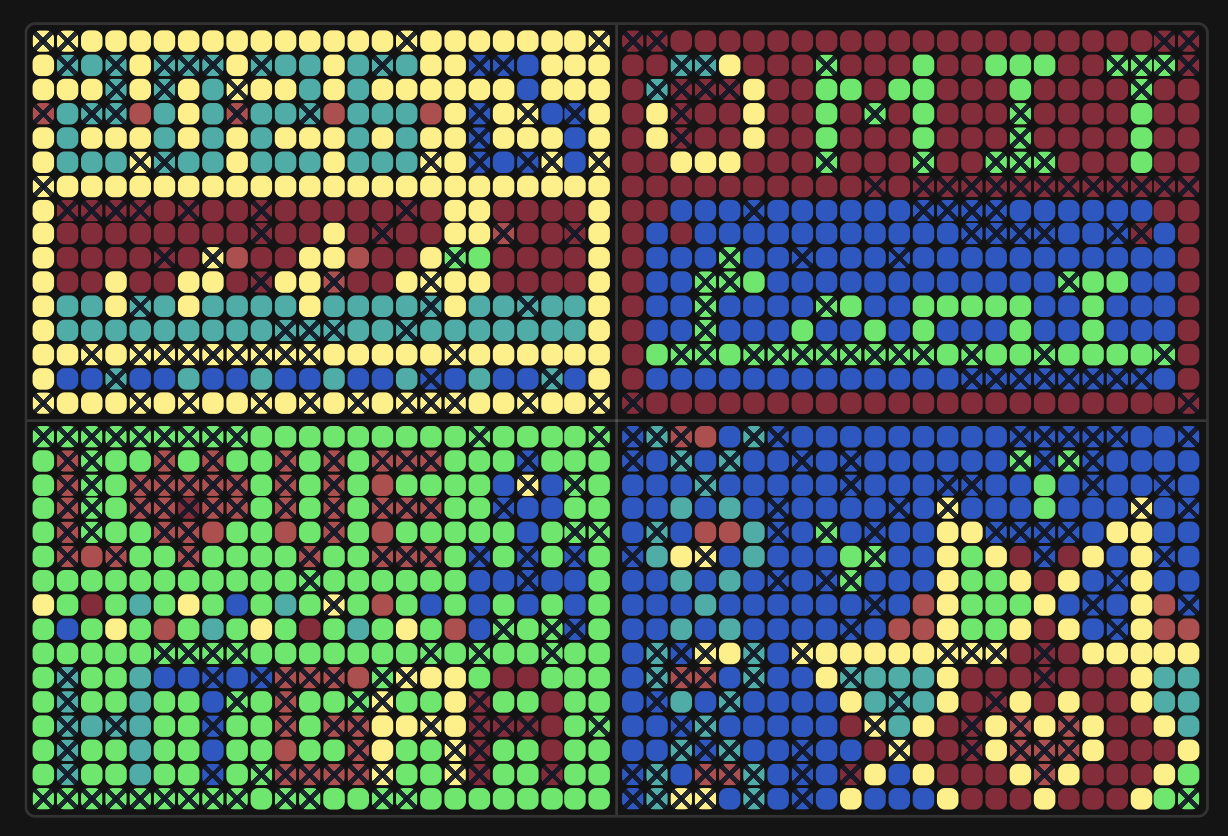
Unfortunately I was away at CHI 2026 during the contribution window, so I didn’t get to commit a pixel in time.
Part B – Cell-Free Protein Synthesis
B1. Role of each component
E. coli Lysate
- BL21 (DE3) Star Lysate (with T7 RNAP): The “factory floor” – a crude cytoplasmic extract carrying ribosomes, tRNAs, aminoacyl-tRNA synthetases, translation factors, and the T7 RNA polymerase needed to transcribe T7-promoter templates. The DE3 Star background also lacks RNase E activity, so mRNAs last longer.
Salts / Buffer
- Potassium Glutamate: Main osmolyte and K+ source for ribosome function; glutamate (unlike chloride) doesn’t inhibit translation.
- HEPES-KOH pH 7.5: pH buffer – holds the reaction near physiological pH so enzymes work and chromophores fold correctly.
- Magnesium Glutamate: Mg2+ is essential cofactor for RNAP, ribosome assembly, and every nucleotide-binding enzyme. Glutamate counter-ion again, for the same reason as K+.
- Potassium phosphate (mono/dibasic, 1.6:1): Phosphate buffer + Pi source. Pi is recycled into NTPs and into the energy regeneration loop.
Energy / Nucleotide System (NMP-Ribose system)
- Ribose: Carbon backbone for nucleotide regeneration; cellular enzymes in the lysate convert ribose + NMPs into NTPs.
- Glucose: Primary energy source – glycolysis in the lysate regenerates ATP from ADP, powering everything else.
- AMP, CMP, GMP, UMP: Cheap nucleotide monophosphates supplied as precursors; lysate kinases phosphorylate them up to NTPs as needed (this is why NMP-Ribose is cheaper than buying NTPs directly).
- Guanine: Free base that lysate enzymes salvage into GMP/GDP/GTP – this is the workaround for the missing GMP in the mix (see B3).
Translation Mix (Amino Acids)
- 17 Amino Acid Mix: The protein building blocks. Tyrosine and cysteine are supplied separately because they have solubility/oxidation quirks.
- Tyrosine (pH 12): Tyrosine is poorly soluble at neutral pH, so it’s prepared in a strong alkaline stock and added separately.
- Cysteine: Highly reactive thiol – prone to oxidation and disulfide formation, so kept separate and added fresh.
Additives
- Nicotinamide: Precursor for NAD+/NADH – needed by glycolysis (GAPDH step) to keep the energy regeneration cycle running.
Backfill
- Nuclease-Free Water: Brings the reaction to volume without introducing RNases that would chew up the mRNA.
Analogy: the cell-free reaction is a kitchen with the chefs (ribosomes, polymerase), the recipes (DNA template), and an inventory system (energy regeneration). The 20-h mix is set up so the kitchen doesn’t run out of energy after one hour – instead of pre-cooked NTPs, it ships in flour (ribose) and grain (NMPs) and bakes its own NTPs continuously.
B2. PEP-NTP vs NMP-Ribose master mix – main differences
The PEP-NTP mix is a sprint: it supplies finished NTPs directly plus PEP (phosphoenolpyruvate) as a high-energy phosphate donor, giving immediate energy and transcription for fast 1-hour reactions, but it’s expensive and burns out as PEP depletes. The NMP-Ribose mix is a marathon: it supplies cheap NMP precursors + ribose + glucose so the lysate’s own enzymes regenerate NTPs and ATP continuously, sustaining transcription/translation for 20 hours at much lower cost.
Analogy: PEP-NTP is buying a pre-charged battery; NMP-Ribose is installing a slow-trickle solar panel. The battery is faster at first but it runs out – the panel keeps producing as long as the sun (glucose) is shining.
B3. Bonus – Transcription without GMP, only Guanine
E. coli lysates retain the purine salvage pathway. Enzymes such as HGPRT (hypoxanthine-guanine phosphoribosyltransferase) convert free guanine + PRPP (which the lysate makes from ribose and ATP) into GMP, and then nucleotide kinases (GMK, NDK) phosphorylate GMP -> GDP -> GTP. So guanine + ribose effectively replaces GMP at a fraction of the cost.
Analogy: you don’t buy bread if you have flour and a baker. The lysate has the baker (HGPRT + kinases) and the flour (ribose), so guanine is enough.
Part C – Planning the Global Experiment
C1. One key biophysical property of each FP affecting cell-free readout
sfGFP – Fast, robust folding even under stress. sfGFP was engineered specifically to fold and mature quickly in conditions where regular GFP fails (heterologous expression, fusion tags). In cell-free, this means it lights up earliest of the green channel and is a forgiving “always works” baseline. Like GFP family, it needs O2 for chromophore maturation (oxidation step), but its maturation is fast (~14 min in vivo).
mRFP1 – Slow maturation and stepwise blue->red intermediate. mRFP1 (the original DsRed-derived monomer) matures over hours via a blue/green intermediate, so 1-hour reactions barely capture any red signal – a 36-h incubation is essentially required to see full red. Also O2-dependent (extra oxidation step compared to GFP).
mKO2 – Orange FP with moderate maturation, pH-stable. mKO2 (from Fungia coral) has good photostability and a relatively low pKa (~5.5), so it tolerates the slight pH drift cell-free reactions experience as glucose ferments to lactate/acetate. Maturation slower than GFP-class but faster than DsRed-derived reds.
mTurquoise2 – High quantum yield, but pKa ~3.1 means very acid-resistant; sensitive to chloride. Probably the brightest cyan available, with QY ~0.93. It folds well in E. coli lysates. Its CFP-class chromophore is insensitive to acidification, so it’s a great choice if the long-incubation pH drops. Like GFP, needs O2.
mScarlet-I – Fastest-maturing monomeric red (~31 min in yeast), but moderate acid sensitivity (pKa ~5.4). This makes it the best red for short or pH-stable reactions; if pH drifts below ~6, signal drops noticeably.
Electra2 – Blue FP derived from mRuby3, monomeric, bright, with a chromophore that doesn’t require O2 for maturation in the same way GFP does (BFPs of this class form their chromophore via a different cyclization route). Designed for live-cell intracellular brightness, which translates well to cell-free. Spectral non-overlap with the green/red FPs makes it ideal for the multi-color canvas.
C2. Hypothesis – one reagent adjustment to improve a specific property
Protein: mRFP1 Reagent(s) to adjust: increase dissolved O2 (looser cap / higher headspace / pre-oxygenated buffer) and add supplemental FAD (~1 uM). Expected effect: mRFP1 maturation includes an O2-dependent oxidation step that’s rate-limiting in sealed cell-free wells, where O2 depletes fast. Increasing O2 availability should accelerate red chromophore formation and raise final fluorescence at 36 h without changing protein yield. FAD has been shown to assist DsRed-family oxidative maturation. Predicted endpoint: >=1.5x fluorescence vs default well.
Alternative hypothesis (mScarlet-I): Increase HEPES buffer concentration from 45 mM -> 80 mM to prevent pH drift below mScarlet-I’s pKa (~5.4) over 36 h. Expected effect: maintain protonation state of the chromophore, preserve fluorescence quantum yield, and prevent late-incubation signal decay.
Analogy: in photography terms, this is choosing the right film for the lighting. mTurquoise2 is high-ISO film (works in any light/pH), mRFP1 is a film that needs long exposure (slow maturation), mScarlet-I is film that gets fogged by acid in the developer (acid-sensitive) – so you adjust the chemistry (buffer, O2, time) to suit the film.
C3. Master mix composition
| Component | Stock conc. | Final conc. | Volume in 20 uL rxn |
|---|---|---|---|
| Lysate | – | – | 6 uL |
| 2x Optimized Master Mix | 2x | 1x | 10 uL |
| FP DNA template | – | – | 2 uL |
| Custom reagent supplement(s) | (fill in) | (fill in) | 2 uL |
| Total | 20 uL |