Week 1 Lab: Pipetting
Pre-lab answers
Stock MS in g/mL
5 M × 532 g/mol = 2660 g/L = 2.66 g/mL
Serial dilution plan: 5 M → 100 µM
Total dilution = 50,000× → 2 steps.
| Step | From → To | Factor | Take stock | + dH₂O | Final vol | Pipette |
|---|---|---|---|---|---|---|
| 1 | 5 M → 10 mM | 500× | 2 µL | 998 µL | 1000 µL | P2/P20 + P1000 |
| 2 | 10 mM → 100 µM | 100× | 10 µL | 990 µL | 1000 µL | P20 + P1000 |
Tubes: 1.5 mL Eppendorfs (volumes too large for PCR strips).
Final reaction (60 µL, MS at 40 µM, dye at 1×)
| Reagent | Stock | Final | Volume |
|---|---|---|---|
| Loading dye | 6× | 1× | 10 µL |
| MS | 100 µM | 40 µM | 24 µL |
| dH₂O | — | — | 26 µL |
| Total | 60 µL |
Why 100 µM intermediate instead of diluting straight to 40 µM? 100 µM is a clean serial-dilution endpoint (50,000× = 500× × 100×); 40 µM isn’t. The 100 µM tube also acts as a reusable stock for downstream reactions — error compounds with every extra dilution step, so fewer steps to a clean intermediate is better.
Part 1 — Mixing color (practice)
Followed protocol: tubes 1–3 single colors (500 µL each), tubes 4–6 mixed pairs (R+Y, Y+B, R+B). Two-step pipetting (200 + 20 µL) on tube 4 to practice tip changes.
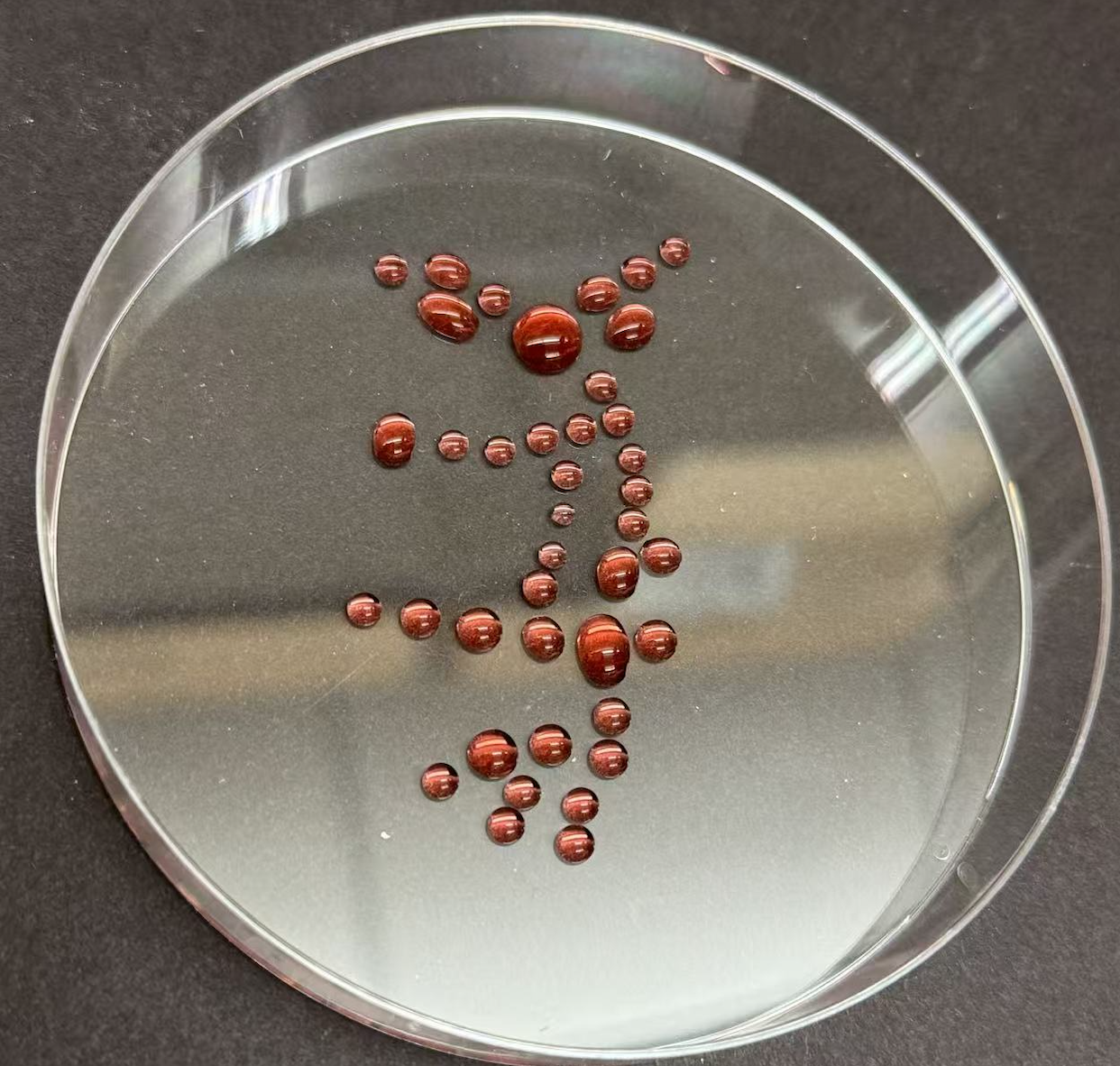
Plating designs: Used 1–10 µL drops on a glass petri to build volume intuition. Drop diameter scales noticeably with volume — 1 µL drops are barely visible without backlight; 10 µL drops bead high enough to catch reflection.
Result
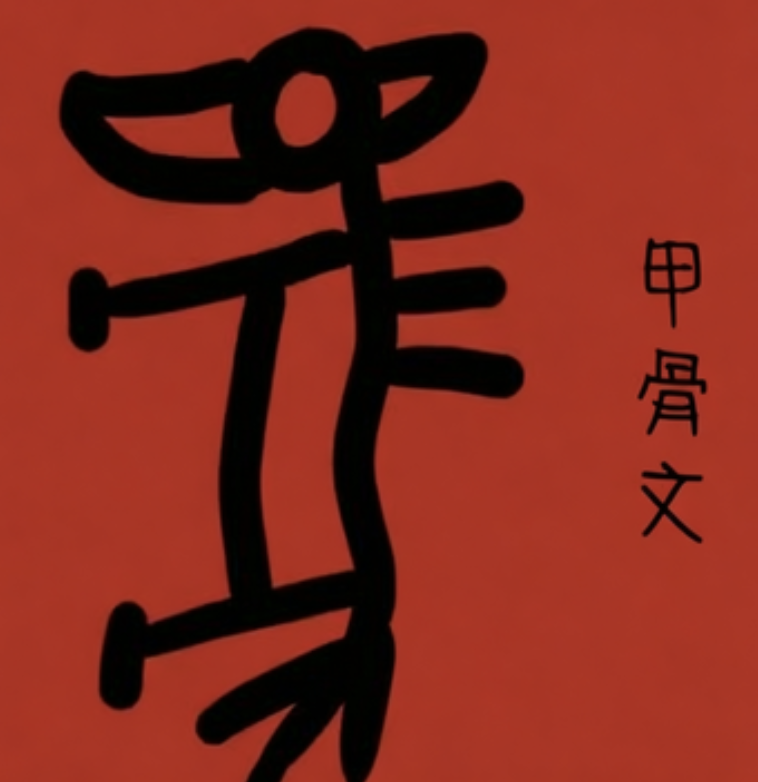
I pipetted the 甲骨文 (oracle bone script) of 马 — the Chinese character for horse — onto the plate to celebrate the Year of the Horse (2026). Oracle bone script is the earliest known form of Chinese writing, carved into ox scapulae and turtle plastrons during the Shang dynasty (~14th–11th c. BCE) for divination. The pictographic form of 马 still shows the horse’s mane, four legs, and tail.
| Reference character (甲骨文 of 马) | My pipetted plate |
|---|---|
| 
|
Observations:
- Drop size variability across the design = visible record of where my hand was steady vs. shaky.
- Surface tension on bare glass keeps drops discrete — no spreading or merging unless they touched.
Part 2 — Serial dilution
Performed the two-step dilution per the table above. Mixed by pipetting up/down 3–4× after each addition. Marked tubes with target concentration.
Prepared the 60 µL final reaction. Loaded 20 µL into a pre-prepared gel well (bonus step) — went in cleanly without puncturing.