Projects
Final projects:
- A cell-free synthetic biology pee pad that detects glucose in canine urine via an engineered P_oxyR–mCherry circuit for early diabetes screening.
LumiPaws engineers an OxyR-responsive genetic circuit into a freeze-dried paper substrate that detects urinary glucose through visual fluorescence. Urine testing is the foundation of preventive care for pets as a way to shift from waiting until the animal is already sick to spotting trouble before it starts.
Yutong Wu · Wellesley College ‘26 · yw108@mit.edu
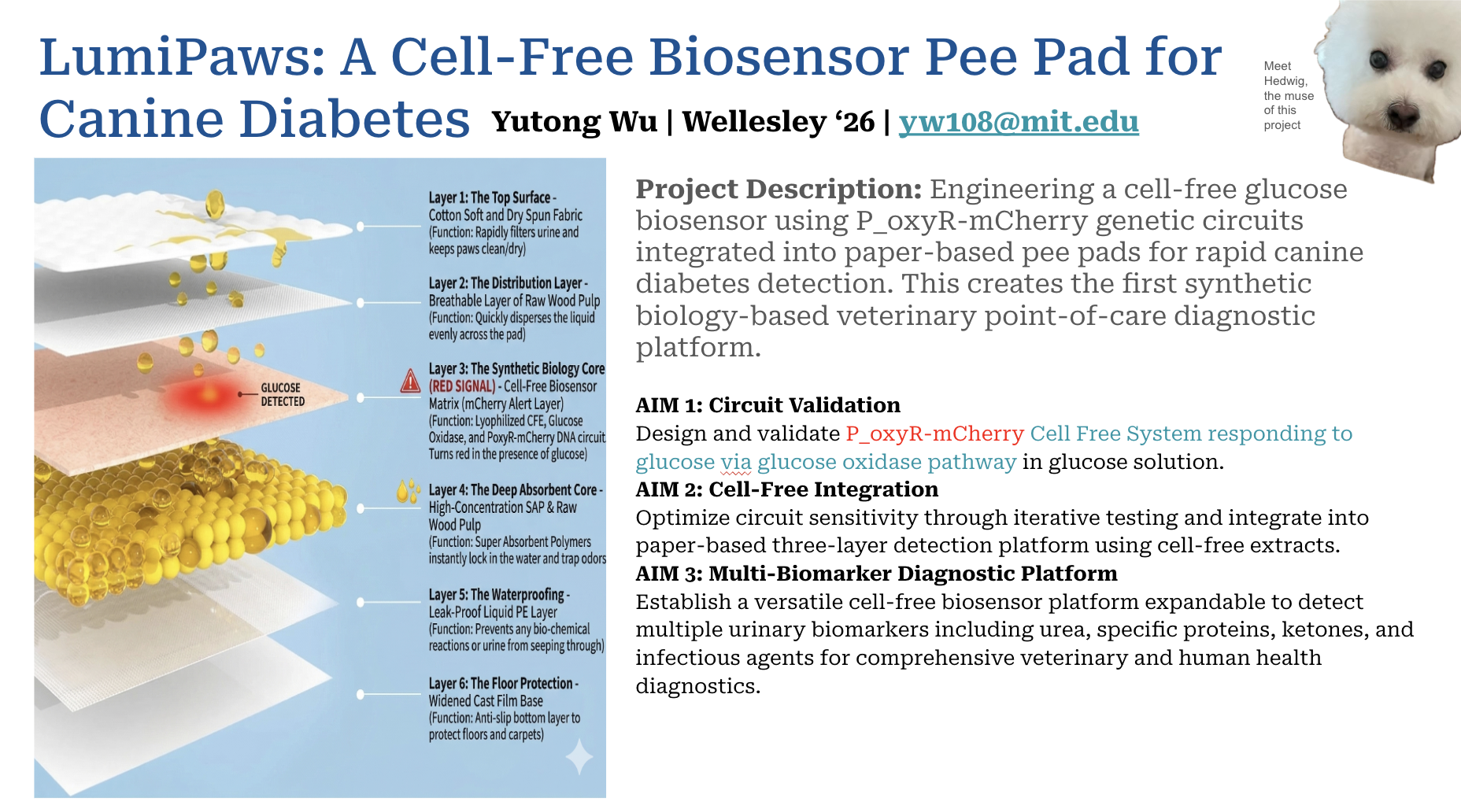
Canine diabetes affects approximately 1 in 300 dogs, and most diagnoses arrive late: after weight loss, excessive thirst, or ketoacidosis bring the family to a clinic. There is no accessible at-home screening tool. Veterinary blood glucose tests require a visit, and pet owners have no early warning system.
LumiPaws turns the everyday pee pad into a diagnostic. A freeze-dried cell-free reaction sits in the absorbent core of a six-layer pad; when a diabetic dog urinates on it, glucose is enzymatically converted to hydrogen peroxide, which activates an engineered OxyR transcription factor and drives mCherry expression, producing a red signal visible to the owner via .
Why red? Urine is naturally yellow, which is a problem for any color-based test, since most signals blend right into the background. LumiPaws uses mCherry, a red fluorescent protein, precisely because red cuts cleanly through yellow rather than getting lost in it. The signal is readable under a focused light at 587 nm, mCherry’s excitation peak, and every kit ships with a small handheld torch tuned to that exact wavelength.
| Metric | Value | Context |
|---|---|---|
| 1 : 300 | Dogs with diabetes | Rising rapidly over the last decade |
| > 100 mg/dL | Clinical glucosuria threshold | Renal threshold ~180–220 mg/dL serum |
| ~ $0 | Equipment to use | Visual fluorescence; no hardware |
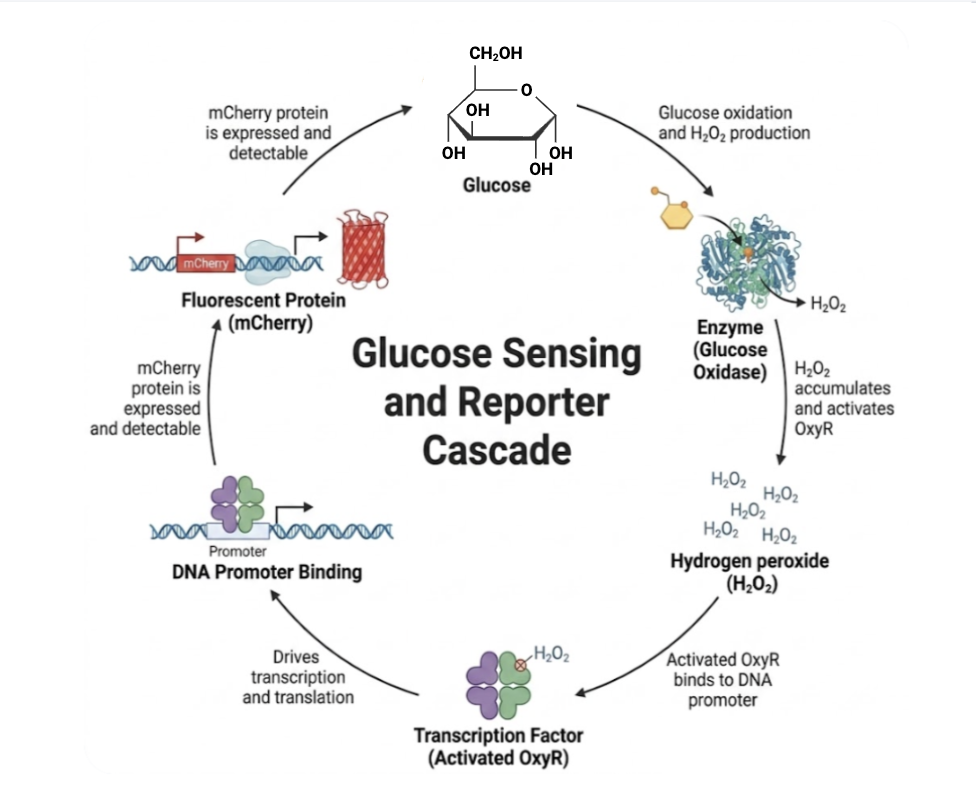 Insert: Glucose → GOx → H₂O₂ → OxyR → mCherry signal flow
Design and validate a P_oxyR-mCherry cell-free system responsive to glucose via the glucose oxidase pathway. Quantify dose-response across H₂O₂ and glucose concentrations in tube and on paper.
Optimize circuit sensitivity through iterative promoter design and freeze-dry the validated reaction onto a paper-based three-layer detection platform suitable for urine-triggered activation.
Establish a versatile cell-free biosensor platform expandable to detect urinary biomarkers including urea, ketones, proteins, and infectious agents for comprehensive veterinary and human diagnostics.
Two rounds of iterative engineering.
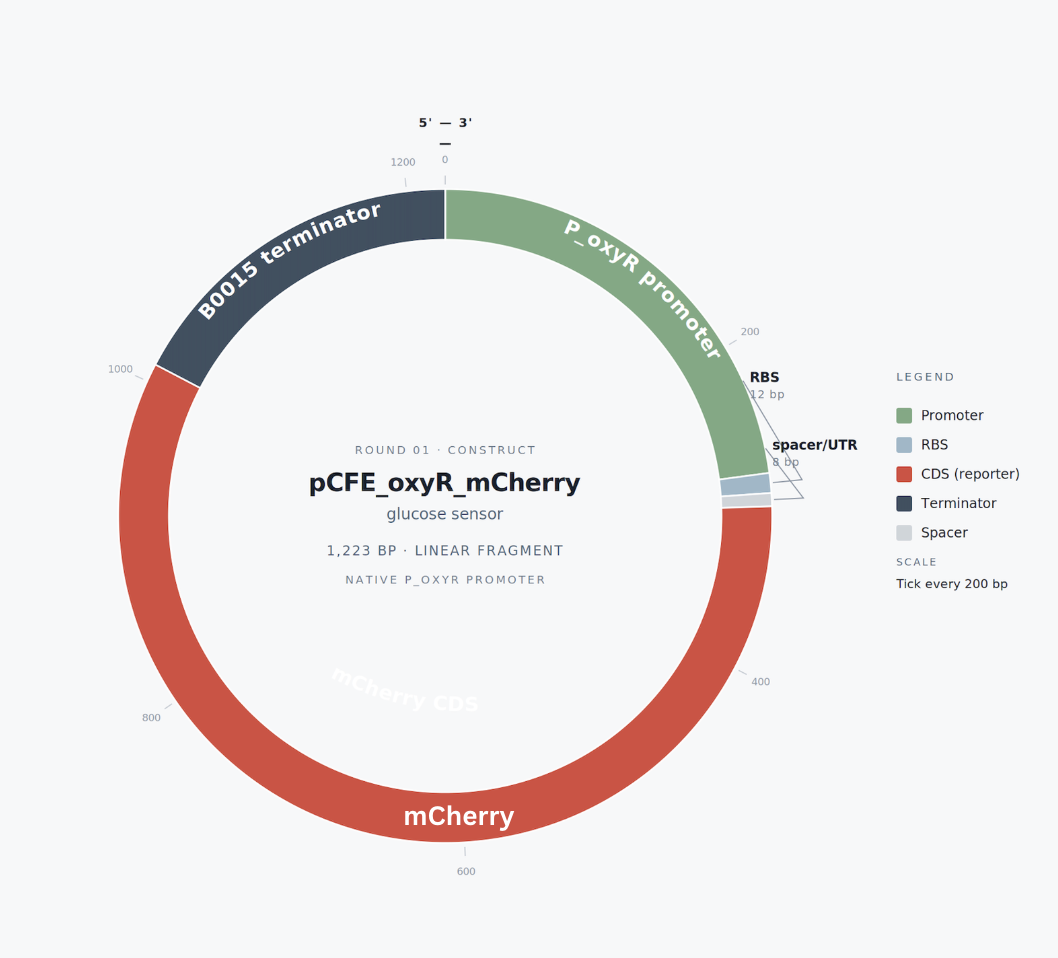
Concept. First iteration used the native E. coli ahpC promoter with OxyR’s endogenous binding site driving mCherry directly. A minimal architecture intended to test whether OxyR-dependent activation could be detected in a cell-free extract.
Architecture. EcoRI → P_ahpC → RBS B0034 → mCherry → rrnB T1 → HindIII. Total length ~1.2 kb. Linear gene fragment ordered from Twist.
Outcome. Worked in vivo but produced negligible signal in cell-free — the native σ⁷⁰-dependent promoter is poorly transcribed by the T7-rich CFPS systems. This motivated Round 2.
Concept. Engineered a hybrid promoter fusing the T7 core sequence with the OxyR operator from ahpC. T7 RNAP provides high-yield transcription; OxyR gates that activity in an H₂O₂-dependent manner. Two cassettes on one template: constitutive OxyR expression upstream, T7–OxyR gated mCherry downstream.
Architecture. EcoRI → T7 → RBS → OxyR → rrnB T1 → insulator → T7-OxyR hybrid promoter → RBS → mCherry → Tphi → HindIII. Two terminator variants used to eliminate sequence repeats. Total length 1,903 bp.
Variants ordered. Two gene fragments: v1 (5 bp spacer) and v2 (3 bp spacer) between T7 core and OxyR operator — to identify the optimal spatial geometry for transcriptional regulation.
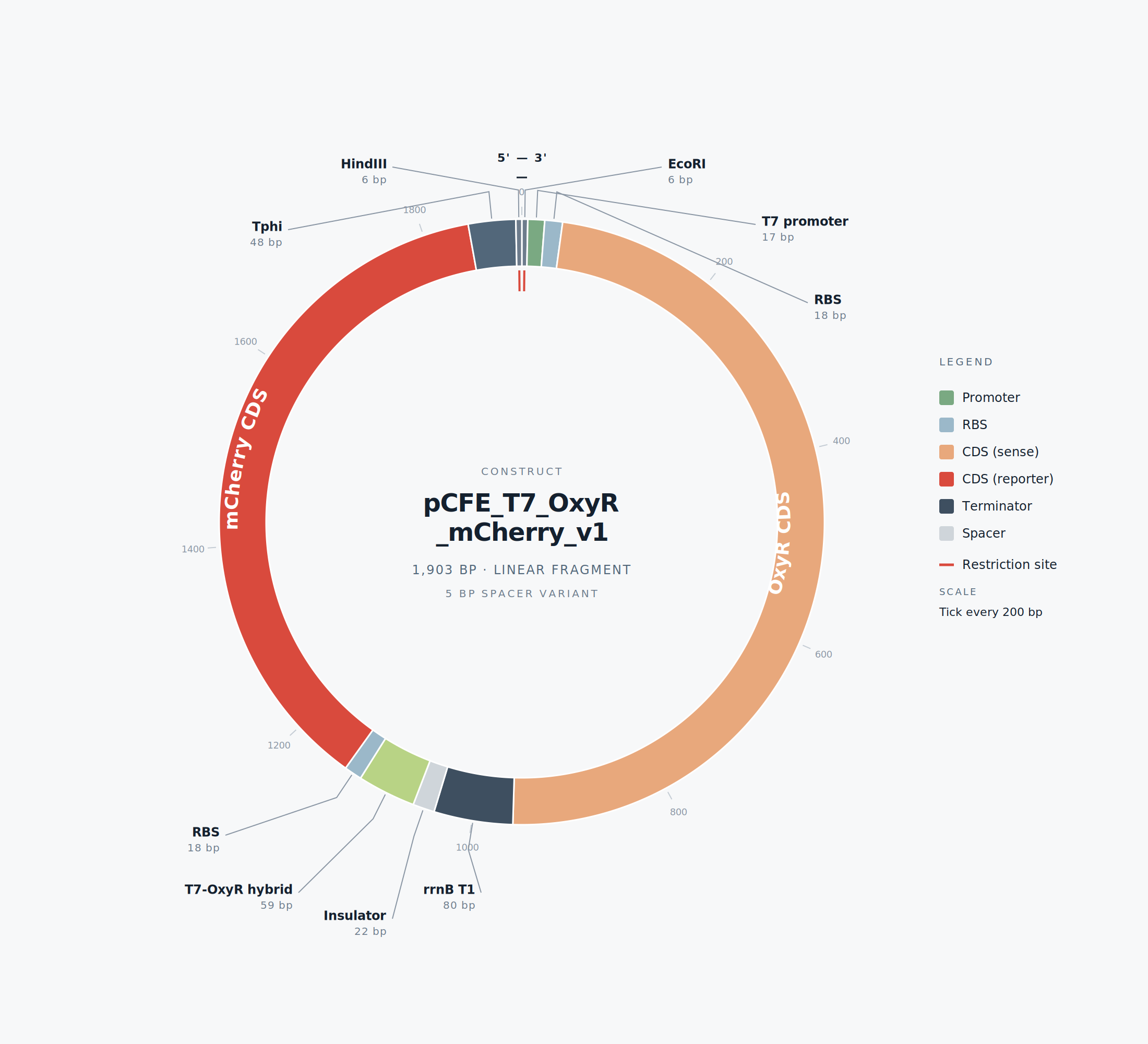 Insert: T7–OxyR hybrid construct map
Final assembled gene fragment, 5’ to 3’. Synthesized as Gene Fragment (Adapters OFF) for direct use in cell-free reactions with GamS protein.
| Element | Source | Function | Size |
|---|---|---|---|
| EcoRI flank | Synthetic | Cloning site / restriction handle | 6 bp |
| T7 promoter | T7 bacteriophage | Drives OxyR expression in CFPS | 17 bp |
| RBS B0034 | iGEM Registry | Strong ribosome binding site | 18 bp |
| OxyR CDS | E. coli K-12 MG1655 | H₂O₂-sensing transcription factor | 918 bp |
| rrnB T1 terminator | BBa_B0010 | Terminates Chapter 1 transcription | 80 bp |
| Insulator spacer | Synthetic neutral | Prevents read-through | 22 bp |
| T7–OxyR hybrid | Engineered (this work) | Gated transcriptional element | ~59 bp |
| RBS B0034 | iGEM Registry | RBS for mCherry | 18 bp |
| mCherry CDS | Codon-optimized (IDT) | Red fluorescent reporter | 708 bp |
| Tphi terminator | T7 bacteriophage | Terminates Chapter 2 transcription | 48 bp |
| HindIII flank | Synthetic | Cloning site / restriction handle | 6 bp |
📄 → View the full experiment protocols (Google Doc)
01 — Construct Design. DNA design and annotation in Benchling. Parts sourced from NCBI (OxyR Gene ID 948462), iGEM Registry (RBS, terminators), and IDT CodonOpt for E. coli-optimized mCherry.
02 — Gene Synthesis. Twist Bioscience Gene Fragments (Adapters OFF), 1,903 bp linear DNA. Two spacer variants synthesized in parallel to triangulate optimal T7–OxyR geometry.
03 — Cell-Free Expression. Ginkgo CFPS Economy Kit (primary) and NEB PURExpress (backup). GamS protein added to protect linear DNA from exonuclease activity in crude extracts.
04 — Enzymatic Conversion. Glucose oxidase from Aspergillus niger (Sigma G7141) co-lyophilized with the cell-free reaction. Converts urinary glucose into H₂O₂ via molecular oxygen.
05 — Fluorescence Readout. mCherry signal quantified on a plate reader (ex 569 nm, em 610 nm) with kinetic measurements every 10 minutes over 4–6 hours at 30 °C. Dose-response curves fit to extract EC50 and dynamic range.
06 — Paper Integration. Optimized reactions freeze-dried onto Whatman #1 filter paper discs and integrated into a six-layer pad architecture: spunbond top → distribution → biology core → SAP → PE waterproofing → base.
What success looks like.
 Insert: mCherry fluorescence vs. H₂O₂ concentration across both variants
Validation of the T7–OxyR hybrid promoter in cell-free reactions across an H₂O₂ titration. Success at this stage unlocks the full glucose cascade and paper integration.
| Key | Description | Target |
|---|---|---|
| LOD | Limit of detection | < 50 µM H₂O₂ |
| EC50 | Half-maximal activation | 100 – 500 µM |
| Range | Dynamic range, fold induction | 5 – 15 × |
| T½ | Time to detectable signal | 1 – 2 hr |
| CV | Replicate variability | < 25 % |
From design to deployment.
Your pet can’t talk, but their urine can.
LumiPaws is a platform, not a single product. The cell-free system at the heart of the pad can be re-engineered to detect a growing range of urinary biomarkers — and the format can expand from dog pee pads to cat litter, creating a unified at-home diagnostic ecosystem for companion animals.
Cell-free expression of urease and creatininase, paired with engineered ammonia- or pH-responsive transcription factors, can flag early kidney disease — one of the most common causes of mortality in older dogs and cats.
Adding β-hydroxybutyrate dehydrogenase to the same cell-free chassis extends the diabetes panel from glucose alone to diabetic ketoacidosis, a life-threatening complication that requires immediate veterinary care.
Toehold switches and CRISPR-Cas12a-based reporters can be freeze-dried alongside the OxyR circuit to detect bacterial or viral DNA in urine — screening for urinary tract infections, leptospirosis, and other pathogens without ever culturing a sample.
Cats use litter, not pads. The same cell-free chemistry can be embedded into color-changing litter substrates, giving cat owners the same early-warning system. One platform, two delivery formats, every household.
Every cell-free reaction we engineer becomes a reusable module. Swap the enzyme, swap the promoter operator, swap the reporter color — and the same freeze-dried paper substrate becomes a different test. LumiPaws starts with glucose because the chemistry is well-characterized, but the roadmap is multiplexed urinalysis at home: kidney, liver, pancreas, infection, hydration — read from a single sample, every day, by the people who already pay closest attention to their pets.
HTGAA 2026 · Twist Bioscience · Ginkgo Bioworks · NEB · Sigma-Aldrich
© 2026 Yutong Wu · HTGAA Final Project · Wellesley College ‘26