Week 7 HW: Genetic Circuits Part II
Assignment Part 1: Intracellular Artificial Neural Networks
1. What advantages do IANNs have over traditional genetic circuits, whose input/output behaviors are Boolean functions?
IANNs provide a massive leap forward by allowing cells to process analog information instead of being stuck with binary logic. Traditional genetic circuits are brittle because they depend on strict thresholds, whereas these networks use weighted inputs to handle fuzzy or noisy data with much higher precision. This compact design enables sophisticated decision making using fewer genetic parts, which is essential for working within the tight constraints of a living organism.
2. Describe a useful application for an IANN; include a detailed description of input/output behavior, as well as any limitations an IANN might face to achieve your goal.
A powerful application is a smart therapeutic cell designed to identify and destroy tumors. The inputs consist of the concentrations of multiple biomarkers like specific micro RNAs found in malignant tissue. The network assigns weights to these signals to calculate a weighted sum, and if that sum reaches a certain level, the output triggers the production of a protein that kills the cell. The primary limitation is the heavy metabolic burden. Running such complex synthetic logic drains the energy reserves of the cell, which can lead to slower growth or the eventual loss of the circuit through natural mutations as the host tries to survive.
3. Below is a diagram depicting an intracellular single-layer perceptron where the X1 input is DNA encoding for the Csy4 endoribonuclease and the X2 input is DNA encoding for a fluorescent protein output whose mRNA is regulated by Csy4. Tx: transcription; Tl: translation.
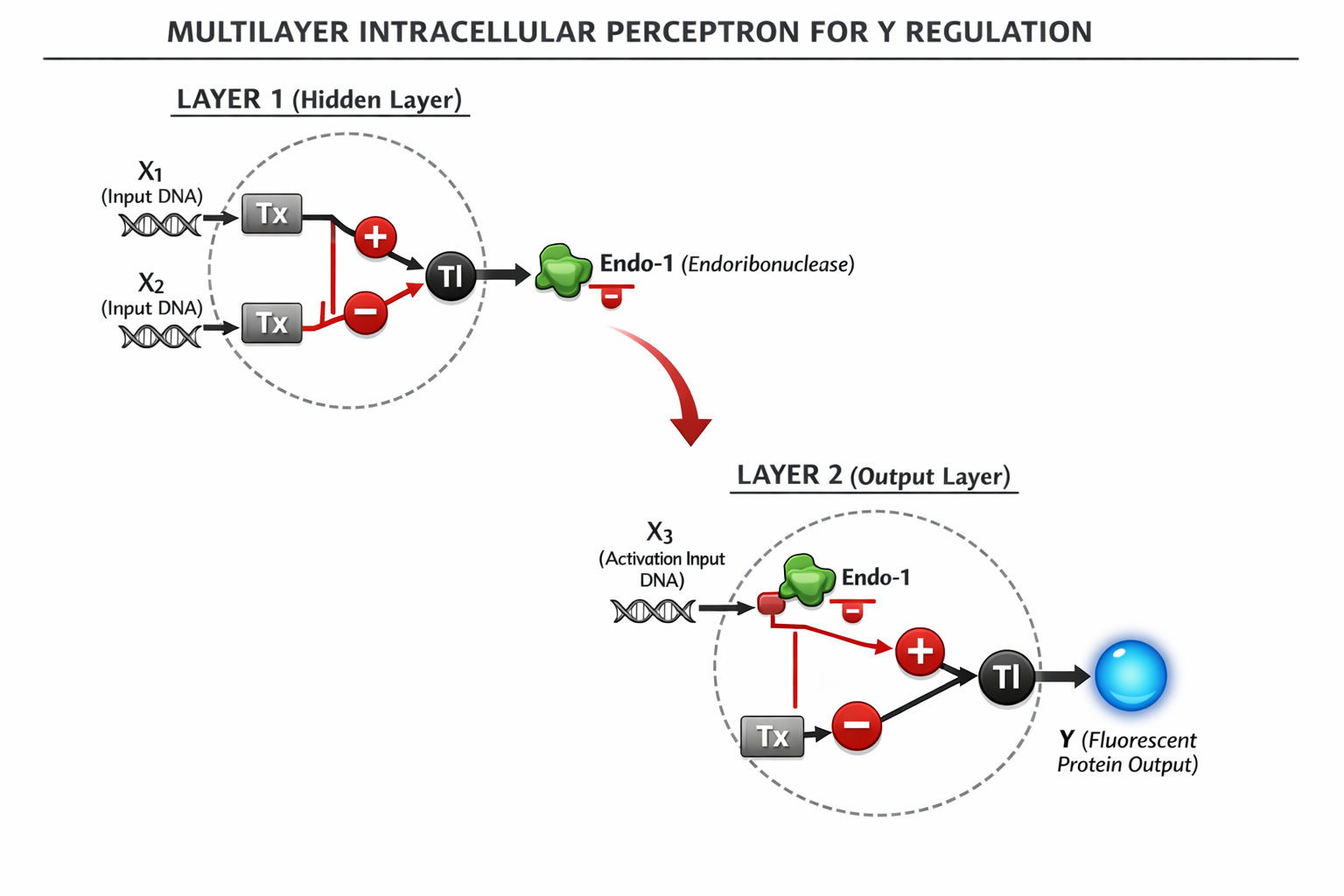 *Note: This diagram was drawn by Chatgpt
This architecture creates a molecular hierarchy where Layer 1 integrates its DNA inputs to produce Endo 1. That enzyme then acts as the inhibitory weight for Layer 2, fighting against the $X_3$ activation signal. The final production of protein $Y$ depends on the combined logic of both stages, showing how information flows through a multi layer neural network.
Assignment Part 2: Fungal Materials
1. What are some examples of existing fungal materials and what are they used for? What are their advantages and disadvantages over traditional counterparts? 2.What might you want to genetically engineer fungi to do and why? What are the advantages of doing synthetic biology in fungi as opposed to bacteria?
Mycelium leather and bio-composites used in construction are prime examples of how fungi are replacing leather and synthetic foams. The main draw is their ability to turn agricultural waste into high-value products with a tiny carbon footprint. While they beat traditional materials on environmental impact, these fungal alternatives can be less consistent and more sensitive to environmental changes like humidity, which currently limits their use in high-stress industrial applications.
Engineering fungi to behave like a living computer using the intracellular perceptron logic from the research you shared, could revolutionize environmental sensing. You might program a mycelium network to monitor soil health, where it calculates a weighted sum of moisture, pH, and nitrogen levels before deciding whether to stimulate plant growth or remain dormant. This smart behavior is far more efficient than a simple on/off switch because it protects the fungi from the metabolic exhaustion that usually comes with heavy synthetic biology modifications.
The reason to pick fungi over bacteria for this work comes down to architecture and chemistry. Fungi are eukaryotes, meaning they can fold and modify proteins in ways bacteria simply cannot, making them better factories for complex molecules. Beyond the chemistry, their hyphal networks provide a physical structure that is inherently stronger and more adaptable for creating 3D bio-materials. Bacteria are great for liquid-phase chemistry, but if you want to build a smart, solid object that can sense and react, fungi are the clear winners.
Assignment Part 3: First DNA Twist Order
Review Part 3: DNA Design Challenge of the week 2 homework. Design at least 1 insert sequence and place it into the Benchling/Kernel/Other folder you shared in the Google Form above. Document the backbone vector it will be synthesized in on your website.