Week 11 HW: Bioproduction & Cloud Labs
Part A: The 1,536 Pixel Artwork Canvas | Collective Artwork
- What you contributed to the community bioart project (e.g., “I made part of the DNA on the bottom right plate”) Even though my contribution was just a few pixels, I liked that I could at least do my part in such an interesting global project.
- What you liked about the project, and what about this collaborative art experiment could be improved for next year? I liked seeing how everyone had different ideas and how they all came together into a single global artwork, how each person gave a very special and personal touch to their work. I think what could be improved for the next event is a guide or more details about the collaborative process and how the process itself works, because I personally didn’t quite understand what it was about or where I was in the drawing process.
Part B: Cell-Free Protein Synthesis | Cell-Free Reagents
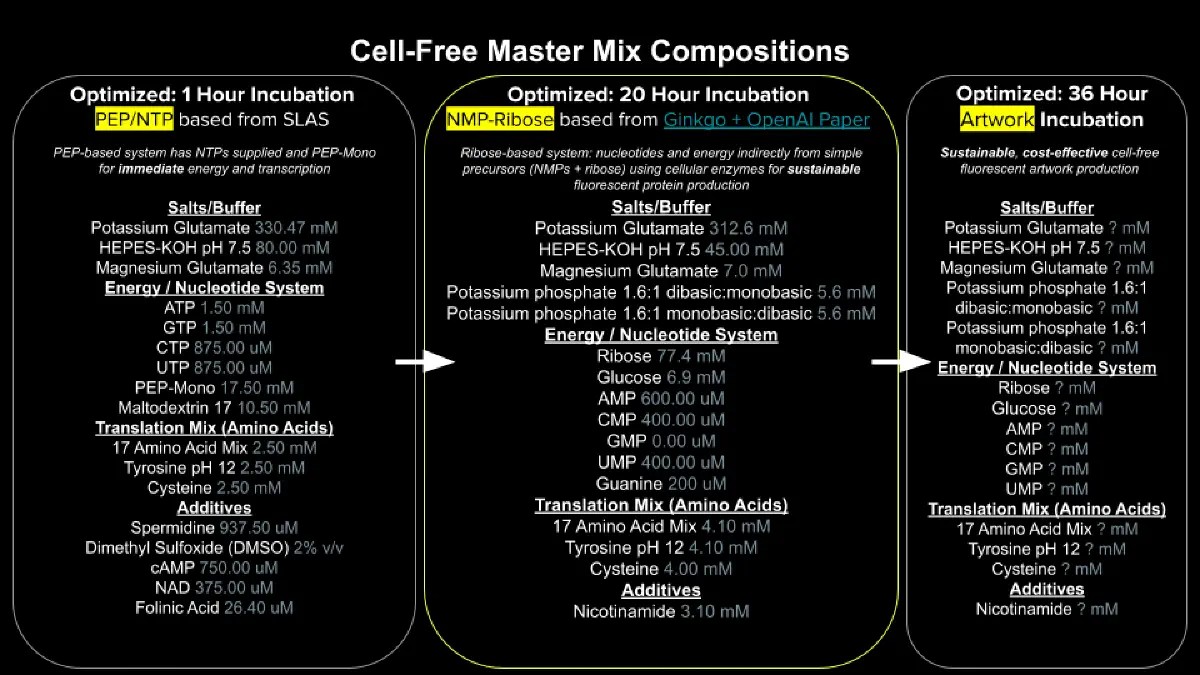
- Referencing the cell-free protein synthesis reaction composition the middle box outlined in yellow on the image above, also listed below), provide a 1-2 sentence description of what each component’s role is in the cell-free reaction.
E. coli Lysate-BL21 (DE3) Star Lysate (includes T7 RNA Polymerase) Provides the cellular machinery (ribosomes, tRNAs, initiation/elongation factors) required for transcription and translation. The BL21(DE3) strain includes T7 RNA polymerase, which specifically transcribes genes cloned under a T7 promoter.
Salts/Buffer: Potassium Glutamate, HEPES-KOH pH 7.5, Magnesium Glutamate, Potassium phosphate monobasic, Potassium phosphate dibasic, Energy / Nucleotide System.
Maintain optimal pH (HEPES), ionic strength, and provide essential ions like Mg²⁺, a critical cofactor for RNA polymerase and ribosome stability. Potassium glutamate mimics the cytoplasmic environment and acts as an osmoprotectant.
Energy / Nucleotide System: Ribose, Glucose, AMP, CMP, GMP, UMP, Guanine,
Supplies energy (via glucose and ribose metabolism) and nucleotide monophosphate building blocks that are metabolically converted into NTPs (ATP, GTP, CTP, UTP). These NTPs serve as substrates for RNA polymerase during transcription.
Translation Mix (Amino Acids): 17 Amino Acid Mix, Tyrosine, Cysteine
Provides all 20 essential amino acids required by ribosomes to synthesize the target protein during translation. Tyrosine and cysteine are added separately because they can be limiting or chemically sensitive.
Additives: Nicotinamide
Acts as a mild nuclease inhibitor, protecting mRNA and DNA template from degradation. It may also support redox balance and serve as a precursor for NAD+.
Backfill: Nuclease Free Wate
Adjusts the final reaction volume to achieve the correct concentration of all components without introducing contaminating nucleases.
- Describe the main differences between the 1-hour optimized PEP-NTP master mix and the 20-hour NMP-Ribose-Glucose master mix shown in the Google Slide above. (2-3 sentences)
The 1-hour optimized PEP-NTP master mix uses pre-formed phosphoenolpyruvate (PEP) and nucleotide triphosphates (NTPs) for rapid energy regeneration and immediate transcription, enabling fast protein production but exhausting energy quickly. The 20-hour NMP-Ribose-Glucose master mix uses nucleotide monophosphates (NMPs) plus ribose and glucose, which are metabolized through glycolysis and salvage pathways to slowly regenerate NTPs, providing sustained energy for prolonged protein synthesis over many hours.
- Bonus question: How can transcription occur if GMP is not included but Guanine is?
Transcription can still occur because the E. coli lysate contains guanine phosphoribosyltransferase, an enzyme in the purine salvage pathway that converts free guanine into GMP (guanosine monophosphate). Cellular kinases then phosphorylate GMP to GDP and finally to GTP, which is the direct substrate required by RNA polymerase for incorporating guanine into RNA during transcription.
Part C: Planning the Global Experiment | Cell-Free Master Mix Design
- Biophysical/Functional Property of Each Fluorescent Protein
sfGFP (Superfolder GFP)
- Property: Extremely fast and robust folding with high solubility, even under non-optimal conditions.
- Effect on expression/readout: Its rapid maturation (minutes) allows for early fluorescence readout, and its folding efficiency makes it ideal for cell-free systems where chaperone availability may be limited. It is primarily translation-limited rather than folding-limited.
mRFP1 (Monomeric Red Fluorescent Protein 1)
- Property: Slower chromophore maturation compared to sfGFP, but faster than its tetrameric parent DsRed. It is monomeric.
- Effect on expression/readout: The slower maturation delays fluorescence onset, requiring longer incubation for signal detection. Its monomeric nature prevents aggregation artifacts, enabling more accurate quantitative measurements.
mKO2 (Monomeric Kusabira Orange 2)
- Property: High brightness and relatively fast maturation, but moderate sensitivity to acidic pH.
- Effect on expression/readout: Provides strong orange signal suitable for multiplexing, but its fluorescence intensity can drop if the cell-free reaction becomes acidic over long (36-hour) incubations due to metabolic byproducts.
mTurquoise2
- Property: Very high quantum yield (0.93) and mono-exponential fluorescence lifetime, but requires precise oxidative folding.
- Effect on expression/readout: Its brightness gives excellent signal-to-noise ratio, but its sensitivity to redox conditions means that suboptimal buffer composition can severely reduce the fraction of properly folded, fluorescent protein.
mScarlet_I
- Property: High molecular brightness and fast maturation for a red fluorescent protein, but still oxygen-dependent for chromophore formation.
- Effect on expression/readout: Provides bright, red-shifted fluorescence with minimal spectral overlap, making it ideal for multiplexed assays. However, oxygen availability in the reaction vessel can become limiting over 36 hours, reducing final yield.
Electra2
- Property: Engineered for brightness and stability in the blue spectrum, but can form aggregates (puncta) under certain ionic conditions.
- Effect on expression/readout: Its blue fluorescence avoids common autofluorescence, but aggregation reduces soluble fluorescent protein. It is also sensitive to redox balance and ionic strength.
- Hypothesis for Maximizing Fluorescence Over 36 Hours
Protein: mScarlet_I
Hypothesis: Supplementing the master mix with additional glucose (to 2.5 g/L)** and magnesium glutamate (to 9.0 mM) , while **increasing reaction surface area (e.g., using a low-retention 384-well plate) to improve oxygen diffusion, will maximize mScarlet_I fluorescence over 36 hours.
Expected effect: The increased glucose extends ATP regeneration beyond 20 hours, sustaining translation. Higher magnesium enhances ribosome activity and translation rate. Improved oxygen availability overcomes the oxygen-dependent chromophore maturation bottleneck specific to red FPs. Together, these changes will yield higher peak fluorescence and slower signal decay compared to the standard master mix.
Alternative hypothesis (for mTurquoise2): Adding *nicotinamide (to 5 mM) and *cysteine (to 5 mM) while slightly reducing potassium glutamate (to 290 mM) will improve redox balance and reduce oxidative stress. Because mTurquoise2 requires precise oxidative folding, these changes will increase the fraction of properly folded protein, resulting in brighter and more stable cyan fluorescence over 36 hours.
- Master Mix Composition Example (for mScarlet_I)
Based on the reaction format (6 µL lysate + 10 µL 2X master mix + 2 µL DNA + 2 µL custom supplements = 20 µL total):
| Supplement | Volume (nL) in 2 µL | Final concentration in 20 µL reaction | Rationale |
|---|---|---|---|
| Nuclease-free water | 1350 | (balance) | Backfill |
| Glucose | 150 | 2.5 g/L | Extends energy regeneration |
| Magnesium glutamate | 100 | 9.0 mM | Boosts translation rate |
| Ribose | 75 | ~12 g/L (standard) | Maintains nucleotide regeneration |
| AMP | 50 | 0.5 mM | NTP precursor |
| GMP | 50 | 0.5 mM | Direct GTP precursor |
| Cysteine | 50 | 5.0 mM | Supports redox and prevents oxidation |
| Nicotinamide | 50 | 4.0 mM | Redox balance |
| Potassium glutamate | 75 | ~315 mM (standard) | Ionic strength |
| HEPES-KOH | 25 | ~45 mM (standard) | pH buffering |
| Total | 2000 nL |
JSON format for the custom supplement (to submit):