Week 1 HW: Principles and Practices
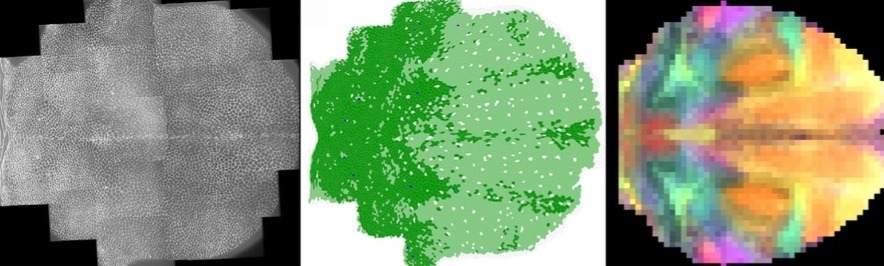
The morphogenetic process in the Drosophila dorsal thorax is explored above: Confocal Image of the dorsal thorax epithelium (left), tracking of cell division (middle) and expression patterns predicted by spatial transcriptomics (right).
First, describe a biological engineering application or tool you want to develop and why.
I’m fascinated by morphogenesis, in which the complex, three-dimensional organisation of biological entities can emerge! The possibilities of synthetically harbouring this process feel endless, however I am most intrigued by the potential of its application in radically-sustainable manufacturing.
Conventional manufacturing techniques (i.e formative plastic methods, subtractive techniques) in their archetypal incarnation contain inherent inefficacies at all stages, from the pre-production through to disposal of the manufactured artefact by the end-user. The plastic spork is an exemplar for how contemporary industrial logic constrains a product from its inception. Compatibility with standard machinery immediately informs material selection. Injection moulding techniques demand a particular design rationale, where minor features like undercuts can cause costs to balloon through added mould complexity. Instead of being repossessed wholly by organic processes at the atomic level when disposed, conventional thermoplastics degrade and colonize such exotic destinations as the mariana trench, our water supply, the human brain etc.
Organisms in the natural world appear unshackled by these constraints. I think immediately of the functionally-graded characteristics of bone, in which matter distribution is varied spatially, optimised to provide lightweight strength and support.
Next, describe one or more governance/policy goals related to ensuring that this application or tool contributes to an “ethical” future, like ensuring non-malfeasance (preventing harm).
Consistency of use: Fair dissemination of information is necessary to permit strong, equitable discussions between distinct stakeholders (public, policymakers, technicians etc), ensuring the ethical concerns of all groups are platformed to guide accurate policymaking.
Transparency in research and application: ‘Growth’ processes should likely be strongly standardized (at least initially) to establish a safe, repeatable precedent of procedure.
Prevention of environmental contamination: Current biowaste disposal processes should be adapted to fit novel requirements as they emerge.
Prevention of utilisation in scenarios considered universally unethical: This one feels pretty clear: no application should cause innate suffering or distress to involved biological materials (or societies in which they are used).
- a. Sound disposal practices of biomass bioproducts as industrial waste: Current biowaste disposal processes should be adapted to fit novel requirements as they emerge.
Next, describe at least three different potential governance “actions”.
1. Implement sound genetic safeguards.
Purpose: emergency termination of cellular processes in the event of dangerous circumstances, whereby the health of a population or ecosystem is suddenly threatened.
Induced auxotrophy (metabolic or via xenonucleic biochemistry), toxin gene expression cassettes, and engineered addiction are all contemporary methods of halting cellular activity outside of a specific environment (lab). A mosaic of approaches is recommended as the most robust containment method, especially when accounting for the spontaneous occurrence of safeguard-negating mutations.
Design: continued research, testing, and update of existing safeguards.
Assumptions: established safeguard techniques identified are inadequate or incompatible for this use case.
Risk of failure (or success!):
a. Strategies prove ineffective and difficult to consistently implement. Environmental contamination occurs frequently; consequences are unpredictable and catastrophic.
b. Genetic safeguards utilised are too complex or specific to permit equitable access.
2. Compose a universal convention outlining acceptable and unacceptable applications in manufacturing (and beyond), requiring strict agreement and adherence at a national level prior to industrial use.
Purpose: establish legal basis for international enforcement of manufacturing practices collectively identified as ethical and sound. Dissuade bad actors from potential misuse, encourage international collaboration, and mandate stewardship at the national scale. Unlike traditional manufacturing where inanimate materials are used, it feels like a necessity to require international collaboration where unethical practices could give rise to unpredictable, dangerous outcomes.
Design: The Biological Weapons Convention (BWC) serves as a strong example for the potential of a multilateral agreement to address and prevent misuse of biological practices at a global scale, reaching practically universal agreement across UN member states. I propose the creation of a convention following a similar framework, however with emphasis placed on proactively identifying and sanctioning acceptable and unacceptable use cases.
Assumptions: success hinges heavily upon members reaching a collective understanding. Additionally, it assumes that national governance voices are strongly aligned with the private interests of the manufacturing sector in each member state.
Risk of failure (or success!):
a. Private interests commence manufacturing via synthetic morphogenesis despite absent participation at UN level.
b. An unanimous decision is made, however coverage of convention proves inadequate, requiring frequent amendments.
3. Establish an independent watchdog for regulation of industrial activity.
Purpose: provide additional layer of security to possible corruption at both national and international scales, serving to conduct random audits of the industrial activity within member states.
Design: using universal convention as a basis, establish key measurable indicators as a baseline for monitoring and governance. Indicators must be specific and comprehensive, defining actions by industry which must be precisely met to guarantee compliance.
Assumptions:
a. The watchdog is sufficiently capable of avoiding corruption. Handlings are fair, just, and do not impose on the national security or privacy of member states.
b. Member states (and industry) corporate sufficiently with requests of watchdog.
Risk of failure (or success!):
a. Undetected convention violations threaten international biosecurity or violate agreements on ethical practices.
4. Implement traceability protocols as..
a. Chain Of Custody (CoC) for synthesis and distribution of manufacturing precursors.
b. Integrated genetic barcodes.
Purpose: ensure all stakeholders are accountable for their contribution to the design, production, and distribution of biological materials prior, during, and post manufacture. In the event that a ‘leak’ occurs whereby an ecosystem is threatened, traceability permits rapid response and containment, as well as identification of processes violating the convention.
Design: a. Define ‘custody’ objects, assigning each with a distinct identifier, lifecycle, and scope of use. Establish assignable states (created, modified, transported, archived, destroyed etc.). Design custody record around requirements identified in convention. b. Establish composition, length, and ideal location of barcode locus.
Assumptions: a. Stakeholders adhere stringently to CoC protocol.
Risk of failure (or success!): CoC processes are too authoritative to strongly discourage prospective stakeholders, with sound intent, from entering the market. The approach cannot achieve the required market leverage to replace the use of conventional manufacturing techniques.
Next score (from 1-3 with, 1 as the best, or n/a) each of your governance actions against your rubric of governance goals.
“Synthetic morphogenesis as a manufacturing technique”
| Does the option: | Option 1 | Option 2 | Option 3 | Option 4 |
|---|---|---|---|---|
| Enhance Biosecurity | ||||
| • By preventing incidents | 1 | 1 | 1 | 1 |
| • By helping respond | 3 | 3 | 2 | 1 |
| Foster Lab Safety | ||||
| • By preventing incident | 1 | 1 | 1 | 3 |
| • By helping respond | 3 | 3 | 2 | 1 |
| Protect the environment | ||||
| • By preventing incidents | 1 | 1 | 1 | 3 |
| • By helping respond | 3 | 3 | 3 | 1 |
| Other considerations | ||||
| • Minimizing costs and burdens to stakeholders | 2 | 3 | 3 | 2 |
| • Feasibility? | 1 | 3 | 3 | 2 |
| • Not impede research | 2 | 2 | 2 | 1 |
| • Promote constructive applications | 2 | 1 | 1 | 3 |
| Total (lower > higher) | 19 | 21 | 19 | 18 |
Last, drawing upon this scoring, describe which governance option, or combination of options, you would prioritize, and why. Outline any trade-offs you considered as well as assumptions and uncertainties.
Although likely the most politically challenging, the convention outlined in Option 2 appears central to establishing the precedent required for ethical use of the novel technology. Option 1 is almost mandatory as a guardrail in the event of industrial pollution, as built-in failsafes provide the greatest degree of protection where incidental mishaps could have dire consequences for public health.
I propose the initial priorisation of Options 1 and 2 consecutively, whereby research seeks to first establish integrated safeguards appropriate for the requirements unique to manufacturing, whilst national policymakers work collaboratively to negotiate terms of the convention. Due to somewhat uncertain ramifications of misuse, initial collaboration directly with the United Nations Office of the Secretary General will provide the expertise necessary to move forward at a national scale, where progress is likely to be more fruitful.
Principles & Practices - Weekly Homework
Reflecting on what you learnt and did in class this week, outline any ethical concerns that arose, especially any that were new to you.
The ability to control the growth of organic matter in a way that is so precise feels unprecedented in the sense that it is not dissimilar to ‘playing god’; it is clear that this gives rise to countless ethical concerns:
Concern: Could the process inadvertently give rise to conscious organisms under the right (or more so wrong) circumstances?
- Action 2.
Concern: What happens if the technique is abused to grow human flesh for use in applications considered universally immoral?
- Action 2, Action 3.
Concern: Could self-propagating organisms be inadvertently created and released into ecosystems?
- Action 1.
Concern: Could the process create significant social upheaval amongst religious societies?
- Action 2.
I will continue to strongly consider this topic throughout the coming weeks, aiming to further philosophise and describe ideas as they arise!
Preparatory Questions (Week 2)
Professor Jacobsen
Nature’s machinery for copying DNA is called polymerase. What is the error rate of polymerase? How does this compare to the length of the human genome. How does biology deal with that discrepancy?
- 1:10^6
- Human genome = ~ 3.2 gbp; approximately one incorrect base is inserted per 1 million correct insertions.
- Human biology employs several DNA proofreading and correction techniques; sense of correct geometry of base pairings, slowing catalysis when mismatch detected, and separation of mismatched primer to exonuclease site for removal etc.
How many different ways are there to code (DNA nucleotide code) for an average human protein? In practice what are some of the reasons that all of these different codes don’t work to code for the protein of interest?
- Substantial degree of combinations possible mathematically (approx 10^190)
- Degeneracy of genetic code (multiple distinct codons encode amino acid) means a small fraction of total combinations actually encode for protein.
Dr. LeProust
What’s the most commonly used method for oligo synthesis currently?
- Phosphoramidite oligo synthesis
Why is it difficult to make oligos longer than 200nt via direct synthesis?
- Small discrepancies in coupling efficiency (95% - 99%) compound exponentially beyond 200nt, reducing sequence accuracy beyond.
Why can’t you make a 2000bp gene via direct oligo synthesis?
- As described above, synthesis becomes incredibly imprecise beyond about 200nt. Accumulation of errors will yield strand coding for dysfunctional characteristics.
Fidelity of DNA replication-a matter of proofreading
George Church
[Using Google & Prof. Church’s slide #4] What are the 10 essential amino acids in all animals and how does this affect your view of the “Lysine Contingency”?
- Arginine, histidine, methionine, isoleucine, leucine, lysine, phenylalanine, threonine, tryptophan, and valine compose the 10 essential amino acids, where arginine is described as ‘conditionally essential’ in some mammalian species, such as humans (Rychen et al., 2018).
- The ‘Lysine Contingency’ describes the knock-out mutation performed in Jurassic Park (1993), in which the dinosaurs were rendered incapable of producing the essential aa Lysine (synthetic auxotrophy), requiring constant supplementation.
- The organic abundance of Lysine as an essential aa effectively renders this method useless, as they would be capable of receiving it through their conventional diet. This is especially interesting when considering prospective use of synthetic auxotrophy to control the growth of a manufactured organism; how might nature creatively find a method to circumvent the integrated safeguard?
Biochemistry, Essential Amino Acids.
Scratchpad
Synthetic biology as…
- A manufacturing technique
- A bioremediation technique
- A fertilization technique
- A method to arrange bacterial growth (magnetotaxis)
Manufacturing technique (key concepts / words):
- Morphogenesis
- Developmental biology
- Tissue patterning
- Hox genes
- Homeoboxes
- Positional information (morphogen gradient)
References
Huigang, L., Menghui, L., Xiaoli, Z., Cui, H. and Zhiming, Y. (2022). Development of and prospects for the biological weapons convention. Journal of Biosafety and Biosecurity, [online] 4(1), pp.50–53. doi:https://doi.org/10.1016/j.jobb.2021.11.003.
Johnson, M.S., Venkataram, S. and Kryazhimskiy, S. (2023). Best Practices in Designing, Sequencing, and Identifying Random DNA Barcodes. Journal of Molecular Evolution, [online] 91(3), pp.263–280. doi:https://doi.org/10.1007/s00239-022-10083-z.
Teufel, J., López Hernández, V., Greiter, A., Kampffmeyer, N., Hilbert, I., Eckerstorfer, M., Narendja, F., Heissenberger, A. and Simon, S. (2024). Strategies for Traceability to Prevent Unauthorised GMOs (Including NGTs) in the EU: State of the Art and Possible Alternative Approaches. Foods, [online] 13(3), p.369. doi:https://doi.org/10.3390/foods13030369.
Trotsyuk, A.A., Waeiss, Q., Bhatia, R.T., Aponte, B.J., Heffernan, I.M.L., Madgavkar, D., Felder, R.M., Lehmann, L.S., Palmer, M.J., Greely, H., Wald, R., Goetz, L., Trengove, M., Vandersluis, R., Lin, H., Cho, M.K., Altman, R.B., Endy, D., Relman, D.A. and Levi, M. (2024). Toward a framework for risk mitigation of potential misuse of artificial intelligence in biomedical research. Nature Machine Intelligence, [online] 6(12), pp.1435–1442. doi:https://doi.org/10.1038/s42256-024-00926-3.
Wang, F. and Zhang, W. (2019). Synthetic biology: Recent progress, biosafety and biosecurity concerns, and possible solutions. Journal of Biosafety and Biosecurity, [online] 1(1), pp.22–30. doi:https://doi.org/10.1016/j.jobb.2018.12.003.