Week 7 HW: Genetic Circuits Part ii
Intracellular Artificial Neural Networks (IANNs)
What advantages do IANNs have over traditional genetic circuits, whose input/output behaviors are Boolean functions?
Cellular processes are inherently continuous, with a multitude of intermeshed processes with inputs and outputs that are mutually significant. It is often difficult, if not impossible, to effectively manipulate such an environment through a boolean system alone.
IANN’s allow for genetic circuits to be programmed which respond effectively to ‘analog’ signals, whereby the rules of gene expression (when, and how much) may be governed by molecular gradients across two or three separate inputs.
Describe a useful application for an IANN; include a detailed description of input/output behavior, as well as any limitations an IANN might face to achieve your goal.
Quorum sensing is the process by which bacterial cells within a shared environment may communicate as a means to regulate population-wide behaviours, typically in response to unique population thresholds. Let’s consider a theoretical case for biomaterial formation, where we have first programmed and cultured a non-pathogenic bacterial species to function as an efficient biomineralisation unit.
To permit a degree of programmability to the duration and localisation of biomineralisation behaviour across each individual bacterium, an IANN may be employed to modify and expand the capabilities of the quorum-sensing process. If we have established that the process is the most efficient across a particular population-nutriant ratio, we will seek to construct a lower and upper threshold to provide a degree of redundancy for use in environments heterogeneous to the laboratory. This is analogous to the band-pass model described in the lecture.
Inputs
- Auto-inducer A: produced only when population values exceed the lower threshold bias.
- Auto-repressor B: produced only when the population values exceed the upper threshold bias (determined by training IANN on culture growing within chemostat under several different ratios; the goal is to coax the population into maintaining a stationary-like phase as the only conditions under which biomineralisation occurs.
Outputs
- Low A low B: no biomineralisation.
- Medium A low B: biomineralisation
- High A High B: no biomineralization
Recognising when a particular population density has been exceeded could prove difficult, and is likely to manifest at different points dependent on energy source. Several separate ligands are likely to be responsible for regulating growth under different conditions; careful construction of the host genome would need to be required prior to developing IANN to limit ‘noise’.
Draw a diagram for an intracellular multilayer perceptron where layer 1 outputs an endoribonuclease that regulates a fluorescent protein output in layer 2.
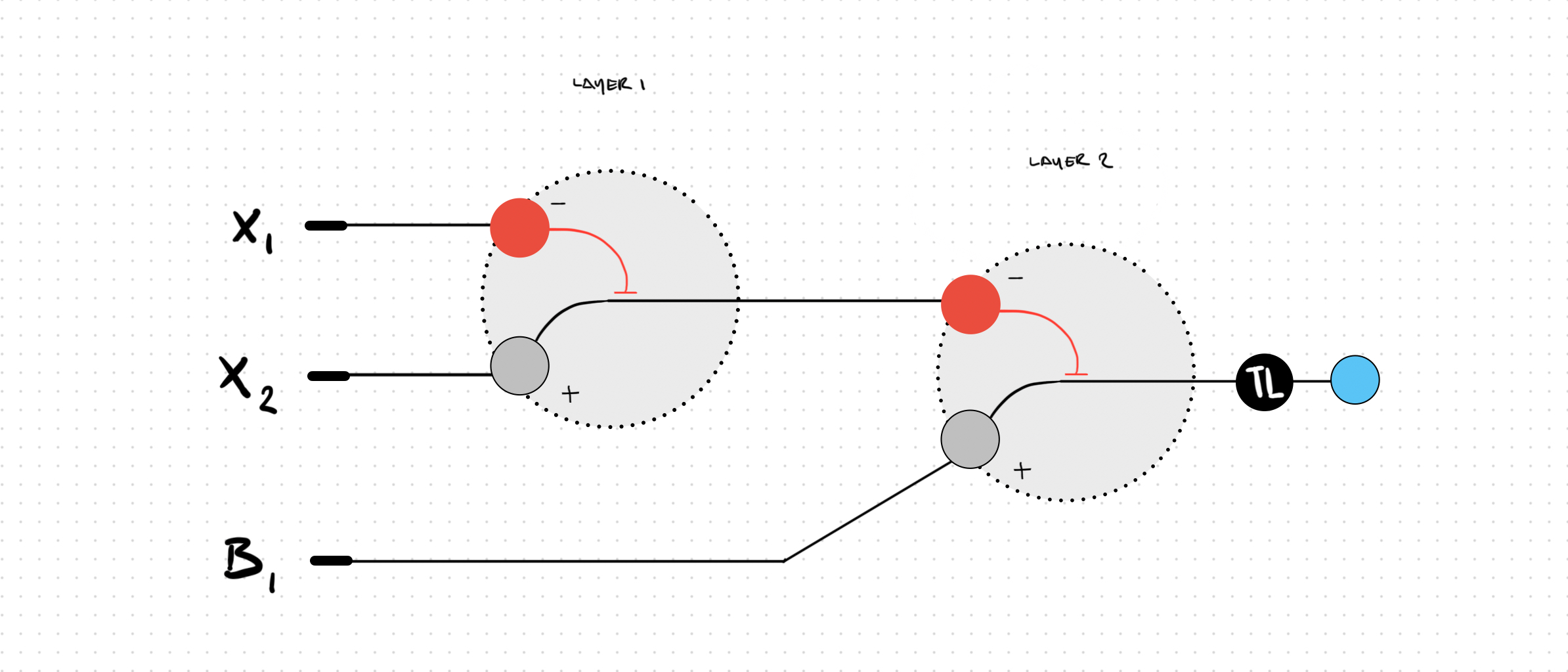 |
Multilayer perceptron: X1 input reduces endonuclease production and thus permits translation of Y1BFP in layer 2. |
Fungal Materials
What are some examples of existing fungal materials and what are they used for? What are their advantages and disadvantages over traditional counterparts?
Applications of filamentous fungal materials are quite diverse due to the varied mechanical properties of both rigid and flexible denominations; construction elements and biodegradable packaging respectively are two excellent examples. Mycelium-based materials often surpass virtually any conventional material where true biodegradability is desirable, as they may be completely decomposed and reintegrated by organic lifeforms without requiring additional processing, and often without industrial composting. Properties such as heat resilience, insulation, and rigidity are highly customisable. Resultingly, the materials are also susceptible to premature decay, moisture, and contamination. Long-term durability is also limited in applications where exposure to friction or mechanical stresses is common.
What might you want to genetically engineer fungi to do and why? What are the advantages of doing synthetic biology in fungi as opposed to bacteria?
I would be interested to explore how the structural properties of fungal growth could be controlled internally to produce highly functionally-graded materials. It would also be quite fascinating to explore the communicative-element of mycelial networks; could a network be constructed which permitted messages to be sent and received in a couple hours across, say, the local park?
The diverse structural and metabolic features of fungi make them an excellent vehicle for synthetic biology in areas such as bioremediation and, of course, biomaterials. Genetically, they share a closer resemblance to humans than plants and prokaryotic bacteria, which is intriguing in its own right. They are comparatively more rugged and resilient to environmental stressors than bacteria, which may be useful in an experimental context.
References
Hinneburg, H., Gu, S. and Naseri, G. (2025). Fungal Innovations—Advancing Sustainable Materials, Genetics, and Applications for Industry. Journal of Fungi, [online] 11(10), p.721. doi:10.3390/jof11100721.
Moreno-Gámez, S., Hochberg, M.E. and van Doorn, G.S. (2023). Quorum sensing as a mechanism to harness the wisdom of the crowds. Nature Communications, [online] 14(1). doi:10.1038/s41467-023-37950-7.