Week 11 HW: Bioproduction & Cloud labs
Part A: The 1,536 Pixel Artwork Canvas | Collective Artwork
My efforts were unfortunately extremely limited, having only contributed 2 pixels total. Definitely regret not having been more engaged! Given the chance to contribute again, I would have loved to coordinate my efforts with members from my node (alike to what occurred across r/place) to build a mutually-crafted design! It was fascinating seeing it evolve over time; I often wondered to what extent others were collaborating.
The scale appeared somewhat limiting in terms of achieving higher-resolution designs. For future iterations where (hopefully) a greater cohort of students are enrolled, it would be fascinating to see what would be possible with 4x the space.
Part B: Cell-Free Protein Synthesis | Cell-Free Reagents
| E. coli Lysate | |
| BL21 (DE3) Star Lysate | Includes T7 RNA Polymerase. |
| Salts/Buffer | |
| Potassium Glutamate | Maintains ionic strength for optimal reaction conditions. |
| HEPES-KOH pH 7.5 | Buffers the system to maintain stable pH. |
| Magnesium Glutamate | Source of Mg^2+ ions which optimise Tx + Tl rates by supporting the function of translational machinery; essential cofactor. |
| Potassium phosphate monobasic | Buffering agent to maintain pH stability. Precursor molecule for regeneration of ATP from ADP. |
| Potassium phosphate dibasic | Buffering agent to maintain pH stability. Additional inorganic phosphate source for ATP regeneration. |
| Energy / Nucleotide System | |
| Ribose | Essential precursor molecule in structure and function of nucleic acids. A core component of ATP and thus a crucial component in its regeneration. |
| Glucose | Significant energy source and substrate for ATP regeneration. |
| AMP | Nucleotide precursor for RNA synthesis. Precursor for ATP regeneration. |
| CMP | ATP regeneration intermediate; precursor of CTP which is required as energy source in the transcription process. |
| GMP | Cost-effective alternative to NTP’s. Converted to GTP via intermediary energy regeneration reactions, an essential energy source for initiation (and more!) during translation. |
| UMP | Precursor molecule for RNA biosynthesis; provides initial structure for phosphorylation which eventually becomes UTP, a substrate in transcription. |
| Guanine | Fundamental base across both DNA and RNA, as well as GTP precursor. Constituent element in energy regeneration. |
| Translation Mix (Amino Acids) | |
| 17 Amino Acid Mix | Constitutes key amino acids essential for the formation of a protein's primary structure (sequence) during polymerisation. |
| Tyrosine | Amino acid with functional roles when integrated as a subunit into primary structure (hydrophobic and polar). May serve as a site of post-postranslational modifications. |
| Cysteine | Amino acid with reductive qualities. Facilitates translational elongation. |
| Additives | |
| Nicotinamide | Essential precursor molecule for NAD+ regeneration, an oxidising agent central to translational processes. |
| Backfill | |
| Nuclease Free Water | Highly-purified water. Shields sensitive contents of mixture from degradation. |
Part C: Planning the Global Experiment | Cell-Free Master Mix Design
Describe the main differences between the 1-hour optimized PEP-NTP master mix and the 20-hour NMP-Ribose-Glucose master mix.
The 20-hour appears to include 2 additional salts/buffers (Potassium phosphate in ratio 1.6:1 dibasic to monobasic), which appears to provide higher, sustained buffering capacity (longer reaction?). The energy/nucleotide system in the 1-hour is immediately accessible; NTP’s are provided pre-synthesised alongside ATP and PEP-mono, which serves as a key intermediate in the ATP regeneration process. 20-hour is more reliant on enzymatic pathways inherent to the lysate for energy regeneration and NTP formation. 1-hour includes heavy supplementation of additives to limit requirement of intermediate metabolic process; 2-hour supplies only Nicotinamide, a NAD precursor required for energy regeneration.
How can transcription occur if GMP is not included but Guanine is?
Guanine must be converted metabolically by cellular machinery in lysate to form GMP prior to its use in transcription. There are two feasible pathways for this lysate; phosphoribosylation directly to GMP (requires that PRPP enzyme is present in lysate) or the Purine nucleoside phosphorylase pathway, in which it is converted into Guanosine, then GMP.
| sfGFP | Oxidative damage and/or mutations to the residue Arg96 may hinder the rate at which the sfGFP chromophore is developed, potentially altering duration until readout. The production of reactive oxidative species is possible in mixes more reliant on expansive metabolic processes. |
| mRFP1 | Notably long mutation time of 60 minutes. Described to possess low acid sensitivity. |
| mKO2 | Notably long maturation time of 105 minutes. Moderate acid sensitivity. |
| mTurquoise2 | Very low acid sensitivity. High photostability. |
| mScarlet_I | Generally robust protein with fast maturation and moderate acid sensitivity. |
| Electra2 | N/a. |
Create a hypothesis for how adjusting one or more reagents in the cell-free mastermix could improve a specific biophysical or functional property you identified above, in order to maximize fluorescence over a 36-hour incubation. Clearly state the protein, the reagent(s), and the expected effect.
I selected mKO2 for enhancement as I love the colour orange!
Some characteristics:
- Maturation time: 108 minutes (quite long!)
- pkA: 5.5 (point at which fluorescence drops to 50 percent of maximum value)
- Brightness: 39.56
Rigidity is considered an intrinsic factor to the magnitude of the quantum yield obtainable by the fluorophore of fluorescent proteins. At first, I hypothesized that:
Artificially inducing mild oxidative stress will increase the monomeric-clamping activity of HSP70 chaperones, fortifying early structural formation and consequently improving rigidity characteristics.
However this approach became a little unraveled once I realised that the concentration of elements in the master mix could only be increased, and not decreased as required to test my hypothesis. I redirected, instead attempting to Increase translational rates and enhance HSP70 activity. Two separate approaches were formulated, each for a group of four wells:
Approach A
| Iteration | Glucose | MgGlutamate | KGlutamate |
|---|---|---|---|
| q1-n5 | 1.250g/L | 6.975mM | 312.56mM |
| q1-n6 | 2.500g/L | 7.600mM | 312.56mM |
| q1-n7 | 5.00g/L | 8.225mM | 325.688mM |
| q1-n8 | 7.500g/L | 8.225mM | 335.688mM |
Approach B
| Iteration | Glucose | HEPES | MgGlutamate | KGlutamate |
|---|---|---|---|---|
| q1-n9 | 1.250g/L | 45.000mM | 6.975mM | 312.56mM |
| q1-n10 | 1.250g/L | 50.000mM | 6.975mM | 312.56mM |
| q1-n11 | 1.250g/L | 53.750mM | 7.600mM | 325.688mM |
| q1-n12 | 1.250g/L | 58.750mM | 7.600mM | 335.688mM |
Part D: Build-A-Cloud-Lab
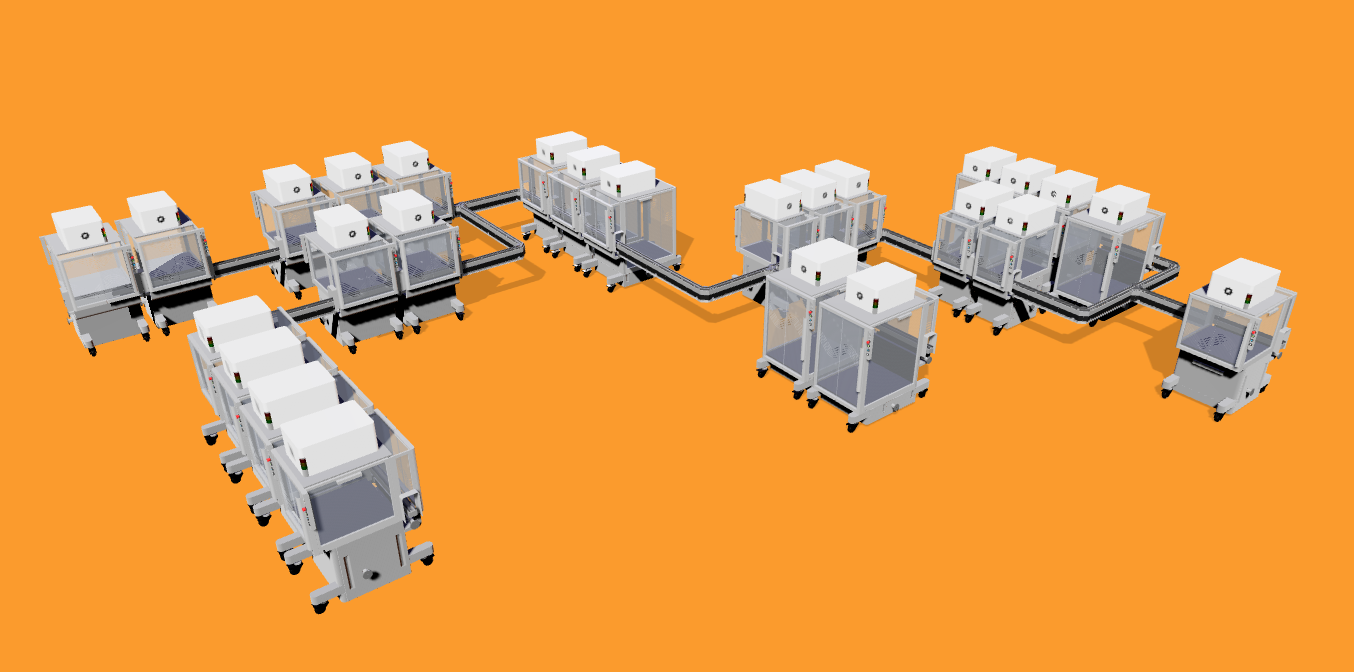 |
Quick attempt! The RAC's have an almost skyline-like appearance when clustered and composed nonsensically. |
References
Banks, A.M., Whitfield, C.J., Brown, S.R., Fulton, D.A., Goodchild, S.A., Grant, C., Love, J., Lendrem, D.W., Fieldsend, J.E. and Howard, T.P. (2022). Key reaction components affect the kinetics and performance robustness of cell-free protein synthesis reactions. Computational and Structural Biotechnology Journal, [online] 20, pp.218–229. doi:10.1016/j.csbj.2021.12.013.