Group: Alya, Beyza, Sydney, Zander.
Brainstorming session Bacteriophages -> L to lyse bacterial cells Release newly produced phages Modification to make more effective for lysing the protein Higher stability for L protein L protein interacts with host (cellular missionary) with chaperone, DnaJ Influence protein folding POSSIBLE DIRECTION: modifying residues to influence how L protein interacts with host proteins Specific minor acid residues can affect lysis
Subsections of Projects
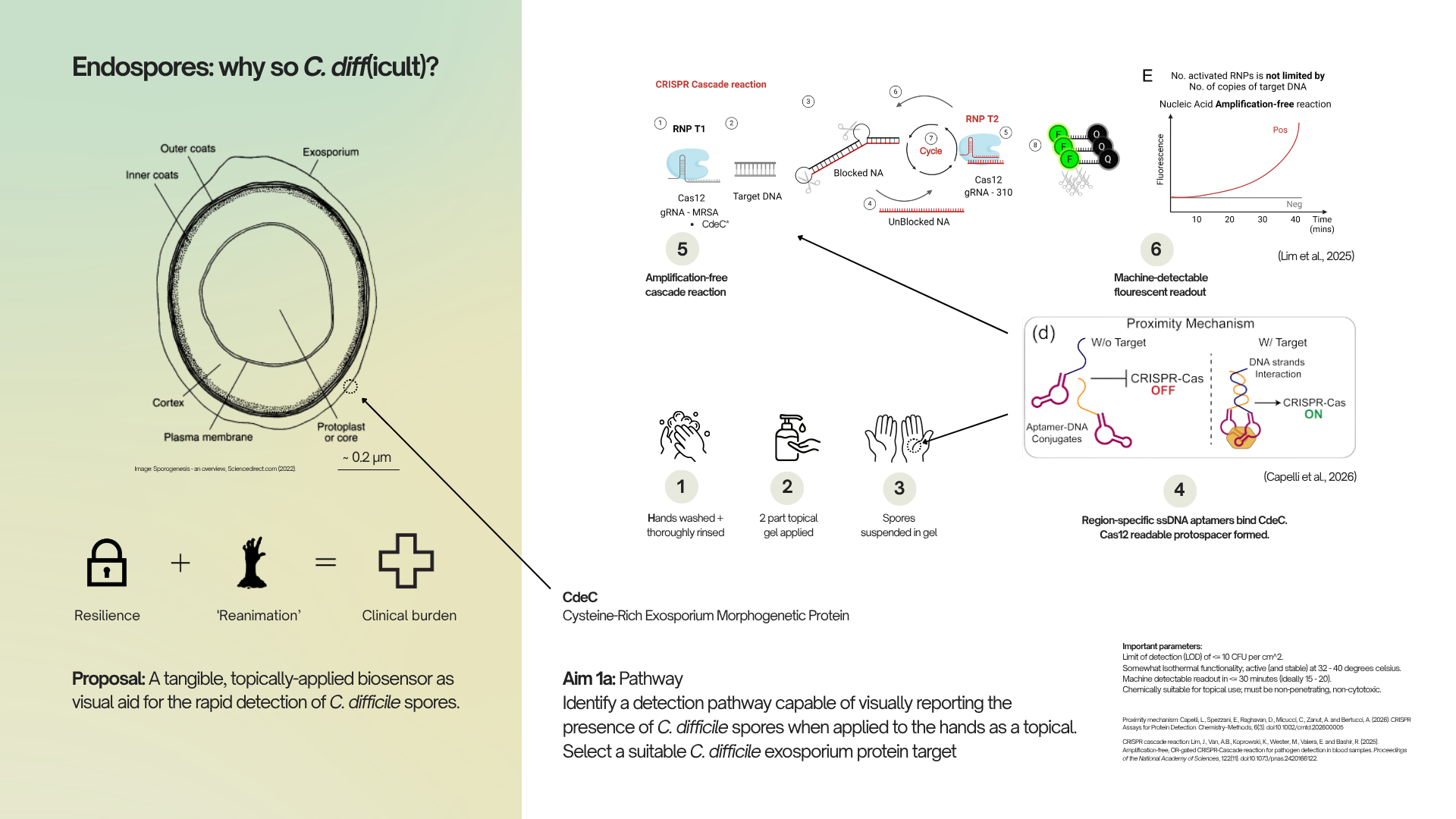
Individual Final Project: Topically Applied Biosensor For the detection of C. Difficile Endospores
Section 1: Abstract
Clostridioides difficile is a pathogenic, spore-forming bacterium, constituting the leading cause of hospital acquired colitis. Highly resistant to common disinfectants, strong hand hygiene (HH) is considered the most effective preventative measure in controlling its transmission; how might we provide a method of endospore contamination detection to enhance the efficacy of handwashing as a preventative measure? The primary objective of this project was to conduct in-silico discovery and screening of ssDNA Aptamers as potential CdeC C. Difficile biomarker binders, with the high-level aim of developing a speculative, topically-applied biosensor for C. Difficile spore detection via fluorescent, macroscale readout. In this project, an iterative process of aptamer generation (Python, ProtScale), evaluation (AptaTrans pipeline), and elimination (ViennaRNA) was investigated, resulting in the curation of a library of 20 potential CdeC binders for synthesis and in-vitro evaluation.
Introduction
Clostridioides difficile (C. Difficile) is a gram-positive, endospore-producing bacterium. A pathogen, the bacterium is responsible for C. Difficile Infection (CDI), an infectious disease with high transmissibility. It is considered the leading cause of hospital acquired diarrhoea. The risk of infection is heightened amongst the elderly and long-term inpatients, especially following the use of antibiotics, by which disruption of the natural gut flora may provide a foothold for the opportunistic pathogen. The sporulation, high-transmissibility, and potential severity of the pathogen often presents a significant challenge in a clinical setting.
The composition of the C. Difficile endospore bestows resistance to most common disinfectants, requiring extended periods of exposure to either sporicidal agents or physical methods (autoclaving) for complete sterilisation. Transmission is most common via the fecal-oral route. Given these properties, strong personal hygiene measures are imperative to stemming transmission, with a particular emphasis on thorough handwashing to physically remove latent endospore contamination.
This project seeks to investigate how cell-free-systems may be deployed as tangible, topical prophylactics for the rapid detection of C. difficile endospores in a clinical setting.
Section 2: Project Aims
Aim 1: Expermimental
Identify and characterise the structure of a suitable C. difficile exosporium protein target (literature review, AlphaFold2). Generate preliminary library of ssDNA sequences biased towards chemical and physical characteristics of target peptide (Python, Colab), then evaluate and retain candidates with Aptamer Protein Interaction (API) scores > 80%. (AptaTrans). Screen pool to identify folding configuration and MFE (ViennaRNA) and retain top 10 candidates for each region. Calculate docking scores (Gibbs free energy of binding) and predict binding site of final pool, identifying candidates with deltaG < - 7.0 to -10.0 kcal/mol (HADDOCK).
Aim 2: Developmental
Evaluate aptamer-target binding kinetics of progressed candidates (SPR). Experimentally evaluate stability of CFS in-vitro against mechanical forces and latent chemical stressors. Conduct preliminary in-vivo trials. Confirm LOD of ≤ 10 CFU per cm2. Calibrate ligase:aptamer ratio to reduce incidence of false-positives in-vitro; reassess or confirm proximity-based ligation technique as transduction pathway. Identify machine-based method of differentiating background fluorescence from readout at macroscale.
Aim 3: Visionary
Improve system to permit readout in interval < 2 minutes. Implement within a clinical setting. Establish a working framework for the development of tangible, topically-applied biosensors for alternative targets and applications.
Section 3: Background
Literature summaries
Cell-free biosensors: where have we been and where do we need to go? (Lucks et al, 2026)
The field has experienced significant technological advancements in the previous five years, with key developments in biological mechanism, technological integration, and target diversity described. Proof-of-concept deployment of biosensors to non-expert users has overall shown great success; the authors highlight the potential for the field to have a significant positive impact across industries. Attention is required to further develop manufacturing and regulatory practices.
Topical Sensory Nanoparticles for in-vivo Biomarker Detection (Sample et al, 2011)
In this study, solid lipid nanoparticles (SLN) were investigated as a topical delivery vehicle for a chemiluminescence-based detection platform intended to detect hydrogen peroxide, a biomarker associated with particular skin cancers. The Phase Inversion Temperature (PIT) method of nanoemulsion production proved successful in the consistent production of 22.4 nm SLN’s, with a tailorable melting point of 32.7C, a value found appropriate for clinical use as a topical. MTT toxicity assays showed minimal irritation in-vivo. Using an optical microplate reader, a LOD of ~ 15mM H2O2 was achieved, the authors noting that sensitivity may be improved via SLN applications at higher concentrations. The authors conclude that the formulation described is well-suited to topical biosensing applications, noting that further work would be advantageous in developing SLN’s as a pain-free platform for topical diagnostics.
Effectiveness of a Glo Germ-based assessment and educational intervention to improve hand hygiene compliance among hospital cleaning staff (Pan et al, 2026)
Recognising the significance of standard precautions (hand hygiene) as essential and cost-efficient measures for the control of healthcare-acquired infections (HAI), the authors investigated the efficacy of Glo Germ, a fluorescent educational tool, as a means to improve hand hygiene protocols in hospital cleaning staff. Glo Germ is an oil-based, ultraviolet fluorescent agent that is applied as a topical to the hands prior to regular handwashing, simulating microbial contamination. The study determined that, pre-intervention, residual fluorescence post-handwashing was present in 33.75% of the participants. Non-compliance dropped to 8.75% post-intervention. The authors remark that, alongside targeted educational interventions, Glo Germ is an effective, rapid tool for the improvement of hand hygiene compliance amongst cleaning staff in healthcare environments.
Opportunity
While application of cell-free systems (CFS) as biosensors is growing across uniquely disparate fields, there has been somewhat limited exploration of the technology as both a topical and fluorescent-diagnostic biosensing method. In Lucks et al (2026), we see that while diverse in mechanism and approach, contemporary diagnostic CFS appear to be quite understandably limited in deployment to physical, bench-top or disposable devices. Pan et al (2026) is a clear, preliminary example of the potential use of visual microbial detection methods in positively altering human behaviour. Sample et al (2011) provide initial indication that topical biosensors show clinical feasibility.
Building upon these observations, the development of a novel CFS approach for the topical detection of microbial contamination appears to address a potentially lucrative gap in the field, potentially contributing to a new class of tangible biosensors with the potential to intuitively reach a broader audience of non-expert users.
Significance and potential impact
Sight is often the most crucial perceptive sense in the daily human experience. Our environments, informational systems, and perception of truth, are fundamentally underpinned by the ability to see, as goes the idiom ‘seeing is believing’. This is particularly evident in the world of biological imaging, where our ability to measure and visualise events not perceptible to the human eye has been the cornerstone of not just scientific breakthroughs, but collective societal shifts in accepted worldview.
The importance of sight has profound implications to public health, where it is often a challenge to effectively communicate the importance of preventative methods when the inherent scale of microorganisms can impede understanding by pure human vision alone. The current West African Ebola virus epidemic is one such harrowing example. Alongside complex social and traditional beliefs, the inability for pathogens to be seen by the naked eye does little to benefit the understanding of disease etiology, but contributes to weakening of adherence to effective preventative measures (Mafuzadze and Manguvo, 2015).
Ethical considerations
The project appears primarily accountable to the principles of clinical ethics, with beneficence and nonmaleficence being of particular importance. As the CFS is intended to function as a rapid assay, it is imperative that an accurate readout is provided, this quality directly relating to its beneficence. If the CFS is delivered via a topical vehicle, guaranteeing non-toxicity and systematic absorption is essential to ensuring nonmaleficence. This principle can also be extended to its potential impact on the broader environment: the continual use and disposal of biologically active components via conventional wastewater must be critically examined to guarantee no ecological harm it enacted.
Adherence to the ethical principles described above may be primarily achieved via two pathways, testing and transparency:
The exhaustive profile and testing of biologically-active elements is mandatory, both within the context of in-vivo and ecologically diverse settings. Development should adhere to the standards required for FDA Class III approval. One possible alternative is the stringent integration of genetic failsafes i.e the components are effectively inert when a given reagent is absent. Failsafe selection must be comprehensive, considering all possible fates of each constituent component in the CFS.
Transparent design and research procedures must be implemented throughout the entirety of the process. External audit should be invited to promote critical discussion of specific implementation details and direction. Alternatively, an in-house critical review group could be formed which performs the same task, without risking the possible ramifications described below.
However, the application of the measures above must also be balanced with the demands of research and (likely limited) funding. Counterintuitively, overregulation could slow progress to the point at which the CFS will have limited reach and hence impact. Proprietary techniques or approaches could be divulged by overtly transparent practices which, in the wrong hands, could lead to the launch of a potentially harmful product, whether by design, complacency, or ignorance.
Section 4: Experimental design, techniques, tools, and technology
Part
Objective
Description
Duration
Status
1
Target identification + selection
Identify and characterise the structure of a suitable C. difficile exosporium protein target.
Literature review: Identity 2-3 papers detailing relevant exosporium structural features. Target selected primary on accessibility and specificity.
AlphaFold: Retrieve predicted structure from AlphaFoldDB.
ProtScale: For target peptide, run:
% accessible residues
% buried residues
Average flexibility
Beta-turn (Deleage Roux)
Hphob (Hopp Woods)
Hydropath (Kyte Doolittle)
Relative mutability.
Python and ChatGPT: Capture and process raw ProtScale data via step-wise function. Establish continuous suitability score; retain two regions which surpass 0.55 threshold.
8 hrs
Complete
2
Aptamer library generation
Generate preliminary library of ssDNA sequences biased towards chemical and physical characteristics of target peptide.
Python and ChatGPT: Identify nucleotide bias values. Generate script to create control + biased libraries for two seperate peptide regions.
Python: Use script to generate 20,000 randomised sequences (10,000 per library); export in batch as seperated .csv.
2 hr
Complete
3
API prediction
Evaluate and retain candidates with Aptamer Protein Interaction (API) scores > 80%.
AptaTrans: For each candidate in each library, provide protien target and predict API.
Python + ChatGPT: Rank binder candidates by API. Visualise result of biasing via overlaid density plot - kernel density estimate. Retain top 100 (per library) with API scores exceeding 80%.
4 hrs
Complete
4
Structural evaluation
Screen pool to identify folding configuration.
ViennaRNA: Score candidates based on Minimum Free Energy; filter for formation of stable stem-loop/hairpin configuration. Retain top 10 candidates per region.
2 hrs
Complete
6
Molecular docking
HADDOCK: Calculate docking scores (Gibbs free energy of binding) and predict binding site of final pool, identifying candidates with ΔG < -7.0 to -10.0 kcal-mol
2 hrs
Pending
Relevant techniques
Pipetting
DNA Gel Art
Bioproduction
Lab Automation
Protein Design
Cell-Free Systems
Gibson Assembly
CRISPR
Technique utilisation
Two techniques/technologies are of noted importance:
Aptamer discovery via AptaTrans (Protein Design*): while undertaking this project, I naively assumed that peptide-binder design suite developed by the Pranam Chatterjee lab (and demonstrated in Week 5!) was applicable to the design of ssDNA aptamers. Only at the point of Twist order preparation did I realise that, (1) the suite was not applicable to the design of ssDNA aptamers, and (2) although a service offered by Twist, multiplexed oligonucleotide synthesis was not offered as an option. Whilst initially a little disheartening, the matter of in-silico aptamer design evolved into not only a significantly educational experience, but the central component of my project!
Aptamer discovery is conventionally conducted via SELEX, an in-vitro, iterative process whereby libraries of known binders are effectively cyclically tested against a target protein, with weak or unbound binders eliminated as candidates prior to initiation of the following stage. Recently, several exciting in-silco methods have emerged as supplementaries (or theoretically, outright replacements) to the costly and long SELEX process, including an approach termed AptaBLE by Chatterjee et al (2026), which is unfortunately not yet publicly available.
The AptaTrans pipeline (Song et al, 2023) is a deep learning technique that employs transformed-based encoders to score binder candidates by a predicted aptamer-protein interaction (API) value. Significantly, binders validated by AptaTrans have been confirmed experimentally in-vitro. The AptaTrans was used centrally in this project to predict API scores for 20,000 binder candidates.
CRISPR/cas12a: the CRISPR/Cas12a platform was selected as the primary MOA due to its transnuclease functionality (ideal for reporter cleavage) and amplification-free compatibility (may be designed to ‘cascade’ as a means of signal amplification at body temperatures).
Theoretical industry partners
Twist biosciences: Aptamer production via multiplexed oligonucleotide synthesis.
Waters Corporation: Measurement of aptamer-target binding kinetics via SPR.
Section 5: results & quantitative expectations
In-silico discovery and proposal of ssDNA CdeC-binding aptamers was selected as the primary feature of the project for validation, primarily due to the importance of the aptamer-based proximity ligation approach in driving the transduction required to permit the use of CRISPR/cas12a. The protocol followed and techniques utilised is outlined incrementally in the subsections below.
Target identification + selection
Three studies focused on the structural characteristics of C. Difficile endospores were compiled. Key findings relevant to target selection are summarised below.
Imaging Clostridioides difficile Spore Germination and Germination Proteins (Sorg and Nerber, 2022)
Germination mediated by CspA and CspC proteins in the spore cortex region
Germination in response to small-molecule germinants (bile acids; very specific)
Fully germinate while remaining encased by exosporium!
Exposporium has a role in adherence of spores to Caco-2 cells (specific receptor?)
Characterization of the Adherence of Clostridium difficile Spores: The Integrity of the Outermost Layer Affects Adherence Properties of Spores of the Epidemic Strain R20291 to Components of the Intestinal Mucosa (Paredes-Sabja et al, 2016)
Exosporium has ‘hair-like projections’
In B. Cereus group, these are formed by collagen-like BcIA glycoproteins
‘Orthologs of the BclA family are highly conserved in the C. difficile sequenced genomes and have been located exclusively in the exosporium proteome’ (Paredes-Sabja et al, 2016)
Outermost exosporium contains BcIA group orthologs, BUT, lacks orthologs of structural proteins; indicates that ‘novel uncharacterised proteins are structural determinants of this layer
Epidemic strain R20291 likely the most clinically significant; 630 is ultrastructurally distinct, lacking hair-like projections on exosporium
‘Competitive-binding assay and trypsin digestion of Caco-2 cells, suggests that spore adherence might be receptor-mediated.’ Further evidence is later presented that strengthens this hypothesis
Protein composition of the outermost exosporium-like layer of Clostridium difficile 630 spores (Paredes-Sabja et al, 2015)
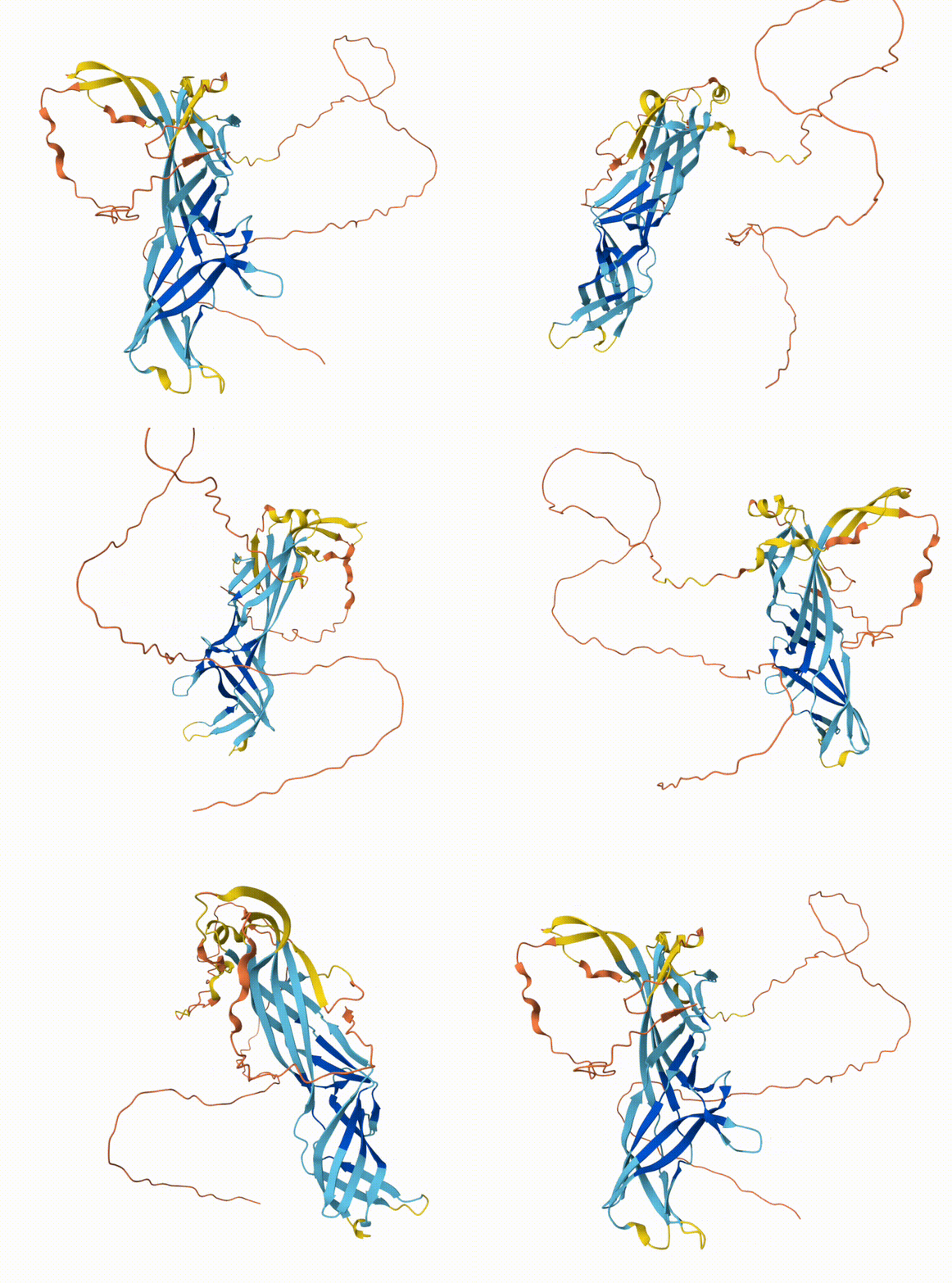
Unfortunately, only the predicted structure was available. Prior to characterisation in ProtScale, residues from N-terminus to position 108 were excluded as pLDDT for this region was < 50. This corresponded to an included window of 108 -> 405.
Prediction uncertainty of CdeC: the lack of experimentally-validated structural information for CdeC presented both an initial challenge and ongoing limitation. As the accuracy of the techniques employed is highly dependent on the input of accurate, resolved structural data, it is difficult to confirm that the final pool of candidate aptamers will actually be functional. A large section of the peptide with low predicted confidence was omitted from the biasing process in an attempt to reduce a flow-on effect in the quality of the biased binders.
Section 6: additional information
References
Angellar Manguvo and Benford Mafuvadze (2015). The impact of traditional and religious practices on the spread of Ebola in West Africa: time for a strategic shift. The Pan African Medical Journal, [online] 22(Suppl 1), p.9. doi:10.11694/pamj.supp.2015.22.1.6190.
Baloh, M., Nerber, H.N. and Sorg, J.A. (2022). Imaging Clostridioides difficile Spore Germination and Germination Proteins. Journal of Bacteriology, [online] 204(7). doi:https://doi.org/10.1128/jb.00210-22.
Barra-Carrasco, J., Olguin-Araneda, V., Plaza-Garrido, A., Miranda-Cardenas, C., Cofre-Araneda, G., Pizarro-Guajardo, M., Sarker, M.R. and Paredes-Sabja, D. (2013). The Clostridium difficile Exosporium Cysteine (CdeC)-Rich Protein Is Required for Exosporium Morphogenesis and Coat Assembly. Journal of Bacteriology, 195(17), pp.3863–3875. doi:https://doi.org/10.1128/jb.00369-13.
Calderón-Romero, P., Castro-Córdova, P., Reyes-Ramírez, R., Milano-Céspedes, M., Guerrero-Araya, E., Pizarro-Guajardo, M., Olguín-Araneda, V., Gil, F. and Paredes-Sabja, D. (2018). Clostridium difficile exosporium cysteine-rich proteins are essential for the morphogenesis of the exosporium layer, spore resistance, and affect C. difficile pathogenesis. PLOS Pathogens, [online] 14(8), p.e1007199. doi:10.1371/journal.ppat.1007199.
Capelli, L., Spezzani, E., Raghavan, D., Micucci, C., Zanut, A. and Bertucci, A. (2026). CRISPR Assays for Protein Detection. Chemistry–Methods, 6(3). doi:https://doi.org/10.1002/cmtd.202600005.
Díaz-González, F., Milano, M., Olguin-Araneda, V., Pizarro-Cerda, J., Castro-Córdova, P., Tzeng, S.-C., Maier, C.S., Sarker, M.R. and Paredes-Sabja, D. (2015). Protein composition of the outermost exosporium-like layer of Clostridium difficile 630 spores. Journal of Proteomics, [online] 123, pp.1–13. doi:https://doi.org/10.1016/j.jprot.2015.03.035.
Green, T.P., Talley, J.P. and Bundy, B.C. (2025). Recent Advances in Developing Cell-Free Protein Synthesis Biosensors for Medical Diagnostics and Environmental Monitoring. Biosensors, [online] 15(8), p.499. doi:https://doi.org/10.3390/bios15080499.
Image: Sporogenesis - an overview, Sciencedirect.com (2022).
Kohlberger, M. and Gadermaier, G. (2021). SELEX: Critical factors and optimization strategies for successful aptamer selection. Biotechnology and Applied Biochemistry, [online] 69(5), pp.1771–1792. doi:10.1002/bab.2244.
Lang, S., Braz, N.F., Slater, M.J. and Kidley, N.J. (2025). In Silico Methods for Ranking Ligand–Protein Interactions and Predicting Binding Affinities: Which Method is Right for You? Journal of Medicinal Chemistry, 68(19), pp.19795–19799. doi:10.1021/acs.jmedchem.5c02582.
Lim, J., Van, A.B., Koprowski, K., Wester, M., Valera, E. and Bashir, R. (2025). Amplification-free, OR-gated CRISPR-Cascade reaction for pathogen detection in blood samples. Proceedings of the National Academy of Sciences, 122(11). doi:https://doi.org/10.1073/pnas.2420166122.
Makovska, I., Biebaut, E., Dhaka, P., Korniienko, L., Jerab, J.G., Courtens, L., Chantziaras, I. and Dewulf, J. (2025). Methods for assessing efficacy of cleaning and disinfection in livestock farms: a narrative review. Frontiers in Veterinary Science, [online] 12. doi:https://doi.org/10.3389/fvets.2025.1581217.
Mora-Uribe, P., Miranda-Cárdenas, C., Castro-Córdova, P., Gil, F., Calderón, I., Fuentes, J.A., Rodas, P.I., Banawas, S., Sarker, M.R. and Paredes-Sabja, D. (2016). Characterization of the Adherence of Clostridium difficile Spores: The Integrity of the Outermost Layer Affects Adherence Properties of Spores of the Epidemic Strain R20291 to Components of the Intestinal Mucosa. Frontiers in Cellular and Infection Microbiology, [online] 6. doi:https://doi.org/10.3389/fcimb.2016.00099.
Mustafa, M.I. and Makhawi, A.M. (2021). SHERLOCK and DETECTR: CRISPR-Cas Systems as Potential Rapid Diagnostic Tools for Emerging Infectious Diseases. Journal of Clinical Microbiology, [online] 59(3). doi:https://doi.org/10.1128/jcm.00745-20.
Qi, M., Xia, N., Wang, X., Wang, X., Chen, H., Lv, D. and Cao, Y. (2025). Development of an Aptamer-Based Surface Plasmon Resonance Biosensor for Detecting Chloramphenicol in Milk. Biosensors, [online] 15(11), p.706. doi:10.3390/bios15110706.
Quintela, I.A., Vasse, T., Jian, D., Harrington, C., Sien, W. and Wu, V.C.H. (2025). Elucidating the molecular docking and binding dynamics of aptamers with spike proteins across SARS-CoV-2 variants of concern. Frontiers in Microbiology, [online] 16. doi:10.3389/fmicb.2025.1503890.
Shin, I., Kang, K., Kim, J., Sel, S., Choi, J., Lee, J.-W., Kang, H.Y. and Song, G. (2023). AptaTrans: a deep neural network for predicting aptamer-protein interaction using pretrained encoders. BMC Bioinformatics, [online] 24(1). doi:10.1186/s12859-023-05577-6.
Stephens, C., Goodey, N.M. and Gubler, U. (2025). A beginners guide to SELEX and DNA aptamers. Analytical Biochemistry, [online] 703, p.115890. doi:10.1016/j.ab.2025.115890.
Sueker, M., Stromsodt, K., Hamed Taheri Gorji, Fartash Vasefi, Khan, N., Schmit, T., Varma, R., Mackinnon, N., Sokolov, S., Alireza Akhbardeh, Liang, B., Qin, J., Chan, D.E., Baek, I., Kim, M.S. and Kouhyar Tavakolian (2021). Handheld Multispectral Fluorescence Imaging System to Detect and Disinfect Surface Contamination. Sensors, [online] 21(21), pp.7222–7222. doi:https://doi.org/10.3390/s21217222.
Varkey, B. (2020). Principles of Clinical Ethics and Their Application to Practice. Medical Principles and Practice, [online] 30(1), pp.17–28. doi:10.1159/000509119.
Supply list
Item
Qty.
Cost (est.)
Google Colab: 100 Compute Units
1
$21.20
Oligonucleotide Pool (92nt length, ~23,000 total) via Twist
Bacteriophages -> L to lyse bacterial cells
Release newly produced phages
Modification to make more effective for lysing the protein
Higher stability for L protein
L protein interacts with host (cellular missionary) with chaperone, DnaJ
Influence protein folding
POSSIBLE DIRECTION: modifying residues to influence how L protein interacts with host proteins
Specific minor acid residues can affect lysis
GOALS
Increase stability of L protein
Higher titers
Higher toxicity of lysis protein
COMPUTATIONAL DIRECTIONS
Attempt to improve L stability
Computational protein design tools
Investigate mutations that could impact protein and host factors interactions
Pull from database what is considered more stable from similar proteins
See what is conserved between them
What does stability mean in this context? Only in cytosol? Ultimate method of delivery?
Use same tool for Week 5
Host cell in unfolded, folded by chaperone
POSSIBLE DIRECTION: If the efficacy of L protein requires chaperone (working within specific temp range), could we mutate to work in greater temperature range for that chaperone
Limit denaturation?
Binding (30-37 C) -> will not be able to lyse bacteria
READING (BEFORE NEXT MEETING)
Stability, which parts of protein to stability
Binding characteristics
What we can change, play with