Week 7 HW: Genetic Circuits II
Assignment Part 1: Intracellular Artificial Neural Networks (IANNs)
1. What advantages do IANNs have over traditional genetic circuits, whose input/output behaviors are Boolean functions?
Boolean genetic circuits treat signals like 0 or 1, meaning every input must pass a hard on/off threshold. However, this can lose useful information. This can be limiting because real biological signals are usually not binary. Inside cells, signals often exist as gradual changes such as in concentration level. IANNs are useful because they keep more of that analog information since they are not only asking “is this signal present or absent?”.
Main advantages of IANNs
They preserve more information. Boolean circuits lose information when they convert a signal into ON or OFF. IANNs keep the strength of the signal.
They are more robust to noise. A Boolean circuit can fail if a signal is close to its threshold. An IANN responds gradually, so small changes or noise are less likely to cause sudden failure.
They degrade smoothly. If an input changes slightly, the output changes slightly. In Boolean circuits, a small change can flip the whole output.
They can handle weighted inputs. Some signals can matter more than others. IANNs can assign different “weights” to different biological inputs.
They are more efficient for complex decisions. A single IANN neuron can combine several inputs in a way that might require many Boolean gates. Fewer gates can mean: less metabolic burden, less delay, or fewer parts that can fail.
2. Describe a useful application for an IANN; include a detailed description of input/output behavior, as well as any limitations an IANN might face to achieve your goal.
IANNs (in theory) could work for any classification problem! For example, IANNs could help a cell decide whether a newly produced protein is likely to be properly folded, or misfolded or whether an environment that cell is placed in is a healthy tissue, inflamed tissue, or damaged tissue. The inputs could include oxygen level, pH, glucose level, inflammatory signals, cell-density signals, stress-response markers etc.
Each input alone is not enough for a reliable decision such as low oxygen might happen normally in some tissues, and inflammation alone does not always mean damage. But the combination of several signals can give a better estimation. A limitation is that these signals are still context-dependent. The same oxygen, pH, or inflammation levels might mean different things in different tissues. So the IANN would need careful calibration, and it might work well in one environment but less reliably in another.
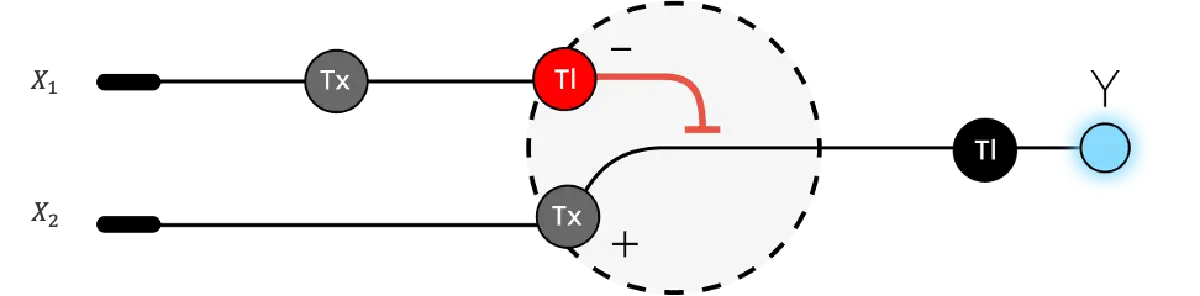
3. Below is a diagram depicting an intracellular single-layer perceptron where the X1 input is DNA encoding for the Csy4 endoribonuclease and the X2 input is DNA encoding for a fluorescent protein output whose mRNA is regulated by Csy4. Tx: transcription; Tl: translation.
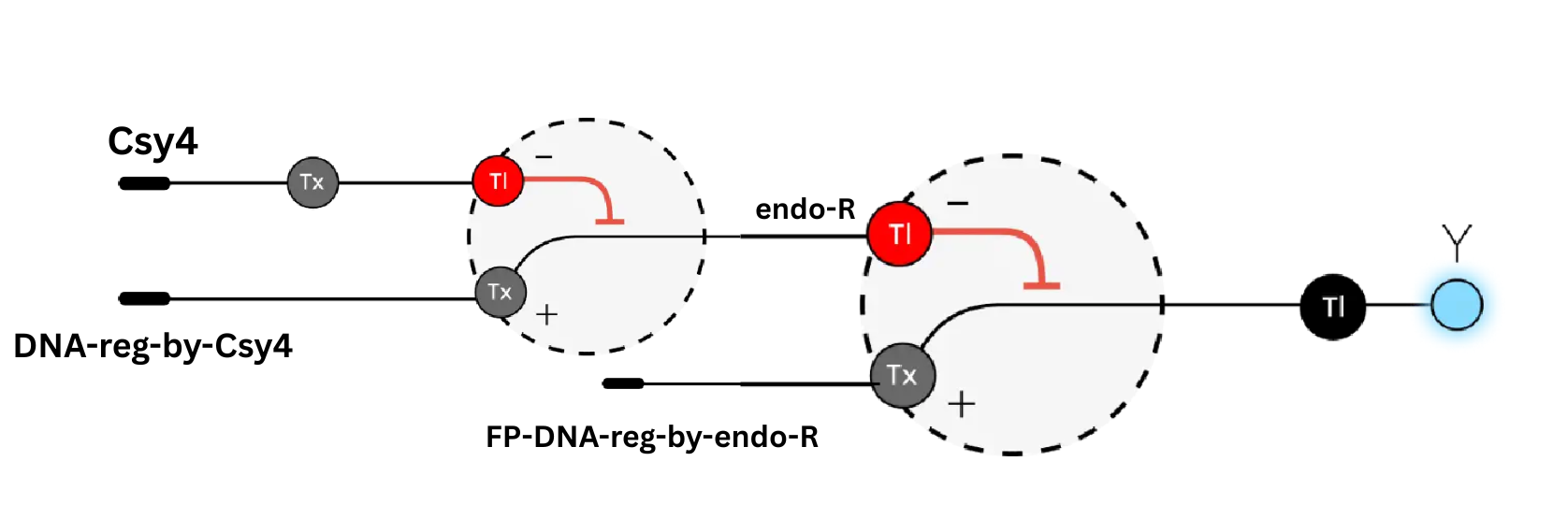
Draw a diagram for an intracellular multilayer perceptron where layer 1 outputs an endoribonuclease that regulates a fluorescent protein output in layer 2.
Assignment Part 2: Fungal Materials
What are some examples of existing fungal materials and what are they used for? What are their advantages and disadvantages over traditional counterparts?
Most current fungal materials are based on mycelium composites. Mycelium is the filament-like growth network of a fungus. In these materials, the fungus is grown through a plant-based substrate such as straw, corn stalks, or other agricultural waste. As it grows, the mycelium binds the loose material together. The final object is usually dried or heat-treated so the organism stops growing and the remaining material becomes a lightweight composite.
Use Cases:
Protective packaging. Mycelium can be grown inside molds to make custom shapes that protect products during shipping. This makes it a possible alternative to expanded polystyrene foam. Its advantages are that it can use agricultural waste, can be compostable, and requires less conventional manufacturing. The main limitations are slower production and lower mechanical strength compared with many petroleum-based foams.
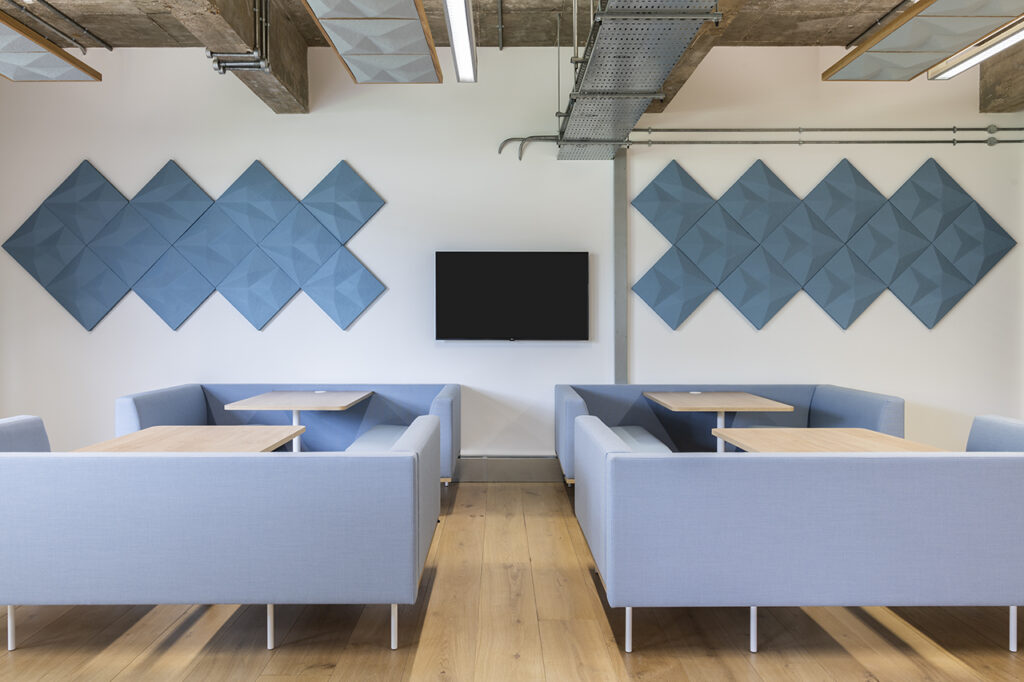
Thermal and acoustic insulation. Because these materials are lightweight and porous, they can trap air and absorb sound. This makes them useful for interior panels, sound-absorbing tiles.
- Architecture and construction. Mycelium has also been used mostly through experimental bricks, panels, and temporary structures. A well-known example is Hy-Fi, a temporary pavilion at MoMA PS1 built from mycelium bricks grown from agricultural waste. This project showed that mycelium materials can be used at architectural scale, but it also shows the current limits: these materials are better suited for lightweight, temporary, or insulating structures than for directly replacing concrete, steel, or structural timber.

- Mycelium-based leather / synthetic vegan leathers (MycoWorks, Bolt Threads) / Design Objects.

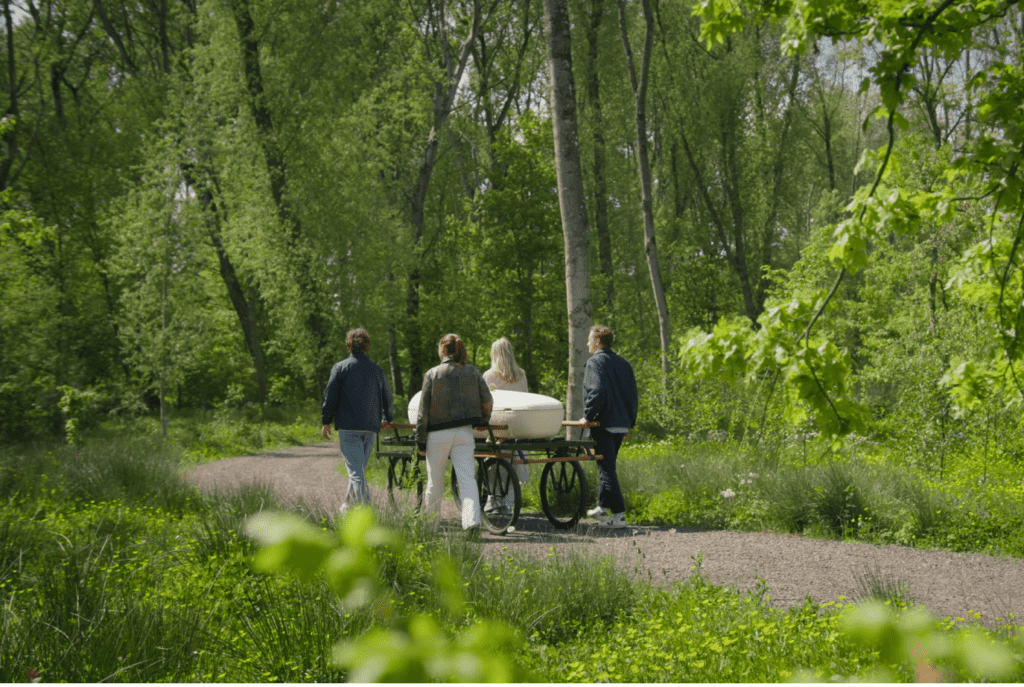
A distinct product example is the Loop Living Cocoon, a mycelium-based coffin. This is different from packaging or construction because it uses mycelium for an end-of-life product where biodegradability is the main value. The coffin is grown from mycelium and plant fibers and is designed to decompose after burial.
Overall strengths and weaknesses
The main strengths of fungal materials are:
- they can be grown from low-value biomass or waste
- they are lightweight
- they can be molded into specific shapes
- they can be compostable or biodegradable
- they can have useful insulation and acoustic properties
- their texture and density can be tuned through growth conditions
The main weaknesses are:
- lower strength than conventional structural materials
- slower production compared with industrial foam or plastic manufacturing
- contamination risk during growth
- limited outdoor durability without coating or treatment
What might you want to genetically engineer fungi to do and why? What are the advantages of doing synthetic biology in fungi as opposed to bacteria?
Fungi are useful for material applications because they naturally form large, connected, three-dimensional networks. Bacteria are easier to engineer in many cases, especially common lab organisms like E. coli, but bacteria usually produce molecules, biofilms, or materials that need extra processing. Fungi directly grow into bulk structures through hyphal extension and entanglement.
Fungi also grow well on many cheap plant-based substrates. This is important because material production only becomes practical if the feedstock is inexpensive. Many mycelium-forming fungi can use sawdust, straw, coffee grounds, hemp, or agricultural residues.
Another advantage is that fungi are eukaryotes. This means they can sometimes process more complex proteins or biomolecules than bacteria. This matters if the material is expected to produce pigments, enzymes, structural proteins, or other functional additives.
The tradeoff is that fungi are harder to engineer than bacteria. Bacteria grow quickly and have standardized genetic tools. Many mushroom-forming fungi grow more slowly and have less developed engineering toolkits. Tools that work in yeast or common lab fungi do not always transfer easily to species such as oyster mushroom or reishi.